From Marketplace to Moral Economy
In an assiduous reading of Philippine modern artist Anita Magsaysay-Ho’s painting, In the Marketplace, art historian Chanon Kenji Praepipatmongkol discusses notions of gender, economic value, and spirituality.
This essay revisits the starting points of the project Communicating Difficult Pasts, which was initiated in 2018 while searching for new ways to artistically and curatorially explore the twentieth-century history of the Baltic region and its ongoing impact.
Ming Wong wanders between worlds. From Chinese painting and philosophy to theatre, film, Non-Aligned histories, and the radical politics of queerness, Wong’s artistic worldview comprises a prescient pastiche of cultural possibilities.
As art historian Anissa Rahadiningtyas argues, Arahmaiani’s long-term, performative, and community-based work Proyek Bendera (Flag Project) foregrounds a socio-political trinity of feminism, environmentalism, and Islam that cultivates a reparative and egalitarian space of potential.
Published to coincide with Fotoclubismo: Brazilian Modernist Photography, 1946–1964 at MoMA, art historian Adele Nelson analyzes the Sala de Fotografia, a last-minute, “in-between” and hitherto unexamined exhibition organized by Foto-Cine Clube Bandeirante for the second edition of the São Paulo Bienal.
What is historicized, how is it recorded, and who determines and controls these seemingly unyielding criteria? Invoking multiple media apparatuses and deriving its title from a rumor, Akram Zaatari’s Letter to a Refusing Pilot (2013) undercuts the hegemonic and umbilical ties of media and history.
Showing up in food, cosmetics, fuel, and medicine—and, by consequence, in much of the air we breathe—corn is a ubiquitous presence in our lives. Inspired by the first episode of MoMA’s Broken Nature Podcast, this text investigates how one single crop travels through our contemporary food system.
Taking as her point of departure the kiondo, and the acknowledgment of the multiple forms technology can take, this essay focuses on Wangechi Mutu’s generative re-imagination and re-inscription of the foundational figure of Eve.
Therapeutically, and deeply attuned to context, Jaya Jacobo intimates spirits of transfemininity through the temporalities of the Philippines. Without spoon-feeding tangibility or timeline, Jacobo unsensationally invokes perseverance in its purest form.
Through a close reading of Kowkülen (Liquid Being) (2020), a video piece by artist Sebastián Calfuqueo, the author delves into the work’s intricate engagement of Mapuche cosmopolitics, proposing a critical approach to the neoliberal violence of water commodification in Chile vis-à-vis nonbinary modes of inhabiting the world.
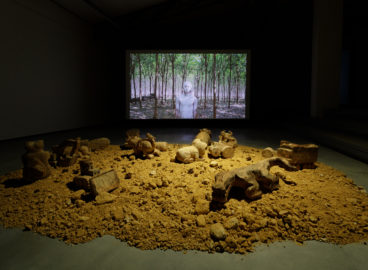
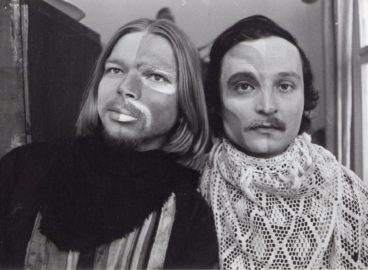
This essay brings together Baltic artists Anu Põder and Virgilijus Šonta, considering their mutual interest in human corporeality and non-heteronormative visuality to explore how their artwork reflects a disregard of official concerns of the late Soviet era, and sheds light on the blind spots of the homogenizing use of Western theoretical frameworks.
In 2007, at age twenty-seven, having already spent several years directing and editing audiovisual programs for broadcast, Rosine Mbakam left her native Cameroon to attend film school in Belgium. Here, Mbakam reflects on her experience in a conversation with Sophie Cavoulacos, Assistant Curator in the Department of Film at The Museum of Modern Art.