South Asia

Dreaming of Food, Air, and Water: In Conversation with Rajyashri Goody 

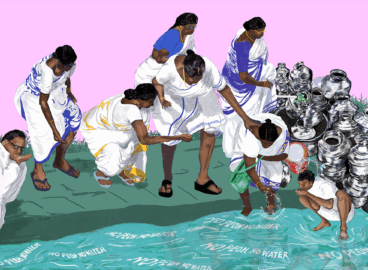
Rajyashri Goody (b. 1990) queries food and water politics, Ambedkarite Buddhist practices, literacy and Dalit literature, and mobility and place-making in the context of caste-based violence and Dalit resistance in India. She works primarily with paper pulp, clay, text, photography, and printmaking. What follows is an abbreviated account of Goody’s session with the C-MAP Bombay/Mumbai Group.…

On Vrishchik: A Conversation with Gulammohammed Sheikh 

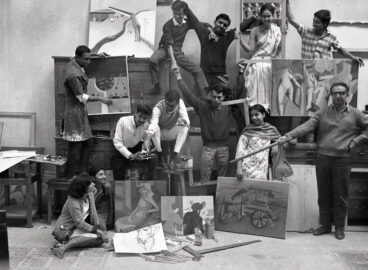
Gulammohammed Sheikh (b. 1937) is an artist, pedagogue, and writer known for his prolific career across practices that include curating and publishing. Sheikh taught art history and painting at the Faculty of Fine Arts at the Maharaja Sayajirao University of Baroda—the foremost institute for avant-garde practice during the post-Independence period—for almost three decades, spearheading an…

“It’s not about superimposing one history onto another; it’s about finding forms of solidarity that grow from where you’re rooted.”: Maya Varma in Conversation with Shrujana Niranjani Shridhar; Part II

Maya Varma: A lot of your work turns toward the lineages that shape Dalit life and knowledge. When you think about these histories, how do you understand the inheritances you’re carrying forward? What pasts are you in conversation with, and how do you imagine the canon you’re stepping into? Shrujana Niranjani Shridhar: I think we…

“What do we allow Dalit women to do?”: Shrujana Niranjani Shridhar in Conversation with Maya Varma; Part I

Maya Varma: To begin, I wanted to talk about where you come from. How has Mumbai shaped you as an activist and as an artist? What did the city mean to you growing up? Shrujana Niranjani Shridhar: For me, Mumbai has always been a working-class city. That’s its defining character. Any city that grows because people come…

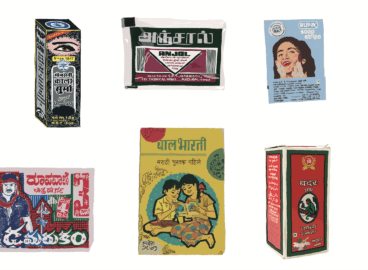
“We’re simply trying to make sense of the country and the city in our own way”: Sameer and Zeenat Kulavoor in Conversation with Paul Galloway

This interview with the sibling duo behind Bombay Duck Designs explores their omnivorous curiosity for the diversity of visual cultures in India and suggests that an embrace of what may, on the surface, seem chaotic reveals opportunities for understanding and connection.  Paul Galloway: An aspect of your work that intrigues me is that it is steeped…

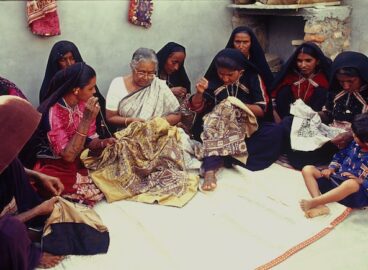
On Craft, Community, and Resilience: A View from the Living and Learning Design Centre

The concept of establishing a museum in a remote region of India—one that is not only geographically isolated but also prone to natural disasters such as earthquakes and cyclones—presents a complex set of challenges. Yet, it also offers a rare opportunity to engage deeply with the traditional knowledge systems of local communities. Located in Ajrakhpur,…

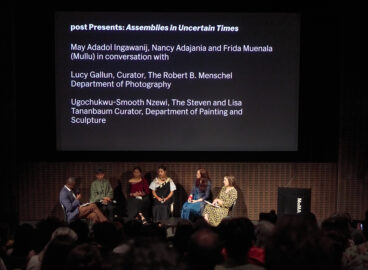
post Presents: Assemblies in Uncertain Times

This public program brought together Nancy Adajania, May Adadol Ingawanij, and Frida Muenala from Mullu for an evening of inquiry into forms and practices of gathering. The speakers, who represent diverse practices in the cultural fields—from art making to curation to institutional leadership—and operate across vast geographies, unpacked their different approaches to assemblies. Among the…

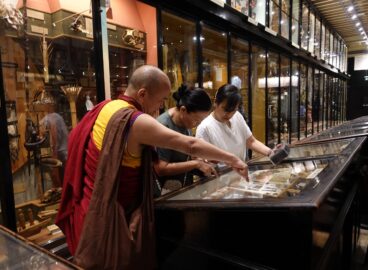
From Loot to Legacy: Rethinking “Tibetan Art” in Western Museums

Debates around the ownership of cultural heritage and decolonizing museums have become increasingly visible and polarizing in the public domain, leading to attempts to redefine the term “museum” itself.1The International Council of Museums (ICOM) Extraordinary General Assembly approved the following new definition of “museum” at the 26th ICOM General Conference held in Prague in August…

A Vision of Modern India: Social Messages and Commodity Culture in New Bollywood

Since the 1990s, the Hindi film industry has undergone several transformations in response to socioeconomic and political changes in India. This is particularly a result of how the Indian nation-state and its film industries have entered into the global market. Though popular Hindi cinema has always circulated internationally through informal, ad hoc networks, during most…