Gulammohammed Sheikh (b. 1937) is an artist, pedagogue, and writer known for his prolific career across practices that include curating and publishing. Sheikh taught art history and painting at the Faculty of Fine Arts at the Maharaja Sayajirao University of Baroda—the foremost institute for avant-garde practice during the post-Independence period—for almost three decades, spearheading an art movement that rejected the abstract and nonrepresentational in favor of a more socially conscious narrative figuration. His prolific writings, considered seminal to the modern Gujarati literature movement, include Gher Jataan (1968), a collection of autobiographical essays, and Athawa (1974), a collection of poems. This was in addition to editing and publishing Vrishchik, a magazine that he and Bhupen Khakhar founded in Baroda in 1969. What follows is an abbreviated account of Sheikh’s conversation with the C-MAP Bombay/Mumbai Group.
Ananya Sikand: Vrishchik, which means “scorpion,” was a little magazine that you founded and edited with Bhupen Khakhar in Baroda. Published monthly or bimonthly from 1969 to 1973, it featured an array of content including poems, stories, critical essays, and folios of printed artworks.
In her 2001 article “Signatures of Dissent,” Geeta Kapur notes that Vrishchik “spoke in the many voices of those artists, critics, [and] poets” that it spotlighted, serving as an active forum for contemporary artistic and literary expressions as well as a catalyst for artists’ views on their field, on art institutions, and on social concerns.1Geeta Kapur, “Signatures of Dissent,” ART India Magazine 6, no. 2 (2001): 79. Sheikh Sir, as you’ve noted in the past, Vrishchik was the need of the day, as there were hardly any communication channels through which artists could speak and raise issues at the time. To get started, could you speak about the story behind the name of the publication and about its form and materiality.
Gulammohammed Sheikh: You have rightly noted that there was a dire need for a communication channel among the artists of India, since there was only one journal—Lalit Kala Contemporary—which was very irregular. There was no other channel through which we could communicate with one another. This was an issue that bothered many of us.
I was with friends at our home in the Residency Bungalow in Baroda. About six or seven people had come for a party, and we were discussing this, and we all agreed we should do something about it. One thought was to bring out a journal, and everybody agreed wholeheartedly—but then asked, “How do we do it?”
Let me give you some background. When I was in England, I had become aware of small magazines published across the world. I used to go to bookshops and find publications by small presses, including collections of poems—such as Allen Ginsberg’s Howl. These were not well-known publishers; sometimes they were just individuals publishing their own work.
In India, the poet Arvind Krishna Mehrotra, who lived in Bombay in those days, had started a small journal called Damn You—a radical literary journal with a critical take on what was going on. Then J. Swaminathan, another artist and friend, brought out a journal called Contra from Delhi. He raised a number of concerns in Contra—mainly about the National Art Academy, the Lalit Kala Akademi (LKA), and its functioning. The LKA was a government-sponsored organization whose members were nominated by the government, and we all felt there was insufficient representation of artists from across India. Vrishchik took up this subject at a later stage.
But let me start with how we began. The first issue was printed at a press in Baroda called Miraj Printery, where I once had a catalogue printed. We asked them if they could print directly from a linoleum block, which they were unfamiliar with but agreed to do. In those days, printing blocks were made of zinc, fixed on a wooden block, and then printed on a letterpress with movable type. Each letter of every word had to be set by hand before the page could be run through the press with a roller.
We chose brown packing paper because it was cheap and because we loved the color. Printing on tinted paper was far more interesting than printing on white. I had previous experience using lino blocks while working on a Gujarati literary journal called Kshitij (1959–67), which was edited by my literary mentor Suresh Joshi. For a journal of limited resources, I devised a method of producing original prints by taking linoleum to Baroda-based artists—K. G. Subramanyan, my teacher, and Jyoti Bhatt, my senior—and having them hand-cut the block. I would then mount it on a wooden block of the same gauge as a letterpress block so that the hand-cut lino could be printed on the letterpress. This meant that 500 copies could be printed at once, and the lino block remained undamaged. The advantage was that it was an original linocut print that could be made available to 500 people simultaneously. I used to go to the press and sit there while each issue was being printed, checking every copy to see whether the print came out well, whether the ink showed through on the back of the page—which sometimes happened with poor printing in those days. You had to learn to work with the printers to bring out the best result. This is the approach we brought to Vrishchik.
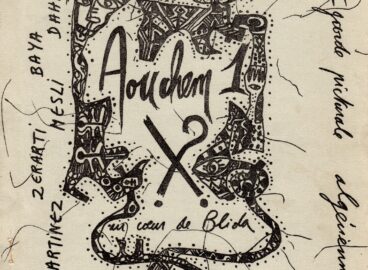
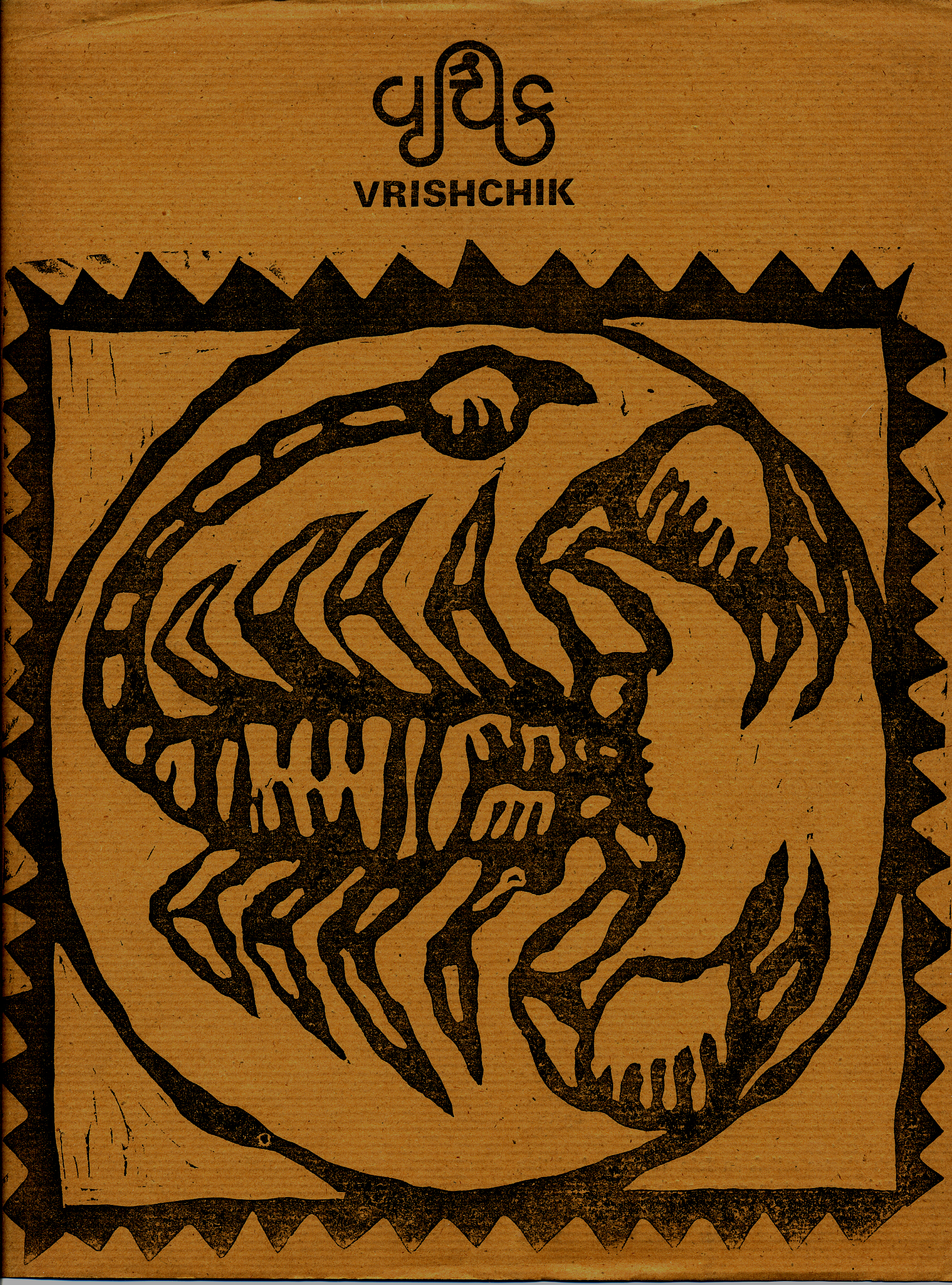
As we were discussing possible names for the journal, somebody asked, “What is your rashi—your zodiac sign?” It turned out that four people in our larger group were Scorpios, including my wife, Nilima. We thought it was a good idea to call it “Scorpion” because it could have its own life—and a little sting. So Vrishchik emerged, and we put a linocut of a scorpion designed by my friend Vinod Ray Patel on the cover (fig. 1).
The purpose of Vrishchik was to reach out not only to visual artists but also to artists of all denominations. We made a list of filmmakers, writers, painters, etc., of about 250 people, and thought we’d just send it out.
The first issue had six pages. Bhupen [Khakhar], my coeditor, produced a little gem of notes on the visual scene, mocking and relishing popular taste—he called them “visual notes.” Geeta Kapur contributed a poem. Would you believe it? Arvind [Krishna Mehrotra] shared a poem from a series about his wife called “Bacchi Chakra.” After that, poems appeared in several issues. On the last page, I wrote a short editorial about current events. As you know, 1969 was a period of great upheaval because of the communal riots that were raging in Ahmedabad and Baroda and causing great turbulence across Gujarat. I began my first write-up by reflecting on the situation that prevailed at that time—a rumination called “Afternoon.”
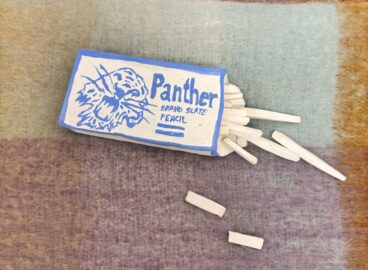
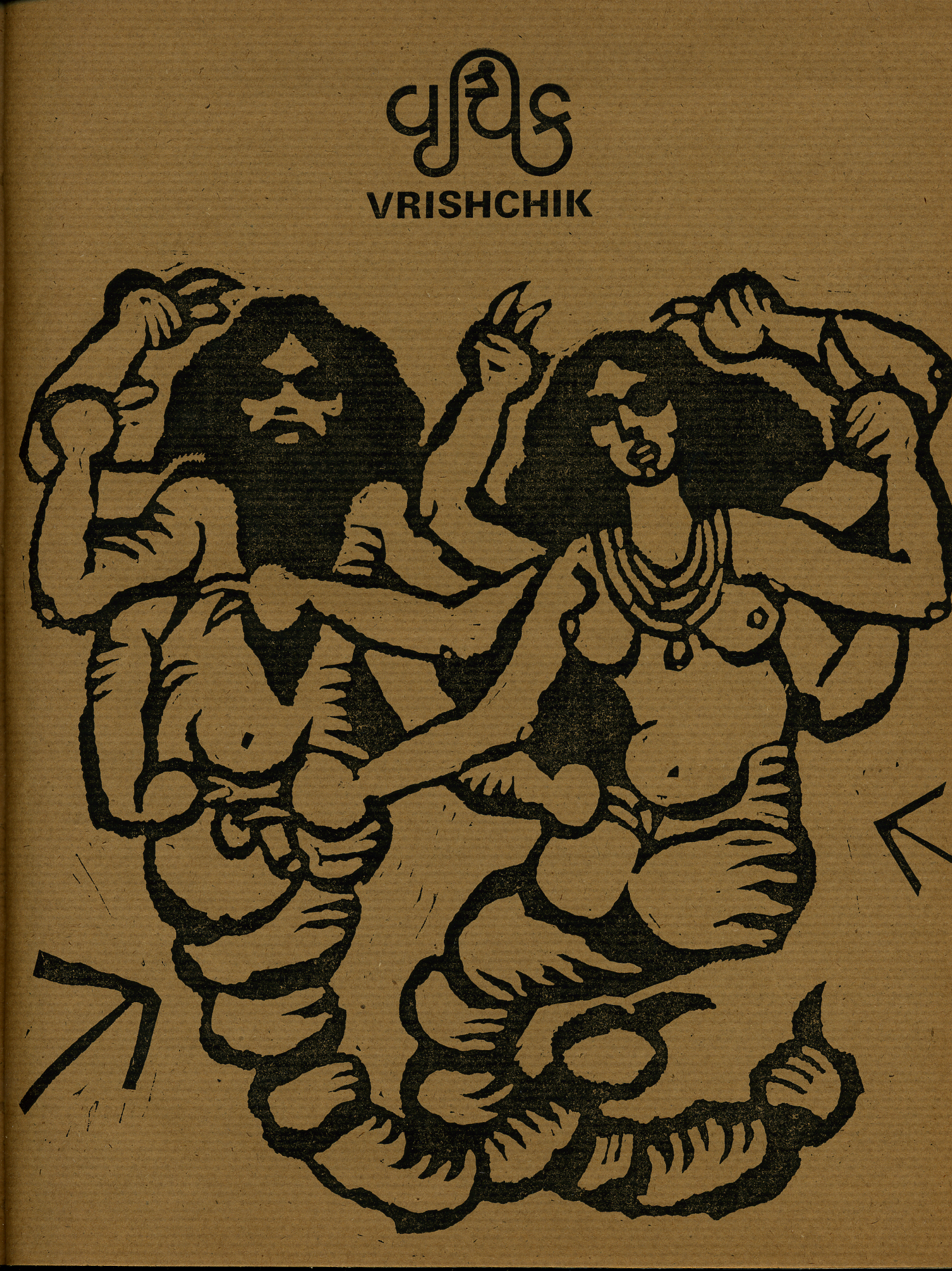
Suresh Joshi had written [an essay] on the poet Rajvi Patel—one of the finest Gujarati poets of my generation—which had originally been commissioned by the journal Books Abroad. We reprinted it in the second issue. For the third issue, Vinod Ray designed another cover—this one featuring a hippie-like man and woman with their hair down; both had bodies of scorpions (fig. 2). That issue included writings on cinema, including a delightful riposte by Bhupen in Gujarati on Bollywood films (this was the only non-English write-up in Vrishchik) as well as drawings by an artist friend of my generation, Nagji Patel.
Lucy Gallun: Could you point out some of the contributors to the early issues of the magazine—the types of things they were wanting to circulate among the community and what you chose to include, as you have already started to do.
GMS: I ran a little office from my home, writing letters to poet friends, writer friends, painter friends, telling them about Vrishchik. Those who received my letters became interested in contributing. Initially, only artists and writers based in Baroda contributed. But later on, I met, for example, a visiting Greek writer who had written about the coup in Athens. I asked to read her piece and found it worthy of publication. She agreed but wanted her identity concealed and chose the pseudonym Erato—the piece was called “A Greek Story.” Vinod Ray made an illustration to accompany it.
Then Bhupen and I were up to some mischief. We decided to buy a popular landscape poster—the kind sold on footpaths—roughly double the size of Vrishchik. We bought 200 or 300 copies and, on the blank reverse side, concocted a dialogue between an artist and an art critic. We came down rather heavily on absurd stories circulating among artists about their role and that of art critics and criticism. It was part gossip, part serious critique, and as expected, it angered many people. We thought it was a way of communicating with our community with no holds barred. We received a number of letters in response; some enjoyed the tongue in cheek humor, but others found it hard to stomach.
The subsequent issue reproduced letters from GIs in Vietnam. It was followed by an issue featuring a dialogue on the state of contemporary printmaking between Jagmohan Chopra, who started Group 8 in Delhi, Bishamber Khanna, Zarina, Jyoti Bhatt, and me. This issue carried ten prints by the aforementioned artists and by K. G. Subramanyan, Jeram Patel, Bhupen, and Anupam Sud—all well-known artists of the day.
After that, Arvind sent a long poem “Song of the Rolling Earth,” which we published. Adil Jussawalla, another well-known poet, submitted a poem called “Dog.” I wrote “Miniature Purana”—a critical view of how art history in India was being written at the time.
In issues that followed, we focused on saint poetry. I came across translations by Arun Kolatkar—a bilingual poet who translated Muktabai, Janabai, and Namdev—and was deeply moved by them. My favorite poem, by Janabai, goes:
I eat God
I drink God
I sleep on God
I buy God
I count God
I deal with God
God is here
God is there
Void is not devoid of God
God is within
God is without
And moreover, there is God to spare.
Arvind had also begun translating the great 15th- and 16th-century poet Kabir. One of his best poems, in Arvind’s translation, reads:
The kings shall go, so will their pretty queens
Courtiers and all proud ones shall go
Pandits chanting the Vedas shall go and go with those who listen to them
Masochist yogis and bright intellectuals shall go
Go the moon and the sun and the water and wind
Thus, only those can remain whose minds are tied to the rocks.
My friend Gieve Patel—the painter, poet, and playwright—had visited Baroda in the early 1960s and met Suresh Joshi, who had written on the Gujarati medieval poet called Vasto. Gieve sat with Joshi, took extensive notes about translating Vasto, and from these notes, produced three poems, which we also published.
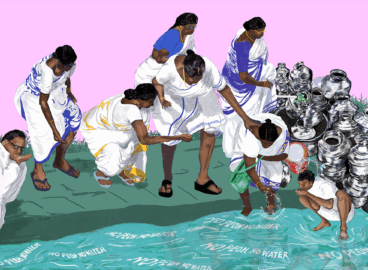
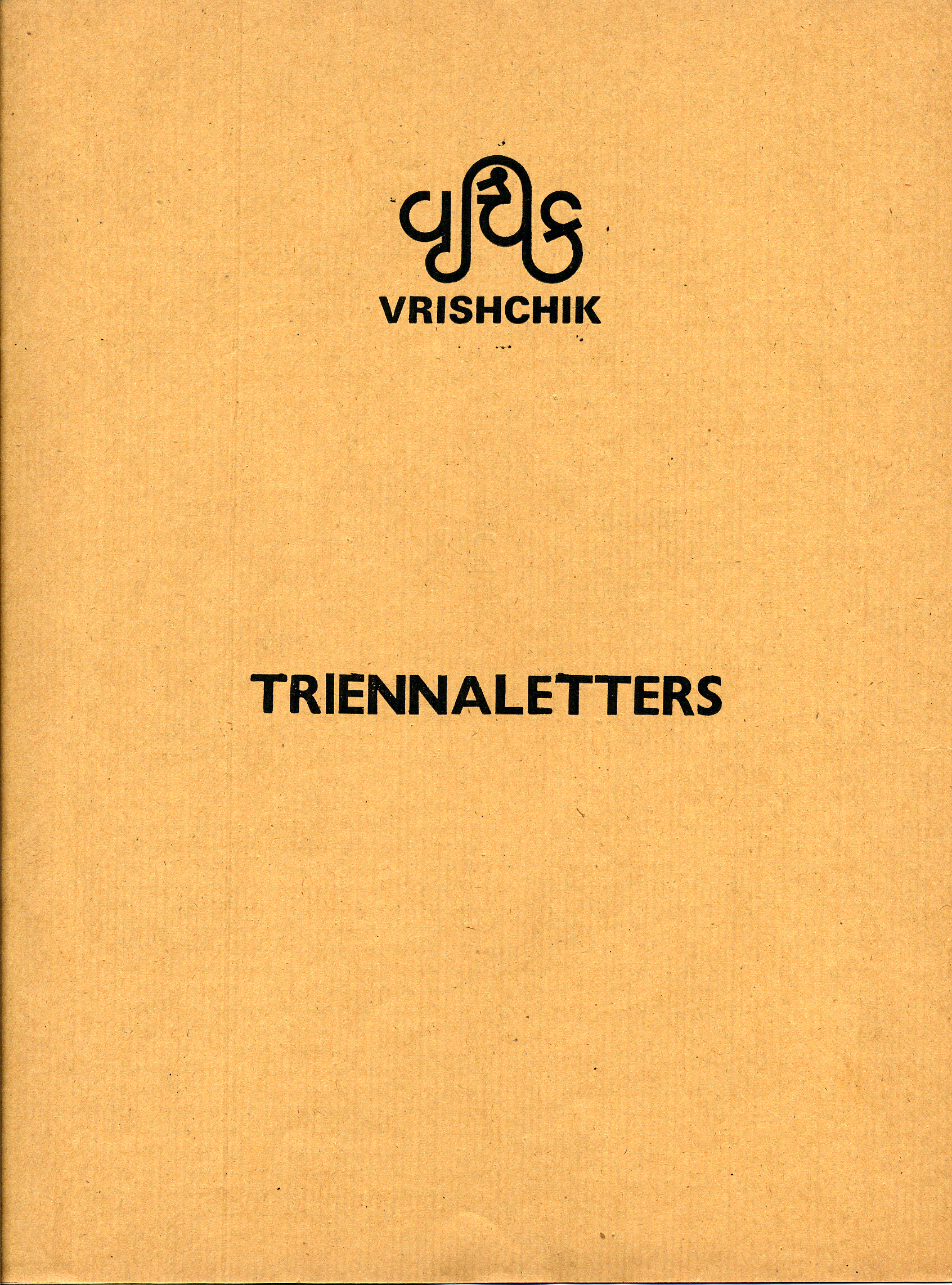
The next issues raised the question of the impending Triennale—the international exhibition planned by the LKA (fig. 3). Many issues were devoted to artists’ letters questioning the relevance of the Triennale. Artists from all over the country wrote in with their views on the impending event—K. G. Subramanyan from Baroda; Pranab Ranjan Ray from Calcutta; Krishen Khanna, Swaminathan, and Roshan Alkazi from Delhi; K. K. Hebbar from Karnataka; and Akbar Padamsee from Bombay. Eventually the Triennale did take place—along with protests and controversy. Vrishchik became a forum for protests against the LKA and its reform. Most of us boycotted the Triennale and the LKA, and so the government was obliged to appoint a commission of inquiry headed by Justice Khosla. After traveling around the country to consult artists, [Khosla’s] suggestion was that the LKA implement a process by which artists themselves elect representatives to serve on its general council.
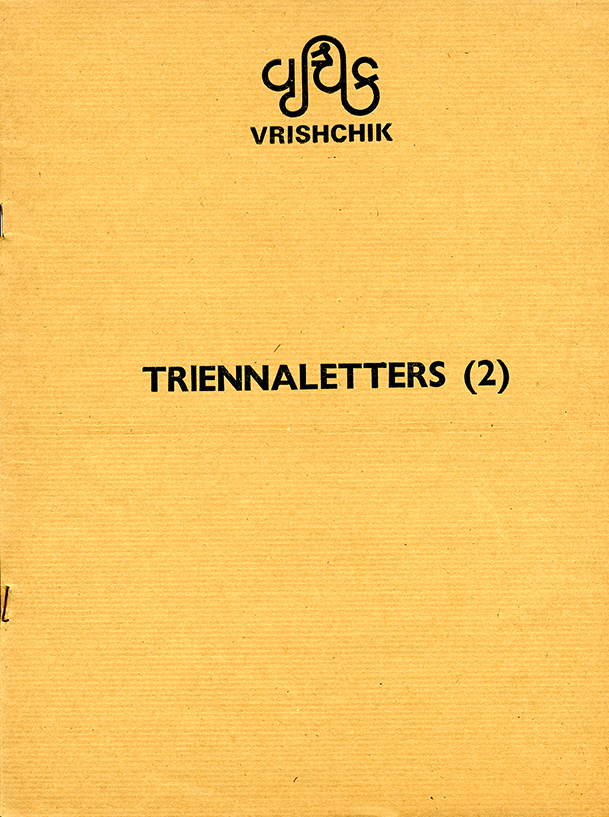
These issues also raised other questions—such as the implications of internationalism. Geeta wrote on this subject, and Vivan Sundaram, her partner at a later stage, wrote a rejoinder. We published both. So, these conversations on the Triennale and on what kind of internationalism India should have eventually led to the reformation of the LKA.
Our main interest was to arouse awareness of issues within the artist community. We were dealing with multiple generations of artists who were active in those days—K. K. Hebbar and Krishen Khanna belonged to the first generation, Swaminathan and I to the next, and then there were younger artists. The basic purpose of Vrishchik was to create that kind of awareness across generations.
Lanka Tattersall: Could you tell us a little more about the state of printmaking in Baroda, which you mentioned was the focus of one of the issues?
GMS: In Baroda, printmaking was an important part of the syllabus right from the beginning—from the 1950s onward. Students of painting took printmaking as a subsidiary subject. I learned printmaking in the graphic arts department of the Faculty [of Fine Arts]. The Smithsonian Institution hosted a printmaking workshop in Delhi in 1970, inviting 100 artists from across India and providing facilities to work on the best papers and zinc plates. Over a month, we learned etching and aquatint under Paul Lingren. On returning to Baroda, I bought an etching press, set it up in my home, and worked on a series. Jyoti Bhatt took to printmaking intensively, and it eventually turned out to be his principal métier. Others who took to printmaking and produced exceptional works were Laxma Goud, Devraj Dakoji, D. L. N. Reddy, and Purushottam and Rini Dhumal—all of whom worked at the Faculty under the guidance of N. B. Joglekar, who headed the graphic arts department.
AS: As additional context, each handcrafted issue of Vrishchik was supplemented by a free original artwork—modest in scale—whether a linocut, woodcut, or lithograph. Sheikh Sir, could you speak further on the artworks that accompanied each issue?
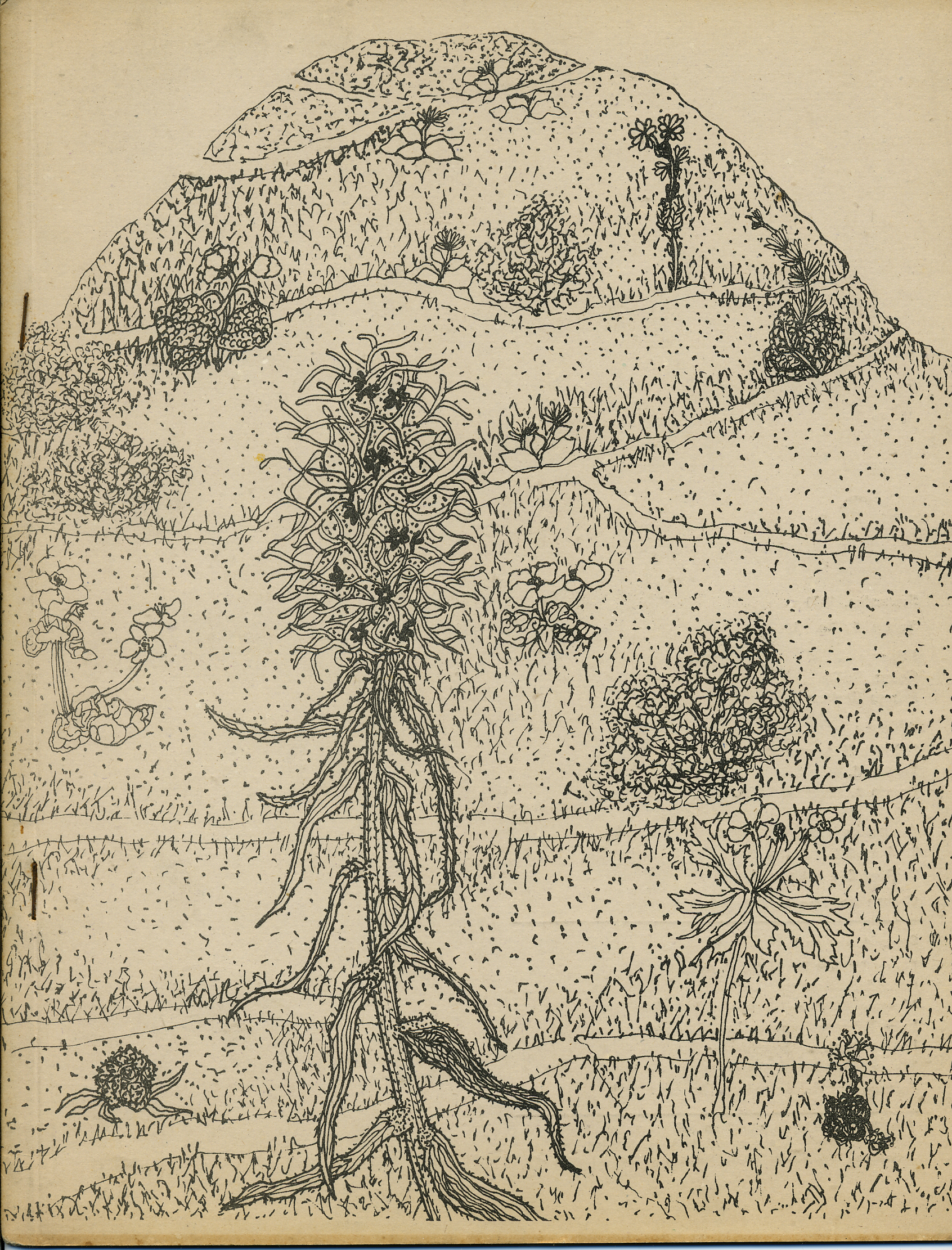
GMS: I had seen four issues of Contra that printed artworks using machine-made blocks. This made me think that Vrishchik could introduce linocuts, woodcuts, and other printmaking mediums. So, while we printed an artwork on the cover, we also included a loose copy of it inside Vrishchik—so that those who wanted could mount and preserve it or put it on display.
As for how Vrishchik was produced: as I said earlier, I was running a little office from my own home, writing letters, keeping correspondence in big files, and sometimes getting my students to help. We had 500 copies per issue, and 250 to 300 had to be sent out, which meant writing addresses, stuffing printed copies in envelopes, and posting them all—which was conducted entirely from the Residency Bungalow. I enjoyed it. I asked Bhupen to handle the accounts, which he did—he was a chartered accountant.
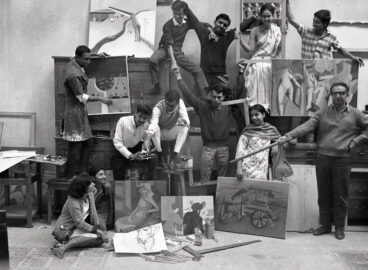
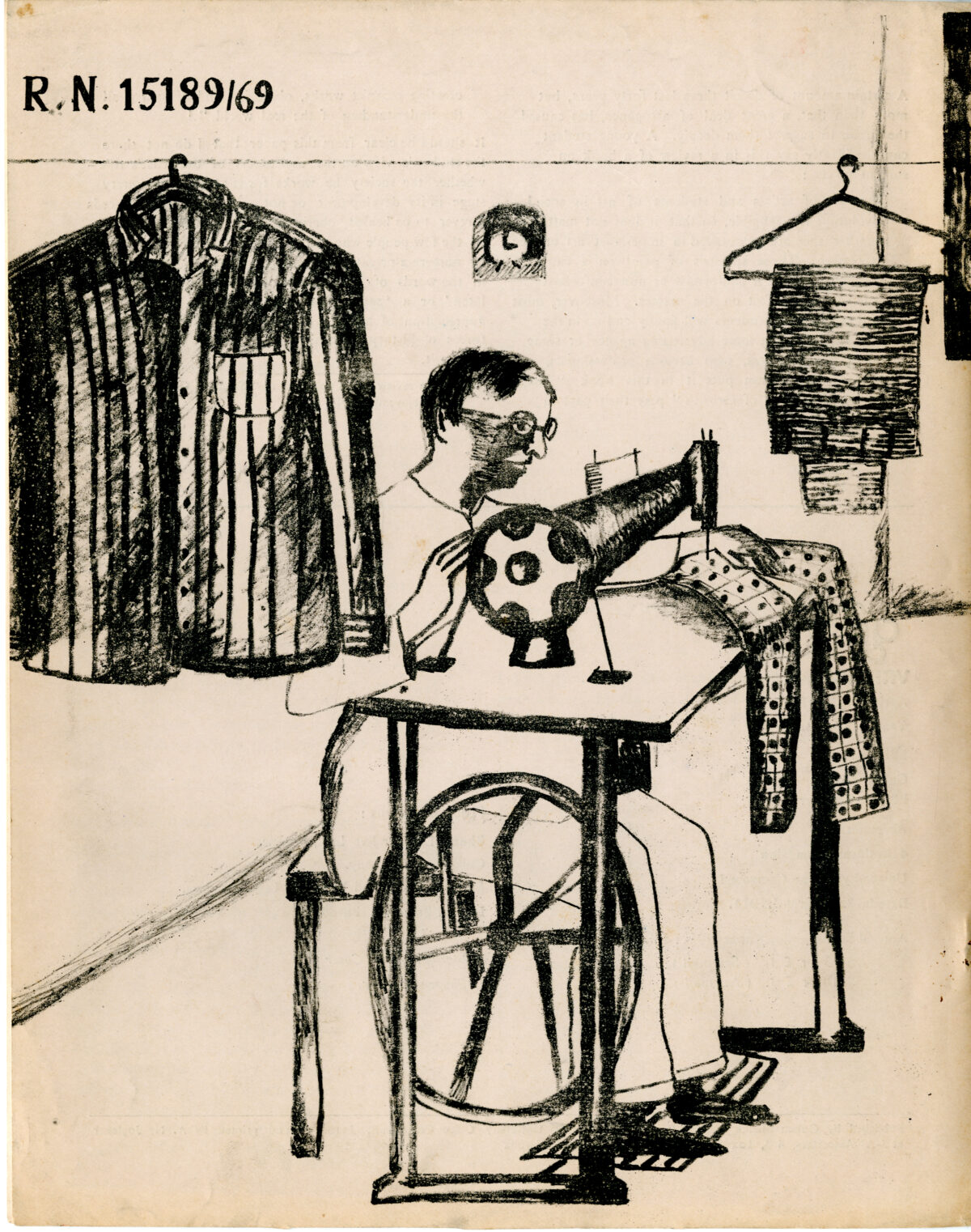
The press we used from the third issue onward, 3-A Associates, was run by N. B. Joglekar and he was amenable to any kind of experiment we wanted to try. First, we gave him linocuts to print. Then I said, “Mr. Joglekar, you also have an offset press.” Offset is like lithography but on a plate—you draw directly on the plate. So, Bhupen and I and others made drawings right there, which were then transferred and printed. Bhupen made a drawing of a tailor, among others (fig. 4).
LG: You’ve discussed your office at the bungalow, working with Bhupen Khakhar, the head of the graphics department, who served as printer, and your students helping with the mailing. Could you say more about the setting at MSU Baroda—and at the same time, your relationship to other artists in other cities, particularly Bombay, given our group has been discussing the art scene there at length?
GMS: As you know, the artist community in India is like an extended family—we all knew each other. I used to travel to Bombay, meet friends there, see their exhibitions, and the same applied to Delhi. I had also been to Santiniketan, to Calcutta, and to several other places. I had personal friendships with many artists, so I asked them for contributions for Vrishchik, and they offered willingly.
LG: Was there something specific about Baroda that enabled this kind of journal to happen in a particular way?
GMS: Baroda was very special among art schools in India at that time. It was one of the most liberal institutions, which allowed all kinds of activities, and we had students from all walks of life and sections of society.
The pioneers of the Faculty had Gandhian ideals—of building something they could handle without hankering after what was beyond their means. The institution was built on basics: painting, which needed a good studio; sculpture, which needed casting facilities; printmaking, which needed an etching press, a litho press etc.; and art history, [which was] taught to every student regardless of department. The Story of Art—a history of world art—which I taught for almost eighteen years was key to every student’s education. I had very young and bright students; they included Vivan, who came from the elite Doon School, while others came from small towns and tribal hinterlands. I taught the Story of Art in English for degree students and in Hindi for diploma students. At some stage, students who knew I was Gujarati asked why I didn’t teach it in Gujarati, so then I taught three classes on the same subject. In the first, Vivan would bring up Jackson Pollock; in the second, students only knew what was happening in their part of India; and in the third, some had not even heard of the Mona Lisa. That was the big challenge—how to teach all of them. It opened my eyes to the diversity of the world of artists coming to the Faculty.
But I will also go back to my background. I grew up in a small town called Surendranagar in Gujarat, where I started writing poetry, drawing, and painting. In those days it was customary for good schools to have a hand-painted, handwritten annual journal. One of my teachers—a poet who led me to write in Gujarati—decided to make such a journal to be placed in the public library every week. He decided that we would produce it together. We went to the Khadi Bhandar—khadi is the hand-spun cloth associated with Gandhi—which produced a very rough handmade paper that I enjoyed working on. Today, all artists love such papers because they are resilient and receptive to paint. On them, I would paint the cover, draw the titles of articles, and illustrate a picture story for children, while my teacher wrote short stories, a thought of the day, and poems. This ran for a year when I was about fifteen. I still have some copies—I showed them recently in an exhibition of my printmaking.
Jay Levenson: You mentioned Vrishchik was addressed primarily to artists. Were there also collectors who were involved?
GMS: No. Our list included visual artists, writers, musicians, and filmmakers—about 200 people, many of whom we knew personally. I think there were hardly any collectors in those days. Those who may have collected works by [M. F.] Husain or Krishen Khanna were not accessible to us.
In those days, if we wanted to exhibit, we did it ourselves. No gallery would pick up our work. We took our paintings to Bombay or Delhi, mounted the exhibition ourselves, printed our own catalogues, and tried to sell the work by sitting in the gallery. I remember my first exhibition in Bombay: I had learned from my seniors that canvases had to be rolled up, so all our canvases were rolled. We took our stretchers, bound everything up, and booked a first-class train for the occasion. In Bombay, we couldn’t afford taxis, so we used horse carriages to transport everything to Jehangir Art Gallery, a public gallery that only opened around 11 o’clock. We’d arrive at six in the morning, wait for hours, then unpack our things, put the frames back on the canvases, and mount the show. A carpenter helped, if we could afford one; otherwise we did it ourselves.
As for collectors, I remember that Air India was a major buyer in those days. There was a gentleman called Jal Cowasji who made the rounds of galleries—and everybody would trail him, because he was the main person acquiring work for the airline. By 1969, the situation had improved with a few more galleries, but private galleries were still very few.
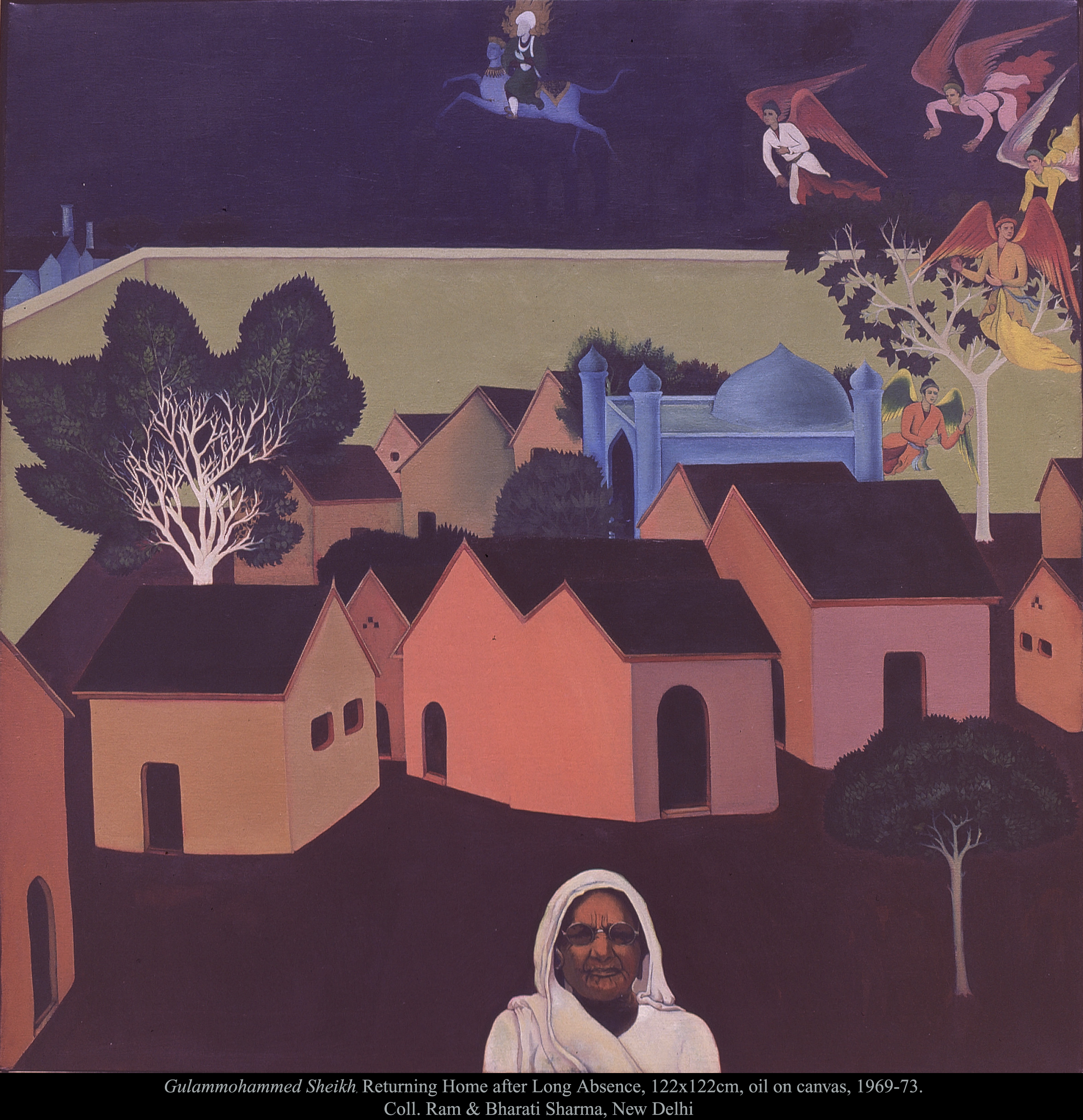
Rattanamol Singh Johal: Could you reflect on the relationship between Vrishchik during that very productive period from 1969 to 1973 and your painting practice at the same time. Reading the editorial from the first issue— “Afternoon”—I was struck by how much it resonates with paintings like Returning Home After Long Absence (1969–73; fig. 5) and Speechless City (1975; fig. 6). Could you speak to the threads that connect your poetry, your narrative writing, and your painting?
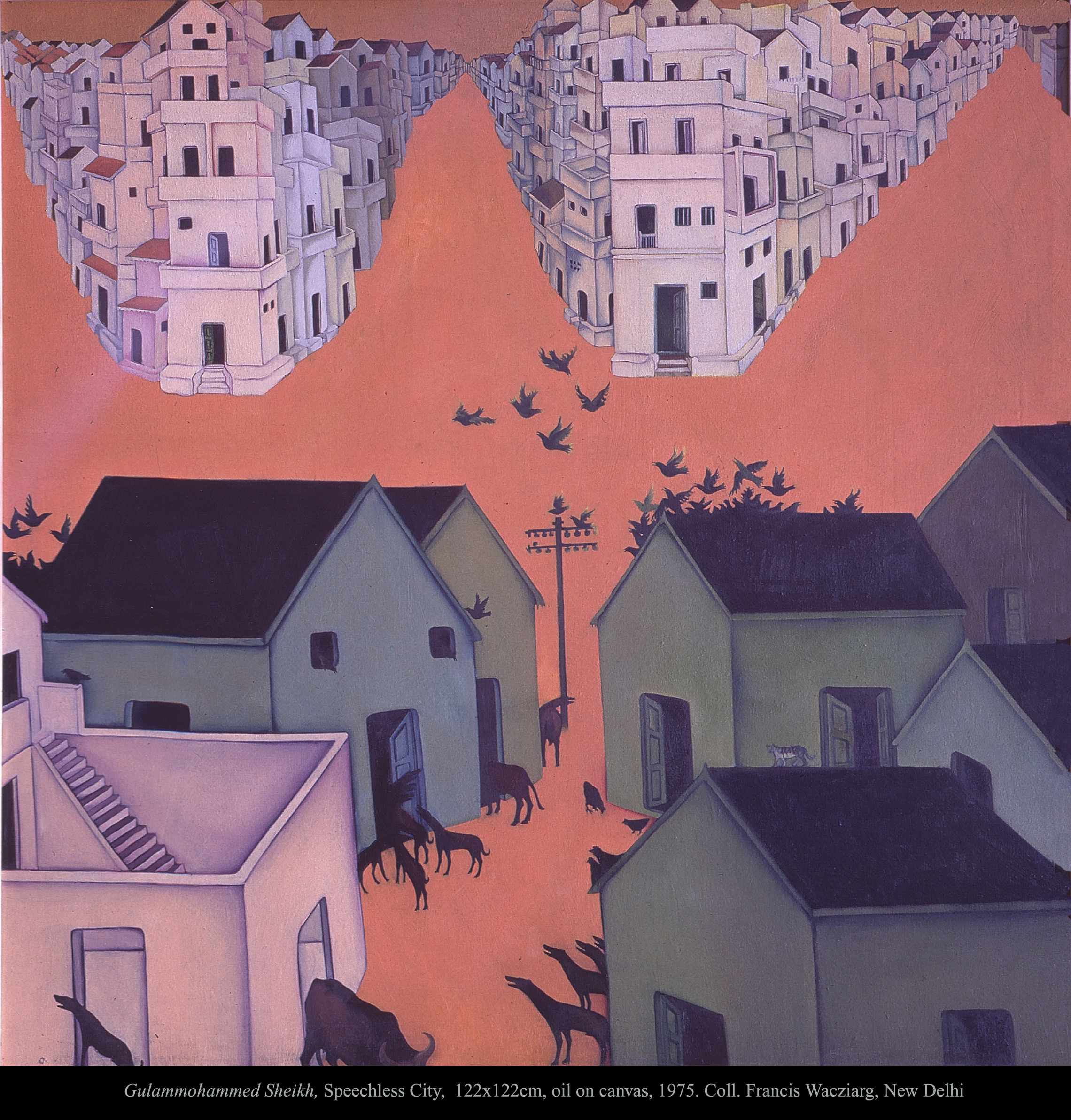
GMS: All of it—my writing on communalism, on silence, on isolation; my painting; my publishing of Vrishchik—were connected.
When I returned from England in 1966, I took a long, nearly three-month journey, traveling by road from London to Bombay via Europe—buses, trains, walking, everything. That journey allowed me to discover India, and I began to look at everything with fresh eyes. I remember being on a bus near Jhansi, watching the landscape change as the bus moved so fast that distant trees appeared to rush toward me and mountains shrank. Experiences like this were accumulating. It was also when I felt I should write my memoir. I was on a train heading home to Surendranagar, and on whatever scraps of paper I had, I started scribbling notes on returning home. That memoir in Gujarati is now published, and hopefully an English edition will appear soon.
At the same time, I began the painting Returning Home After Long Absence. My memoir and my painting went hand in hand, opening pages of each other. In the painting, I brought in my mother, images of the town I grew up in, an Islamic backdrop with an image of the Prophet, a big wall—I wrote an entire chapter in my memoir on a wall—and trees, particularly the peepal tree, the Ficus religiosa, which was a beautiful tree that I could see from my window at the Faculty. All these things combined during those years.
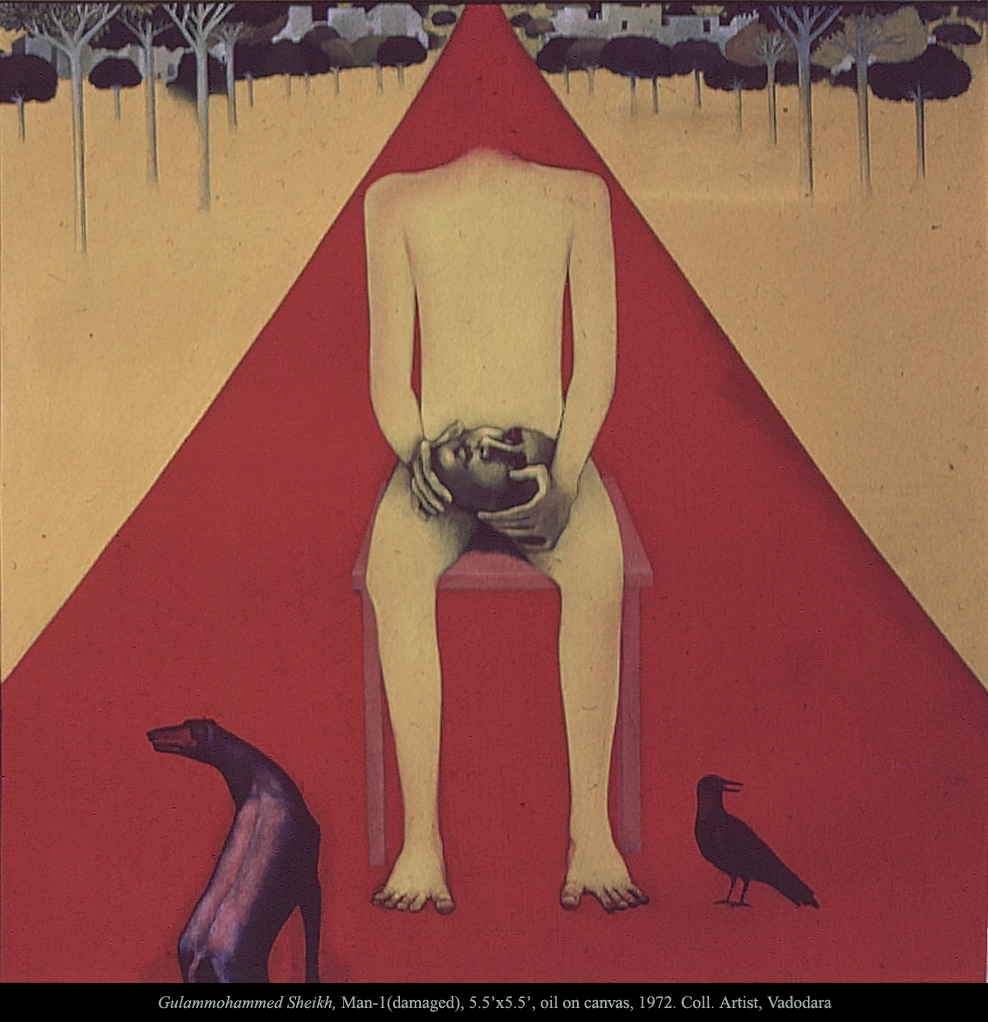
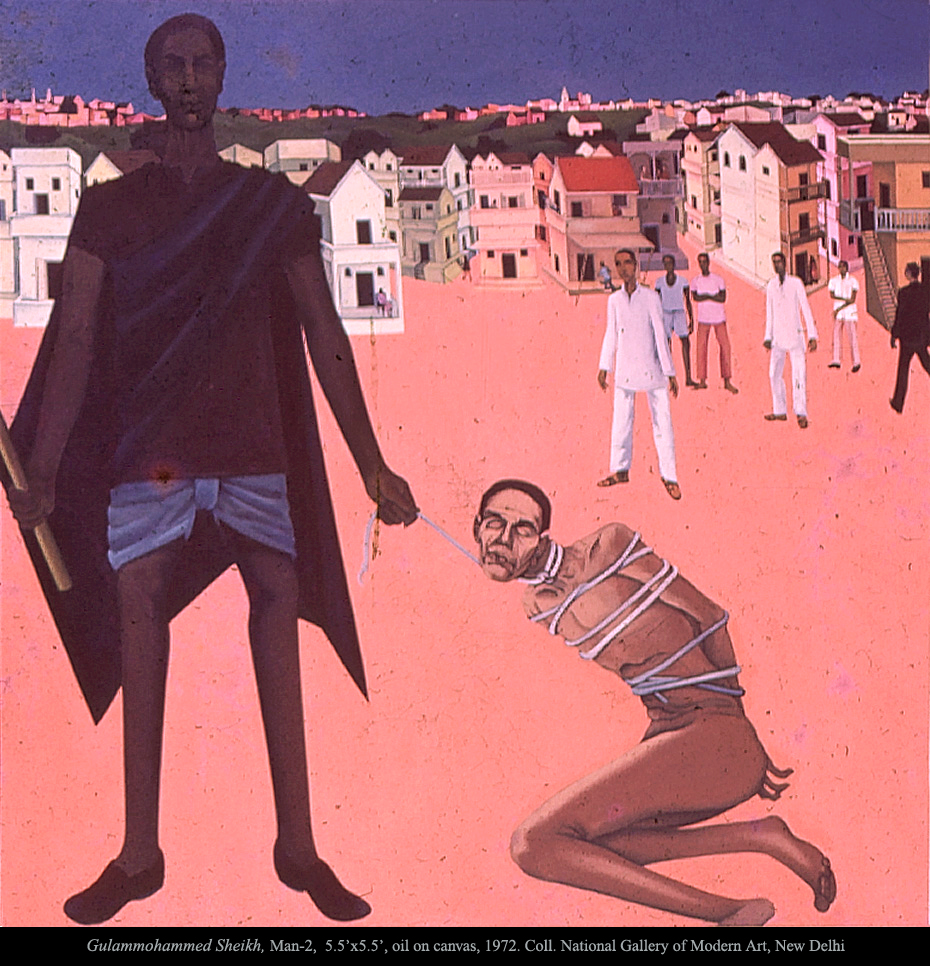
By 1973, I was painting both from within myself and from what I saw around me—I painted two works called Man I and Man II (figs. 7, 8). Man I is a metaphorical work in which a man is seated, with his head on his lap. In Man II, a man holds another man [who is tied up] as an object of public display. That was when my eyes opened to the politics of India—which eventually led to Speechless City, painted while the Emergency was in effect. The roots of many paintings that came later were sown during that same period, while I was also publishing Vrishchik and writing poetry.
AS: I’d like to close by asking about your commitment to multilingualism across your writing, poetry, teaching and publishing practices.
GMS: I do not really know how to explain it—all three languages come to me naturally. I knew Gujarati because it is my mother tongue, and so if I want to write poetry or creative prose, like my memoir, I choose Gujarati. I learned Hindi on my own—and everyone in India knows some Hindi because of Hindi cinema. And English, I learned in school and college.
Vrishchik was, in part, a kind of lesson for me: It allowed me to polish my English. I did not know English very well at the start, but those four years helped me learn it properly. I was communicating with a large number of people, writing and receiving letters, editing contributions, proofreading—and when Adil or Gieve wrote in perfect English, I had to ensure that every word was printed exactly as they had written it.
All of this was part of my life, [as was] living within a family with my children and Nilima. I cannot really describe myself. I can only say that all of this is part of me—not something I took on as a challenge or as a duty, but something that came naturally. It was all part of my makeup.
Every Indian speaks two or three languages: the local language, Hindi, English or another language. We are plural by nature, multilingual. We think in multiple languages simultaneously. That is the makeup of the average mind, and thus, I am not so different. By writing in multiple languages, I have learned that I have to find myself in each of them.
The C-MAP Bombay/Mumbai Group would like to express its sincere thanks to Gulammohammed Sheikh and to the team at the Asia Art Archive in India for making Vrishchik available to us. The magazine’s various issues can be accessed via the following link.
This essay stems from the Contemporary and Modern Art Perspectives (C-MAP) Bombay/Mumbai initiative at MoMA. The 2024-2026 Bombay/Mumbai research program was conceived and organized by Ananya Sikand (C-MAP Bombay/Mumbai Fellow) and Lucy Gallun (Curator, The Robert B. Menschel Department of Photography). Read more about C-MAP here.
- 1Geeta Kapur, “Signatures of Dissent,” ART India Magazine 6, no. 2 (2001): 79. ↩︎