Rajyashri Goody (b. 1990) queries food and water politics, Ambedkarite Buddhist practices, literacy and Dalit literature, and mobility and place-making in the context of caste-based violence and Dalit resistance in India. She works primarily with paper pulp, clay, text, photography, and printmaking. What follows is an abbreviated account of Goody’s session with the C-MAP Bombay/Mumbai Group.
Ananya Sikand: Today we’re joined by Rajyashri Goody, who will present her artistic practice and long-term research on the interweaving of Dalit food culture and Dalit literature adapting recipes from autobiographies. These recipes serve as the backbone of her work across ceramics, installation, photography, printmaking, and performance.
Food is an important site of memory, resistance, resilience as well as a form of embodied politics, because among the many reasons that the Hindu caste system has such deep roots is that rules related to adhering to caste have been applied to basic activities necessary for survival such as eating and drinking, which are bound up in casteist notions of purity and pollution. Dalit people have been treated as untouchable and impure for thousands of years, and many are still denied basic rights to food, water, land, and literacy. Rajyashri’s work highlights how Dalit identity is being reclaimed and reinvented through acts of everyday resistance, especially relevant in the present moment given the rise of Hindu nationalism, which promotes the upholding of casteist values, vigilantism, and violence against minority communities in the name of religion.
Rajyashri’s work is presently part of the Post-National Digital Pavilion, a program developed by the Institute of International Visual Arts (iniva) in collaboration with the British Council at the 61st Venice Biennale.
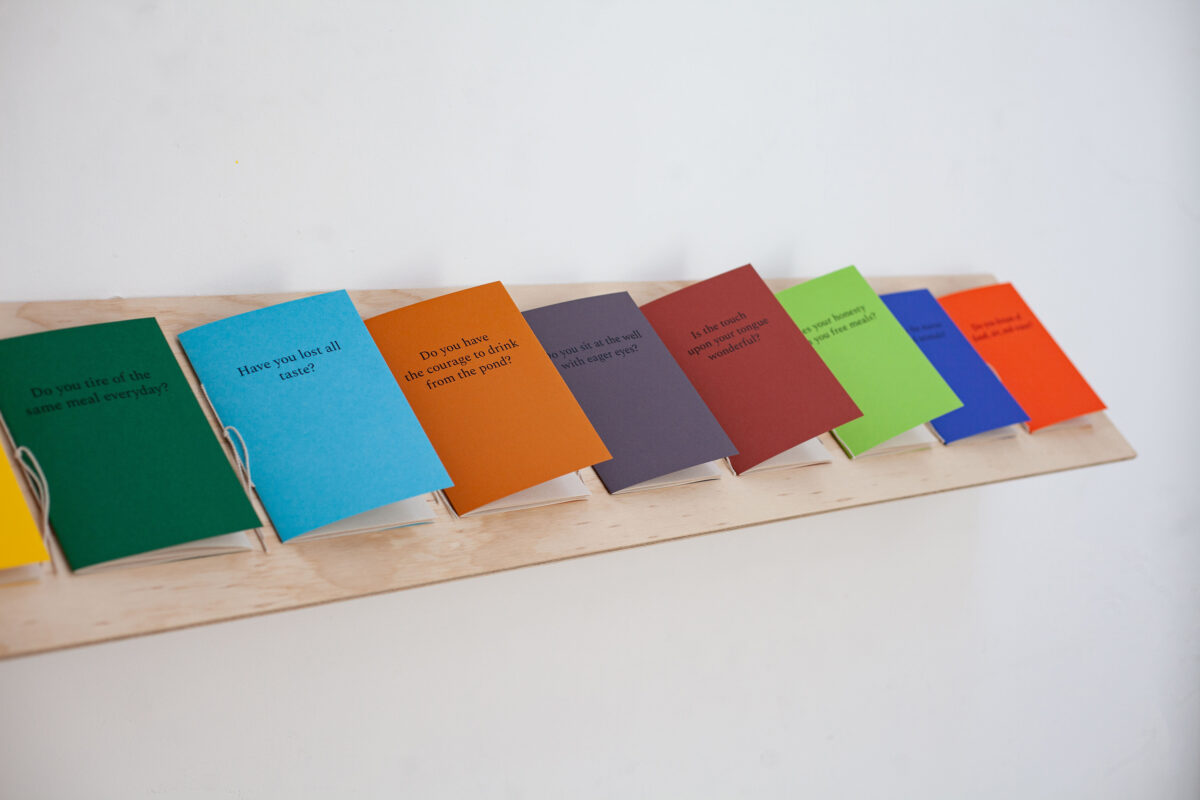
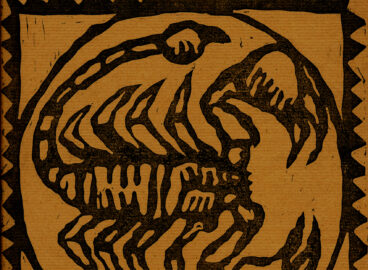
Rajyashri Goody: I want to begin with the recipes (fig. 1) that I work on, an ongoing practice since 2017. I started my research in 2016, when many parts of India were seeing a lot of lynchings based on the suspicion of eating or transporting beef. At the time, Muslim and Dalit people were targeted, accused of eating beef, and then publicly attacked. Simultaneously, there were many protests. One, in particular, led by lower-caste people in a village called Una in Gujarat centered on their refusal to pick up dead animals, a job forced on this community because of their lower-caste and “untouchable” status. Across India, Dalit people are forced to take on the role of sanitation workers, which includes disposing of carcasses of dead animals. Dead cows have been a major source of food for the community because, historically, Dalit people haven’t been allowed to own land, much less grow their own crops, etc. Today, many Dalit people are resisting these jobs, but it’s very difficult because no other caste wants to undertake them. Dalit people, even if they’re going to school, etc., are forced by the system to take on such labor. I read, about 10 years ago, that all the sanitation workers in India are Dalit and that no other communities are involved in this work. As all of this was happening in 2016, I started thinking about my own food practices—given my mother belongs to this community—and asked myself: What do we eat as Dalit people?
My family doesn’t eat beef because we became Buddhist in the 1950s, like a lot of Dalit people. In embracing Buddhism, we gave up eating meat in general—and especially beef because of its connection with sanitation work. But I asked myself, What if I’m eating vegetarian food? Does that then become Dalit? What about if I share food with an upper-caste person? What about the food makes it upper-caste or makes it polluted—as is thought to happen if a Dalit person shares food with an upper-caste person.
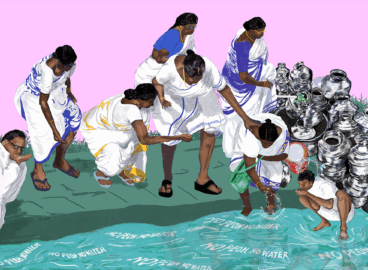
I’ll read a recipe from my writing called “Well Water”
Although the well
belongs to the Patils,
the spades and the shovels,
the sweat,
the explosives
of the Mahars
were used to dig and build it.
You are the reason
for water in the well.
But now you are not allowed
to draw water from it.
If you are walking by
feeling tired and thirsty
go down the well
to drink water
while your friends keep watch.
Make sure no one sees you.
Otherwise you might be badly beaten.
Quench your thirst
furtively.
Touch the water.
Gather it in your cupped palms.
Ripples might form on the surface.
The water inside the earth might shake.
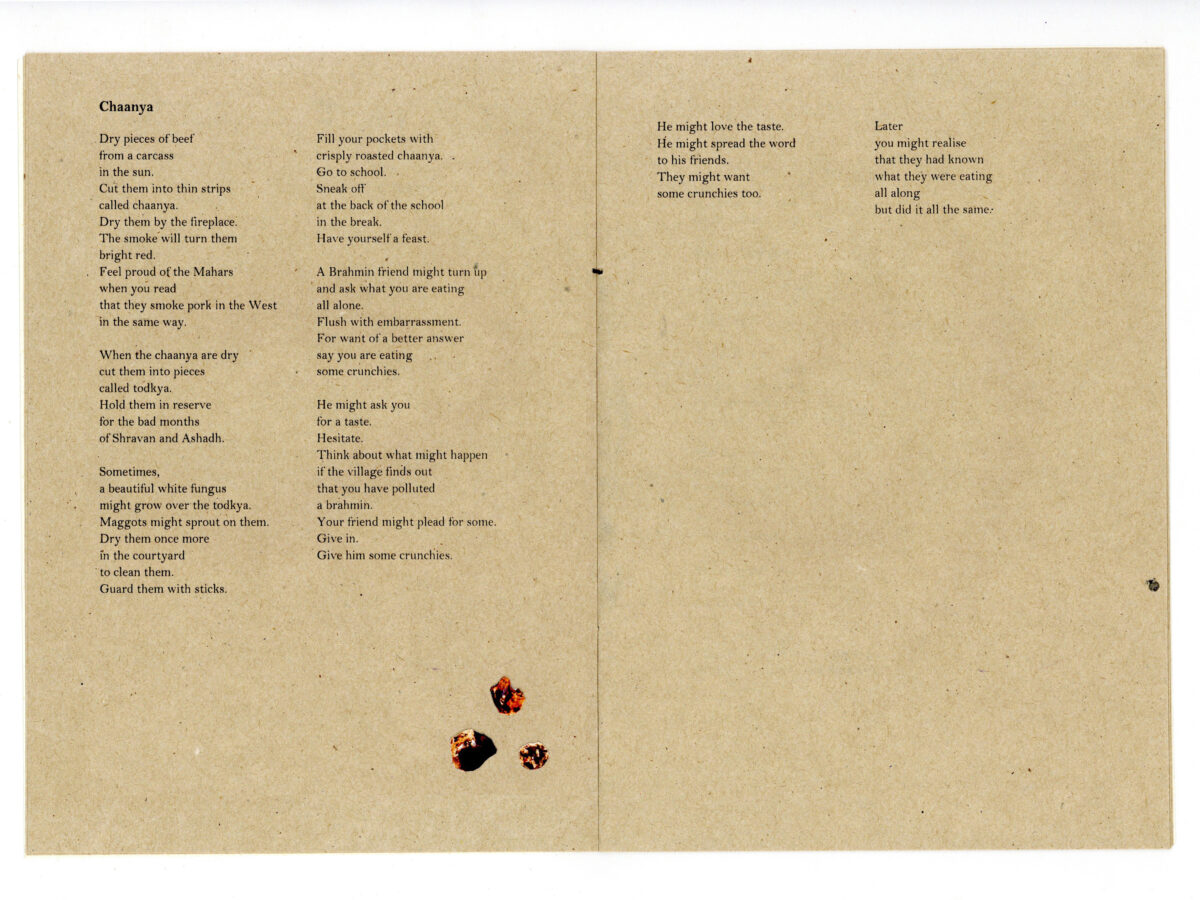
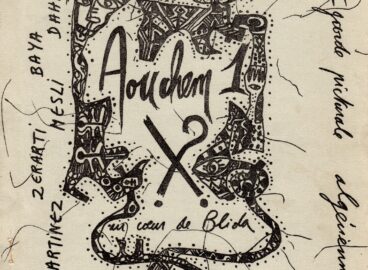
This writing is adapted from Dalit literature—“Well Water” from Sharankumar Limbale’s writing and “Chaanya” (fig. 2) from Daya Pawar’s. Whenever I read a Dalit autobiography, I mark where the writer mentions food or water. Then I switch it from the first person to the second to make it read like a recipe—but often one that’s impossible to actually follow. I started this exercise for a number of reasons, including the fact that I couldn’t find any Dalit cookbooks—other than Shahu Patole’s Anna He Apoorna Brahme, which had just come out in Marathi.1This book is now available in English. See Shahu Patole, Dalit Kitchens of Marathwada, trans. Bhushan Korgaonkar (HarperCollins India, 2024). And there haven’t been any other Dalit cookbooks since people from the community haven’t been allowed to read and write. So how does one write a cookbook in the first place? A cookbook assumes many things, including access to a functioning kitchen, utensils, and ingredients, all of which is related to socioeconomic status. But there’s also an assumption of pride in one’s food, which with Dalit people is difficult because many of our food practices stem from being forced to eat leftovers, to beg, to make do with nothing—but not as a form of resistance. It’s not something that parents want to pass on to their kids. So how does one remember and gather these recipes, and should one even bother? That’s when I realized that it’s not necessary to have a Dalit cookbook in a conventional sense. But Dalit literature, a massive genre given it’s only 50–60 years old, is filled with writing about food and water. Dalit oppression is deeply connected to the stomach, so this exercise has allowed me to understand the similarities in Dalit food across India, but also the differences—and how time works in strange ways. For example, I’d be reading something written 40 years ago and something else written five years ago, and it could be the exact same story. This continues, and I’ve made 23 cookbooks so far.
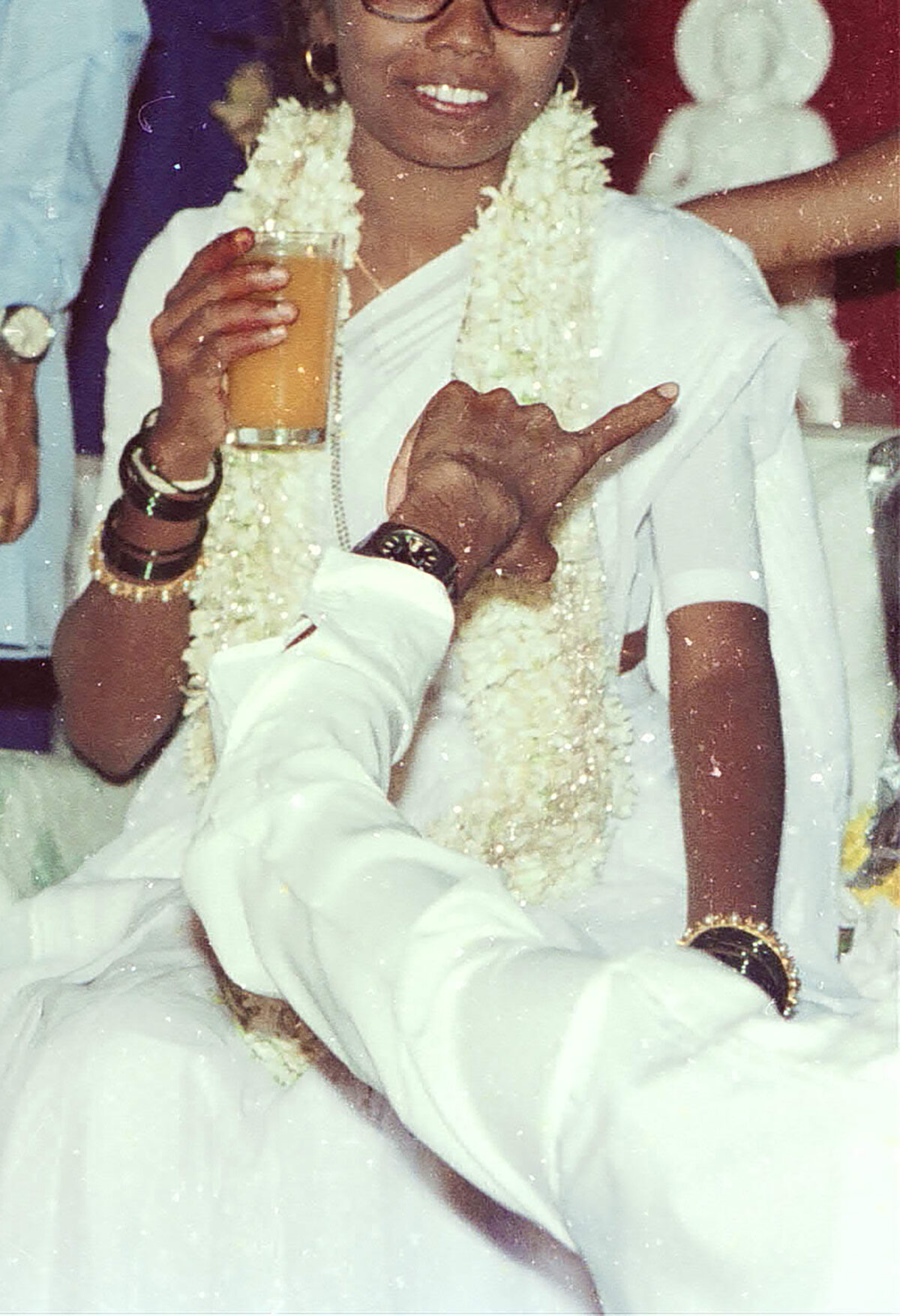
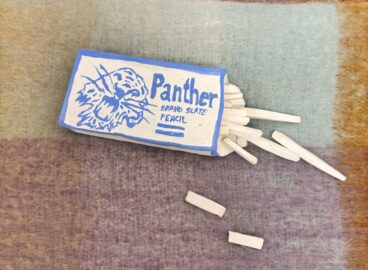
These recipes allowed me to build on other works, such as those shown in the exhibition Eat with Great Delight (2018) at the Clark House Initiative (fig. 3).2Rajyashri Goody: Eat with Great Delight, curated by Skye Arundhati Thomas and Rosanna McLaughlin, Clark House Initiative, Mumbai, July 12–August 6, 2018. This series came from my family photos, specifically from examining them as records of where traces of food existed. My family has had access to a camera since the late 1980s, when my mother married my father, a white man who came to India to do social work, and he had a camera. Not only did he take photographs, but also other family members began to use the camera. It was interesting to see the differences between the photos that he took for work and our own family photographs of celebrations. I showed 18 family photos as they were, alongside eight recipe books. Photography, just like writing, is a tool for access. What do you do with a camera? What do you photograph? What do you do with a pen? What do you write about?
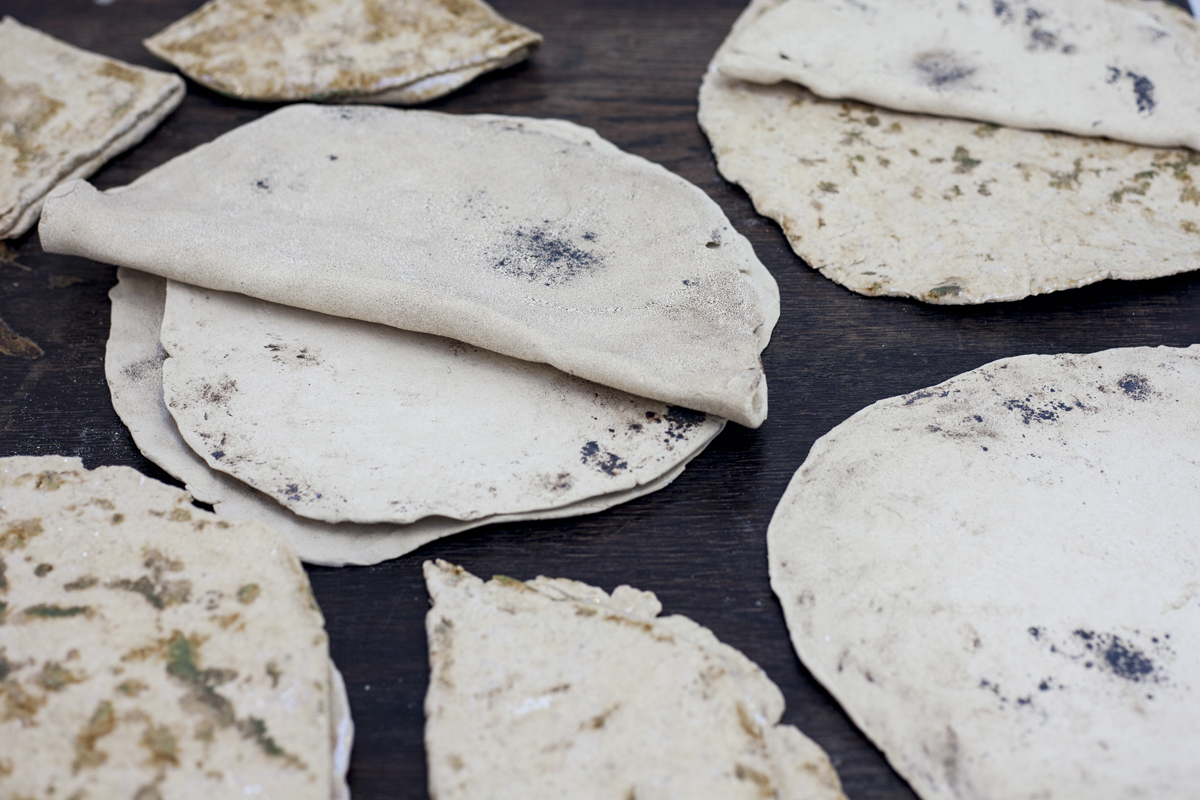
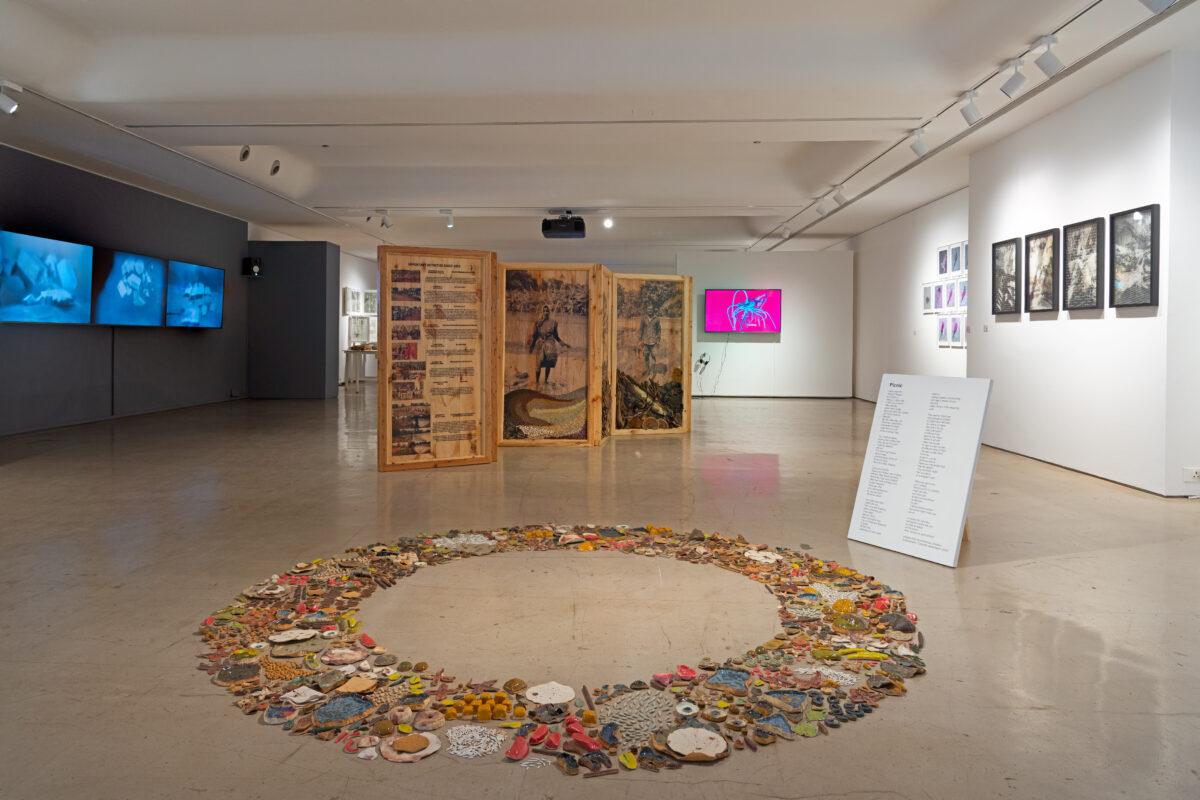
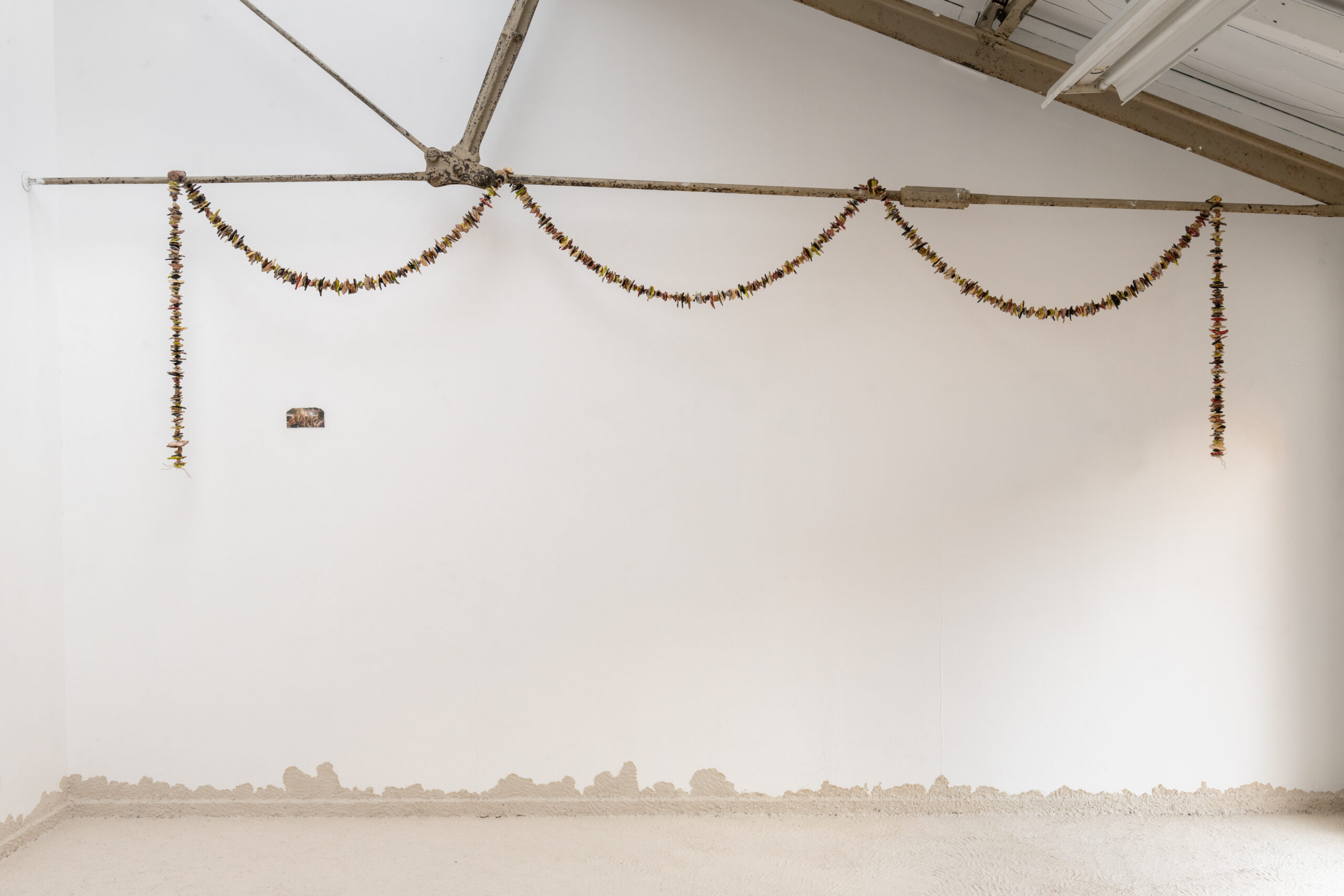
I also started working with ceramics in 2017, which came about because I didn’t want to actually cook the food—because it’s not about that. I’m not interested in making a Dalit dish, and people were approaching me and saying, “Can you cook something?” They didn’t get it. But I did want to make something with my hands. Because the reading and writing were getting to be too much, I felt like I needed to process it in a different medium. I started with bhakris (fig. 4a), rotis made out of millet, because some Dalit writers write beautifully about it, comparing it to the sun and moon, to the mother and father, to heaven and hell. I wanted to create the bhakri in a material that would last. Then I went on to make larger installations that reimagine many of the recipes (fig. 4b)—especially if they center foraging or hunting or stealing food—and processed these stories while making the ceramics. Some pieces look like food items, but there are many that don’t. Some look rotten; some look like fungus. Unlike food, or perhaps like Dalit food, they are inedible.
Then I made Is the water chavdar? between 2020 and 2022. It’s an installation of 10,000 stupas, which look like inverted bowls, about the Chavdar water tank in Mahad, Maharashtra. In 1927, our leader Dr. B. R. Ambedkar walked to this tank with 10,000 people to drink water from it. They were in Mahad for a conference on Dalit rights, and even though the government had made it legal for Dalit people to access public water bodies, they were still carrying their own water. So they drank from this tank to make a point. It’s one of the most important Dalit events in history, and yet, it’s forgotten by mainstream upper-caste India. It’s not really mentioned in history textbooks, but Dalit people grow up learning about it and going to Mahad. I wanted to make a memorial or homage to the people who went there. Also, this event was not photographed. Even though cameras were accessible in 1927, it was not considered important enough to record.
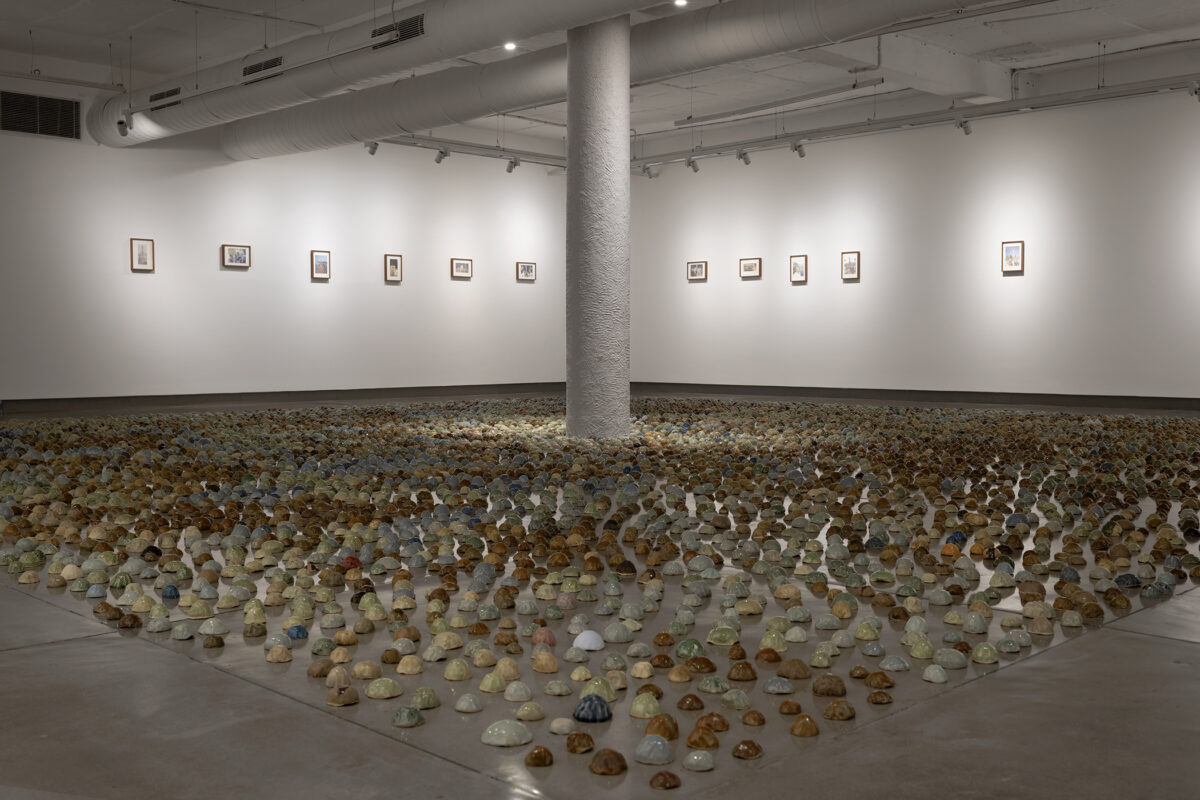
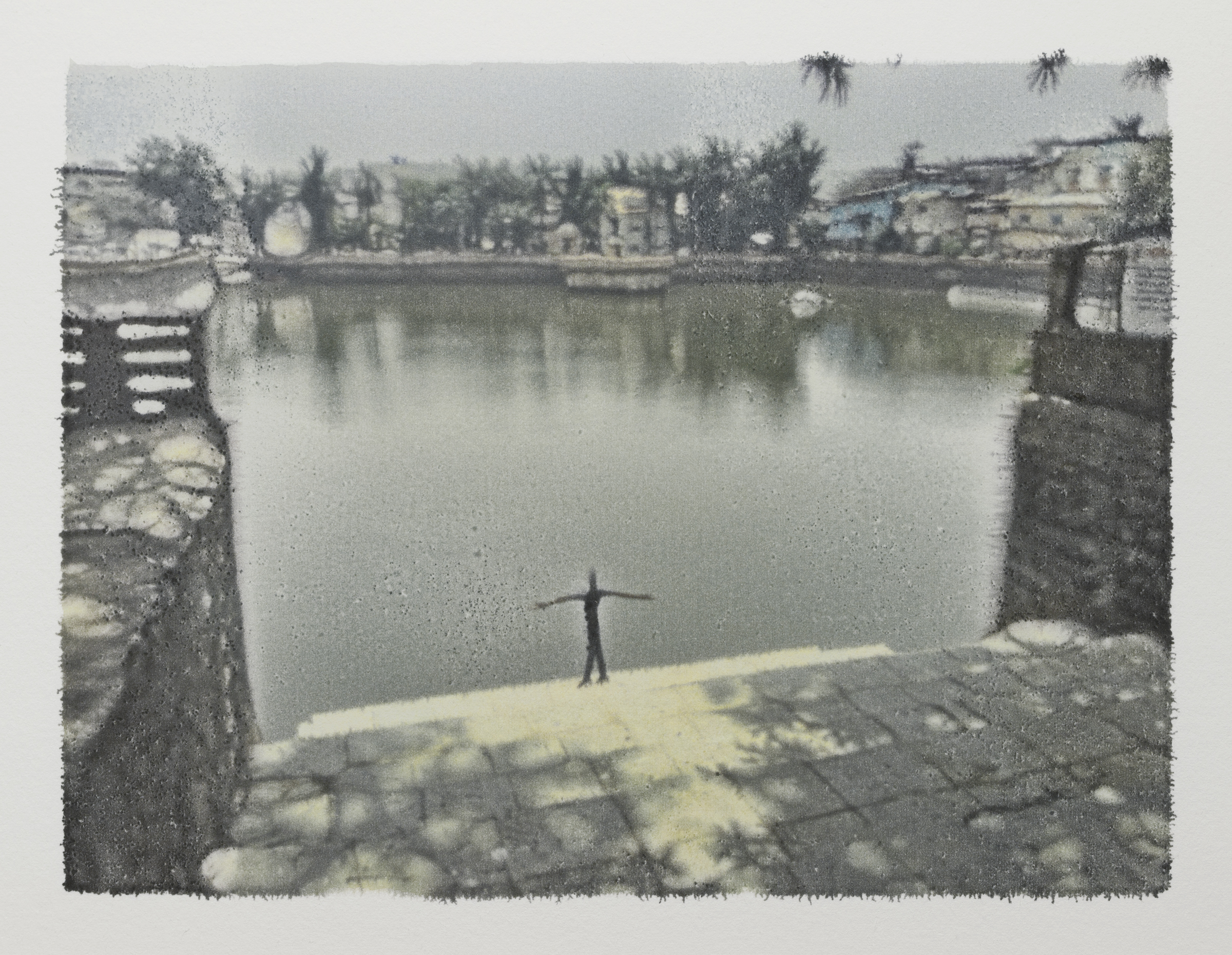
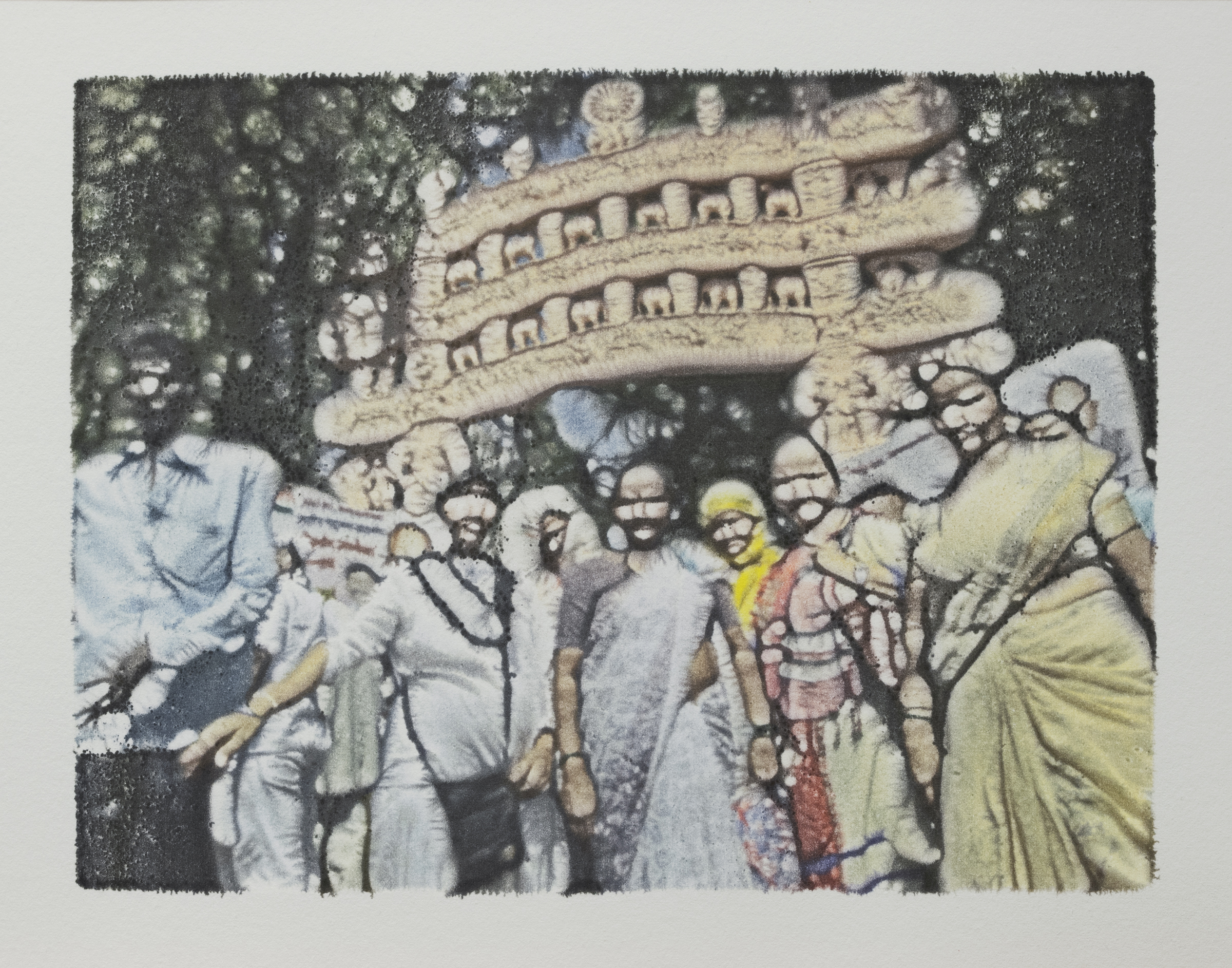
I made 10,000 stupas and arranged them to look like a square water tank (fig. 5). I surrounded them with prints of images I sourced from Google Maps. Even though images of the 1927 event don’t exist in any formal archives, Google Maps has thousands of images of Dalit people visiting the location since then. I chose 27 and printed them on transparent sheets and then pressed them into printmaking paper, which gives them a wet-looking quality (figs. 6a–c). This process allowed me to protect the identity of the people in the pictures, but at the same time, they stand in for people from the past or the future. I wanted their faces in the prints because I think people taking photographs of themselves at the water tank is special. It also allowed me to speak about the water without displaying any actual water. These images surround the installation, and then in the middle of it, a beam in the center of the space is covered with paper pulp I made from the Manusmriti, which Ambedkar burned in Mahad about six months after the original event. He burned the book, saying that it must be destroyed, but at the same time, he knew that it was more important for the ghost of Manu, which still lives on in people’s minds, to be burned and defeated.3The guidelines for Hindu law and social conduct are recorded in the Manusmriti (Laws of Manu). Codified between the 2nd century BCE and the 3rd century CE, this ancient text sanctions the caste system as well as gender-based segregation, untouchability, strict controls on literacy, etc. As Rajashri has noted in the past, many religious people regard the Manusmriti as their constitution, despite independent India having its own constitution whose primary architect was Ambedkar.
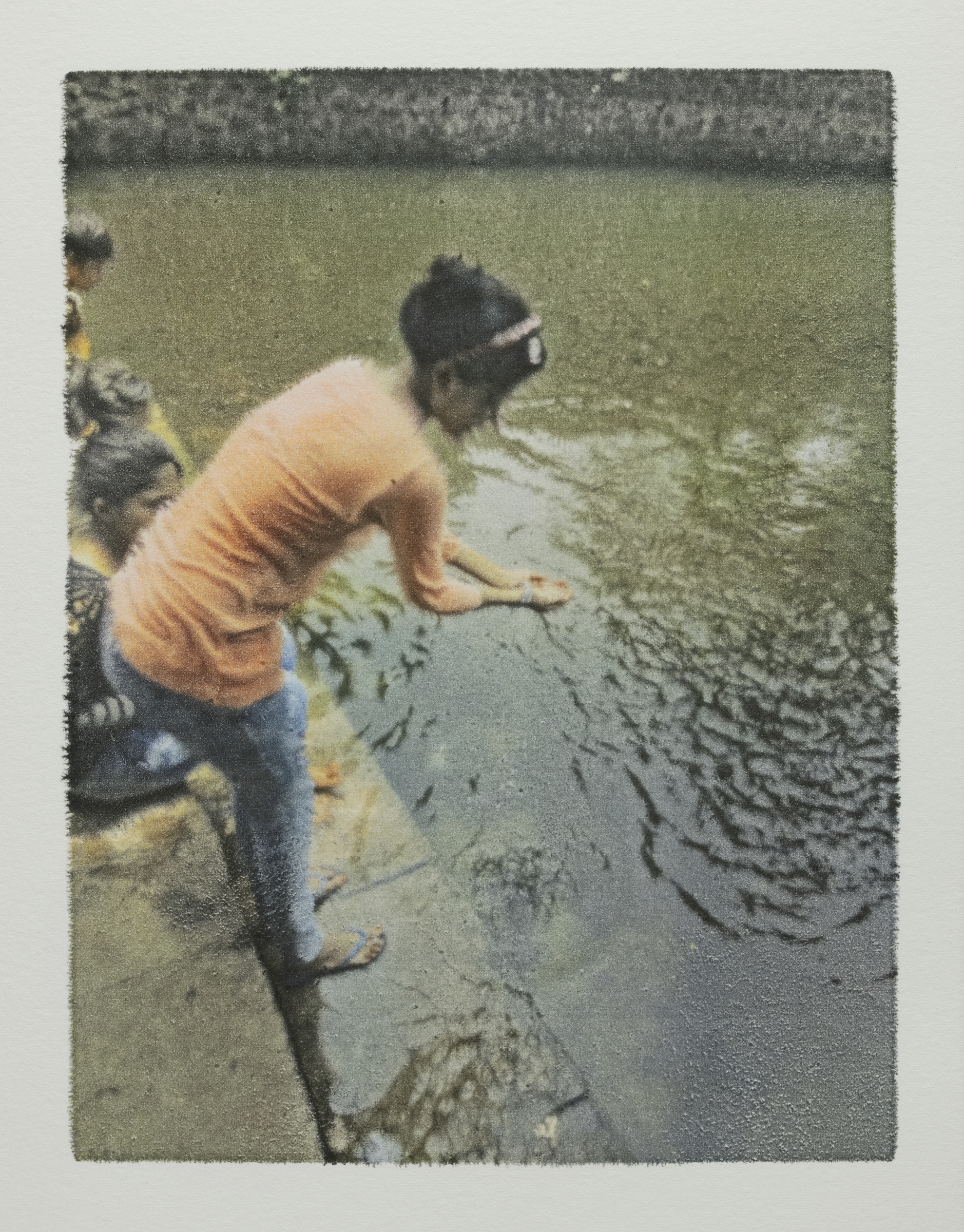
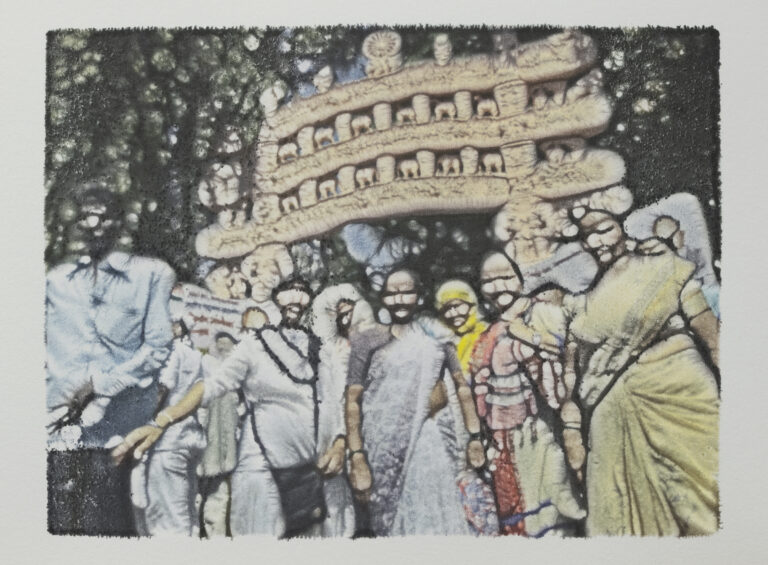
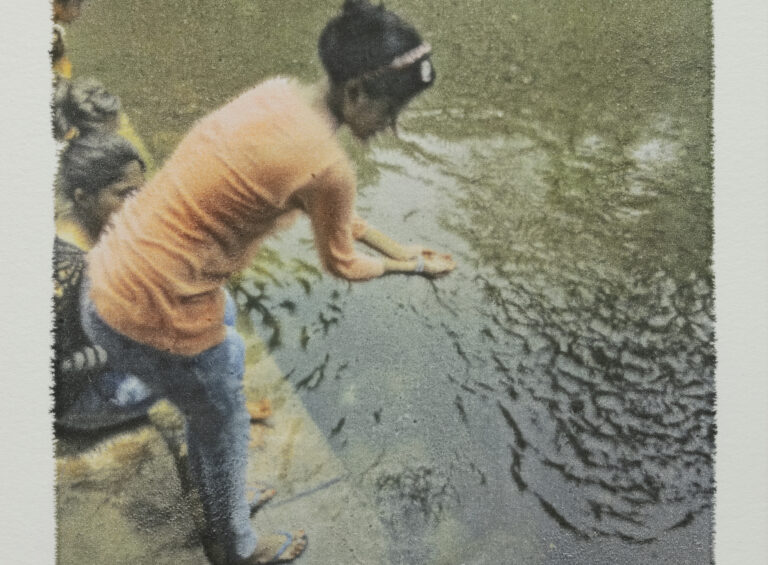
In Deeksha (figs. 7a–b), I printed photographs that I had taken of my family celebrating the anniversary of our conversion to Buddhism. In 1956, about six months before Ambedkar died, he converted to Buddhism. He said, “I may have been born a Hindu, but I won’t die one,” and along with him, many Dalit people converted. Our form of Buddhism is quite different as there’s no god, no worshipping of any Hindu deities, no superstition. Gods have controlled Dalit people for thousands of years. It is said that you’re born in this community because you were bad in your past life, so there’s no mobility outside of it unless your god decides differently. With Buddhism, you’re taught to learn to build dignity from within yourself. Now there’s a big resurgence of Buddhism, but if I tell people I’m Buddhist, they’ll know I’m Dalit. I don’t know how much of a difference it makes to others, but at least for us, for our own dignity, it does matter.
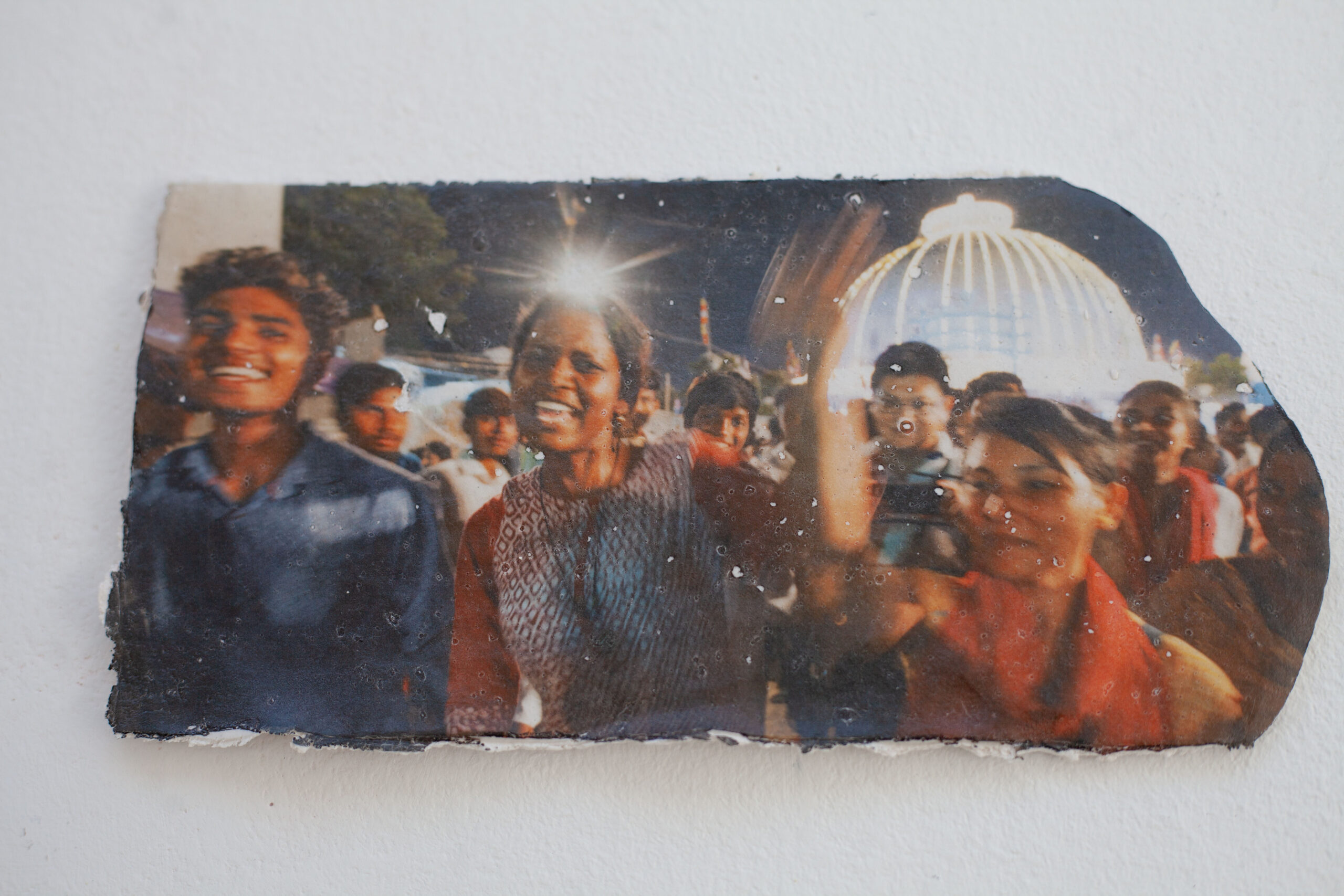
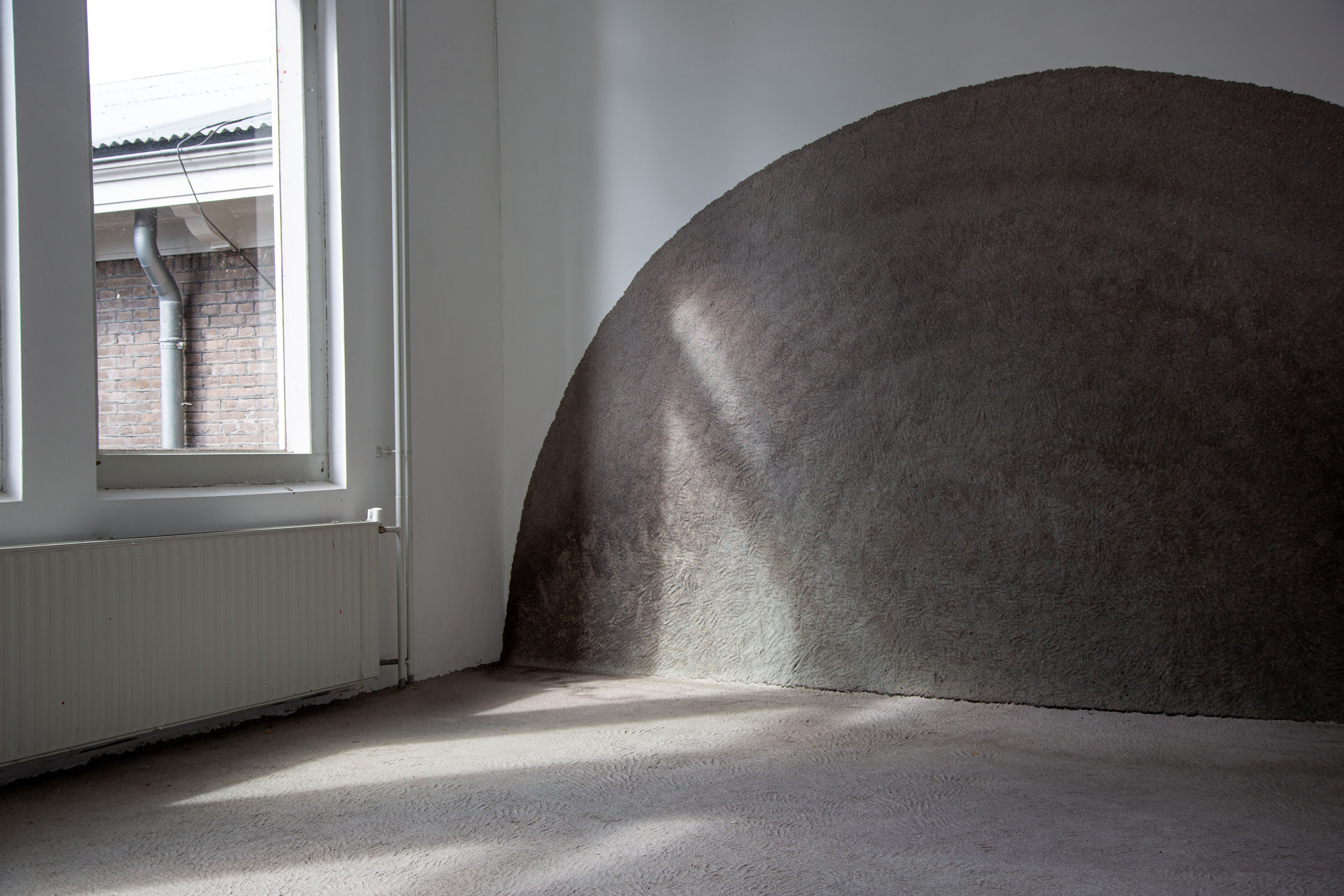
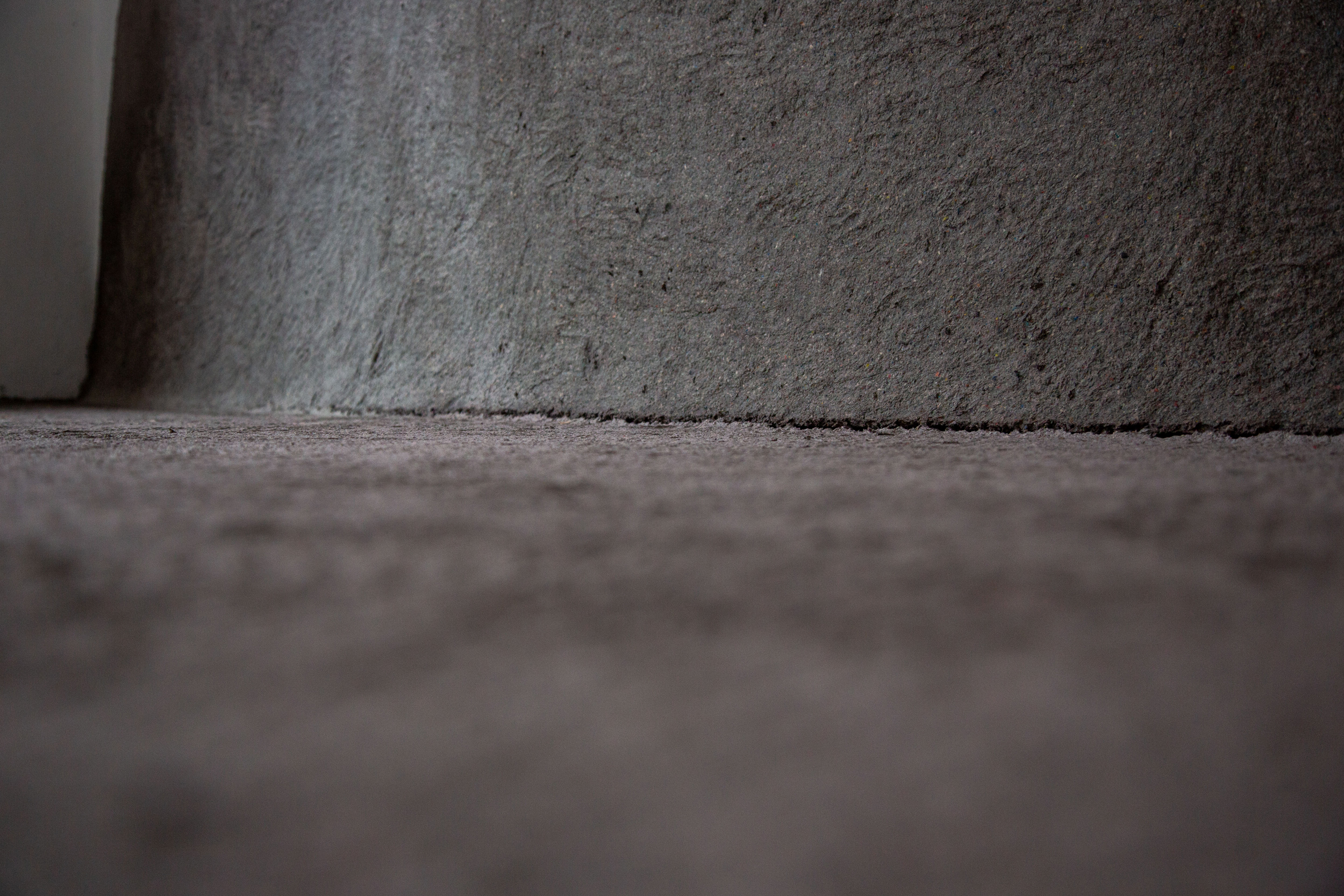
For Did you open the door, or did you find it open for you? (2023), I built a stupa with paper pulp from newsprint (figs. 8a–b). Ambedkar started many newspapers in his lifetime, so I was thinking about literacy, access to it, and the possibilities of it. The stupa has become quite an important architectural form. Whereas within Hinduism, we wouldn’t be allowed inside a temple, this conversion has allowed us to access and embrace ancient Buddhist sites that have been in the vicinity for thousands of years as a way of reconnecting—or connecting in the first place—with our new religion. We’re also building new stupas that are hollow inside to serve as meeting places. In Bombay and Pune, you often see white domed structures that are Dalit Buddhists spaces, and they’re occupying more and more parts of India. I built this stupa thinking about the past and the future.
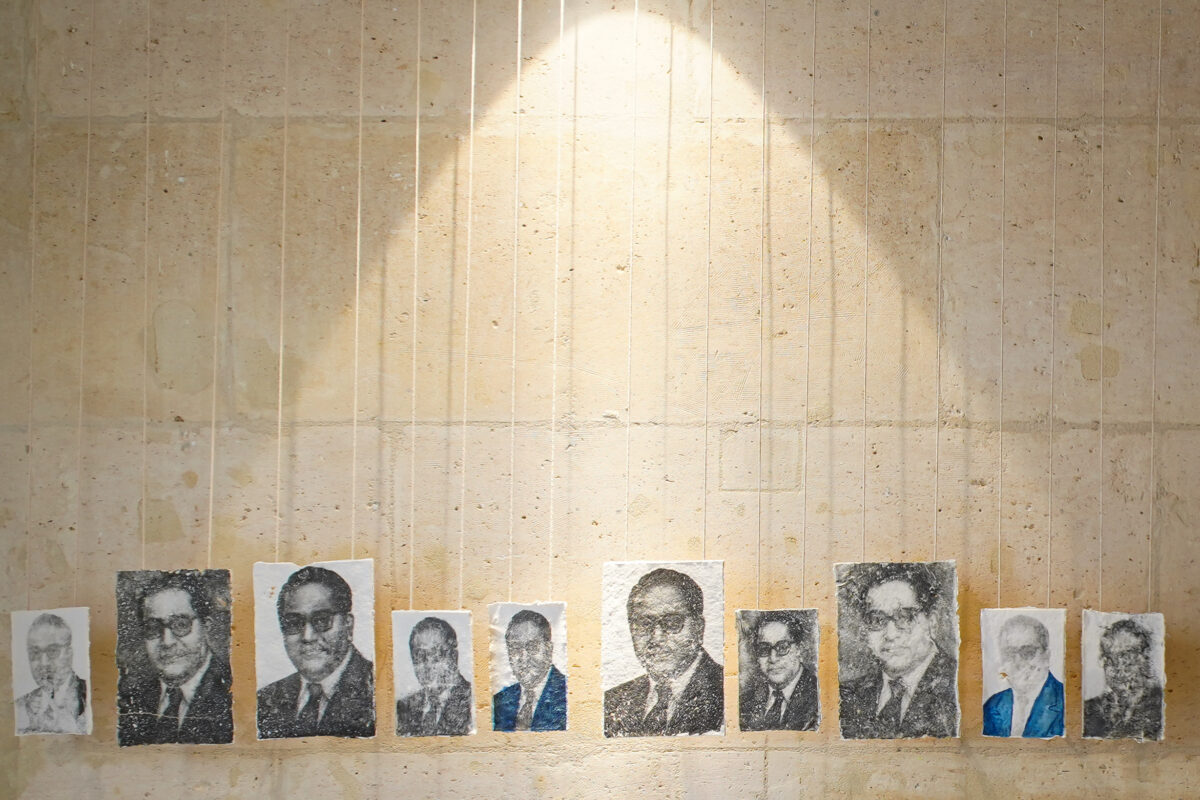
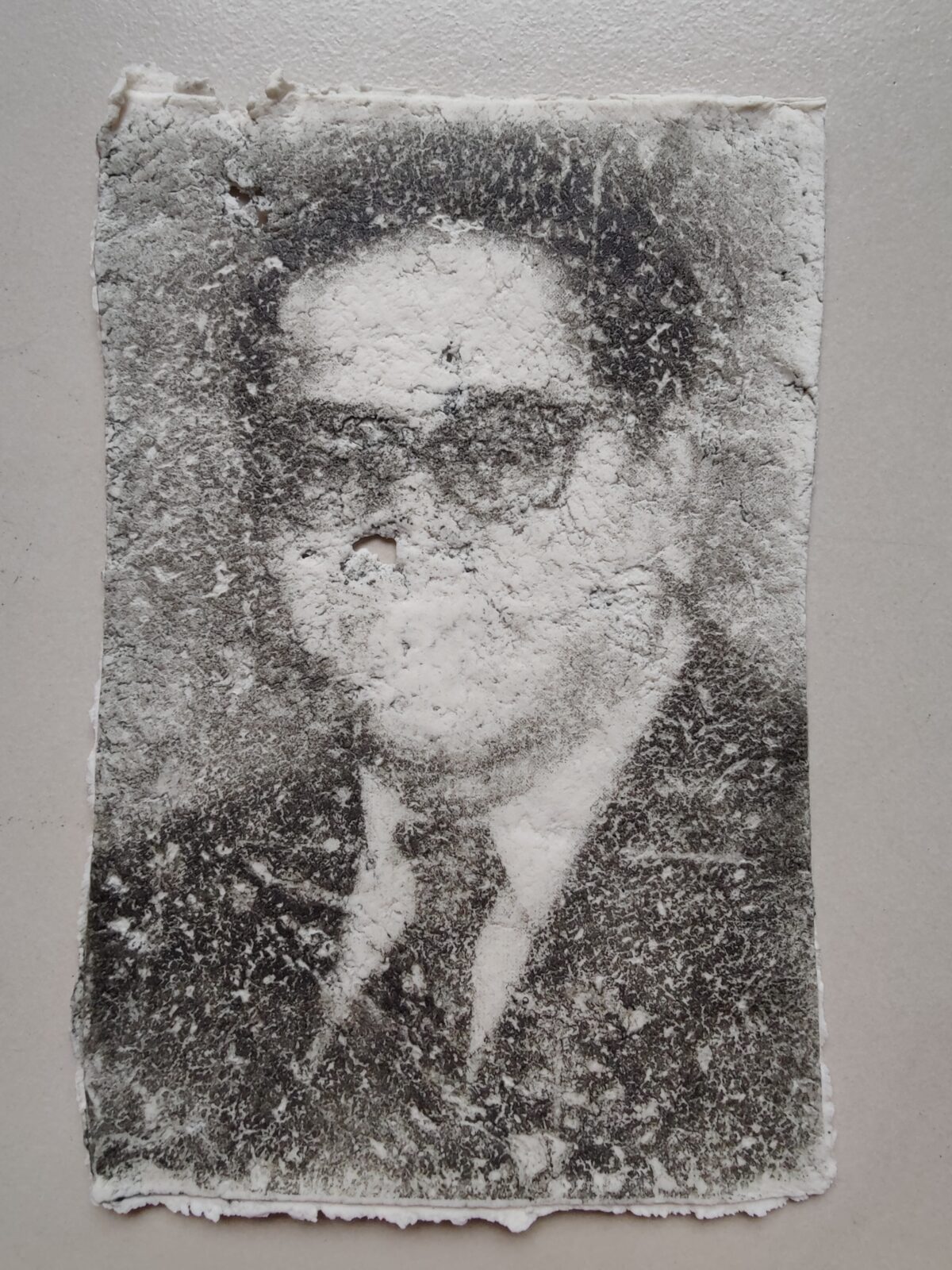
I started Give up your old habits in 2023 based on the image of Ambedkar (figs. 9a–b), and now I’m building a larger body of work around it. Ambedkar’s image is everywhere, across India—a man in a suit, tie, and glasses, often holding a book—and it’s an interesting relationship that we’ve built with it, because it’s one of pride. Yet it’s also a marker of where Dalit people live, which allows others to make judgments and assessments. In this body of work, I’m printing the same image of Ambedkar on porcelain, but as a silkscreen print, so when it’s on the wet clay, it becomes something else. Each one looks quite different but they all have hints of Ambedkar in them. I’m repeating them in the hundreds and thousands, so let’s see what happens with that.
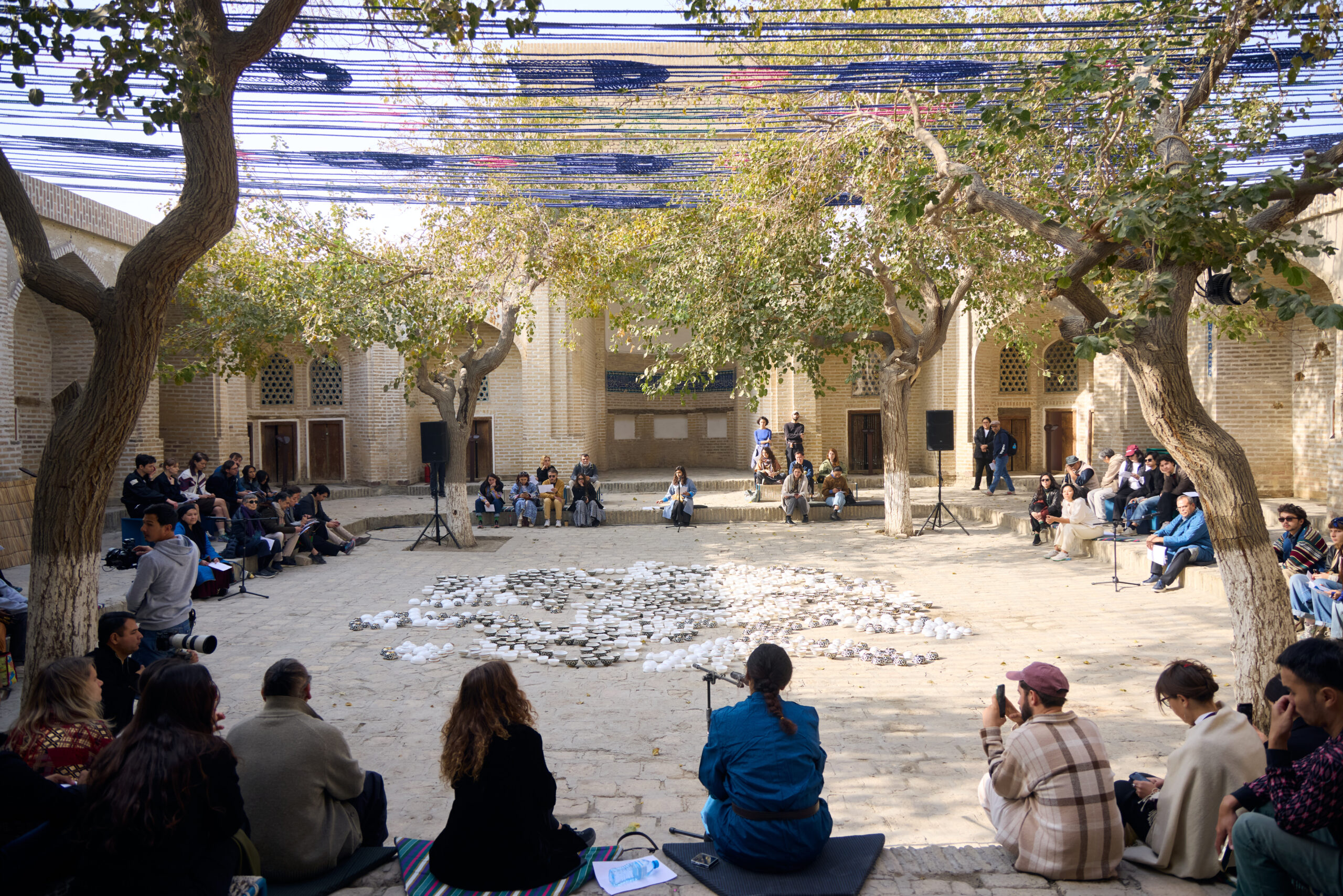
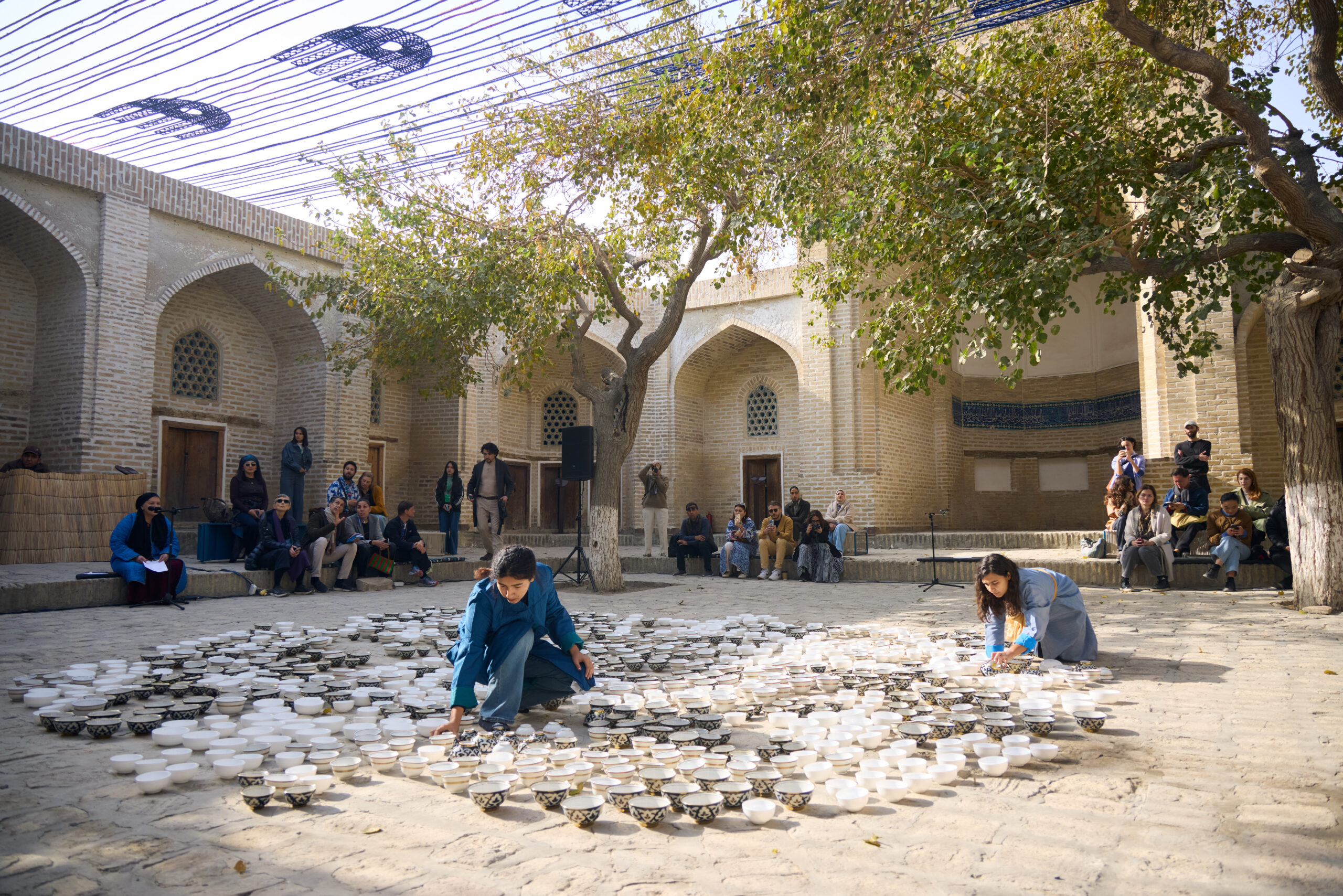
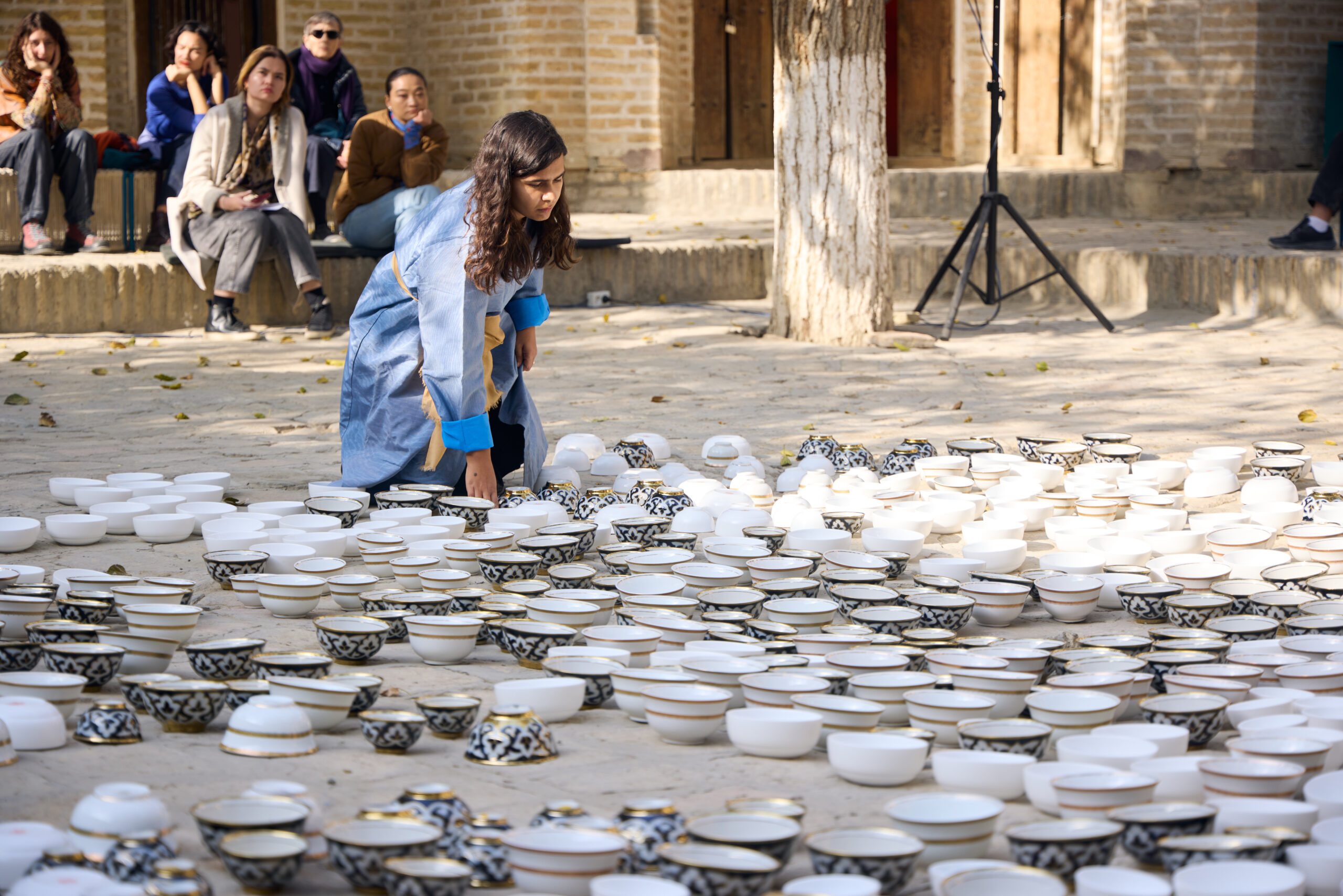
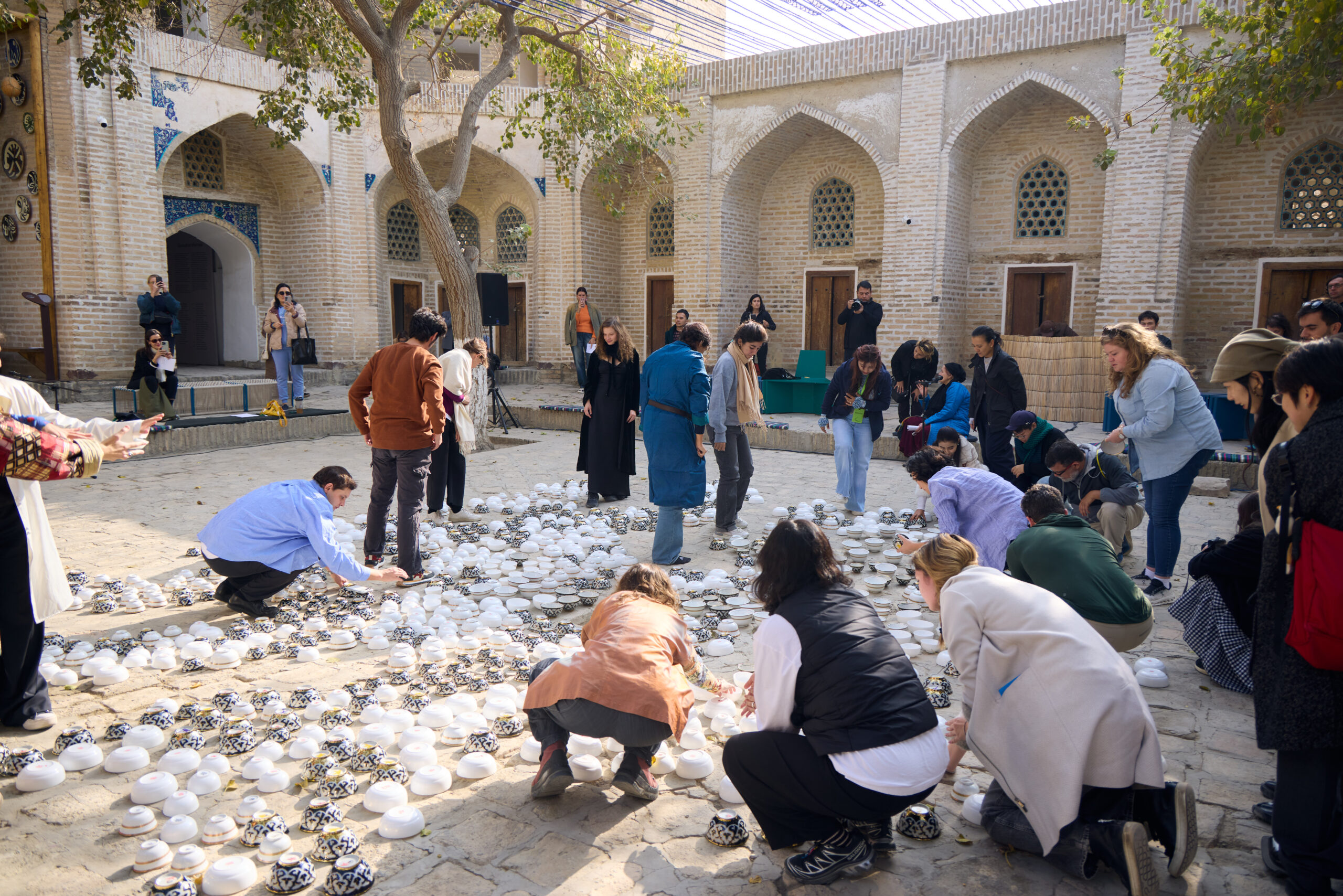
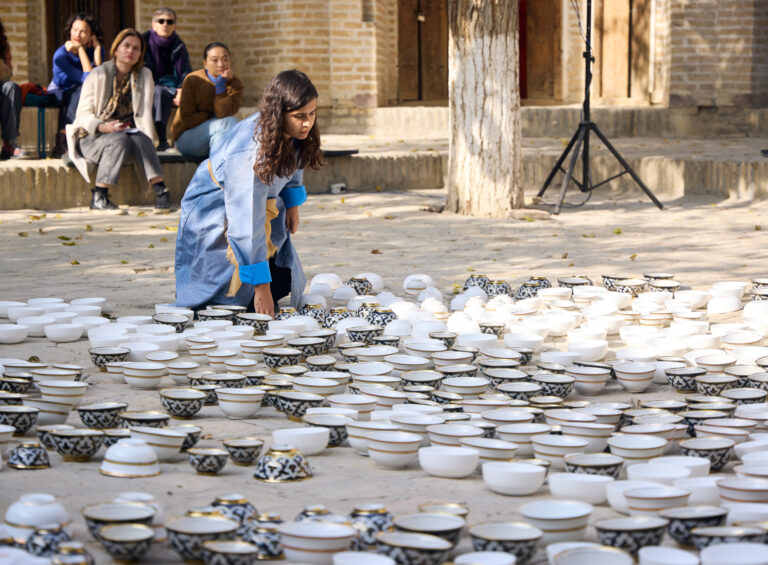
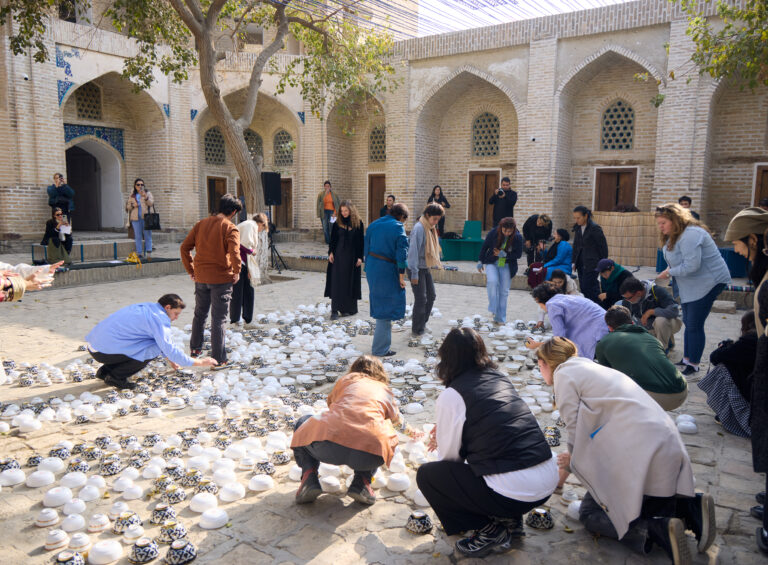
I’ve also been doing quite a few performances over the past years. Turn Your Bowl into a Stupa (figs. 10a–d) was in Bukhara. Essentially, it was 1,000 bowls that we turned upside down. I feel like this is a strong metaphor for Dalit Buddhism. There is a Tibetan story about when the Buddha was dying . . . His disciples asked him, “What do we do with your body when you die?” And he took his begging bowl and turned it upside down. Though nobody knows if it’s historically true and given Dalit people’s association with begging, with this embrace of a new religion—we’ve also taken the begging bowl and turned it upside down and said no to the past and rejected many things. The performance began with me reading out the recipes followed by turning the bowls upside down with three collaborators. I was very excited to perform this work in Bukhara because the name “Bukhara” stems from the word vihara, which means “Buddhist monastery” or “temple.”
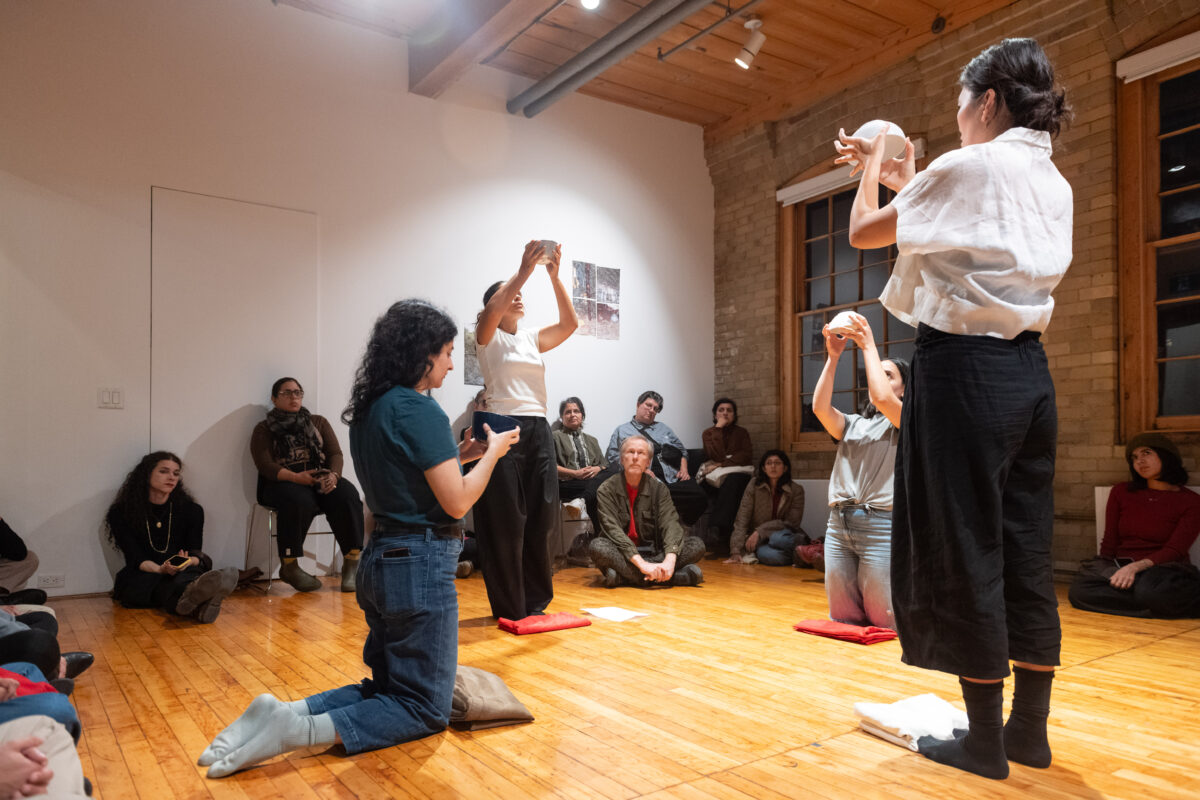
Everything is quiet now was a small performance that I did in Canada (fig. 11). It included four people and four bowls, which we slowly turned upside down. It started with a poem I had written about the Khairlanji massacre, a caste-based atrocity that took place 19 years ago, in which a whole family was brutally killed—and they still haven’t gotten justice. I was using the turning of the bowl as a way to slow down time and to think about this family. I’ve also been working with press photographs that were taken at the sites of this atrocity—at the hut that the Bhotmange family lived in, at the canal where their bodies were dumped. As horrible as it sounds, these photographs and even more violent ones have played a huge role in rallying the Dalit community to push for justice. It was also—as a 16-year-old—my first real encounter with what a Dalit atrocity looks like and with seeing the whole community come together in response to these photos. Though this is a strange way of spending time with them—they’re ink-jet prints, so I use a paintbrush and water to erase them, but they’re still there though certain bits are washed out.
AS: As a way of beginning our conversation within the context of this group, which is focused on the city and the theme of infrastructures, I was thinking about Pune and Maharashtra as larger infrastructures in your practice—from the neighborhoods where you’ve fabricated different elements of your practice to your involvement with the secular art movement started by Prabhakar Kamble, Clark House, histories of Dalit activism in the region, etc. Could you speak about this?
RG: It’s all connected. Because my parents are involved in social work, it’s not really been a choice to involve myself in these things. I think even if I wasn’t making art, they would still be an important part of my life. It has been quite special to be involved with the secular art movement, which is the art wing of a political movement in Maharashtra. And it was in spaces like Clark House, the Ajanta caves, and The Middle Way Retreat Centre in Kondanpur where these conversations were had and still continue. The last time we did a secular art movement workshop, we just wanted to get together and see each other’s practices—because we don’t often have opportunities or time or spaces for that—and to look at each other’s work, to listen to each other. Though there’s room for so much more. For example, it’s still very difficult to critique each other because if we’re seen critiquing each other even slightly publicly, then upper-caste artists or people in the art world will use that against us. They try to involve themselves in it and pit us one against the other. It’s quite exhausting. Unfortunately, we’re still seen as just Dalit artists by savarna people. I don’t think I’ll ever make work that’s not about caste, but there has to be space beyond that category. Also, if somebody doesn’t want to recognize the persistence of caste, they simply won’t. Labeling us this way makes it convenient for them to stereotype our practices, tick a box, and look away as fast as possible.
Lucy Gallun: Thinking about this idea of space-making and how it has come through in your practice across different approaches, media, techniques, etc. . . . You talked about writing being a place, and of literacy and disseminating writing being a history that you’re taking up in your work, but also, about the building of a stupa—of creating something that’s visible in communities—especially in Maharashtra. Could you speak about this idea of a practice of space-making and what it means to you?
RG: Many upper-caste dialogues center on the fact that there’s not enough information, or that people don’t see caste, or that they didn’t grow up practicing caste, etc. Even when I was looking for Dalit cookbooks, I couldn’t find them. But then I realized that it’s just a matter of shifting my perspective; perhaps they don’t exist in a conventional form, but they do exist nonetheless, and then I discovered there’s so much in Dalit literature. I think this is the case with space-making as well, and that my large-scale installations are a way for me to spend time in the spaces themselves, but also, to really think about the significance of these spaces. Whether it’s an ancient site or the Chavdar water tank, which in photographs looks like any other water tank, is important to me. They are both big and small omnipresent sites, and Dalit people recognize and remember them. Even though the white stupas are everywhere, it’s easy for upper-caste people not to pay attention to them in their day-to-day landscapes. For instance, I’m in Goa now, and while Goa is the neighboring state to Maharashtra, and Maharashtra has always had a visible Dalit presence—there are blue Buddhist flags and white stupas everywhere—Goa has considerably less of one. But I tell myself that I have to find out what and how this looks in Goa. I’m trying to train myself to look differently.
Ksenia Nouril: I’m struck by the materiality of your work—the breaking down, disintegrating, and bringing back together of paper pulp, your painting of photographs to dissolve them, etc. Could you talk about materiality in your practice?
RG: The materiality of my work is very important, if not the most important. Materiality, such as the texture of the paper, for example, allows me to move away from words, from writing, from that sort of language, and allows for a certain kind of infrastructure of invisible presence. The paper disintegrates, and while you can no longer read what is on it, it’s still there. I’m trying to figure out what that means and what to do with it. There’s a lot of hope with Dalit narratives, but there’s also one step forward, three steps back. A lot of the work that people are doing gets invisibilized. With materiality, it allows for that hesitation. While I can be more hopeful when I’m speaking, the materiality of the work allows for a sadness, a haziness, a blankness that paper or ceramic or the blurred photograph can communicate to the viewer better than I can.
Lanka Tattersall: Since Ananya mentioned you’re exhibiting in Venice, could you speak about what you’ll be up to there?
RG: Essentially, it was a grant to produce work that could be shared digitally and that would involve what my community means to me. There’s a Dalit girls’ hostel in Pune—close to where I live—and my parents have been involved with it for decades. I’ve also been visiting it since I was little. Most of the girls there come from villages around Maharashtra, and they’re there because their schools are extremely far from their homes—sometimes 20 kilometers away. Having to walk these distances to get to school would be incredibly difficult. I held workshops—on writing about food, about school, and on drawing their journeys to school, drawing what their schools looks like—and produced a booklet of 15 recipes and stories about finding food, stealing food, etc. The girls who participated were 13–14-year-olds, so their stories are more joyful than the ones I typically read, and I merged them with recipes that I created from female Dalit Maharashtrian writing—so they read as narratives from young girls, and time is again warped. Alongside it, the stories are also presented on video, where the girls read them out in Marathi and English.
LG: I was thinking about how you read us some of your recipes in English, and about the girls reading in Marathi and English, and to a previous session on the little magazine movement in Maharashtra that thought through the different ways that information is shared and what communities share through language, and I’m curious about how that has come up in your practice.
RG: Until last year I was quite adamant that everything I write had to be in English, even though I can read Marathi and Hindi and I’ve accessed many autobiographies via English translations from Tamil and Telugu. I don’t see English as a non-Indian language, and historically, we weren’t allowed to study pure Marathi or Sanskrit, so an English-language education was the way out and necessary for upward social mobility. English has been an important language of access. There’s no real nostalgia for Marathi, but at the same time, there is something to be said about things that are untranslatable. When I’m reading a Dalit autobiography in Marathi, it’s different from what it is in English. I don’t want to romanticize it, so I keep it in English, because if my audience can read English, then I don’t want to create a barrier to the work. But what I realized from the girls reading in Marathi and English is that even if the audience can’t understand Marathi, there is a generative pause in listening to another language. Again, the girls are studying English; they’re not fluent, but they wanted to read in English as much as they wanted to read in Marathi. If I had robbed them of reading in English, I would have made them feel like they weren’t good enough or that they shouldn’t have been studying English in the first place, so to have their voices in both languages was important.
AS: I have a question about reading as a practice in your looking at memoirs, autobiographies, and memory texts. These writers would have been among the first generation in their families to be educated. Could you speak about these primary sources and about the format of the recipe—what drew you to it, how you adapted some of the larger concerns of the texts into recipes, etc.
RG: I started with Maharashtrian Dalit writers because they were in my house. The Maharashtrian Dalit community also has an advantage, because Ambedkar was from this community, and it has been the force of his direct influence that has and continues to encourage the community to leave behind caste-based manual work, move to cities, and send their kids to school. A lot of the writers in this genre are male—though there are many female writers as well. But, if one was going to send their children to school for the very first time, it was often the sons who were sent. The realization that one could also send their daughters came later.
But with the recipes . . . they’re a ploy to get the audience to read the original book. I keep things simple and, in each booklet, I’ll only include six recipes—some short, some slightly longer—and then at the back of the booklet, it says that this has been adapted from “x” autobiography to invite the audience to read this literature. I wish it was not about that, but coming from this space of people not knowing where to start, I provide them with options. Also, as much as my family is involved in this work, it’s still difficult to have one-on-one conversations because there is a lot of shame involved. There are things that people just don’t want to talk about, and I respect that. Dalit writers have written down everything that they needed to, so I decided to see what they’ve written about and to bring it out in whatever way I can. It’s almost like preliminary research for having actual conversations with my own family and others in the future.
AS: It’s also a ploy for people who claim caste doesn’t exist . . .
RG: Yes. The act of opening a book and reading for oneself has allowed me to have more interesting conversations around caste, especially compared to my earlier works which were a little more on the nose, and elicited anger and questions such as why I’m showing work on caste if caste doesn’t exist. So sometimes opening a book, reading it, and trying to figure it out for oneself allows the audience to take it in differently.
This essay stems from the Contemporary and Modern Art Perspectives (C-MAP) Bombay/Mumbai initiative at MoMA. The 2024–2026 Bombay/Mumbai research program was conceived and organized by Ananya Sikand (C-MAP Bombay/Mumbai Fellow) and Lucy Gallun (Curator, The Robert B. Menschel Department of Photography). Read more about C-MAP here.
- 1This book is now available in English. See Shahu Patole, Dalit Kitchens of Marathwada, trans. Bhushan Korgaonkar (HarperCollins India, 2024). ↩︎
- 2Rajyashri Goody: Eat with Great Delight, curated by Skye Arundhati Thomas and Rosanna McLaughlin, Clark House Initiative, Mumbai, July 12–August 6, 2018. ↩︎
- 3The guidelines for Hindu law and social conduct are recorded in the Manusmriti (Laws of Manu). Codified between the 2nd century BCE and the 3rd century CE, this ancient text sanctions the caste system as well as gender-based segregation, untouchability, strict controls on literacy, etc. As Rajashri has noted in the past, many religious people regard the Manusmriti as their constitution, despite independent India having its own constitution whose primary architect was Ambedkar. ↩︎