Jaider Esbell: Fissures between Worlds
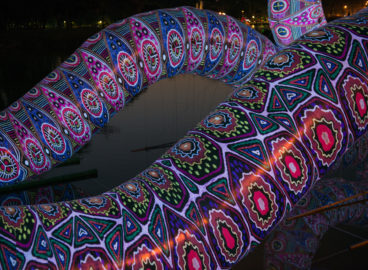
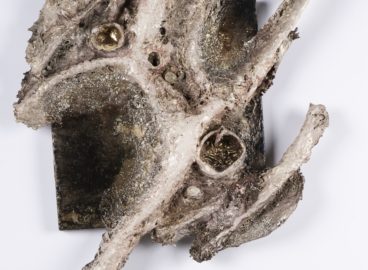
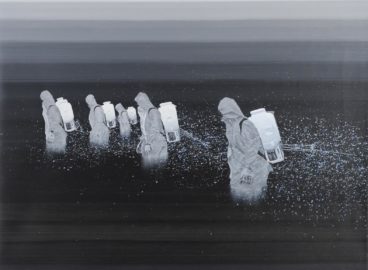
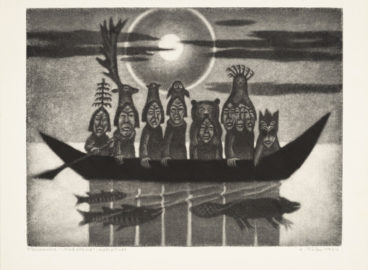
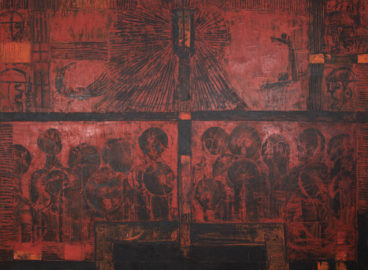
Madeline Murphy Turner analyzes recent artworks by the late Jaider Esbell, a pioneering artist, enabler, and advocate of Indigenous perspectives, environmentalism, and land rights.
By way of Men Taking Banana Beer to Bride by Night (1956), a painting featured in our “One Work, Many Voices” series, which focuses on individual artworks chosen from MoMA’s collection, art historian Gabriella Nugent highlights the role of memory in Ntiro’s practice. She argues that these memories are a product of distance and thus complicate the frameworks of art history.
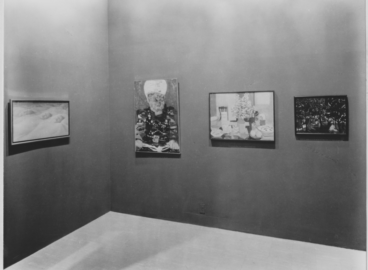
Zenta Logina (1908–1983) was a Latvian artist at work during the Soviet occupation. Her paintings, reliefs, and sculptural objects developed in a singular manner, as she broke away from the accepted framework of visual arts codified by the regime and crossed into the realm of contemporary art as we define it today.
Curator Veronika Molnár discusses questions of industrial agriculture, techno-optimism, and the fossil energy infrastructure with the artist Rita Süveges, also touching upon the pervasive role of the current right-wing political regime in Hungary’s contemporary art scene.
In this essay, cultural historian Linda Kaljundi revisits Estonian art of the late Soviet period. Looking at work from the 1970s and 1980s from an ecocritical and environmental perspective, she argues for the necessity of taking a comparative, transnational approach in order to reach beyond the Western centric understanding of environmental art histories.
C-MAP Africa fellow, Nancy Dantas, reads Mozambican modernist Bertina Lopes’s anticolonial trajectory and long-distance nationalism in ‘Tribute to Amílcar Cabral’ (1973).
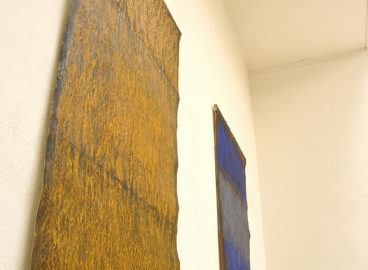
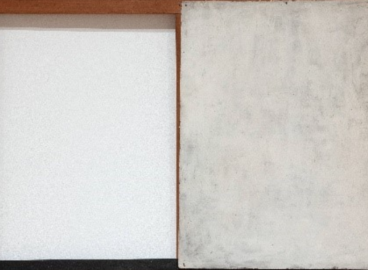
In 1964, Swiss-born Brazilian artist Mira Schendel (1919–1988) exposed the anatomy of a painting by stripping canvas from a stretcher. For this work, which she created that year while living in São Paulo, Schendel left only a few traces of canvas, which can still be found tangled in the tacks that originally fastened it to the wooden support.
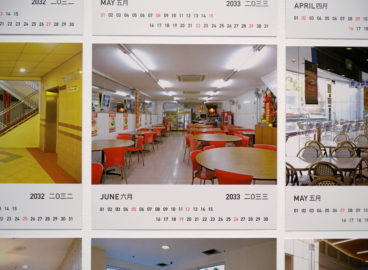
In her detailed analysis of Heman Chong’s nearly two-decade-long artistic practice, art historian and curator Kathleen Ditzig contextualizes the ways in which Chong has consistently and intently negotiated with cultural policy and national politics.
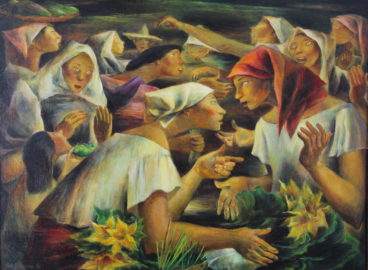
In an assiduous reading of Philippine modern artist Anita Magsaysay-Ho’s painting, In the Marketplace, art historian Chanon Kenji Praepipatmongkol discusses notions of gender, economic value, and spirituality.
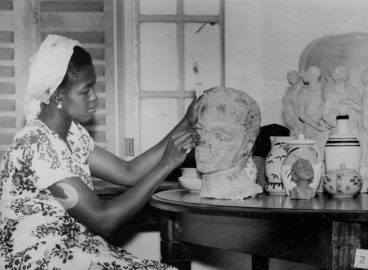
Refusing to fit into the mainstream art of her time, Gazbia Sirry replaced formal modernist training with local Egyptian art conventions to critically address women’s rights, patriarchy, social justice, and Western imperialism.
If landlessness is another condition that transforms Africans into wanderers, with nothing but their labor to sell for a pittance, then the genre of landscape painting in South Africa represents a space-time of possession and dispossession. Implicit in Gladys Mgudlandlu’s landscapes is a reminder of how the ownership of land has historically epitomized South African nationhood.
Estonian artist Sirje Runge’s (born 1950) visionary 1975 thesis project conceptualizes the dynamics between the needs of the individual and the overall logic and construction of the city space in late Soviet Estonia.