A Death Sentence Is a Precondition for More Life
Joshua Chambers-Letson extrapolates antinomies from Danh Vo’s Death Sentence, a work on paper in MoMA’s collection, in particular the coexistence of values related to life and death.
Joshua Chambers-Letson extrapolates antinomies from Danh Vo’s Death Sentence, a work on paper in MoMA’s collection, in particular the coexistence of values related to life and death.
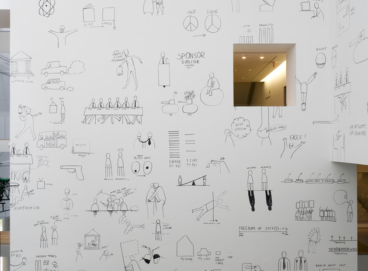
The first of its kind on post, this interactive commission sees artists S. Yi Yao Chao and Poklong Anading and curator Chương-Đài Võ responding to three archival collections at Asia Art Archive and, more broadly, approaches to artmaking in Southeast Asia.
This year’s C-MAP seminar series, Transversal Orientations, comprised four panels that took place on Zoom in June 2021. This essay reflects on Looking Sideways, the first panel in the seminar series featuring Sorawit Songsataya, Corina L. Apostol, and Ruth Simbao.
Hinged on the transversal as a means to engage with and envision new networks and ways of thinking about modern and contemporary art, the 2021 C-MAP seminar series offered an exploration and interrogation of the intertwining of multiple coeval life-worlds through concepts of “extending across.” Included here are abstracts and recordings of the four panels held on Zoom on June 2, 3, 9, and 10.
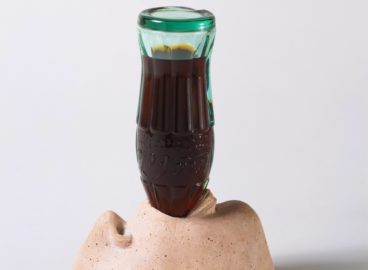
This text brings together Marisol’s sculpture Love and Frank O’Hara’s poem “Having a Coke with You” to explore their shared investigations of the personal in a capitalistic landscape, queer eroticism, global Cold War politics, and stoppered versus flowing communication.
In the spirit of collectivity despite geographical distance, post invited contributions to create a “collective poem” based on the 1981 project Poema Colectivo Revolución by the artists’ group Colectivo 3.
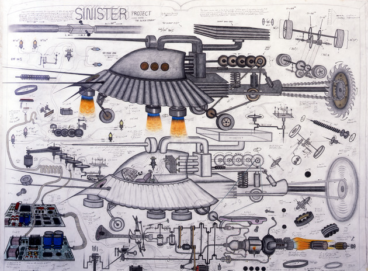
Responding with imagination to the brutality and violence of Sierra Leone’s civil war (1991-2002), Abu Bakarr Mansaray’s monumental drawing Sinister Project depicts a fictitious war machine with careful detail that reveals the artist’s background in science and engineering.
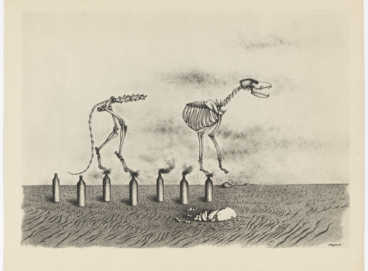
As the only woman artist in the 1920s avant-garde group Devětsil and an important figure in both Czech and French Surrealism, Toyen produced a significant body of work in painting, drawing, printmaking, and collage.
A major new publication, Art and Theory of Post-1989 Central and Eastern Europe: A Critical Anthology, presents key voices of this period that have been reevaluating the significance of the socialist legacy, making it an indispensable read on modern and contemporary art and theory. The following dialogue belongs to a series of conversations between artists and members of the C-MAP research group for Central and Eastern Europe at MoMA.
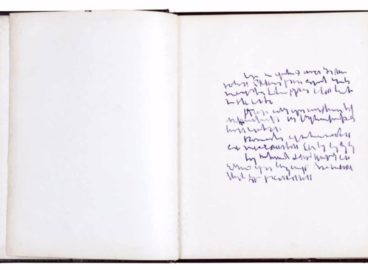
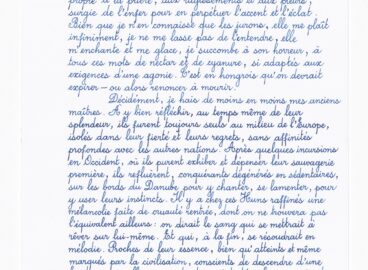
Fernando Bruno analyzes the particular relationship between painting and writing in the work of Argentine artist Mirtha Dermisache, examining the specific ways in which it contrasts with some of the most significant artistic tendencies at the end of the sixties and seventies in Argentina.
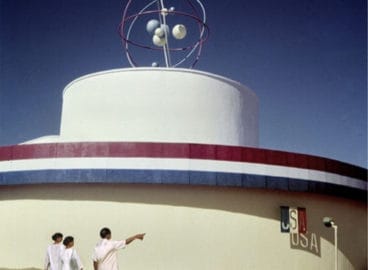
Shi Lu’s 1955 trip to India to oversee the design of the Chinese Pavilion at the Indian Industries Fair and his 1956 trip to Egypt for the Afro-Asian Art Conference offer a lens for understanding the PRC’s outreach and artistic diplomacy in the Cold War era.
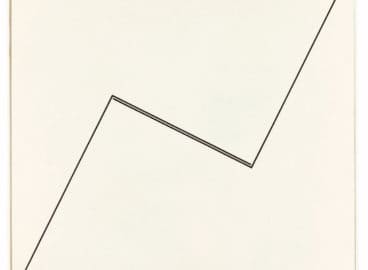
Twelve ink drawings by Hércules Barsotti explore a radical geometry and a systematic mode of working that, already in 1960, point to a new mode of working for the Brazilian artist.