Texts by Conceptual Artists from Eastern Europe: Slovakia
This series presents newly translated texts from the 1970s by Conceptual artists from Poland, Hungary, and Slovakia.
Juan Acha highlights the role of the artistic avant-garde in the achievement of a “cultural revolution,” or the awakening of a revolutionary spirit against the values of the bourgeoisie and the socio-economic and political structures established in the Third World.
The interview with Zarina considers the artist’s life and work as a bridge between New Delhi and New York.
Experimenting with ideas of disruption, participation, community, and institutional critique, Argentine artist Marta Minujín blindfolded and “kidnapped” fifteen audience members as part of Kidnappening.
Going beyond the context of modern Brazil and its experimental art scene, this essay traces a wide genealogy for his body of work, from local traditions such as samba to European intellectual figures such as Friedrich Nietzsche.
This series presents newly translated texts from the 1970s by Conceptual artists from Poland, Hungary, and Slovakia.
In the mid-1960s, Brazilian artist Lygia Clark turned from painting and sculpture to make participatory “proposições” (propositions). In the 1970s, she started “corpo coletivo” (collective body) experiments.
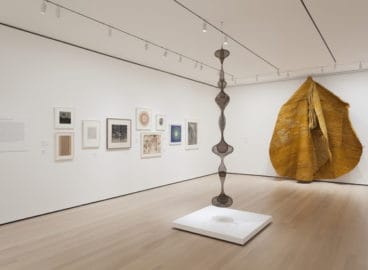
Yellow Abakan and Pregnant by Magdalena Abakanowicz engage with a diverse range of materials that address the limitations of working as a female sculptor under state socialism.
In the mid-1960s, Brazilian artist Lygia Clark turned from painting and sculpture to make participatory “proposições” (propositions). In the 1970s, she started “corpo coletivo” (collective body) experiments.
This essay considers Robert Rauschenberg’s 1975 residency in Ahmedabad, India, which fostered an environment of exchange and collaboration between Rauschenberg and the Sarabhai family.
Despite protests and petitions from leading architects and architectural historians across the world, the Hall of Nations was surreptitiously demolished overnight on April 23-24, 2017. In this essay, Stierli bids farewell to architect Raj Rewal’s iconic building—a hallmark of modernist architecture in post-independence India.
At the age of sixty-seven, Polish artist Zofia Rydet began her photographic series Sociological Record in an effort to document Polish individuals in their private and deeply personal spaces.