Texts by Conceptual Artists from Eastern Europe: Hungary
This series presents newly translated texts from the 1970s by Conceptual artists from Poland, Hungary, and Slovakia.
This series presents newly translated texts from the 1970s by Conceptual artists from Poland, Hungary, and Slovakia.
As part of an ongoing collaboration between the Jaipur Literature Festival and MoMA, this post Presents discussion “Patriot Games: Contextualizing Nationalism” explores nationalism around the world, with panelists Urvashi Butalia, Bouchra Khalili, Bruce Robbins, Eyal Weizman, and moderator Marie Brenner.
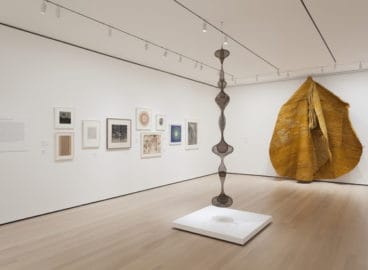
Yellow Abakan and Pregnant by Magdalena Abakanowicz engage with a diverse range of materials that address the limitations of working as a female sculptor under state socialism.
Michelle Elligott, Chief of Archives, Library, and Research Collections at MoMA, speaks with Maciej Cholewiński, Archivist at Muzeum Sztuki in Łodz (MSŁ).
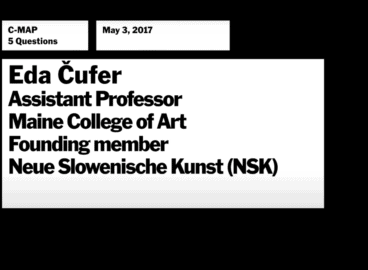
Eda Čufer, art historian and member of the art collective Neue Slowenische Kunst (NSK), sheds light on the challenges in negotiating between canonical art histories and local specificities in Eastern Europe, specifically in the countries of former Yugoslavia.
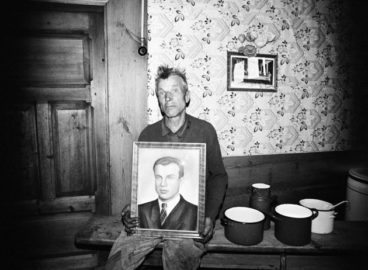
At the age of sixty-seven, Polish artist Zofia Rydet began her photographic series Sociological Record in an effort to document Polish individuals in their private and deeply personal spaces.
The roundtable discussion focuses on international networks that decenter, complicate, or even bypass Western-centric models.
Art historian Anthony Gardner reminds us to think of art historical categories as broad and flexible, and identifies exhibition histories in the former Yugoslavia, as a rich area of interest.
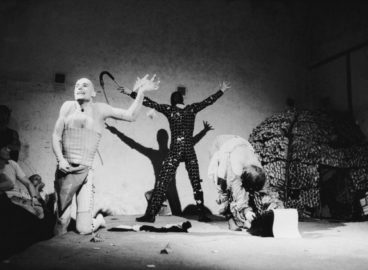
From action painting to free-form music concerts, East German performance art establishes itself in the GDR’s final decade.
During 2016 and 2017, more than 80 scholars, artists, and curators visited MoMA as C-MAP guests. n conjunction with the 5 Questions interview series, we asked them a sixth question: How can MoMA better approach international artistic production and exchange?
Art historian April Eisman looks at art produced in the German Democratic Republic (GDR) from the context of multiple canons.
Over a dozen members of the C-MAP Central and Eastern European group traveled for research to Moscow in March 2017. As Roxana Marcoci, Senior Curator of Photography, notes, Russia spans eleven time zones and includes two-hundred nationalities. From this vast and deeply complex nation, the participants report on their impressions below. Reflection by Ksenia Nouril, C-MAP Central…