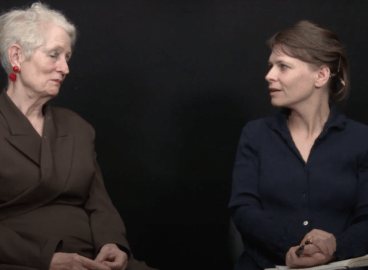
Sudhir Patwardhan in Conversation with Prajna Desai
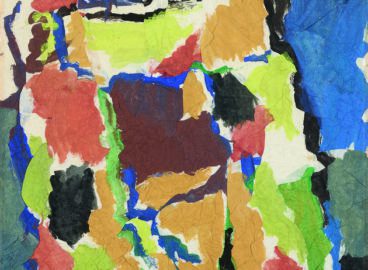
The Indian artist Sudhir Patwardhan is chiefly a painter in the realist tradition moving between images of the city, inhabitants, and milieu.
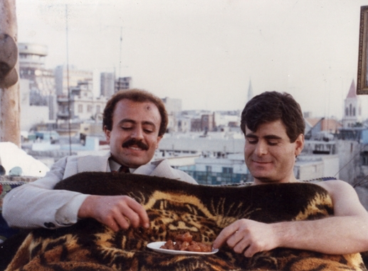
In this sardonic text, acclaimed Syrian filmmaker Ossama Mohammed bitingly describes the conditions of filmmaking under the Ba’athist regime in Syria. Under strict control of the National Film Association that was founded in 1963, only one film was produced every year in the country.
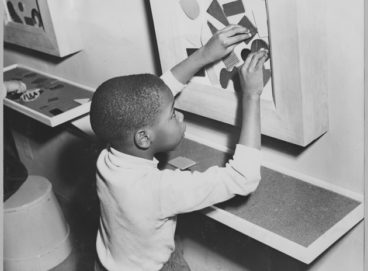
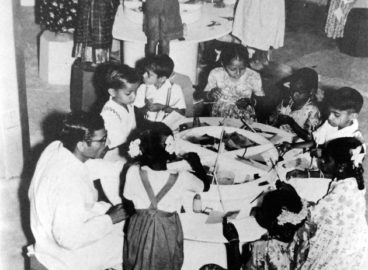
This text is a reimagined transcription of a series of conversations between Prabha Sahasrabudhe and Indira Gandhi that took place in 1960 at the Westbury Hotel in New York City.The reason for their meetings was to discuss bringing an adaptation of MoMA’s Children’s Art Carnival to India.
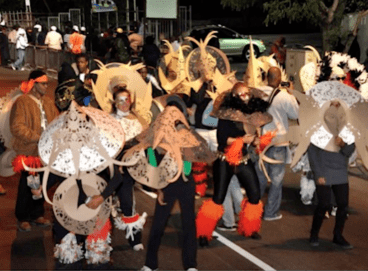
Branislav Jakovljević, Claire Tancons, and Anoma Pieris consider how concepts related to self-representation and performativity not only generate sites of resistance, but also recast our perspective on established discourses of the national, ethnic, diasporic, and racial.
Mulk Raj Anand is perhaps best remembered as a cultural critic, writer, philosopher, and patron of the arts. But Rashmi Viswanathan turns her attention to his lesser known initiative to establish India’s First Triennale of Contemporary World Art in 1968. This essay explores Anand’s optimistic use of the triennale to shift international cultural relations and…
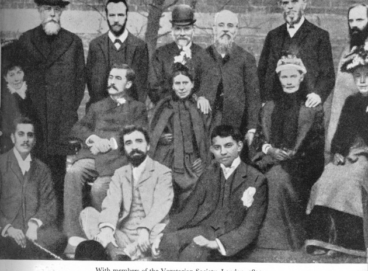
Riyaz Tayyibji considers the little-known architectural collaborations of Mahatma Gandhi, charismatic leader of the Indian freedom movement, in light of discourses of modern architecture. Weaving in discussions of phenomenology, material, and a discipline of privacy, the essay explores aspects of Gandhi’s philosophical and political thinking that propose a notion of the modern with an ethical and spiritual underpinning for 20th century architectural practice.
Cultural theorist Mieke Bal discusses her writing devoted to Nalini Malani’s Shadow Plays, multi-dimensional artworks that draw from different cinematic technologies and disparate repositories of images.
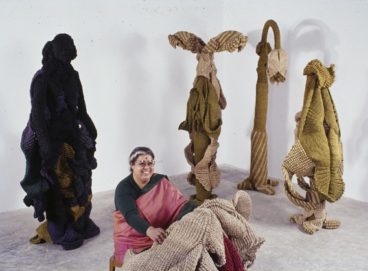
Cara Manes on Sheela Gowda’s complex and multidisciplinary practice.
Lyn Hsieh reflects on education strategies she encountered during the C-MAP Asia group trip to India and Bangladesh in January 2018.
“Where do our arts stand with regard to the consciousness that is blossoming in the Arab nation?” This question was posed in 1956 in a questionnaire on “Art and Arab Life” that was circulated to artists in Lebanon, Iraq, Egypt, and Syria in a special issue devoted to the arts of the Arab world of the Beirut-based, pan-Arab journal al-Adab, which was established in 1953 as an outlet for politically engaged thought and cultural analysis.
The Kochi-Muziris Biennale has produced three exhibitions since its inception in 2012, with its fourth edition opening in December 2018. This essay sites the biennale within the historical context of the twin port cities of Kochi and Muziris, as well as within the recent burgeoning of the biennial as a international format for viewing “global” art and representing local identities.
The recent documentary “Reading Architecture” (2017) explores the contemporary history of design in India across five practices in Mumbai. Sameep Padora, one of five featured architects, is the founder of Sameep Padora & Associates (sP+a), a Mumbai (India) based architecture studio. In 2016, he initiated sPare, a research arm of the studio.