Part 1: “Art Has No Borders”: Rauschenberg Overseas Culture Interchange
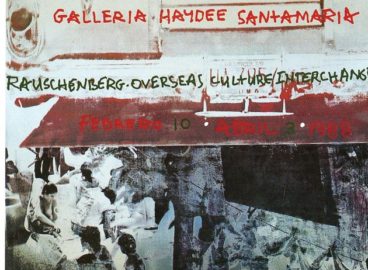
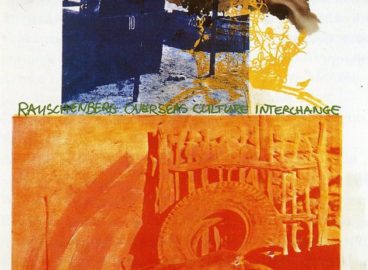
The Rauschenberg Overseas Cultural Initiative was a large-scale international traveling exhibition that doubled as a cultural exchange program.
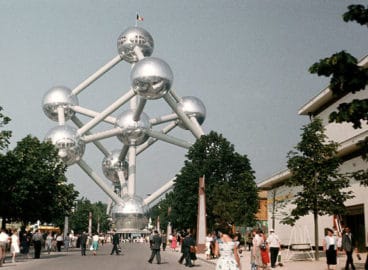
When the Brussels Expo presented the exhibition Fifty Years of Modern Art in 1958, it unintentionally pioneered a more broadly global view of modern art, although not without some friction.
As part of an ongoing collaboration between the Jaipur Literature Festival and MoMA, this post Presents discussion “Patriot Games: Contextualizing Nationalism” explores nationalism around the world, with panelists Urvashi Butalia, Bouchra Khalili, Bruce Robbins, Eyal Weizman, and moderator Marie Brenner.
Shi Lu’s 1955 trip to India to oversee the design of the Chinese Pavilion at the Indian Industries Fair and his 1956 trip to Egypt for the Afro-Asian Art Conference offer a lens for understanding the PRC’s outreach and artistic diplomacy in the Cold War era.
As the Guggenheim prepared to open its exhibition Art and China after 1989: Theater of the World on October 6, 2017, post collaborated with the Guggenheim’s Checklist blog to reflect on works by Yang Fudong and Zhang Peili, two important contemporary artists from China.
This essay considers Robert Rauschenberg’s 1975 residency in Ahmedabad, India, which fostered an environment of exchange and collaboration between Rauschenberg and the Sarabhai family.
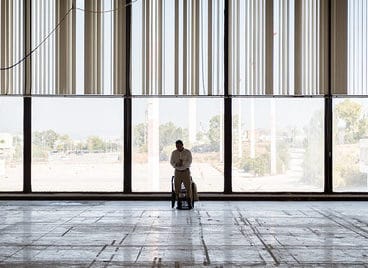
Despite protests and petitions from leading architects and architectural historians across the world, the Hall of Nations was surreptitiously demolished overnight on April 23-24, 2017. In this essay, Stierli bids farewell to architect Raj Rewal’s iconic building—a hallmark of modernist architecture in post-independence India.
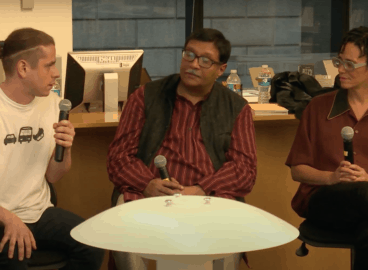
The roundtable discussion focuses on international networks that decenter, complicate, or even bypass Western-centric models.
Film curator La Frances Hui attended the International Film Festival of Kerala and follows up with this discussion of the award-winning Malayalam feature Sexy Durga by Sanal Kumar Sasidharan.
Art historian Emilia Terracciano examines the possibility of developing and de-colonizing narrative tools for the writing of (Indian) art history.
During 2016 and 2017, more than 80 scholars, artists, and curators visited MoMA as C-MAP guests. n conjunction with the 5 Questions interview series, we asked them a sixth question: How can MoMA better approach international artistic production and exchange?
Art historian April Eisman looks at art produced in the German Democratic Republic (GDR) from the context of multiple canons.