This essay reflects on my two encounters with historical records: a trip to West Papua to visit the grave of Arnold Clemens Ap and the Biak Water Tower, and a reading of Moelyono’s archive on the Wonorejo Dam project in East Java. Although these encounters occurred in different places and emerge from distinct historical conditions, both were shaped by the legacies of the New Order (1966–1998), a policy implemented under Suharto (1921–2008). Suharto’s 32-year-long repressive authoritarian regime suppressed cultural diversity through ideological uniformity and mobilization of development that often ignored the rights of Indigenous peoples. The combination of pressure on civil society and the 1998 economic crisis triggered its downfall in May 1998.
By bringing West Papua and the issues around the Wonorejo Dam into conversation, this essay argues that encounters with so-called archives often occur through traces, silences, and afterlives, revealing how the New Order and its historical legacies continue to be remembered and contested. Together, these encounters challenge conventional understandings of archives, recasting them as relational formations produced through memory, social networks, traces of events, and struggles over historical representation.
Graves
In August 2022, I sat on the back of a motorbike driven by my friend Terry. He wanted to show me a place that mattered. As we moved through contemporary Jayapura, I imagined a web of people, footpaths, and realities that connected the region to the present, but the histories I was trying to understand remained layered beneath the land.
I had arrived in Papua with an intention: to learn about artistic practices in the region. I expected to encounter artists’ studios, exhibitions, and collections. When Terry finally stopped the motorbike, I found myself visiting graves instead.
There is a thought that continues to haunt me: I was confronted with the reality that to learn the history of artistic practices in West Papua is to begin with grief—to learn how someone died, why they died, and what forms of cultural expression were deemed dangerous enough to be suppressed.
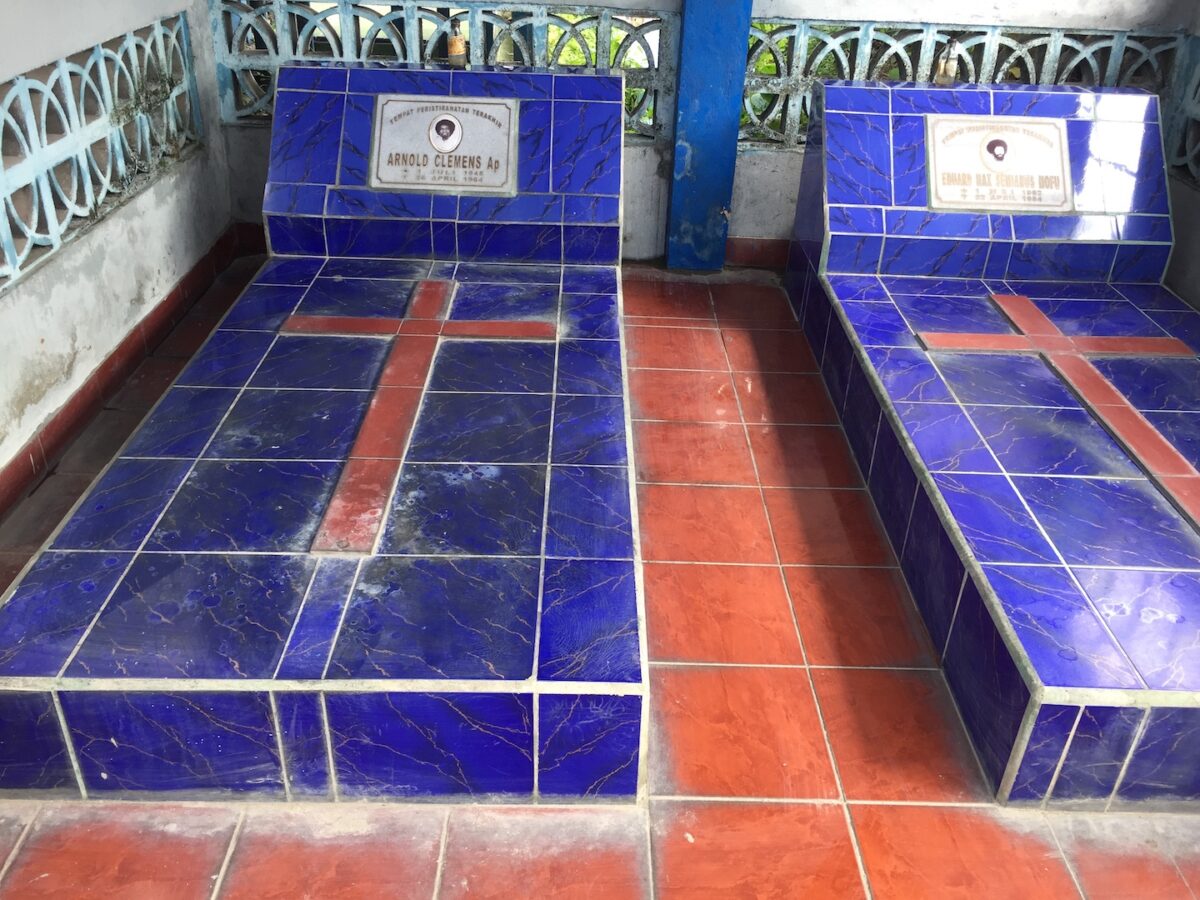
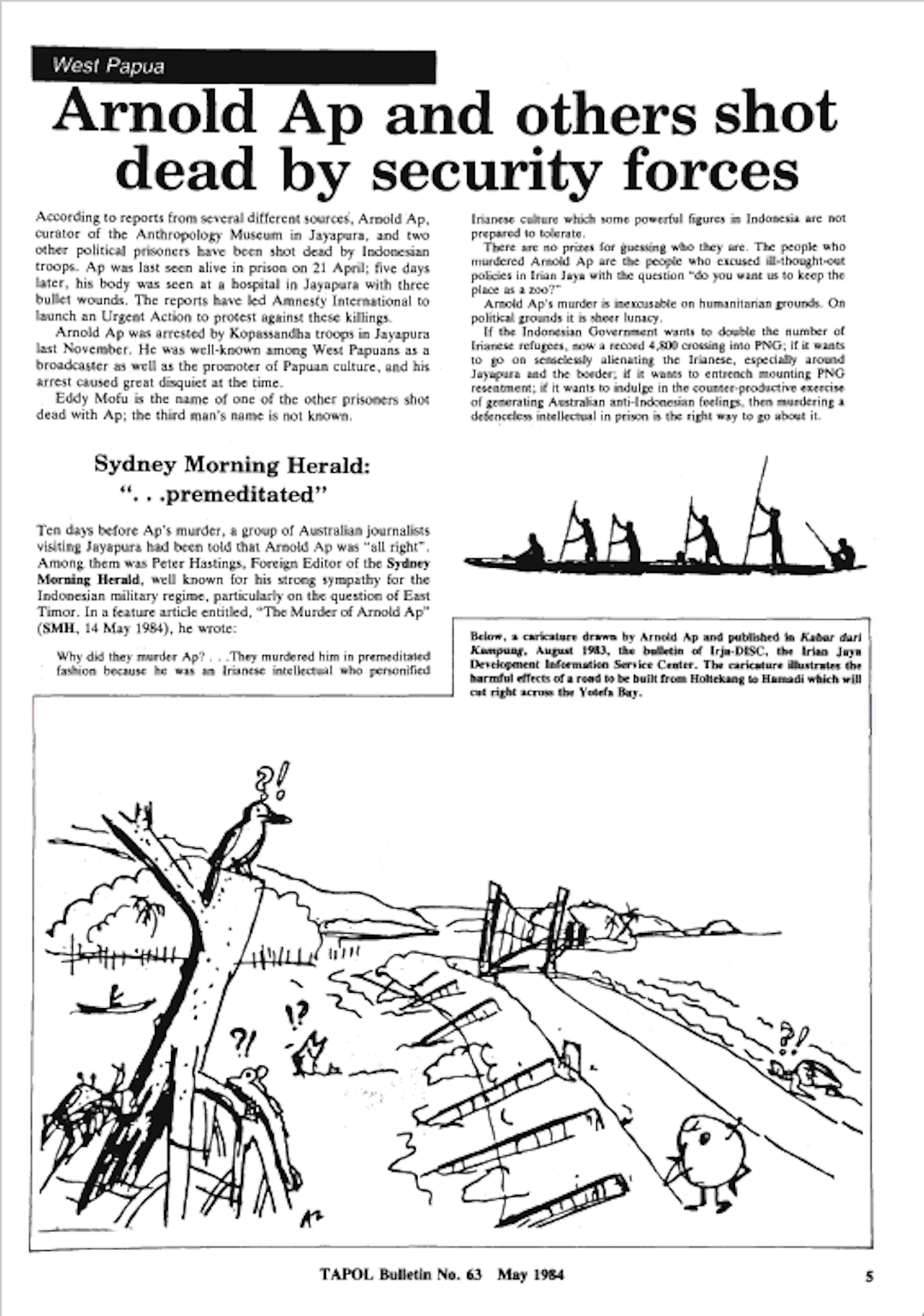
The story repeatedly returns to Arnold Clemens Ap (figs. 1, 2).
Control over aesthetics under Suharto was extended to West Papua. The New Order could accommodate cultural differences as long as they remained displayed within the framework determined by the state. Artistic practices that generated critical consciousness, however, were not celebrated but instead disciplined. Papua experienced one of the most acute manifestations of this censure.
As Chabib Duta Hapsoro argues in his analysis of the design collective Decenta, the New Order’s cultural policy did not simply repress artistic expression, it actively produced a state-sanctioned aesthetic of “Indonesianness.”1Through commissioned work such as public monuments, architectural ornamentation, and aesthetic elements, variety and patterns from ethnic Indonesian were incorporated into a national narrative as decorative markers of national unity, detached from the political realities, historical conflicts, and power relations that shaped them. Chabib Duta Hapsoro suggests that this cultural regime functioned as a form of depoliticization. See Hapsoro, “Identitas Keindonesiaan dalam Elemen-elemen Estetik Kelompok Decenta: Representasi Praktik Depolitisasi Orde Baru dalam Bidang Kebudayaan[i],” June 29, 2015, https://chaduha.wordpress.com/2015/06/29/identitas-keindonesiaan-dalam-elemen-elemen-estetik-kelompok-decenta-representasi-praktik-depolitisasi-orde-baru-dalam-bidang-kebudayaani/. It was precisely this tension that defined Arnold Clemens Ap’s work.
Arnold Clemens Ap, a Papuan anthropologist and cultural leader, was assassinated by the Indonesian Kopassus (Komando Pasukan Khusus, or Special Forces Commando) in 1984 for his artistic expressions through Mambesak, a music group he founded with Sam Kapisa, Eddy Mofu, Yoel Kafiar, and Martiny Sawaki.
The group celebrated Papuan folk arts rooted in everyday life, reviving local songs and dances with a distinct Papuan accent and articulating key elements of Papuan cultural identity. By enabling Papuans to hear themselves, represent themselves, and recognize themselves, Ap transformed preservation into a form of cultural self-determination. The state’s response reveals the limits of New Order multiculturalism: Papuan culture could be celebrated as “tradition” but deemed dangerous when it spoke in its true voice.
I carried a rather modernist expectation of how history should be encountered. I imagined spending days in a room, reading and tracing references through neatly organized collections. I assumed I would find evidence preserved in archives and institutional repositories.
The lack of archives is not simply an archival problem. It is a political condition. Decades of militarization, censorship, and restricted access to information have produced profound gaps in the historical record. In West Papua, this has meant one thing: The people make their own documentation, and it frequently functions as a counternarrative. Many events survive through testimonies, oral histories, personal collections, and other forms of dispersal across nongovernmental organizations and church networks.2See Yokbeth Felle, “Bearing Witness: The Power of Community-Led Documentation in West Papua,” Witness (blog), July 17, 2025, https://blog.witness.org/2025/07/community-led-documentation-in-west-papua/.
I encountered this impulse in the work of Papuan Voices, a collective documentary filmmaking initiative founded by young Papuans committed to telling stories from an Indigenous lens-based perspective. Since 2011 they have documented lived experiences of resistance and sovereignty. It is important to resist the state media propaganda that portrays West Papuan activism as separatist threats, diverting coverage from the state’s human rights abuses and heavy military intervention in the area.3See also Meilinda Sari Yayusman and Cahyo Pamungkas, “Papuan Voices: Digital Media Usage for Peacebuilding,” Journal of Peacebuilding & Development 18, no. 3 (2023): 347–52, https://doi.org/10.1177/15423166231201125. These Papuan activists build their own records of the world they inhabit. As Yokbeth Felle, a West Papuan woman activist observes, grassroots documentation in Papua has become a vital tool for preserving truth, memory, and resistance amid conditions of repression and erasure.4See Felle, “Bearing Witness.”
Consequently, many Papuan histories survive not through official archives but instead through community records. As curator of the Cenderawasih University Museum in Abepura, Arnold Clemens Ap played a vital role in preserving Papuan art and cultural identity. He collected, recorded, and documented traditional songs from various ethnic groups across Papua, preserving the region’s rich languages and musical traditions, which were increasingly at risk due to political suppression.5See A. Andreas Goo, “Mambesak Obat Mujarab Bermuatan Nilai Budaya Papua, Suatu Refleksi Antropologi Papua,” in Grup Mambesak: Simbol Kebangkitan Kebudayaan Orang Papua Proto: Spirit Mambesak: Kami Menyanyi untuk Hidup, Dulu, Kini, dan Nanti, ed. A. Andreas Goo, S.Sos., M.Si. (Uncen Press dan Lembaga Studi Meeologi, 2019), 32.
A Water Tower
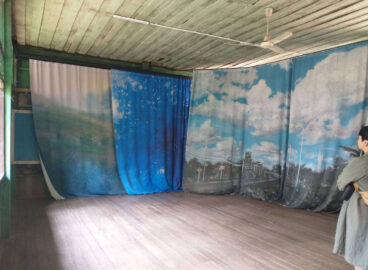
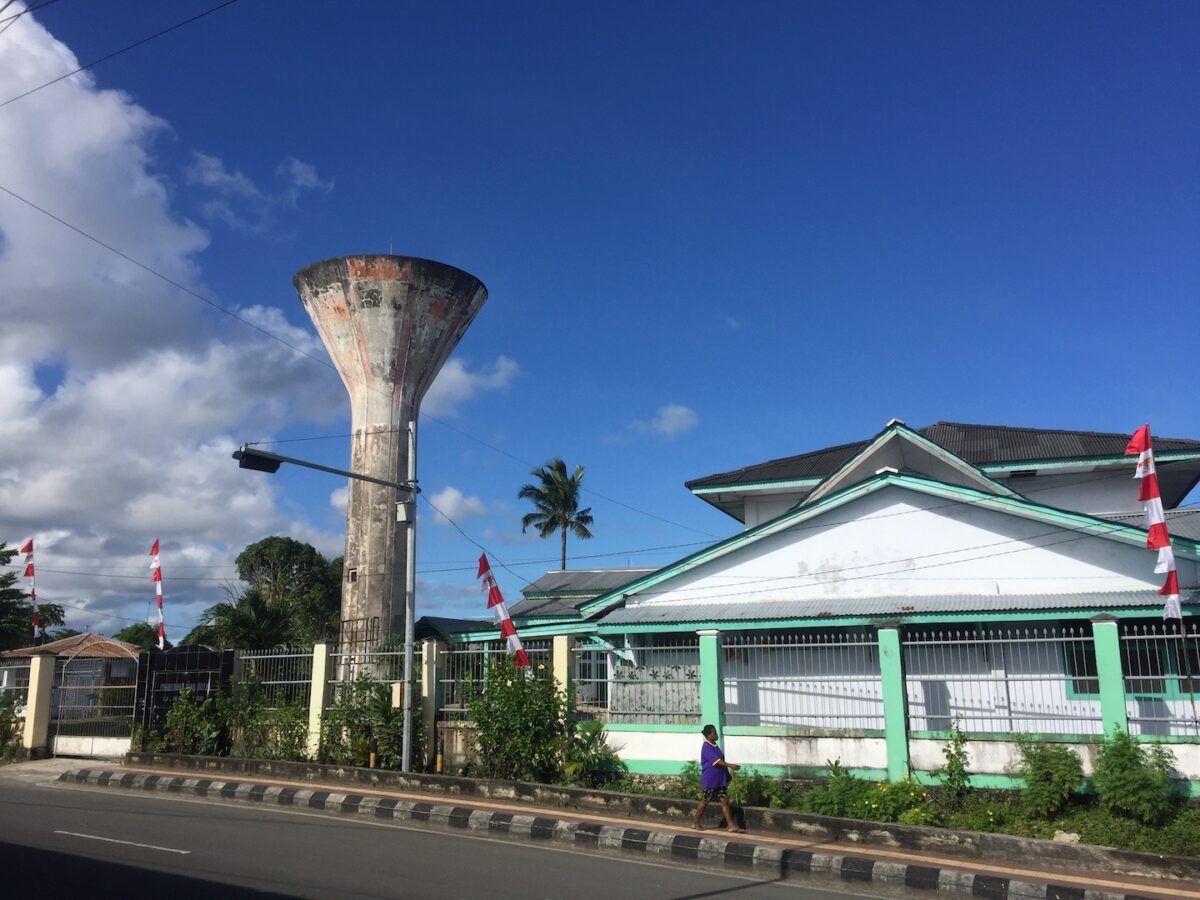
From Jayapura, I flew to Biak, where Papuan Voices was holding its fifth Festival Film Papua. Before attending any screenings or discussions, I visited the Water Tower, which stands as a memorial to the violence of the 1998 Biak massacre, or Biak Berdarah (fig. 3). To understand the histories embedded in the site, I began by reading a survivor’s eyewitness testimony recorded in 2003:
The attack on July 6th took place in the morning, when we were under the water tower. During the initial attack the troops assembled around us in a U formation. There were Brimob police in riot gear, army troops (Kopasgad), a company of soldiers from the local Kodim barracks, as well as Navy personnel. They formed a letter U around us and then shot at us repeatedly while we were still under the water tower. They kept shooting, telling us to head down to the dock. We were herded down to the dock. So at around 6:30, I was led by two Indonesian military officers directly to a Naval Ship. The ship has a number on its side, 534.6“The Biak Massacre: Citizens Tribunal,” biak-tribunal.org, https://www.biak-tribunal.org/massacre-location/.
Alongside the testimony, I encountered a hand-drawn map produced by survivors and witnesses (fig. 4).7Papua Human Rights Advocacy Study Institute (Elsham), “Nama Tanpa Pusara, Pusara Tanpa Nama: Laporan Pelanggaran HAM di Biak Irian Jaya” [Name Without Grave, Grave Without Name: Report on Human Rights Violations in Biak, Irian Jaya], Jayapura, July 10, 1999, https://www.biak-tribunal.org/wp-content/uploads/2014/09/ELSHAM-Laporan-Biak-1998_Bahasa-Indonesia.pdf. This document functions as evidence of the attack. It records routes, locations, movements, and memories that probably were never fully preserved within official state repositories. I asked myself, if such documentation is absent or inaccessible, could vernacular records become crucial technologies of remembrance?
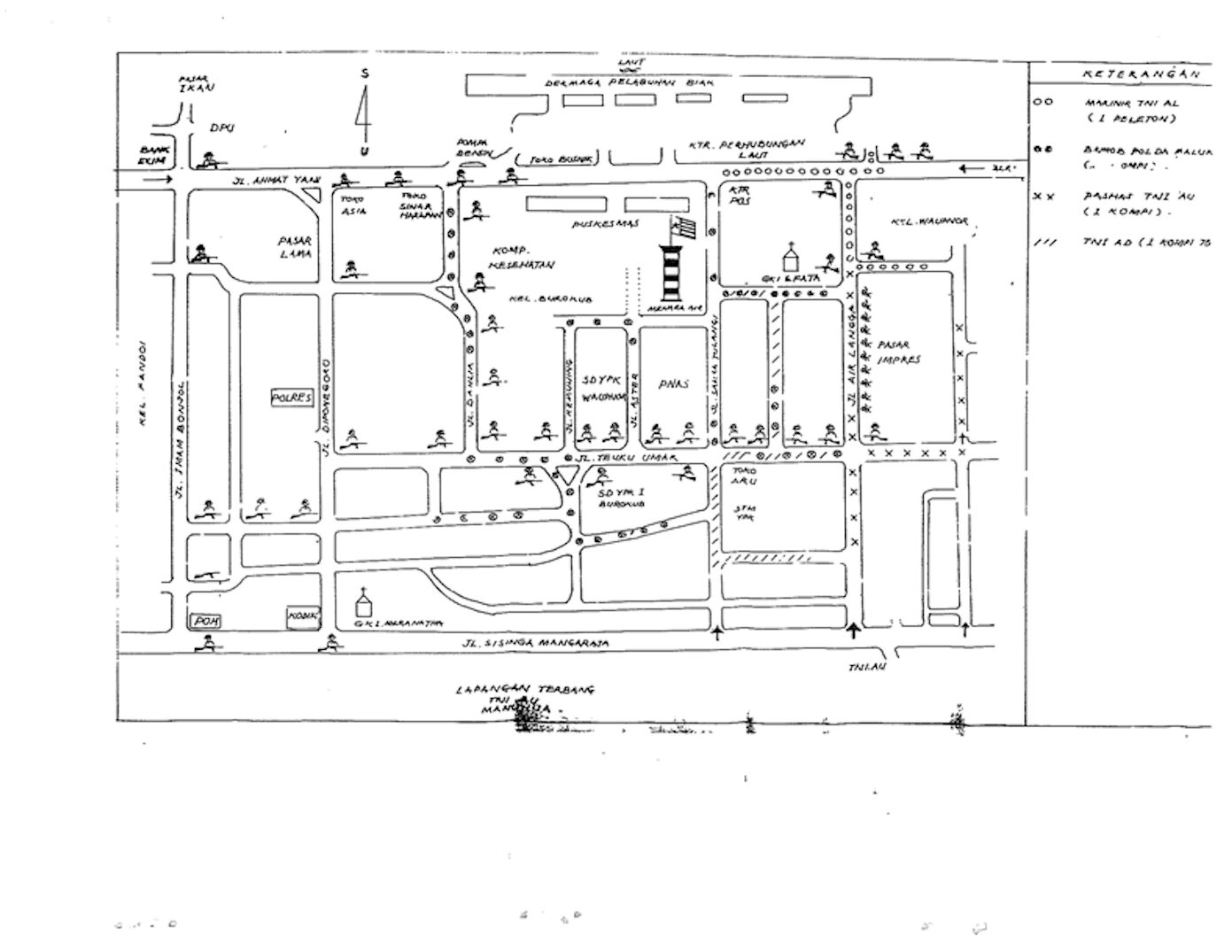
This time, my encounters with archives led me to sites of mourning. In Biak, the event exists through survivors’ testimonies and hand-drawn maps.
Reflecting on this encounter, I began to understand what might be described as a glitch in the archive: It is not simply a lack of information; it is evidence of historical erasure. It is that we often come to know history through its aftermath—from sites of violence, from death records, from a water tower, and from graves. West Papua taught me that some archives are born from loss.
A Dam
The activist and artist Moelyono (b. 1957) is known for his long-term engagement with communities in rural and remote areas across Indonesia. Throughout his practice, he has consistently worked alongside groups affected by the New Order. His trajectory as an artist, educator, and activist has been shaped by encounters with communities of people whose lives were structured by displacement and marginalization.
In 1982, construction of the Wonorejo Dam began in the village of Wonorejo, located almost seven miles west of the regency capital of Tulungagung on the southern coast of East Java, where Moelyono lived. The dam was part of a larger development project aimed at supplying water for industrial needs in Surabaya.
Moelyono’s engagement with the Wonorejo Dam project emerged from his earlier environmental art practice in Tulungagung. In 1984–55, while developing his environmental art project KUD—Kesenian Unit Desa (Village Unit Art), he investigated the ecological and social conditions surrounding the swamplands of Waung and the broader water management schemes in the region. This inquiry led him to news of the construction of the Wonorejo Dam, which he continued to follow after 1985. From 1986 onward, he immersed himself in the local community around the dam by participating in cultural activities, documenting performances, organizing art initiatives, teaching children, and supporting journalistic coverage of the project.8Moelyono, Retak Wajah Anak-anak Bendungan, exh. cat. (Cemeti Art House, 2011), 4.
Through this long-term involvement, he observed the social consequences of the dam’s construction, particularly issues surrounding land acquisition, relocation, and the lost sense of community and culture. This eventually culminated in the exhibition Reflections on the Construction of Wonorejo Dam, held at Taman Budaya Solo in 1994, which brought wider public attention to the experiences of affected residents and the broader implications of the development project.9Refleksi Pembangunan Dam Wonorejo, Taman Budaya Solo, Solo, 2-6 April 1994.
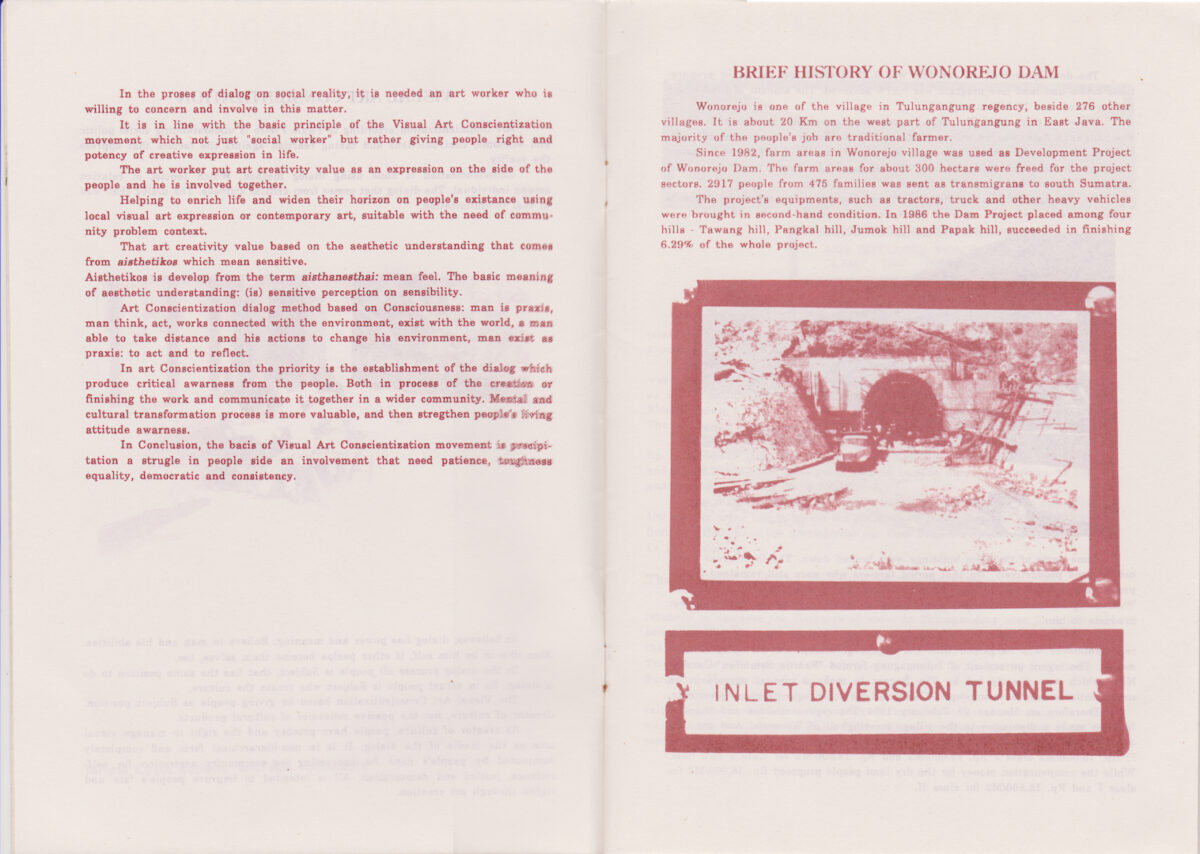
The items assembled in the archive fall into two categories: documentation of the exhibition Reflections on Construction of Wonorejo Dam and related research materials on the Wonorejo Dam project, which informed the exhibition. Not merely records of an artistic project, they are traces of encounters, conversations, and collaborations between Moelyono and residents whose lives were transformed by the state-led development.
The exhibition archive contains a catalogue, an exhibition proposal and accompanying correspondence with the gallery, and photographic documentation of the display. Also included is a catalogue from the ARX exhibition in Perth, which addressed a similar theme and provides evidence of the continued development and presentation of Moelyono’s work on the Wonorejo Dam project beyond the 1994 exhibition (fig. 5).10The Fourth Artists’ Regional Exchange (ARX), exh. cat. (Australia & Regions Artists Exchange, 1995).
Hyphen—
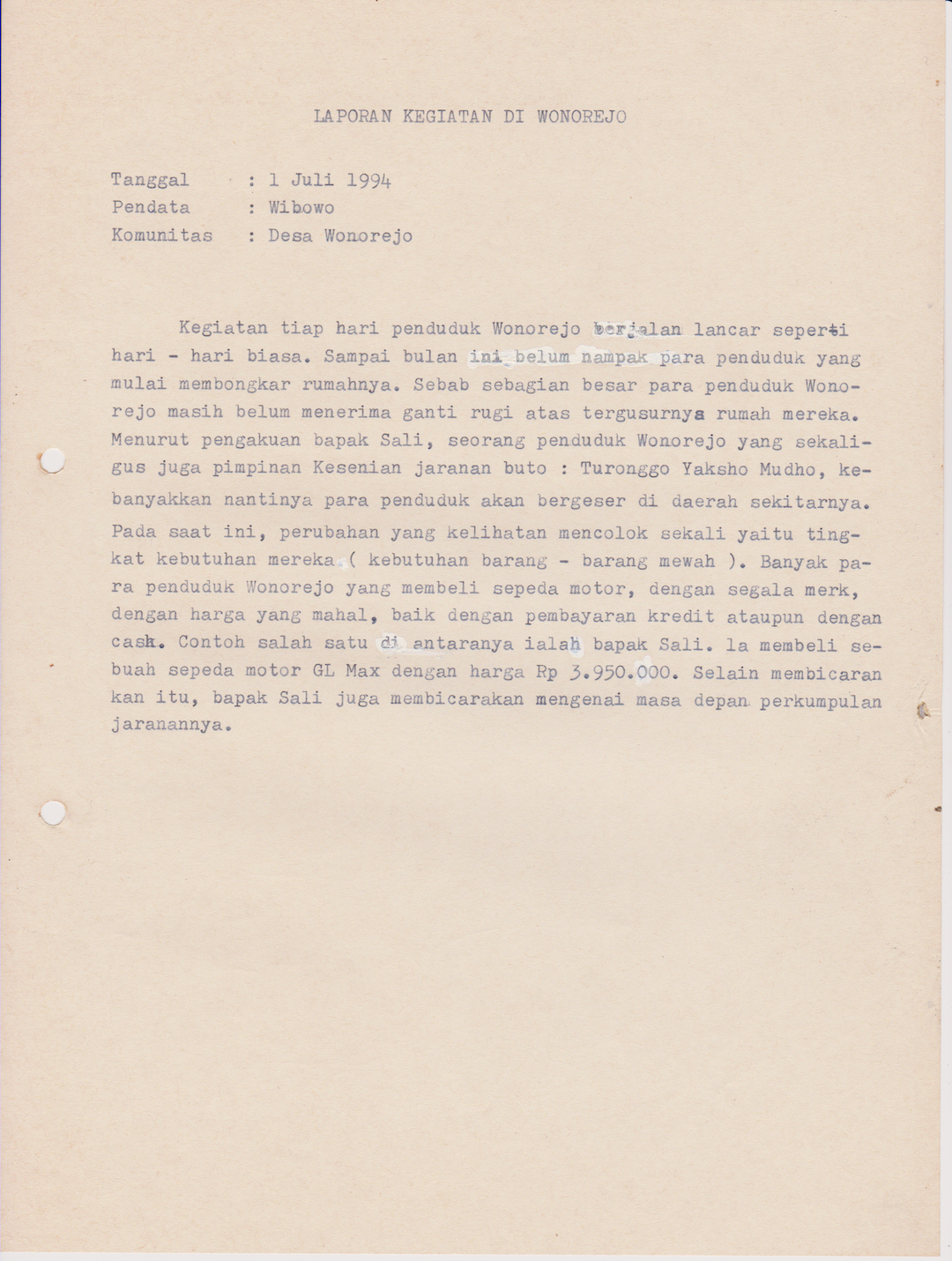
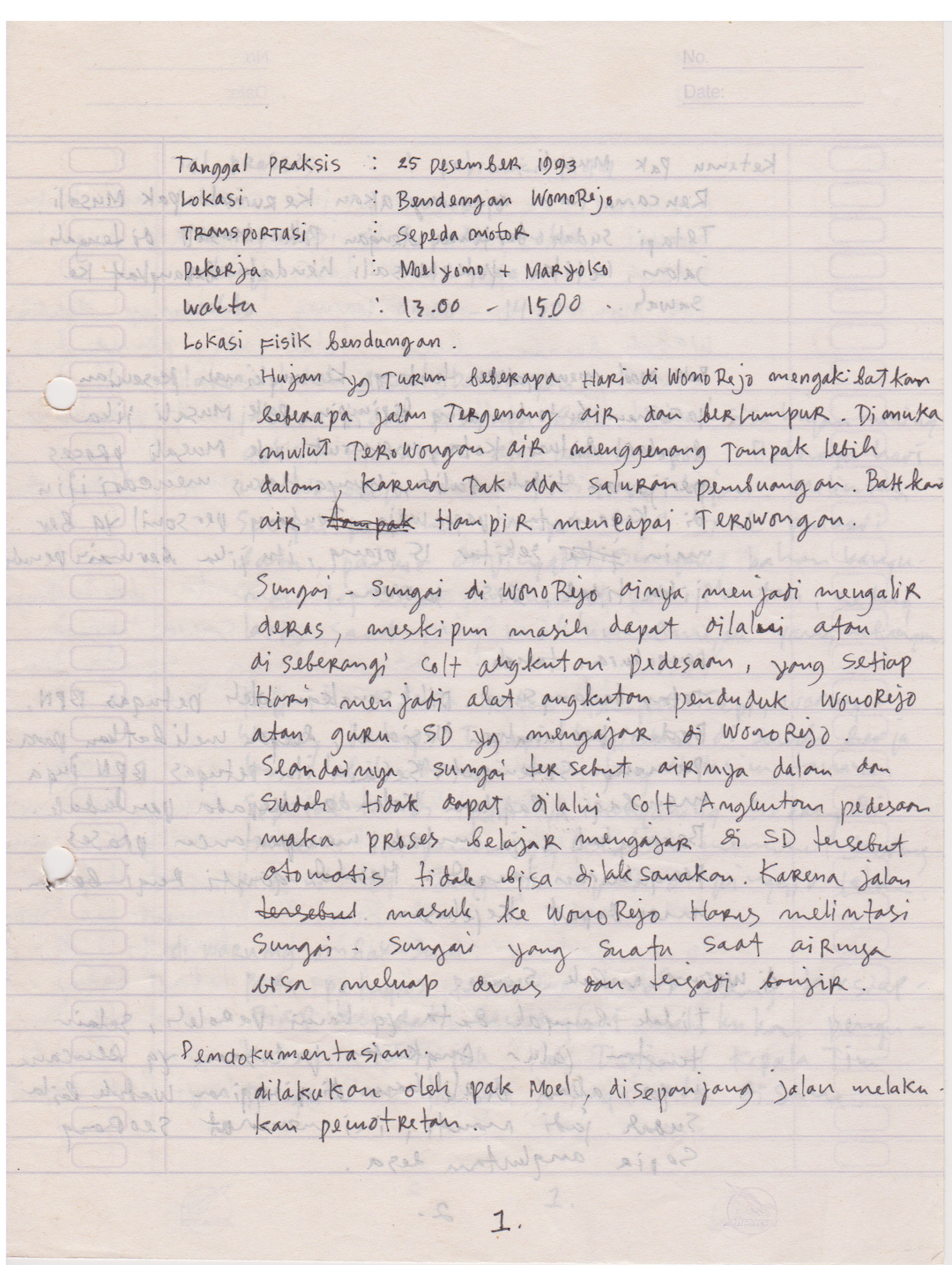
The research materials consist of field notes documenting meetings with local residents and observations of conditions in the area surrounding the dam (figs. 6–8). Many of these materials were collected through establishing relationships with local residents. The access to the dam construction area was guarded by military personnel. To gain regular entry, a privilege extended to local residents, Moelyono participated in community activities, including documenting Jaranan Buto performances, reviving the art of glass painting, teaching children to draw, and assisting journalists in covering the dam’s construction process.11Moelyono, Retak Wajah Anak-anak Bendungan, 4.
Among the documents are a community-made map12This community-made map, drawn with colorful pens, documents both the spatial and social history of the community. It traces where people once lived, identifies former communal spaces—such as the village office, school, market, and football field—and shows where the community later relocated. Beyond depicting geography, the map records collective memories by linking places with stories of what happened there and how the community’s landscape changed over time. as well as photographs of the dam site, everyday life in the village, agricultural landscapes such as rice fields and farmlands, residential areas, and community cultural activities, including Jaranan Buto performances and glass painting. The archive also contains government-made catalogues and pamphlets about the dam construction, including technical drawings. Equally important are the newspaper clippings that Moelyono carefully preserved and described as “additional data,” which explain ongoing developments in the field. What was presented by the state as modernization and progress appears in these documents to have been met by the resistance and resilience of local people to the developmentalist projects.
My initial inclination was to regard all the materials in Moelyono’s collection simply as archives. Yet I recalled my visits to a monument and tomb in Jayapura, which felt like archives, where history seemed to reside and return through remembrance and that has led to an increasing sense of frustration. In retrospect, I was familiar with the overuse of the term “archive” to refer to anything that is possessed in one’s collection, or to oversimplify anything-related-to-history as archive—a more profound term could be “historical record” or “site.”
As I have begun learning about archival theory more formally, I have become more attentive to the distinctions between “archives,” “records,” and “personal collections” and to the importance of using these terms with greater precision.
In the case of Moelyono, the relationship between the exhibition materials and the Wonorejo documentation suggests a more robust archival formation. This growing awareness has not led me toward a more rigid classification of the materials; rather, it has prompted me to ask whether such distinctions are sufficient for understanding an artist’s archive. The exhibition catalogue, proposal, and photographs document the public presentation of the project, while the field notes, photographs, and community documentation record the observations, relationships, and forms of participation through which the work was developed.
A particularly revealing aspect of the archive concerns the presence of government documents related to the dam project. When I asked Moelyono how he had obtained materials that appeared to belong to official bureaucratic channels and whether they had once been considered confidential, his response complicated conventional assumptions about archival acquisition.
Paradoxically, the documents were gathered instinctively. Indeed, they were not collected through formal procedures. Rather, they emerged through everyday social relations. Moelyono recalled that some were obtained through a neighbor who worked as a staff member on the dam project. Others were shared by journalist friends who were investigating the development and had assembled extensive documentation, photographs, and reports.13Interview with the artist. In Moelyono’s case, they are an archive collected through networks of trust, friendship, and commitment.
The provenance of these materials lies in the relationships through which knowledge was gathered, shared, and mobilized to document a history of displacement and resistance.
The archive reveals how artistic production and social engagement were mutually constitutive in Moelyono’s practice; a series of materials record different moments in an ongoing process in which artistic practice and sociopolitical commitment continuously shaped one another.
This shift in my understanding of archives also informed how I approached sites such as the Biak Water Tower and the grave of Arnold Ap. Neither can be considered an archive in a conventional sense of documentary record, yet both were entry points in my attempt to understand the social and political conditions revealed by the lack of archival materials in West Papua. Rather than treating them as archives per se, I began to understand them as sites that solicit archival inquiry—places where the absence and fragmentation of records become visible.
Archival absences are not accidental gaps in the historical record but rather the effects of political suppression, restricted circulation of information, and structural erasure. Such erasures become retrievable in the sites of remembrance and community-produced records. In this sense, my encounters with history do not always begin with the archive; sometimes they begin in the social and material traces left behind by those histories.
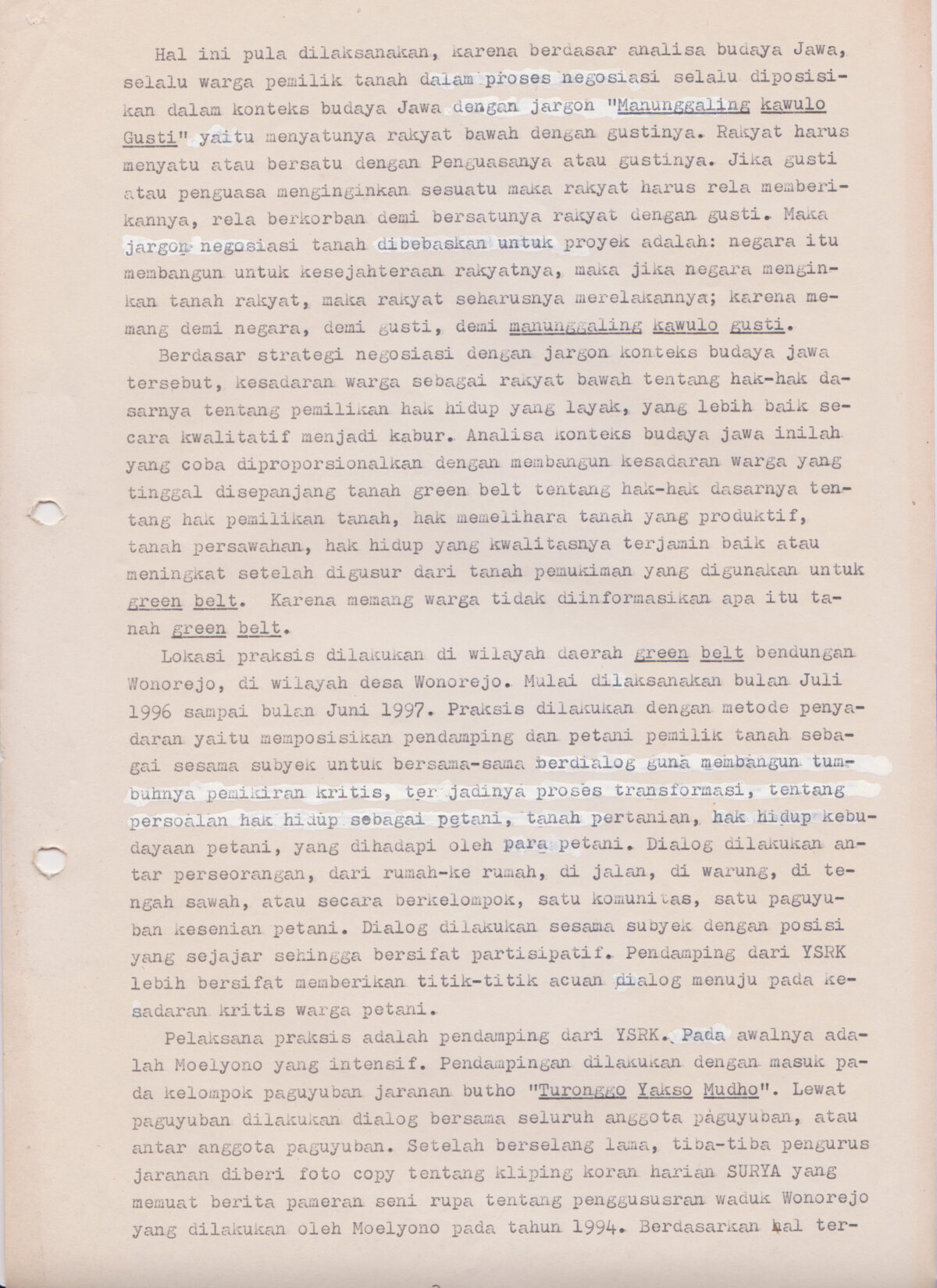
I have chosen to translate the following passage from this document to close this article.
Analyzing Javanese culture, in the negotiation process landowners are always positioned in the context of Javanese culture with the jargon “Manunggaling Kawulo Gusti,” namely the unification of the lower classes with their gusti (god).
If the god or autocrat wants something, then the people must be willing to give it, willing to make sacrifices for the sake of uniting the people with the god.
So the jargon for negotiating land acquired for projects is [as follows]: The country builds for the welfare of its people, so if the state wants the people’s land, then the people should give it up, because it is for the sake of the country, for the sake of Gusti, for the sake of unity, manunggaling kawulo gusti.
I write this essay in honor of the memory of Terry A. Manufandu (1996–2025), an activist for Indigenous rights, environmental justice, and Papuan liberation. Rest in power, Terry. I owe you my intellectual labor.
- 1Through commissioned work such as public monuments, architectural ornamentation, and aesthetic elements, variety and patterns from ethnic Indonesian were incorporated into a national narrative as decorative markers of national unity, detached from the political realities, historical conflicts, and power relations that shaped them. Chabib Duta Hapsoro suggests that this cultural regime functioned as a form of depoliticization. See Hapsoro, “Identitas Keindonesiaan dalam Elemen-elemen Estetik Kelompok Decenta: Representasi Praktik Depolitisasi Orde Baru dalam Bidang Kebudayaan[i],” June 29, 2015, https://chaduha.wordpress.com/2015/06/29/identitas-keindonesiaan-dalam-elemen-elemen-estetik-kelompok-decenta-representasi-praktik-depolitisasi-orde-baru-dalam-bidang-kebudayaani/. ↩︎
- 2See Yokbeth Felle, “Bearing Witness: The Power of Community-Led Documentation in West Papua,” Witness (blog), July 17, 2025, https://blog.witness.org/2025/07/community-led-documentation-in-west-papua/. ↩︎
- 3See also Meilinda Sari Yayusman and Cahyo Pamungkas, “Papuan Voices: Digital Media Usage for Peacebuilding,” Journal of Peacebuilding & Development 18, no. 3 (2023): 347–52, https://doi.org/10.1177/15423166231201125. ↩︎
- 4See Felle, “Bearing Witness.” ↩︎
- 5See A. Andreas Goo, “Mambesak Obat Mujarab Bermuatan Nilai Budaya Papua, Suatu Refleksi Antropologi Papua,” in Grup Mambesak: Simbol Kebangkitan Kebudayaan Orang Papua Proto: Spirit Mambesak: Kami Menyanyi untuk Hidup, Dulu, Kini, dan Nanti, ed. A. Andreas Goo, S.Sos., M.Si. (Uncen Press dan Lembaga Studi Meeologi, 2019), 32. ↩︎
- 6“The Biak Massacre: Citizens Tribunal,” biak-tribunal.org, https://www.biak-tribunal.org/massacre-location/. ↩︎
- 7Papua Human Rights Advocacy Study Institute (Elsham), “Nama Tanpa Pusara, Pusara Tanpa Nama: Laporan Pelanggaran HAM di Biak Irian Jaya” [Name Without Grave, Grave Without Name: Report on Human Rights Violations in Biak, Irian Jaya], Jayapura, July 10, 1999, https://www.biak-tribunal.org/wp-content/uploads/2014/09/ELSHAM-Laporan-Biak-1998_Bahasa-Indonesia.pdf. ↩︎
- 8Moelyono, Retak Wajah Anak-anak Bendungan, exh. cat. (Cemeti Art House, 2011), 4. ↩︎
- 9Refleksi Pembangunan Dam Wonorejo, Taman Budaya Solo, Solo, 2-6 April 1994. ↩︎
- 10The Fourth Artists’ Regional Exchange (ARX), exh. cat. (Australia & Regions Artists Exchange, 1995). ↩︎
- 11Moelyono, Retak Wajah Anak-anak Bendungan, 4. ↩︎
- 12This community-made map, drawn with colorful pens, documents both the spatial and social history of the community. It traces where people once lived, identifies former communal spaces—such as the village office, school, market, and football field—and shows where the community later relocated. Beyond depicting geography, the map records collective memories by linking places with stories of what happened there and how the community’s landscape changed over time. ↩︎
- 13Interview with the artist. ↩︎