The Harvest of Evelyn Ashamallah
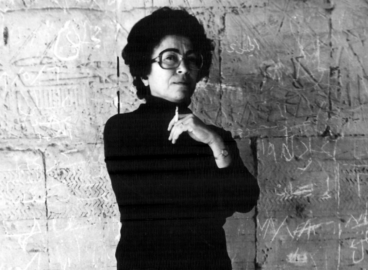
Evelyn Ashamallah (born 1948) presides over history from her small apartment in Talaat Harb in downtown Cairo. Across the past six decades, she has demonstrated a legacy of constant negotiation…
The annual Asilah Cultural Moussem, an international festival held in northern Morocco, was cofounded in 1978 by Mohamed Benaïssa and Mohamed Melehi in collaboration with Toni Maraini and Al Muhit Cultural Association. It served as a significant postcolonial cultural platform, involving activists from the Casablanca Art School and artists from Africa, the Arab world, Asia,…
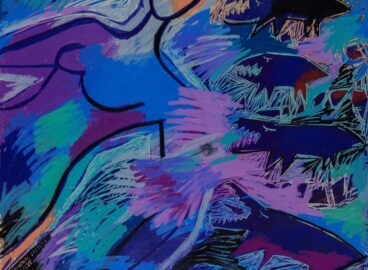
A few years after Algeria gained its independence from France in 1962, the artist Houria Niati (b. 1948) took up a position with the Ministry of Youth and Culture, where she taught painting, ceramics, and drawing to both adults and children. Art workshops were intended to help Algerians work through the trauma of the Algerian…
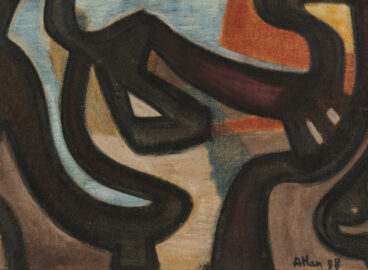
Jean-Michel Atlan (1913–1960)—who signed simply as Atlan in his works—is most often considered a representative of lyrical abstraction, an art movement that took root in Paris after World War II. Born in the Casbah of Constantine to a Jewish Berber family…
Jean-Michel Atlan (1913-1960) – qui signait simplement Atlan – est le plus souvent considéré comme l’un des représentants de l’abstraction lyrique, mouvement qui marqua la scène parisienne dans l’après-guerre. Né dans la casbah de Constantine, au sein d’une famille juive berbère, comme…
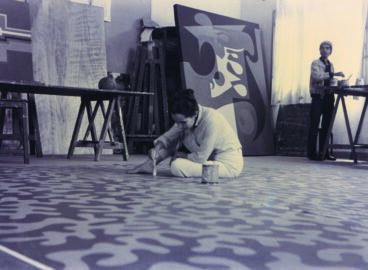
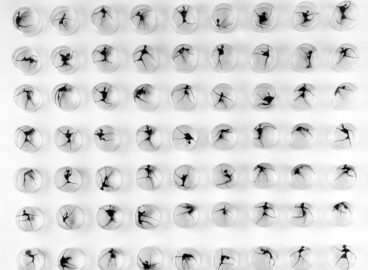
Malika Agueznay was among the first woman modernist abstract artists in Morocco. She was a student at the Casablanca École des Beaux-Arts from 1966 to 1970, during the experimental tenure of the faculty known as the Casablanca School. Shaped by the formative experience within the school, she has also distinguished herself by the ways her research emphasizes her female identity. Throughout her career, she has elaborated on seaweed as a central motif in her abstract practice. This motif is both deliberately evocative of femininity and rooted in her own female perspective.
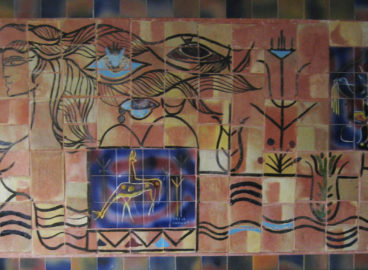
As the entrepreneurial co-founder of the Société Zin, a modernist design company, Safia Farhat (Tunisian, 1924–2004), contributed to the visual aesthetics of civic space during the formative period of Tunisian socialism and state feminism. Jessica Gerschultz introduces Farhat’s key role in sustaining a mural tradition for Tunisian modernists.
Refusing to fit into the mainstream art of her time, Gazbia Sirry replaced formal modernist training with local Egyptian art conventions to critically address women’s rights, patriarchy, social justice, and Western imperialism.
Inji Efflatoun fut une peintresse et une militante marxiste et féministe égyptienne. De juin 1959 à juillet 1963, elle fut emprisonnée par le régime nassérien en raison de son appartenance au parti communiste. Au cours de ces années, elle continua à peindre. Célébrés dès les années 1960, et aujourd’hui recherchés sur le marché de l’art, les tableaux de cette période sont souvent considérés comme les plus importants de son œuvre.
Celebrated as early as the 1960s, and highly sought-after on the art market today, Egyptian painter Inji Efflatoun’s production during her four years of incarceration by the Nasserite regime is often considered the highlight of her oeuvre.
The publication, Modern Art in the Arab World: Primary Documents (2018), edited by Anneka Lenssen, Sarah Rogers, and Nada Shabout, offers an unprecedented resource for the study of modernism: a compendium of critical art writings by twentieth-century Arab intellectuals and artists. The selection of texts—many of which appear for the first time in English—includes manifestos, essays, transcripts…