The Triangle Network is a global network of artists and visual arts organizations that supports professional development and cultural exchange among artists, curators, and other arts professionals worldwide. It was initiated in 1982 by Anthony Caro and Robert Loder in New York City with the first Triangle Artists’ Workshop, and over the next two decades, grew into an international network of workshops using the “Triangle model.” Held in over 20 countries, the workshops put artists in touch with their peers in other countries and relied on donations in kind and grants for funding. The Triangle Arts Trust coordinated workshops internationally and raised funds to develop the network.1For more information, see “Triangle Network History,” Triangle Network website, https://www.trianglenetwork.org/triangle-network/about/triangle-network-history/.
The following is an edited transcript of a talk by Berry Bickle (fig. 1) delivered at a meeting of the Contemporary and Modern Art Perspectives (C-MAP) Africa group at MoMA in November 2024. Bickle was invited to discuss her role as an organizer of the second Triangle Network Pachipamwe workshop in Zimbabwe (August 12–26, 1989), known as Pachipamwe II, and her subsequent participation in various Triangle Artists’ Workshops in Africa in the 1990s.
I’d like to begin with an introduction to Pachipamwe—both as a project and as it was introduced to fellow Zimbabwean artists and to me.
In 1988, our first gathering, the first Pachipamwe workshop, took place in Murewa, Zimbabwe, about 120 kilometers north of Harare. By way of background, the Triangle [Artists’] Workshops had been initiated in South Africa in 1985. Robert Loder had a network of Zimbabwean friends, including Pat Pearce, a wonderful artist in her own right and an early supporter of Zimbabwean stone sculpture.
In a conversation between Pat and Robert, Robert introduced to Pat the idea of the possibility of a workshop in Zimbabwe. From there, the contact was made with Tapfuma Gutsa, who at that stage had recently graduated from City & Guilds in London and had returned to Zimbabwe—actually returning to live in Murewa. The initiation of the workshop really came about through this triangular relationship between Robert Loder, Pat Pierce, and Tapfuma Gutsa.
We were invited to Murewa, and our host and venue was the Murewa Culture House, which had been built post-independence. It was intended as a kind of blueprint that would be replicated throughout the country, although in reality, I don’t think the initiative ever really extended beyond Murewa itself. Even so, it was a very interesting proposition: to place contemporary artists within a culture house that had been conceived around localized cultural practices.
In other words, the space was primarily oriented toward music and other forms of cultural production rooted in local traditions. So the introduction of a group of contemporary artists into that space became a very interesting proposition—raising questions about where contemporary art practices might be situated in relation to more traditional conceptions of a cultural venue.
The initial workshop at Murewa had some quite extraordinary elements. We were welcomed in a very traditional sense, within a very specific ceremonial framework. Not only were we introduced to the culture house itself, but also we were introduced to the ancestors. The ancestors were told what we were doing there. That created a very powerful sense of linkage—between something that operated within a known cultural and spiritual framework and something that was, in many ways, unknown: a group of contemporary artists gathering to work together.
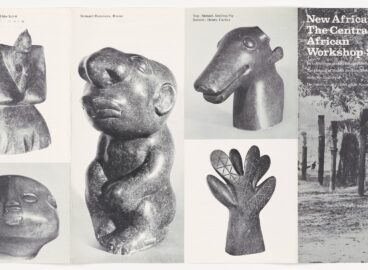
There were 14 artists in total. The emphasis of the workshop was very much on sculpture, because the initial sensibility was to somehow invigorate what was perceived as a somewhat moribund stone sculpture movement. The idea was that the workshop might introduce a new dynamism that could move that practice forward. So there was both a focus and a kind of urgency around sculpture.
Three artists from Bulawayo were invited: me, a painter; Rashid Jogee, also a painter; and Adam Madebe, who worked in metal. We came not as outsiders, but with a different sensibility. Similarly, David Koloane [and] Bill Ainslie, both from South Africa, and Willard Boepple, who came from America, brought additional perspectives. Meanwhile, the other sculptors and participants were deeply engaged in the Zimbabwean stone sculpture movement. So the presence of painters and artists working in other mediums introduced another dimension into the workshop.
It was very dynamic—extremely interesting. What was particularly compelling to me was the intergenerational dimension of the conversations. There was an exchange between very established, well-known stone sculptors and a much younger generation. Figures like Tapfuma Gutsa and Brighton Sango had already begun to break away from what stone sculpture had been in the decades since the 1960s. That internal tension and expansion made the workshop especially dynamic.
The workshop itself was full of revelations. It was inspiring, energetic, and transformative. Murewa became, in a sense, the beginning—the heartbeat—that brought Pachipamwe, or at least the need for further workshops and continued interaction between artists, into sharp focus.
The link between what happened in Murewa in 1988 and Pachipamwe in 1989 came through an exhibition titled Artists on the Frontline, hosted at Konstnärshuset in Stockholm. This exhibition brought together artists from Mozambique, Angola, Zimbabwe, and South Africa. At that time, this was a very contentious proposition, because we were still in the midst of the struggle against Apartheid in South Africa. The inclusion of South Africa alongside so-called frontline states was politically sensitive.
Having met Bill Ainslie in Murewa, I had a conversation with him in Stockholm. I asked: “What is the point of meeting our Angolan, Mozambican, South African, and Zimbabwean counterparts in Stockholm? What we need is to meet in Africa.”
Because we had both participated in Murewa, the idea emerged that we could apply for funding to expand the workshop. We wanted to create a situation where artists from across the region could come together, get to know one another, and strengthen their ties on African soil, in Africa itself.
This was also deeply tied to the political realities of the time. South Africa was still under Apartheid. It was extremely important to support South African artists by inviting them into a space where they could participate freely—something that would not have been possible within South Africa itself. Workshops like Thupelo had limitations under those conditions. Pachipamwe, by contrast, offered a space in Zimbabwe—at Cyrene Mission (fig. 2)—where artists from across the region could gather.
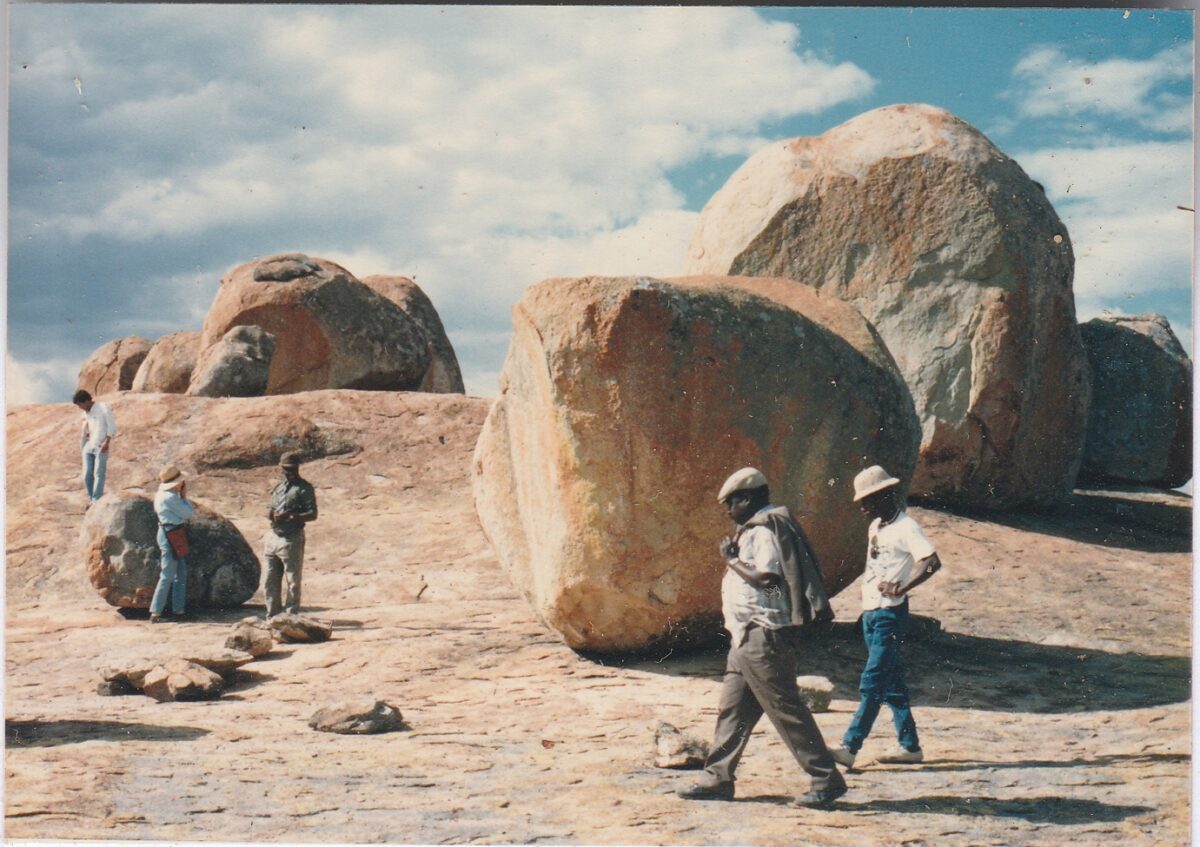
The choice of Cyrene Mission was shaped by multiple, layered considerations. One of these was the significance of place. Cyrene is located near the Matobo Hills (fig. 3), a World Heritage site known for extraordinary rock art—paintings that are millennia old. These works were created by migratory artists, and this idea of migration resonated deeply with us. The artists who had painted those caves had moved across regions that are now divided into separate nation-states.
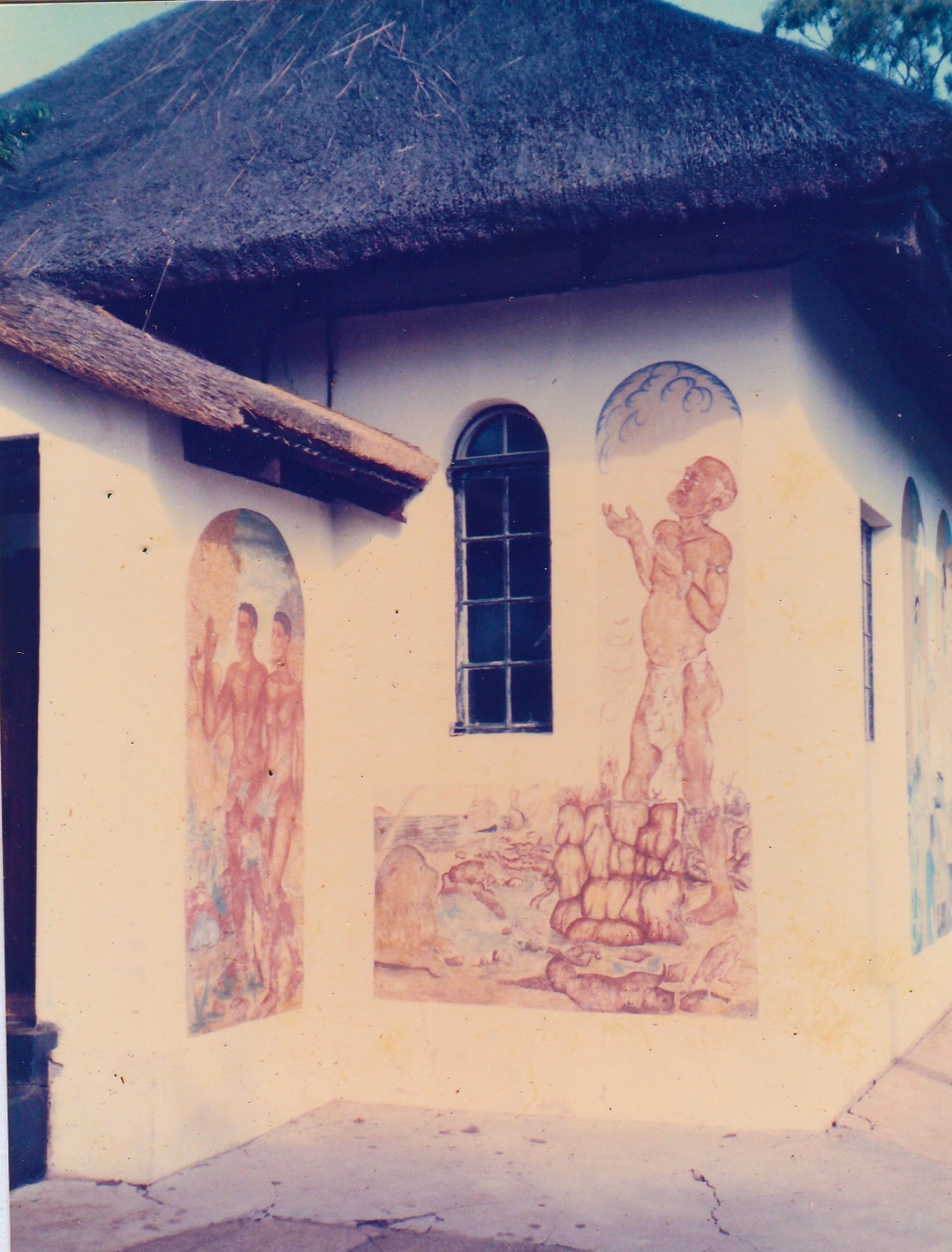
In our postcolonial moment, we were trying to recover narratives that had been fractured by colonialism and war. The proximity to a site of such deep cultural, historical, and artistic significance made Cyrene a powerful location. The second element was Cyrene itself. Established in 1939 under the Anglican Church by Canon Paterson, it began as an art school for people with disabilities. Over time, it expanded due to demand. The murals in the chapel—created by successive generations of students—are particularly significant. Canon Paterson encouraged his students to interpret Christian iconography through their own vernacular forms. These murals remain today and are quite unique.
There is also a lineage connecting Cyrene to later artistic training in Zimbabwe. Many artists who trained under Paterson went on to teach at the Mzilikazi Art & Craft Centre in Bulawayo. The artists who participated in Pachipamwe were, in many cases, students of those teachers. So Cyrene represented an important historical node in the development of art education in Zimbabwe.
Finally, there were practical considerations. As a school, Cyrene could be used during holidays. It provided accommodation, studio space, classrooms, and large communal areas. Artists could occupy classrooms, work in halls, or use outdoor spaces. All of these factors contributed to making Cyrene an ideal site.
At Pachipamwe, the workshop expanded from 14 artists in the first Murewa edition to 22 in 1989. There was a strong emphasis on inviting regional artists—from Botswana, South Africa, Angola—as well as international participants. Communal spaces played a crucial role. The dining area, in particular, became a central social space (fig. 4). I believe very strongly that the ability for artists to socialize easily—to move between formal and informal interactions—was essential to the flow of the workshop. Studio environments were intense and focused, so these moments of gathering, eating, and conversation were equally important in building relationships.
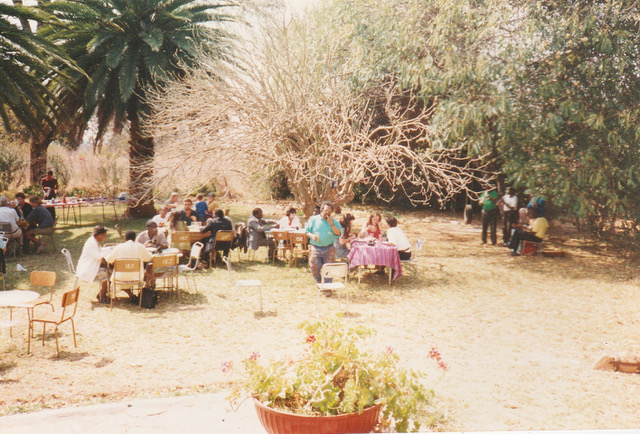
Sculptors often chose to work outdoors, while other artists occupied interior spaces. There was also experimentation across mediums. Voti Thebe introduced a papermaking workshop, bringing in new techniques and materials. This created opportunities for interdisciplinary exchange—sculptors, for example, engaging with paper as a material.
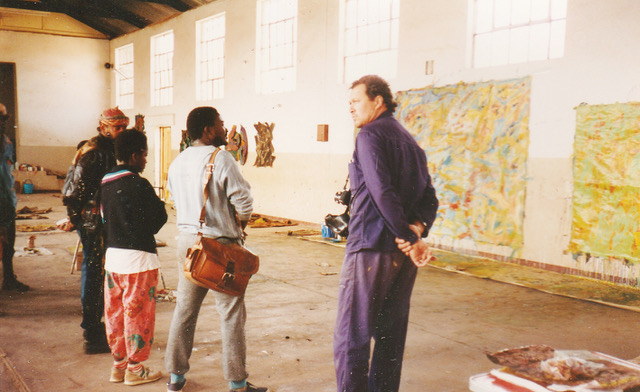
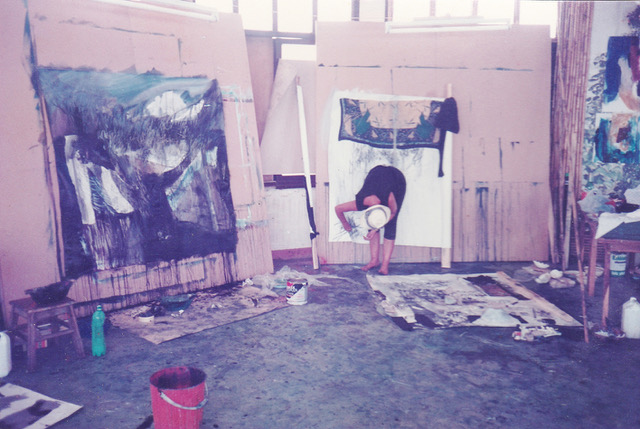
Materials in general were limited. One of the solutions we found was to use industrial packaging paper, which came in large rolls. This allowed artists to work on a much larger scale than they were used to. Many artists did not have access to personal studio space, so this sense of expansiveness—of being able to work big—was transformative (Fig. 5).
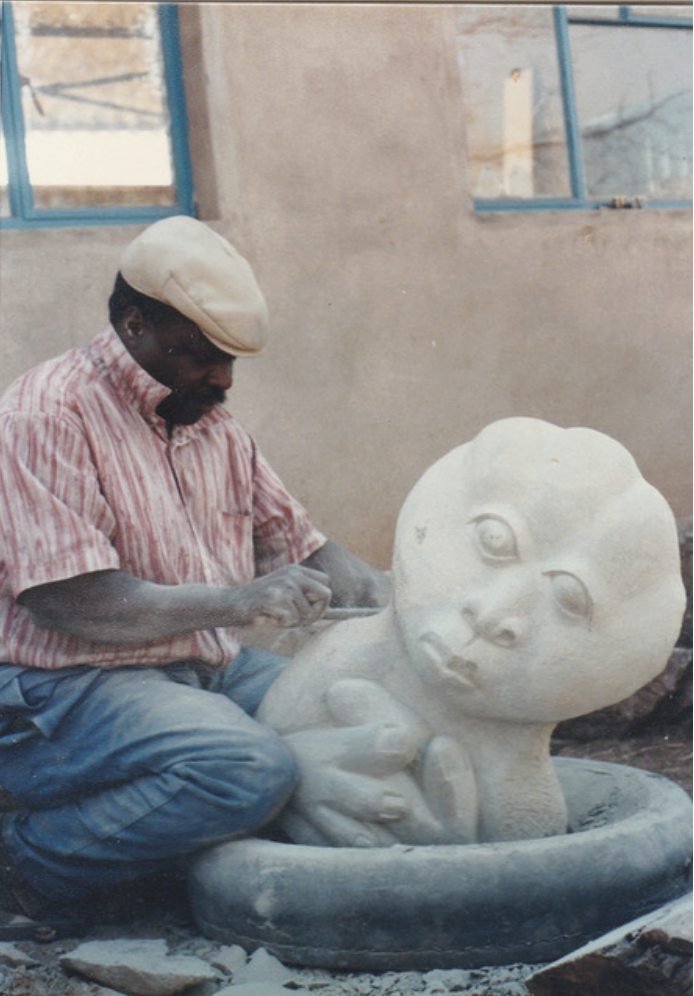
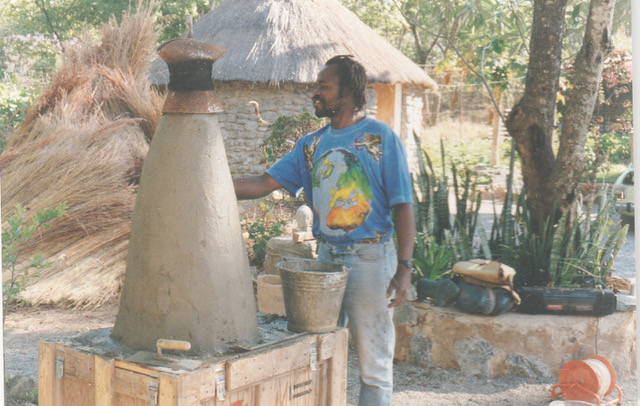
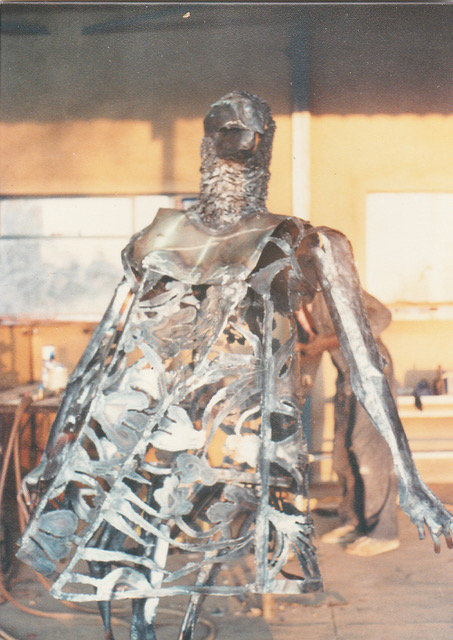
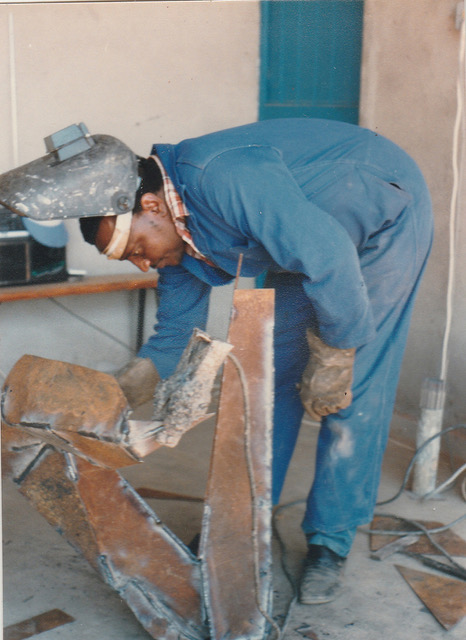
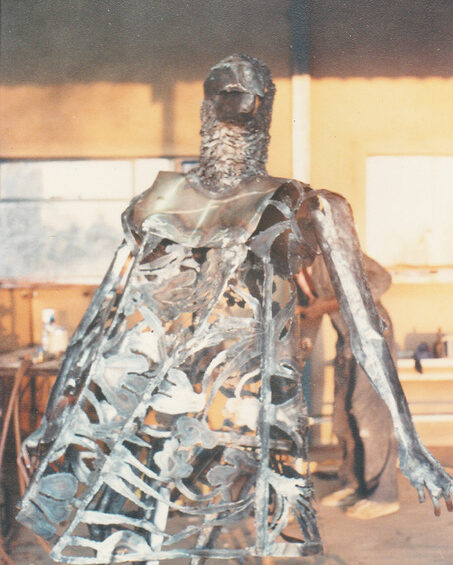
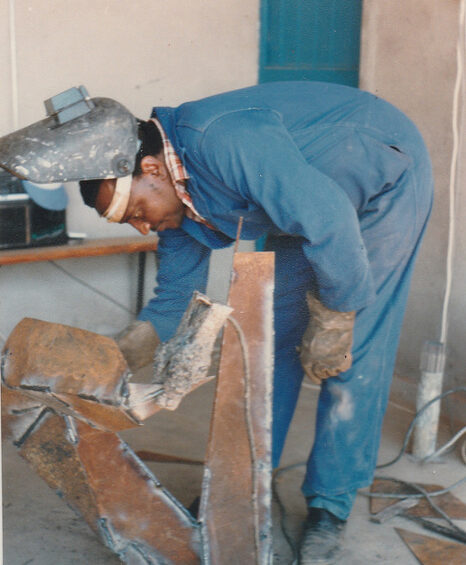
At this stage, Zimbabwean stone sculpture (fig. 6) remained a dominant force, but it was also being challenged and expanded. Tapfuma Gutsa (fig. 7) was particularly important in this regard. He broke many of the established conventions of stone sculpture, incorporating mixed media and developing forms that moved beyond carving into construction. He worked with welders, stone carvers, and materials such as cement, building rather than subtracting.
International artists also had a strong influence. Sokari Douglas Camp (fig. 8), for instance, had a significant impact on artists working in metal, including Adam Madebe (fig. 9) and David Ndlovu. The scale of Sokari’s work opened up new possibilities for these artists.
Bill Ainslie’s presence was also crucial. As the founder of the Johannesburg Art Foundation—a key institution for Black artists during Apartheid—he brought both experience and political weight. His return to Cyrene, where he had taught in the early 1960s, was deeply meaningful. Helen Sebidi (fig. 10), introduced by Bill, was another important presence. The inclusion of women artists was a key aspect of Pachipamwe.
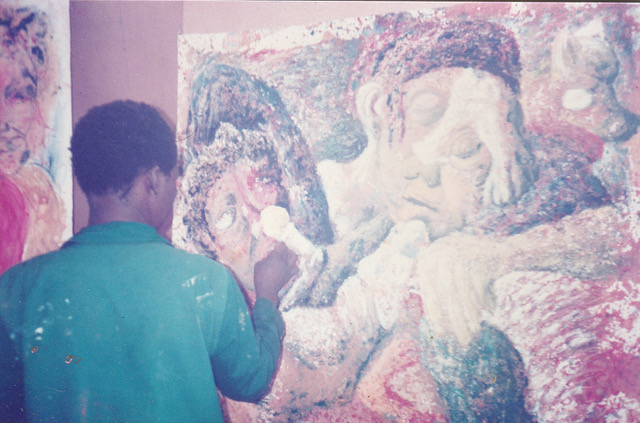
Evenings were dedicated to discussion. Artists brought slides and presented their work. These sessions lasted one to two hours and were highly discursive. Rather than formal critiques, the exchanges were more akin to open conversations or studio visits. Participation was voluntary, and the format remained organic. The workshop itself functioned as an intense, immersive environment—almost like a pressure cooker. Artists stepped away from their everyday lives and worked intensely for two weeks within a collaborative framework.
The impact of Pachipamwe extended across the region and beyond. Artists from Botswana went on to establish Thupelo Botswana. Namibian artists created Tulimpamwe. And then Mbala was created in Zambia. These are direct linkages from artists who visited the Zimbabwean workshops and then went on to create workshops in their own countries.
The Mozambican artist Fatima Fernandes came to the Pachipamwe workshop in 1990. This was a workshop that was held outside of Harare. She then returned to Mozambique and initiated the Ujamaa workshops (fig. 11). I assisted her in an organizational capacity in Mozambique.
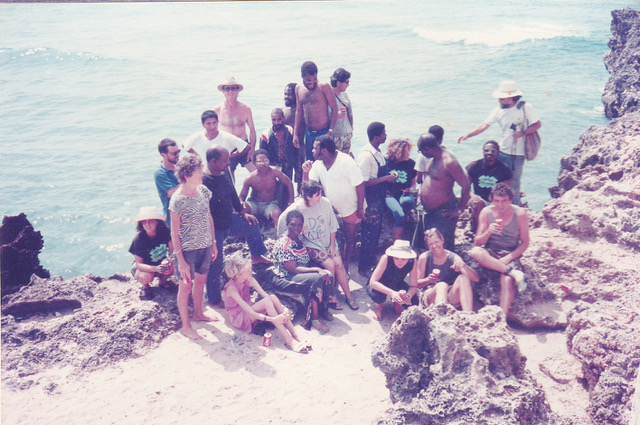
The Ujamaa workshops were held in Pemba. At that stage, Mozambique was still in the grips of a civil war, so Pemba was effectively the only safe place where we were able to host artists. What we are seeing here is the group, and also the environment of what Pemba was like—and where we were able to host the workshop.
Another important point is that the linkages through Mozambique brought us very close to Lusophone Africa and also to South America. There were, for instance, artists from Peru and from Brazil. The dynamic of the Mozambican workshops extended into South America, into Brazil, and into the Lusophone context. This became a very dynamic and interesting example of how the interconnectivity of workshops had an extraordinary capacity to extend intercontinentally.
Ujamaa, I think, had three editions. After the initial workshop in Pemba, there were two further editions in the city of Maputo, in which I was still engaged as a participant.
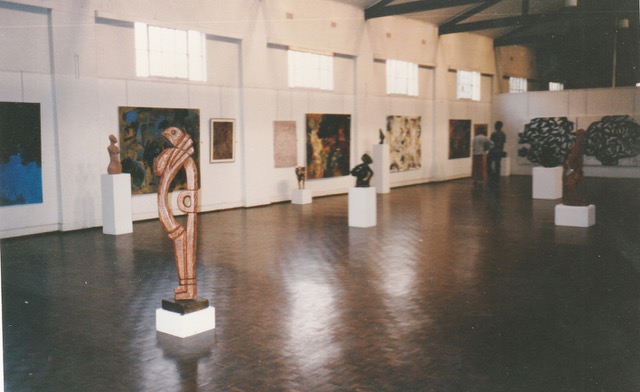
We are also looking here at the exhibition from the Ujamaa workshop (fig. 12). We had to transport all of the work from the very north of Mozambique back to Maputo in order to host the exhibition. Exhibitions were an important part of the workshops. Not always—only when it was possible to formalize them—but when we could, it was very important to have an audience view [them] and to make the work accessible and open to audiences.
We were able to do that with the Pachipamwe exhibitions as well. We mounted exhibitions through the national galleries of both Bulawayo and Harare.
The final Pachipamwe workshop at Cyrene was held as a tribute to Bill Ainslie. We were able to invite his two children, and we inaugurated a small library that still today is attributed to Bill. So the last Pachipamwe at Cyrene in 1993 had that commemorative dimension.
Bill died in a car accident returning from Pachipamwe in 1989. It was extremely tragic. It was also something very close to us, because we had been working with him intensively for two weeks. Following that, we established a remembrance library at the Cyrene Mission—the Bill Ainslie Library.
This became part of the final Pachipamwe workshop held at Cyrene in 1993: both a memorial to Bill and an opportunity to invite his two children, who are both artists in their own rights, to participate in the workshop. It was the final Pachipamwe workshop in which I was directly involved as a participant.
After that, Pachipamwe went on to have another life. It passed into the hands of younger Zimbabwean artists, who continued to organize workshops. I believe they hosted workshops in Mutare, in the eastern part of Zimbabwe. It became an initiative for a younger generation of artists—artists who perhaps had different needs and expectations from those that shaped the original Pachipamwe and its initial formation.
The workshops continued until around 1996. And then, in a sense, their necessity was no longer there. So they came to an end—quite organically. I think that this is perhaps how the workshop movement should function, that it [should come] to a natural end when artists no longer feel the same urgency or need for what the workshops once provided.
An important development that followed is how artists who had been involved in the workshops began to build their own residency programs. These programs allowed them to invite international artists to come and work in more sustained environments—spaces that were structured more as residencies than as short-term workshops.
This is also a very important point: In a sense, out of the workshop experiences came Robert Loder’s investment in longer-term spaces. First, the Bag Factory in Johannesburg, which continues to be an important site for artists’ studios, and then Gasworks in London.
The sensibility of the workshops—their dynamism, their intensity, their openness—had a profound influence on these later developments. It led, in a way, to the idea of creating permanent working studio spaces for artists. From there, the network evolved further, becoming centered on residencies, enabling exchanges between African artists and international artists, and facilitating opportunities for artists from Africa to work in places like London.
The Bag Factory, for example, remains very dynamic today. It continues to offer space for visiting artists to take up studios and participate as residents.
Personally, I have taken a great deal from the workshops. The works of my own that I have included here are from around 2000–2001. I think that the introduction to new ideas around materials and media came directly from the workshops.
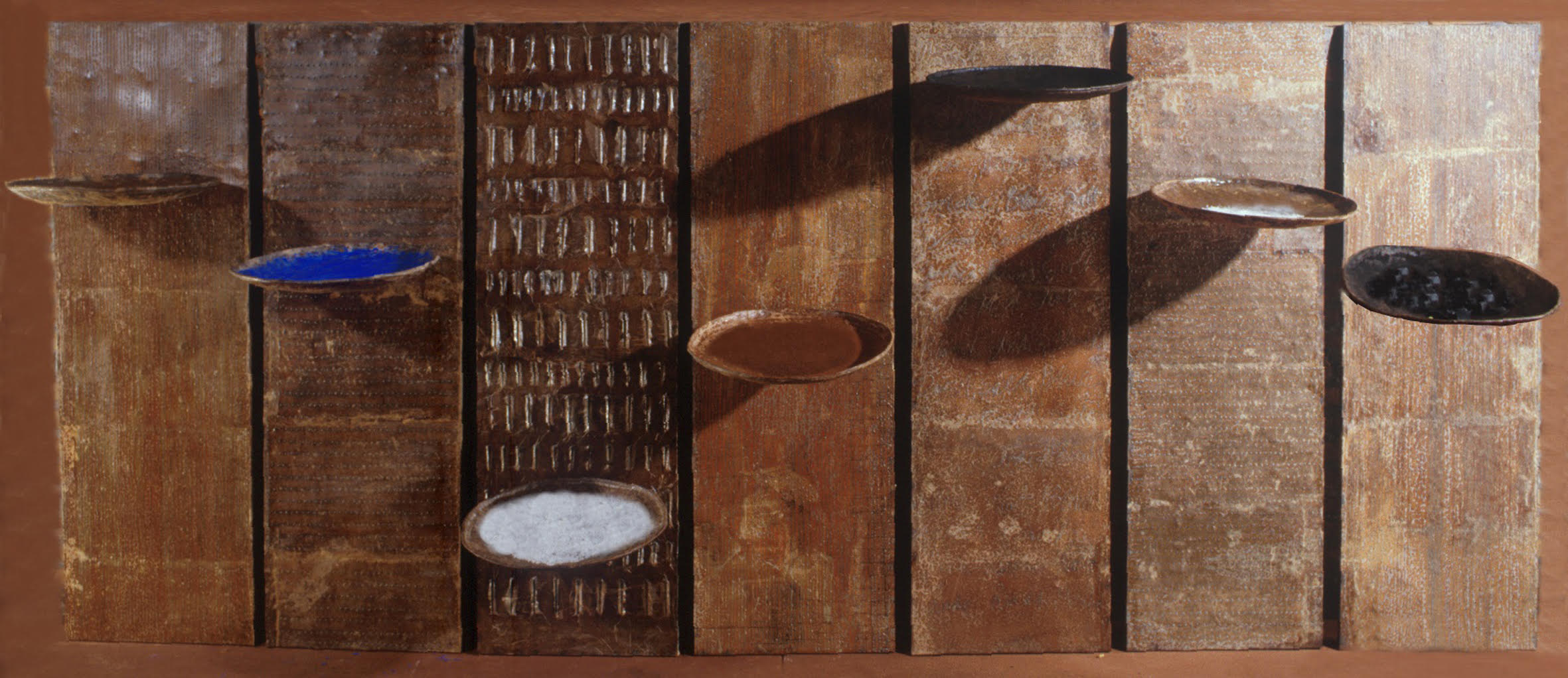
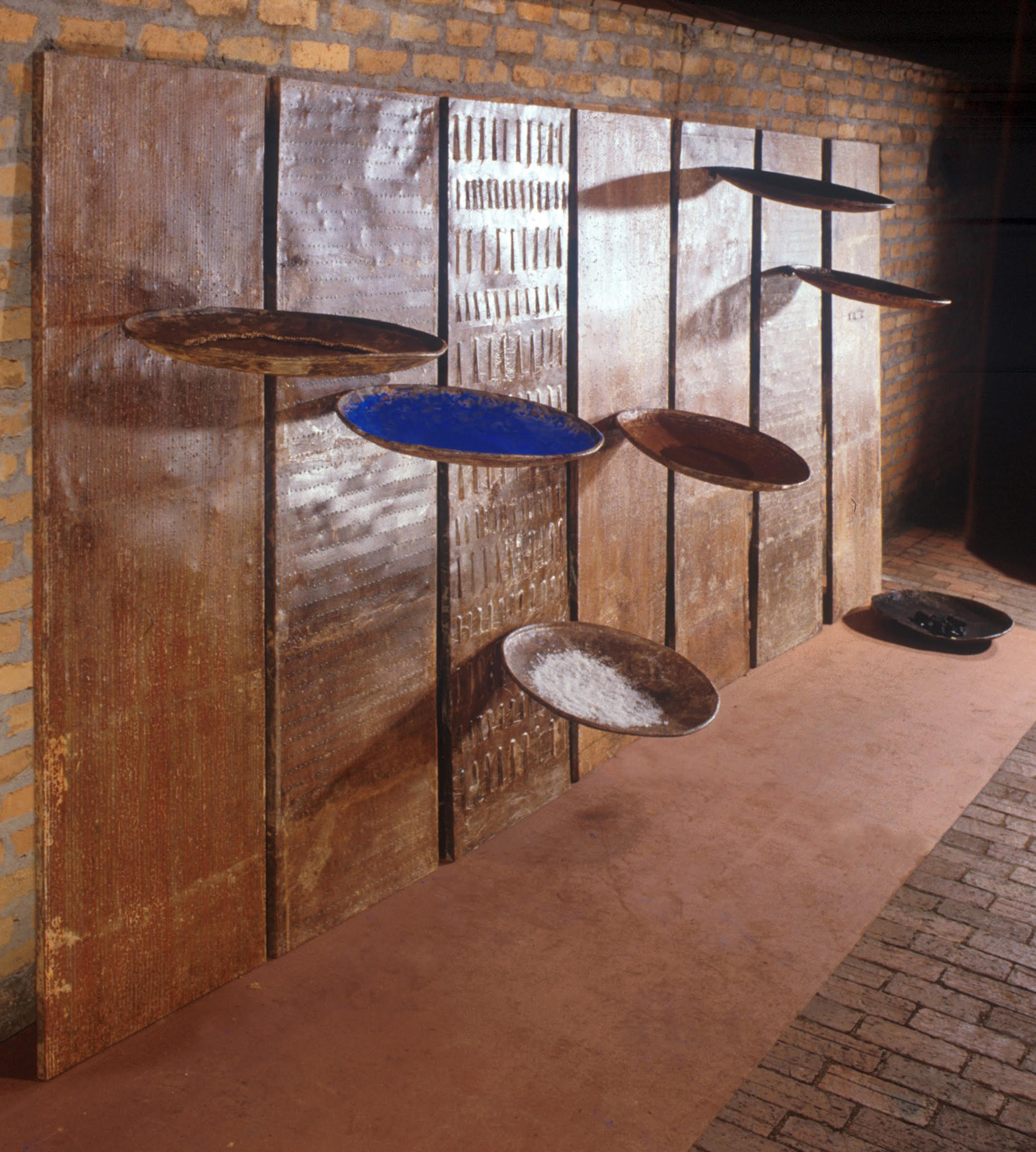
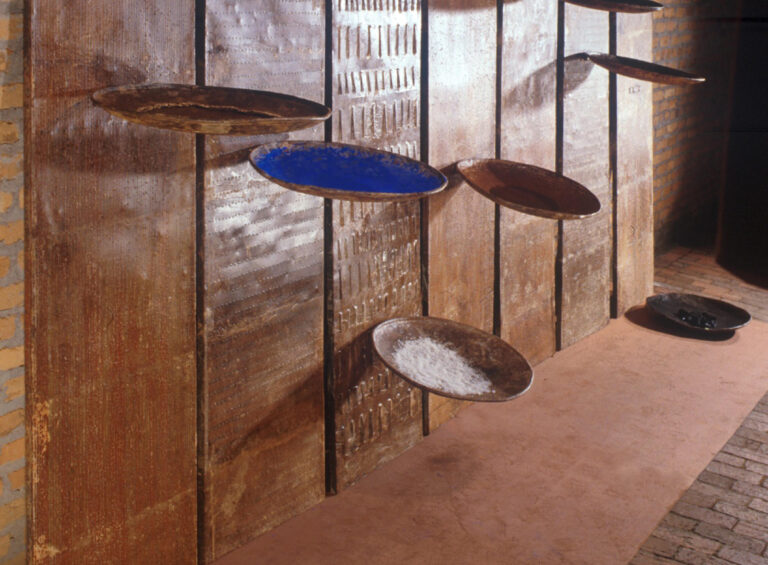
Having watched artists working in metal, I became very interested in expanding what had previously been, for me, a largely two-dimensional practice—drawing, painting, collage. From there, I began to move into other materials. My interest in metal, in particular, came directly from working alongside artists who were engaged in that medium (figs. 13, 14). That was a direct influence of the workshops.
I will never forget watching Sokari Douglas Camp work. That experience has stayed with me for a very long time. I returned to it later, carrying the memory of having shared that creative environment—an environment that was marked by generosity.
And I think that this is one of the defining aspects of the workshops: the generosity of artists in sharing their ideas, their knowledge, and their space.
These elements never left me. I have included my own works here to reflect that sense of curiosity—the desire to explore different mediums—which emerged from working alongside artists who were themselves working across different forms and materials.
When I think back on the broader context—the histories and conditions that had separated these nations, these Southern African countries—I am struck by how necessary it was to begin breaking those separations down. The workshops created something else: a space based on linkages rather than borders.
And I think that this was one of the most important and compelling motivations for being part of the workshops.
The 2024 C-MAP Africa research program was conceived and organized by Beya Othmani (C-MAP Africa Fellow) and Ugochukwu-Smooth Nzewi (The Steven and Lisa Tananbaum Curator, Department of Painting and Sculpture, and C-MAP Africa Group Leader). Read more about C-MAP here.
- 1For more information, see “Triangle Network History,” Triangle Network website, https://www.trianglenetwork.org/triangle-network/about/triangle-network-history/. ↩︎