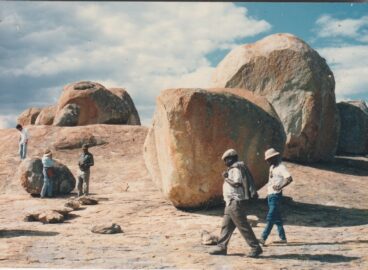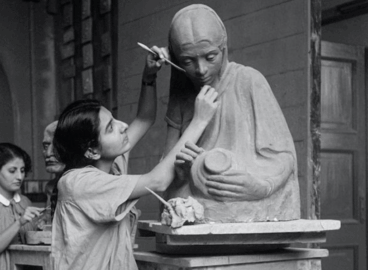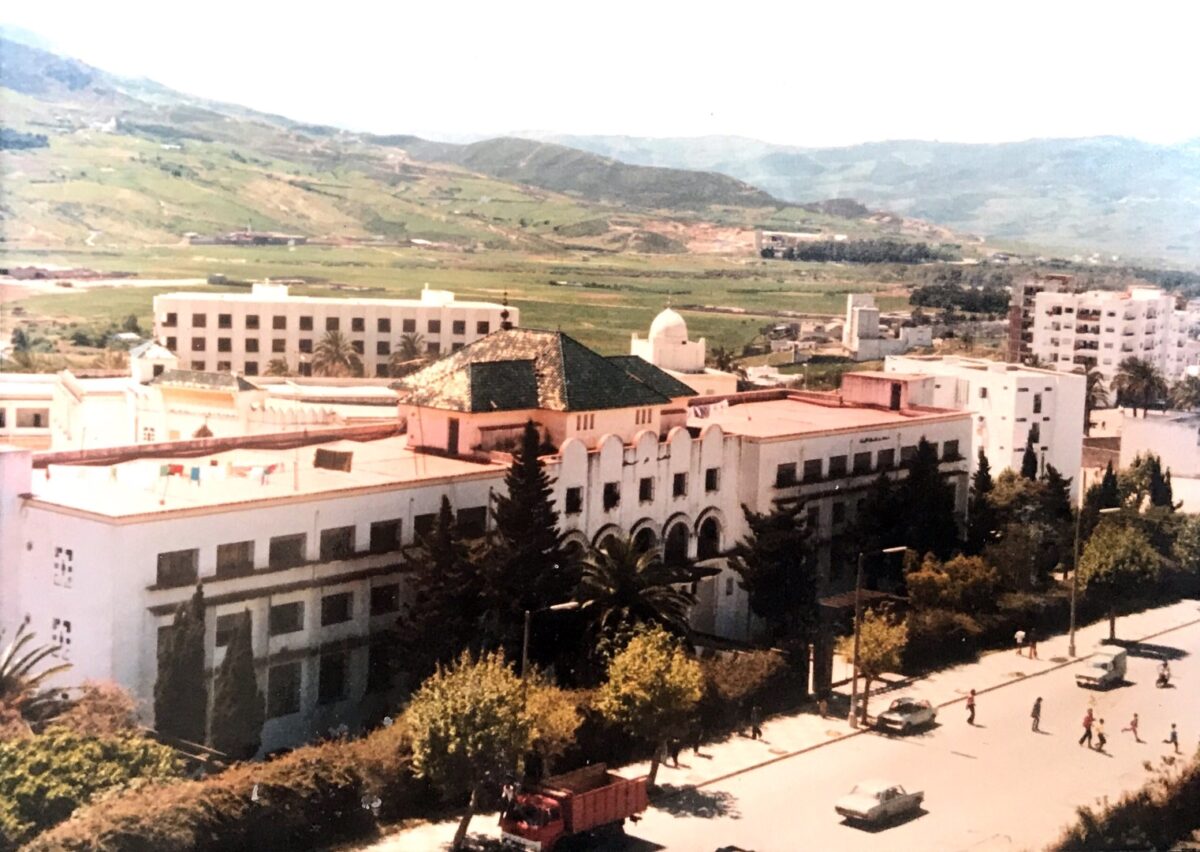
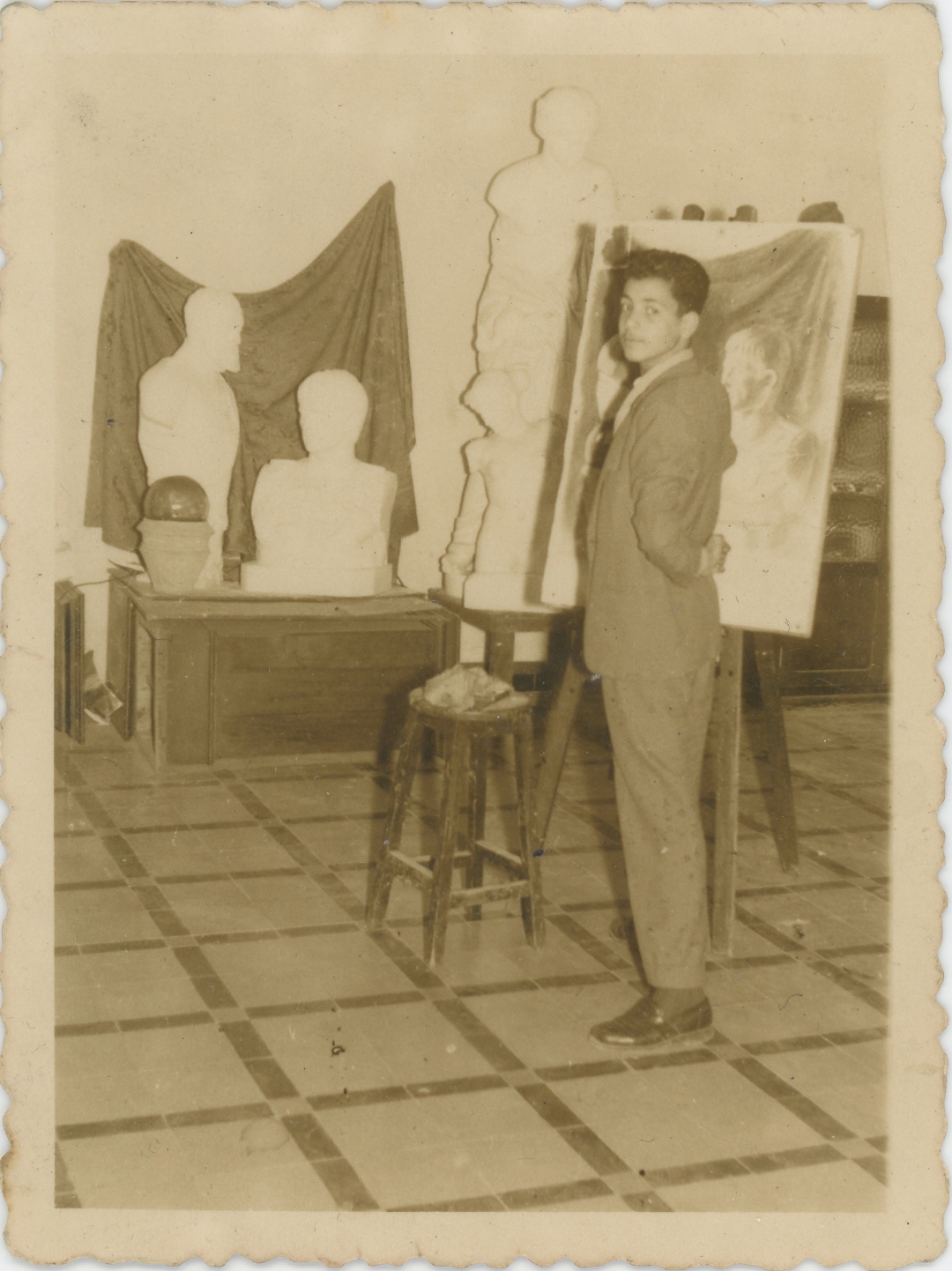
Morocco’s first fine arts school, L’Institut national des beaux-arts (The National Institute of Fine Arts; hereafter INBA), is located in Tetouan—a city in the northern region known as the Rif (fig. 1). The school was founded in 1946 by the Spanish colonial government as La Escuela preparatoria de bellas artes (The Preparatory School of Fine Arts; hereafter EPBA) and served as part of military dictator Francisco Franco’s mission to formulate a more positive image abroad after the Spanish Civil War (1936–39).1According to Elisa Germán, after the Spanish Civil War, which resulted in General Franco’s victory and the start of his military dictatorship, the government attempted to rehabilitate its negative image through the arts. I argue that the arts were also used as a form of soft power to create connections and to emphasize a shared Andalusian past with Morocco to justify Spain’s claims to the land. Germán, “The Creative State: The Calcografía Nacional and Printmaking in the Spanish Civil War and Francoist Madrid, 1936–1959” (PhD diss., Boston University, 2020), 147. While fine arts courses were offered in primary schools during the French and Spanish protectorate era (1912–56), the EPBA, led by the Spanish painter Mariano Bertuchi Nieto (1884–1955), was the first of its kind to provide Moroccans with the opportunity to extensively study fine arts, obtain scholarships to study abroad, and envision a career as an artist or fine arts instructor (fig. 2).2Bouabid Bouzaid, “Centro de arte moderno de Tetuán,” in Catálogo: Centro de arte moderno de Tetuán, ed. Bouabid Bouzaid et al., exh. cat. (Centro de Arte Moderno de Tetuán, 2013), 14. To this day, Bertuchi is recognized by many Tetouanis as the “Spiritual Father” of “La Escuela Pictórica de Tetuán” (The Pictorial School of Tetouan) or “La Escuela de Tetuán” (The Tetouan School)—labels coined by Spanish art critics Carlos Antonio Areán González and Dora Bacaïcoa on the occasion of a group exhibition of Tetouani artists at the Ateneo de Madrid in 1967.3Bouzaid, “Centro de arte moderno de Tetuán,” 14.
In the 1950s, the best Moroccan students having completed their studies at the EPBA were awarded scholarships by the Spanish government to continue their education at institutions such as Madrid’s Royal Academy of Fine Arts of San Fernando or Seville’s Royal Academy of Fine Arts of Saint Isabel of Hungary.4It is important to note that this exchange opportunity was also extended to students in Spain. Spanish academies sent their students to Chefchaouen and Tetouan to “perfect their technique, sensibility, and contact with their brother country” during the protectorate era. Khalil Ben Oumaïa, “Succès artistiques à Madrid, avec l’exposition d’un peintre marocain (Janvier 1941),” in Hommage à Feu Mohamed Sarghini: Artiste Peintre, 1923–1991, exh. cat. (Ministère des Affaires Culturelles, Rabat,1991), unpaginated. As in most of the formerly colonized world, the first group of artists studying in Europe—equipped with fine arts as a tool for building a “modern civilization”—returned home to their newly independent country to spearhead a “cultural renaissance.”5Mahmoud Hammad, “Arab Art . . . and Its Position in Relation to the World’s Art (1971),” in Modern Art in The Arab World: Primary Documents, ed. Anneka Lenssen et al. (The Museum of Modern Art, 2018), 339. In Spain, Franco maintained a conservative environment and retrograde cultural agenda throughout his dictatorial reign (1939–75).6Maria Begoña Fernandez Cabaleiro, “La Escuela de Madrid en la crítica de arte del Franquismo: La ‘nuncarota’ conexión con la vanguardia,” in “Nueva época,” special issue, Espacio, Tiempo, y Forma Serie VII. Historia del Arte, no.3 (2015): 86. Germán, “The Creative State,” 116. In higher education, he eliminated “decadent” influences, foreign emulation, Russophilia, effeminacy, and the dehumanization of art and literature, instead looking to Spain’s Golden Age, or the neoclassical eras of the 16th through 18th centuries, as models for the artistic values he encouraged.7Germán, “The Creative State,” 118. As a result, the environment in which Tetouan’s modern painters studied was a restrictive one in that all personal freedom of thinking and imagination had been eliminated.8Bouabid Bouzaid, “Madrasa Tetouan al Tashkili,” in Peintres de Tétouan, ed. M’hammed Benaboudand Bouabid Bouzaid (L’Association Tétouan Asmir, 2009), 2: 9–10. According to scholar Fernando Labrada Martín, individual creative pursuits were undertaken only after students had developed a sound academic foundation at one of the Spanish art academies.9Germán, “The Creative State,” 123. See also Fernando Labrada Martín, La estampación artística. Discursos leídos ante la Academia de bellas artes de San Fernando en la recepción publica de Sr. D. Fernando Labrada el día 2 de abril de 1936 (Real Academia de bellas artes de San Fernando, 1936). In addition to cultural conservatism, Franco promoted education in “practical and utilitarian fields” to prepare students for nation-building. As a result, Moroccan students also obtained teaching degrees and were, for the first time, equipped to professionalize themselves as instructors of fine arts.10Mohamed Sarghini received his teaching certification in 1950, Meriem Meziane in 1959, Meki Megara in 1961, Saâd Ben Cheffaj in 1962, and Ahmed Amrani in 1965.
While the INBA’s contemporary artists have gained attention in the art market and the international exhibition circuit, the school’s modern period, which I designate as the 1950s through the 1970s, remains largely an enigma. Contemporary artists from Tetouan are therefore presented as if emerging from a void.11Scholars Silvia Naef and Nada Shabout have both stated that contemporary practice is incorrectly believed to have emerged from a “total void” or from what has been categorized as “ethnographic artifacts” of Islamic and traditional African arts, which is a view that “utterly neglects the modern.” Naef, “Visual Modernity in the Arab World, Turkey, and Iran: Reintroducing the ‘Missing Modern,’” Asiatische Studien—Études Asiatiques 70, no. 4 (2016): 1005; and Shabout, “Writing of Art History, Archiving, and the Arab World,” posted May 13, 2020, YouTube, https://www.youtube.com/watch?v=PvLNpXZg7g4. The Francophone hegemony of Morocco’s cultural discourse has centered Casablanca’s modern artists, while Tetouan’s cultural scene has been superficially discussed, sidelined, or absent altogether.12Tina Barouti, “Palestine as Solidarity and Metaphor in Morocco’s Rif: Ahmed Amrani’s Palestina (1978) and Adelante (1979),” in “Morocco’s Palestine,” special issue, Souffles-Monde: A Pan-African Journal and Platform, no. 3 (2025), https://www.soufflesmonde.com/posts/palestine-as-solidarity-and-metaphor-in-moroccos-rif-ahmed-amranis-palestina-1978-and-adelante-1979. Artists such as Ahmed Amrani (b. 1942), Saâd Ben Cheffaj (b. 1939), and Meki Megara (1933–2009) not only trained at the colonial-era EPBA, but they also became instructors at the ENBA in the postindependence period. Mohamed Sarghini (1923–1991) would bypass the preparatory school to become the first Moroccan to enroll at a European art academy. He then returned to Tetouan to serve as the school’s first Moroccan director. Meriem Meziane (1930–2009) would also bypass the EPBA and become the first Moroccan woman to enroll at an art academy abroad. Though she never taught or studied at the Tetouan art school, her trailblazing career as a woman artist is important to Tetouan’s art history.13It is important to also credit Chems Eddoha Ataa Allah, who began her studies at the ENBA in 1957 and became the first Moroccan woman to graduate from the school in the postindependence era. Their work, among that of many others, shows that Moroccan modern art is multifaceted—both within a Tetouani context and on a national scale. In their personal practices, they experimented with a diversity of formal styles, thereby breaking away from the conservatism for which the Tetouan art school was known.
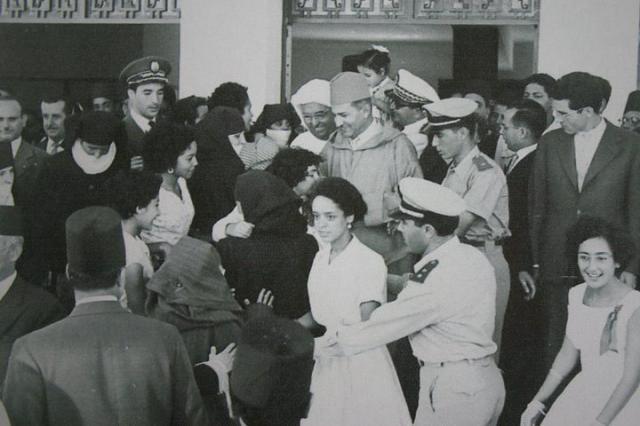
After Morocco’s independence in 1956, Spanish instructors and students gradually departed the school, and Sarghini began his tenure as director—a post he held until 1986. To consolidate the institution into the larger national project, King Mohammed V re-inaugurated the EPBA as L’Ecole nationale des beaux-arts (The National School of Fine Arts; hereafter ENBA) in 1957 (fig. 3). The immediate postindependence period has been described as a time of “Moroccanization” or “valorization of Moroccan identity,” with the end goal of creating a “purely” Moroccan school through the appointment of a Moroccan director and enrollment of a Moroccan student body.14María Dolores Jiménez Valiente, “La Escuela pictórica de Tetuán: Historia, desarrollo e impronta del arte marroquí contemporáneo” (PhD diss., Universidad de Alicante, 2018), 132; Tania Chorfi, “Introduction à l’art contemporain marocain: L’école picturale de Tétouan (Partie 1),” posted July 25, 2020, YouTube, https://www.youtube.com/watch?v=iJqI4Ydrs8E; Bouzaid, “Centro de arte moderno de Tetuán,” 14–15. Unlike at Casablanca’s art school, where Farid Belkahia (1934–2014) became director in 1962 and led his peers through a pedagogical overhaul, the ENBA maintained an approach to fine arts inherited from Spain. I argue that there are many reasons for the ENBA’s slow shift away from the metropole of Madrid. Tetouan, and the greater Rif region, was disenfranchised by the central Moroccan government in the years immediately after independence—leaving it politically, socially, and culturally disconnected. One response to this subjugation is the Rif Revolts of 1958, which shaped the conditions under which the institution evolved.15Barouti, “Palestine as Solidarity and Metaphor in Morocco’s Rif,” 2025.
Despite this turmoil, the decades following independence in Morocco were a time of openness and study in search of emancipation due to the atmosphere of cultural and patriotic movement.16Bouzaid, “Madrasa Tetouan al Tashkili,” 9–10. It was a moment of renewed energy and creativity, with debates over authenticity playing a central role in artistic circles. Bouabid Bouzaid (b. 1953), an alumnus of the art school and later an instructor there, wrote that this was a difficult stage in the country’s history as many first- and second-generation artists were preoccupied with the question of originality, how to define modernity, and the search for identity.17Bouzaid, “Madrasa Tetouan al Tashkili,” 9–10.
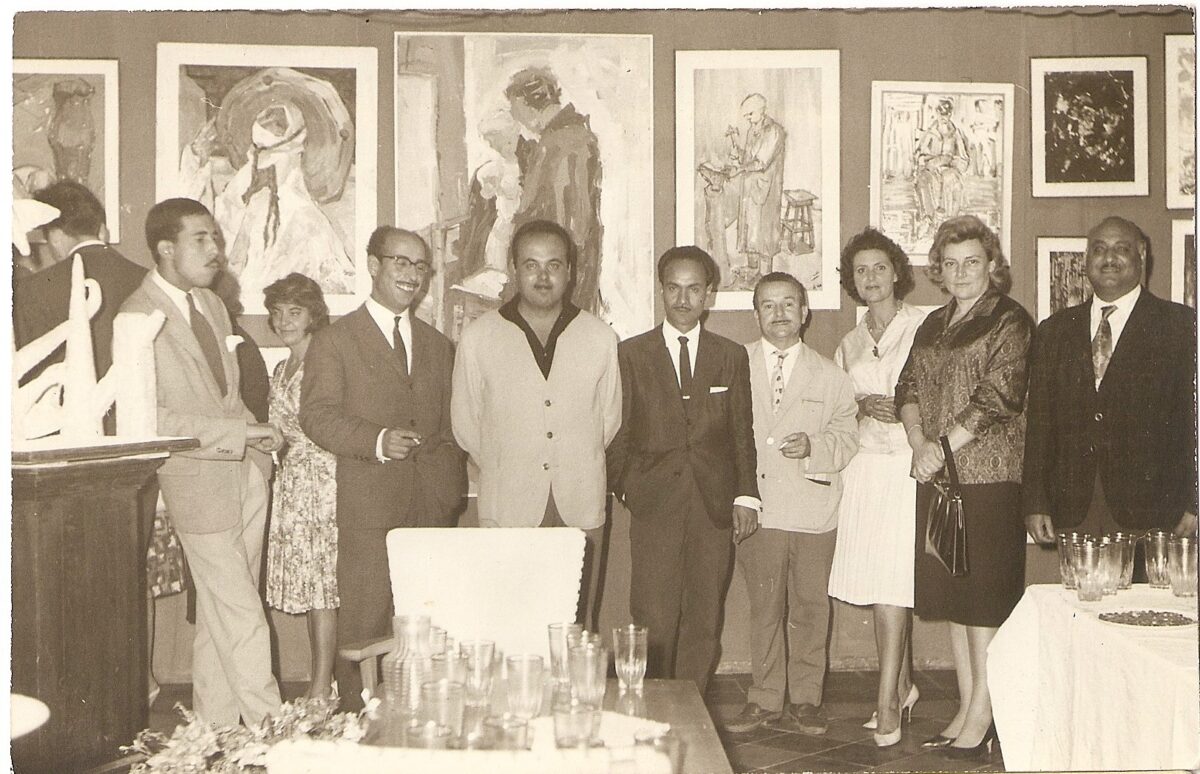
Art historian María Dolores Jimenéz Valiente wrote that after independence, the ENBA maintained Bertuchi’s pedagogical model, albeit with slight modifications including an increase in courses, workshops, and teaching hours.18Valiente, “La Escuela Pictórica de Tetuán,” 130. From the 1960s onward, course load and study hours increased from 16 to 45 hours per week.19Valiente, “La Escuela Pictórica de Tetuán,” 130. Students completed preparatory coursework across drawing, anatomy, art history, decorative arts, and perspective before choosing a specialty in their second or third year.20Valiente, “La Escuela Pictórica de Tetuán,” 124. The most significant change, perhaps as part of the king’s nationalization project, was that the school was now recognized at the secondary education level, thereby affording students the opportunity to receive a diploma at the end of their three-year study.
In Casablanca, Belkahia and his peers believed that arts education in Morocco at the onset of independence was deficient, incompatible with the needs of Moroccans, and shaped by imported, outdated colonial models. Indeed, they referred to it as “backward” and “bastardized.”21Farid Belkahia et al., “Responses to the Souffles Artists’ Questionnaire (1967),” in Lenssen et al., Modern Art in the Arab World, 271. Mohamed Chabâa (1935–2013) lamented that colonialism had “corrupted” Moroccan society’s taste, while Jilali Gharbaoui (1930–1971) believed that Moroccan arts education was “incomplete” and failed to teach students “how to see.”22Belkahia et al., “Responses to the Souffles Artists’ Questionnaire” (1967),” 271–72. The artists associated with Casablanca’s art school had a very different experience from those in Tetouan. In the 1960s and 1970s, the former led a pedagogical overhaul, moving away from fine arts teachings inherited from Europe and toward a greater exposure to local Moroccan arts and crafts, particularly the visual culture of the Imazighen, in order to form an inherently Moroccan visual culture.23Tina Barouti, “Vernacular Culture and Abstraction,” in Cy Twombly: Marocco, 1952/1953, exh. cat. (Humboldt Books, 2023): 9.
Although the ENBA’s pedagogy remained unchanged, its first generation of artists was equally preoccupied with formal innovation and a quest for a Moroccan identity in their individual artistic practices. In the colonial period, emphasis on Orientalist subject matter or stereotypical scenes of daily life depicting an unchanged, timeless Morocco akin to Spain’s Andalusian past were used as mythmaking and propaganda to justify Spain’s presence in northern Morocco.24For more, see Tina Barouti, “Our Dream Was to Rescue: Preserving the Past and Preparing the Future in Tétouan’s Centro de Arte Moderno,” Spain-North Africa Project, posted July 8, 2019, https://www.spainnorthafricaproject.org/bulletin/2019/7/8/arts-feature-our-dream-was-to-rescue. By the postindependence period, it can be argued that Sarghini, Meziane, Megara, Ben Cheffaj, and Amrani continued painting scenes of local people, heritage, folklore, and landscapes as a strategy in their search for national identity. They drew from a multitude of formal approaches and image traditions, including Islamic calligraphy, ancient mythology, cosmology, abstraction, and figuration, as well as from Cubism and Expressionism. They synthesized their local culture with forms inherited from multiple sources, thereby affirming Tetouanis as artists in a modern, connected world. For the sake of space, this essay will highlight several examples, but it is in no way intended to be an exhaustive review of all the artists associated with the institution and the city’s artistic scene.
As the ENBA’s first Moroccan director, Sarghini is a central figure in Tetouan’s modern art history (fig. 4). Despite his role as an administrator and upholder of colonial-era fine arts pedagogy, he was experimenting with radically new forms to represent his culture and identity. In his 1958 Cortège de mariée (Bridal Procession), for example, he depicted a wedding procession through a natural landscape (fig. 5). Sarghini has reduced figures, animals, and objects to geometric forms—to triangles, rhombi, ovals—straying from academic realism and instead utilizing a daring formal approach. His subjects appear to chaotically merge with the tranquil background. Ultimately, Sarghini’s Cortège de mariée borrows the compositional structure and subject matter of Orientalist paintings only to deconstruct them.
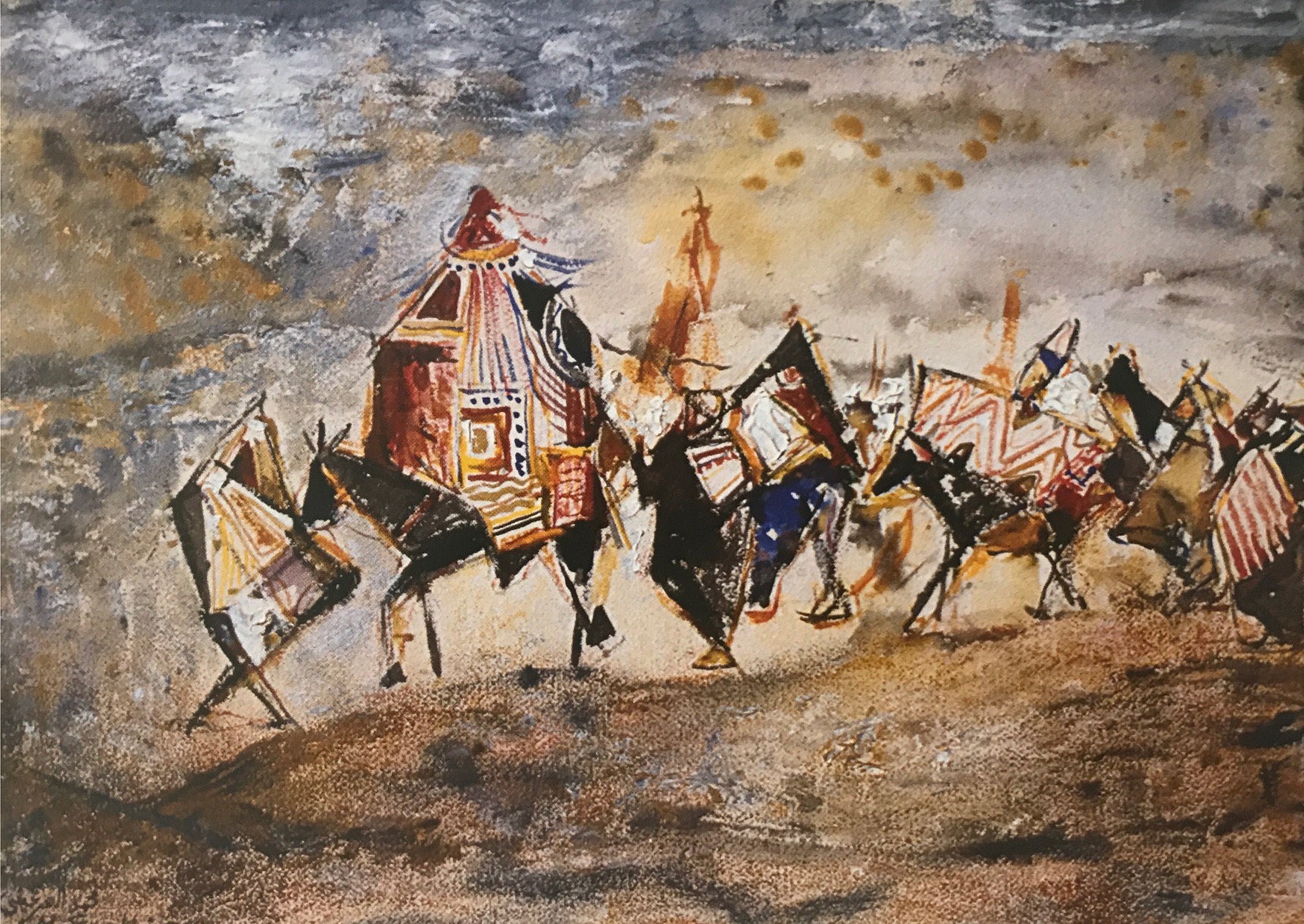
Figure 5. Mohamed Sarghini. Cortège de mariée (Bridal Procession). 1958. Mixed media on paper, 19 11/16 × 25 5/8" (50 × 65 cm). Private Collection. Courtesy of the Mohamed Sarghini Estate
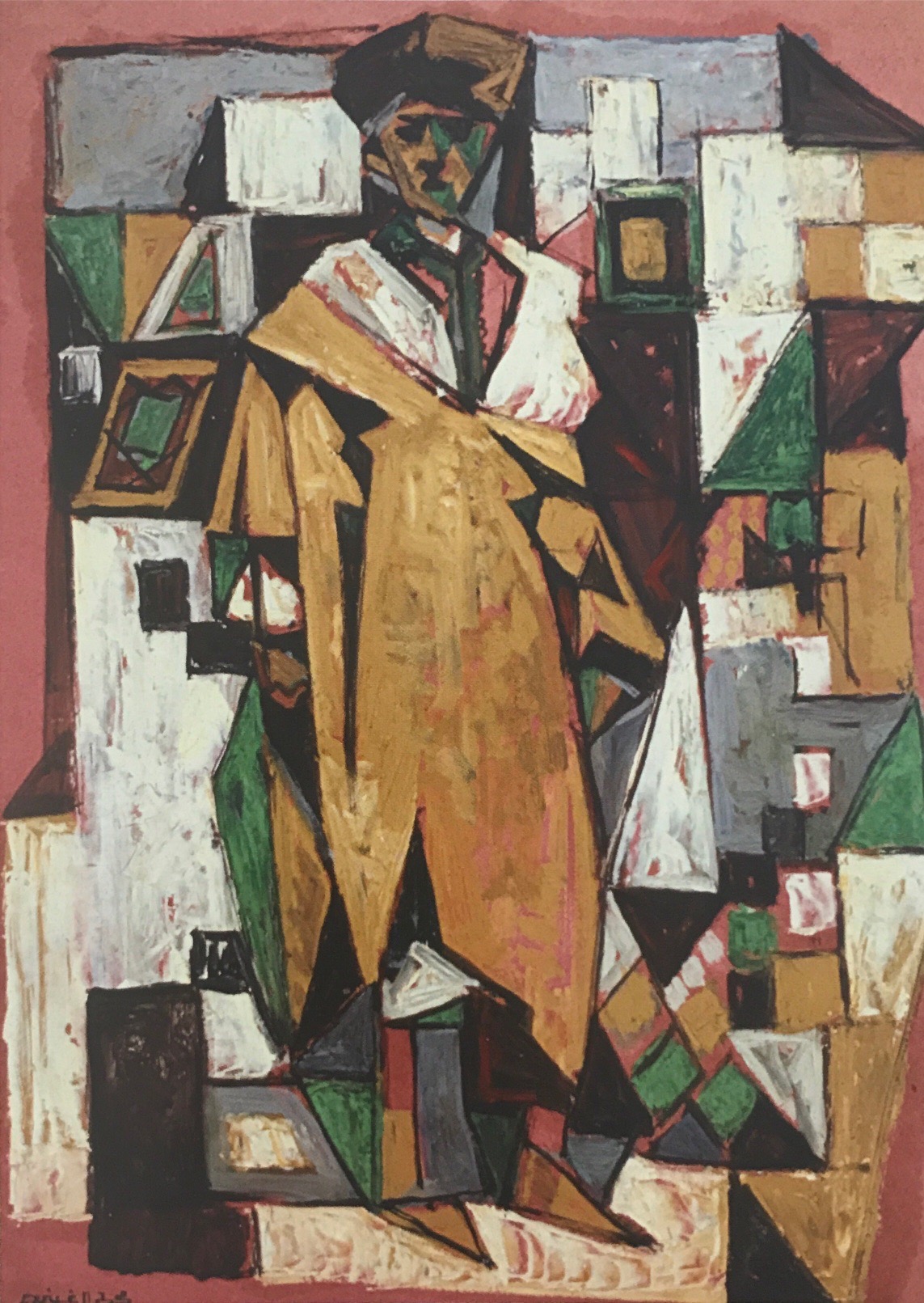
Figure 6. Mohamed Sarghini. L’homme et son univers (Man and His Universe). 1957. Oil on board, 24 13/16 × 19 5/16" (63 × 49 cm). Private Collection. Courtesy of the Mohamed Sarghini Estate
This geometric rendering can also be found in L’homme et son univers (Man and His Universe), an existential painting created just one year after Morocco declared its independence (fig. 6). At the center of the composition, a man stands alone, dressed in Moroccan attire, appearing to float in front of a mass of multicolored shapes. He looks directly at us through eyes made of dark black brushstrokes, while his hands and feet blend into a geometric background composed of colored blocks. Sarghini’s more cubist approach here emphasizes the two-dimensionality of the canvas and reduces, fractures, analyzes, and rearranges his subject, thereby presenting a new way of seeing. By the mid-to-late 1960s, his work had become increasingly abstract.
Like Sarghini, Meriem Meziane bypassed training at Tetouan’s EPBA to directly enroll in 1953 at Madrid’s Royal Academy of Arts. Born in Melilla, a Spanish enclave on the African continent connected to northeast Morocco by a land border, Meziane came from a prominent military family, a privileged position that undoubtedly granted her this institutional access. Despite this, she is considered a key figure in Tetouan’s art history—a reflection of the specificity of Tetouan’s artistic milieu. Indeed, the art community in Tetouan was relatively small and tightly knit, and so artists were integrated into its history not only through formal training or teaching, but also through sustained presence—through friendships, regular exhibitions, and active participation in the local scene. Meziane, who had a studio in the nearby Spanish enclave of Ceuta during this period, was deeply embedded in the artistic network.25For more on Meriem Meziane’s reception in Spain and her studio in Ceuta see “MERIEM MAZIAN Moroccan painter 1953 مريم مزيان معرض التراث المغربي باسبانيا,” posted June 27, 2019, YouTube, https://www.youtube.com/watch?v=aJC4_1o0Ke0. She also was the first Moroccan artist in Tetouan to ever have a gallery exhibition, making her undoubtedly an important part of the city’s artistic ecosystem. It is important to distinguish between the institution itself and what has been more loosely described by Areán and Bacaïcoa as the “Tetouan School” or “Pictorial School of Tetouan”—a critical category akin to the Casablanca Group, also known as the Casablanca School—that designates a broader artistic tendency rather than a formal affiliation with the ENBA.
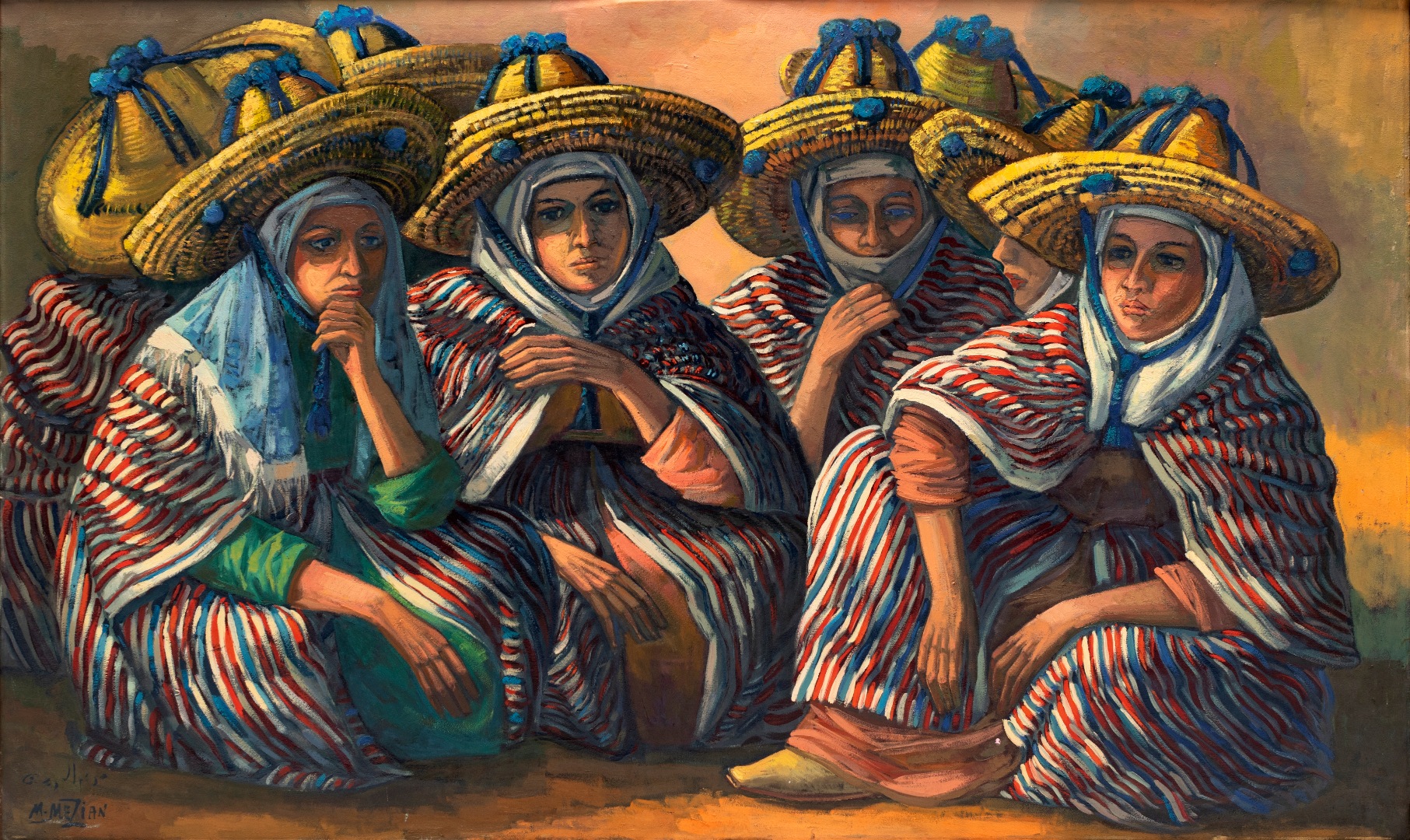
Figure 7. Meriem Maziane. Jebliat. 1950. Oil on canvas, 48 × 70 7/8" (122 × 180 cm). Collection La Fondation Nationale des Musées-Musée Mohammed VI d’Art Moderne et Contemporain, donation succession Meziane. © Graphely/MMVI
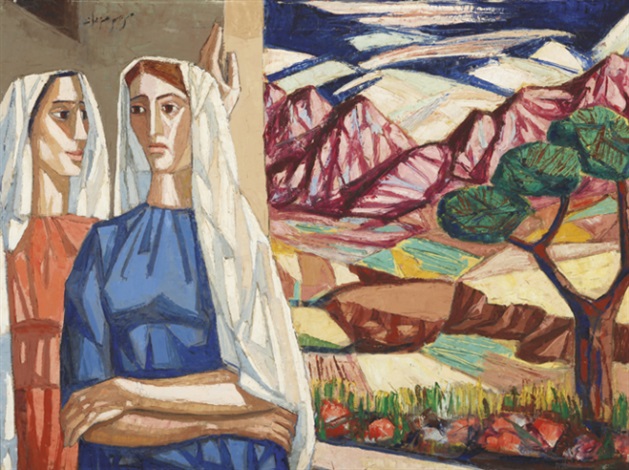
Figure 8. Meriem Maziane. Femmes à la fenêtre (Women at the Window). Undated. Oil on canvas, 29 1/2 × 39 3/8" (75 × 100 cm). Private Collection
Much like Sarghini, Meziane monumentalized the commonplace. According to art historian Samir El Azhar, Morocco is omnipresent in her paintings—particularly the beauty of its landscape, the generosity of its people, and its ancestral traditions.26Samir El Azhar, “The Changing Roles of Female Visual Artists in Morocco,” Journal of Global Initiatives: Policy, Pedagogy, Perspective 14, no. 2 (2019): 69. Meziane was especially interested in women’s performance of social, ritual, and festive activities and borrowed her subjects, colors, and forms from her home in the Rif Mountains.27El Azhar, “The Changing Roles of Female Visual Artists in Morocco,” 69. Art historian Mohamed Adib Slaoui has noted that her “realistic” paintings were particularly focused on Imazighen, jbali (people of the mountains), and Tetouani women and their costumes, jewelry, and social traditions, thereby giving the work a special “ethnographic and cultural vision.”28Mohamed Adib Slaoui, Moroccan Visual Art: A Female Perspective, trans. Samir El Azhar (Editions Oumnia, 2012), unpaginated. One such example is the Jebilat painting from 1950 in the permanent collection of the Mohamed VI Museum of Modern and Contemporary Art (MMVI) in Rabat (fig. 7). Farmworkers were a common motif in modern painting across the Arab world, and here, Meziane presents them as the backbone of a newly independent Morocco.29In Egypt, for example, Mahmoud Mukhtar monumentalized the peasant woman in his iconic pink granite sculpture Nahdat Misr (Egyptian Awakening; 1919–28). According to Meziane, she wished to reflect her country in her work, especially “people of my own kind, of my own race, born between the Mediterranean and Black Africa who illustrate a great ethnographic richness including all aspects of Africa, Arab, and Berber civilizations . . . a picture that is born and ends in Morocco.”30Meriem Meziane, “The Painter’s Reflections,” trans. Dawn Schwartz, in Morocco as Seen by a Painter (Royal Air Maroc, 1982), 49.
Meziane has noted that her decision to study in Madrid’s art academy was due to her desire to adopt the “figurative style” that remained a dominant artistic approach throughout her career.31Meriem Meziane, “The Painter’s Reflections,” 49. While loyal to figuration, she also included more experimental formal elements in her work. In an undated oil painting titled Femmes à la fenêtre (Women at the Window), she has presented a landscape that moves away from realism, favoring a more geometric style (fig. 8). The colors are bold and exaggerated, with each element of the scene heavily outlined and brushstrokes left visible. On the left-hand side of the composition, two women in white headscarves and monochromatic dresses stand side by side, one gazing outward, the other turned inward with anxiety. We can interpret this painting as a commentary on the role of women in the newly independent nation, with the seemingly anxious woman serving as a metaphor for Morocco’s past while the woman in orange represents a more optimistic future, one in which Morocco is fertile, lush, and blossoming. We can also interpret these women as symbols, or guarantors, of future generations.
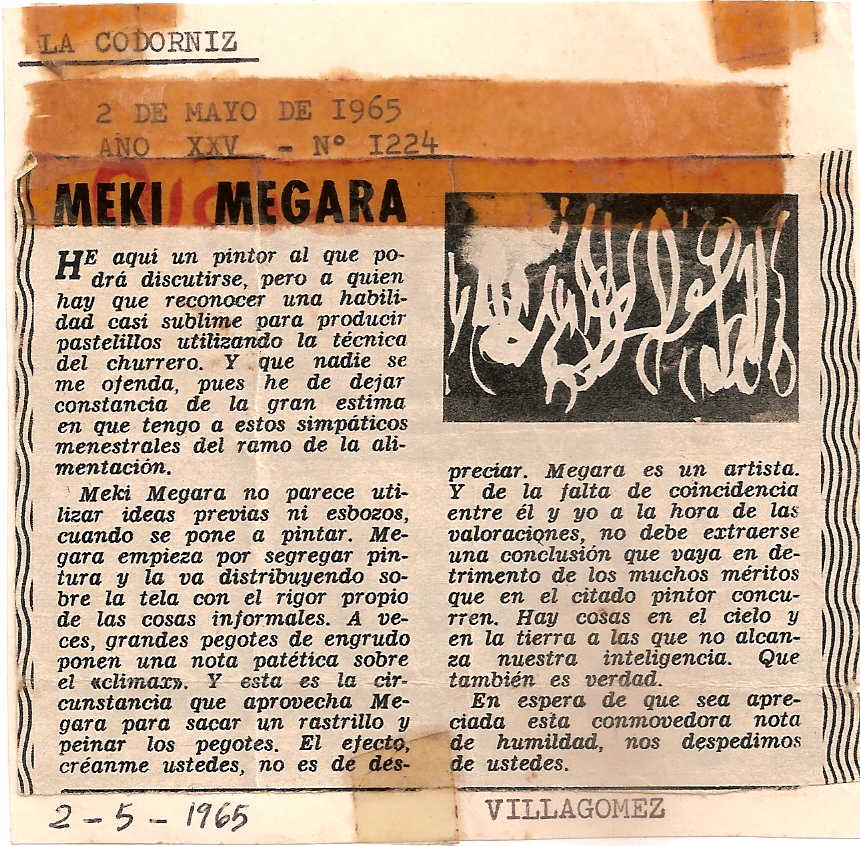
The artist Meki Megara utilized a variety of formal approaches, including the artistic tendency known as hurufiyya, or “letterism,” which merged modernist abstraction with Arabic calligraphy. He was consistently in dialogue with other Arab artists throughout the 1950s and 1970s via pan-Arab conferences, biennials, and exhibitions. Of all Tetouani modern painters, Megara was perhaps the one most championed by Spanish art critics and media outlets (fig. 9). They often presented him as the perfect example of the compatibility between so-called Moroccan sensibilities, such as calligraphy, and Spanish training. Scholar and friend of the artist M’hammed Benaboud has described Megara as “always open to the West but his life was a typical Tetouani one.”32M’hammed Benaboud, Mekki Megara (ASMR Association), 3. In his 1973 text Cinco momentos en cien años de arte español: 1874–1973, Areán expresses that what is most interesting about Arab artists like Megara is that “they all master the European ways of processing matter, eroding it, and applying it with refinement”; they use “occidental” techniques yet maintain “a deep-rooted loyalty to the Arab spirit.”33Carlos Antonio Areán González, Cinco momentos en cien años de arte español, 1874–1973 (Organización Sala, 1973), 271. He goes on to present Megara as an artist familiar with Spain and the “technical procedures” that “any good European painter” would know but ultimately a “man of the Islamic world” who is naturally and innately “concerned with calligraphic ease and the free flow of lines.”34Carlos Antonio Areán González, Comprender la pintura (Teide, 1969), 107. This is arguably a simplistic and essentialist reading of his work. Placed in the context of postindependence Morocco, Megara’s work is radical in its engagement with artistic trends of the larger Arab world and its break from academicism.
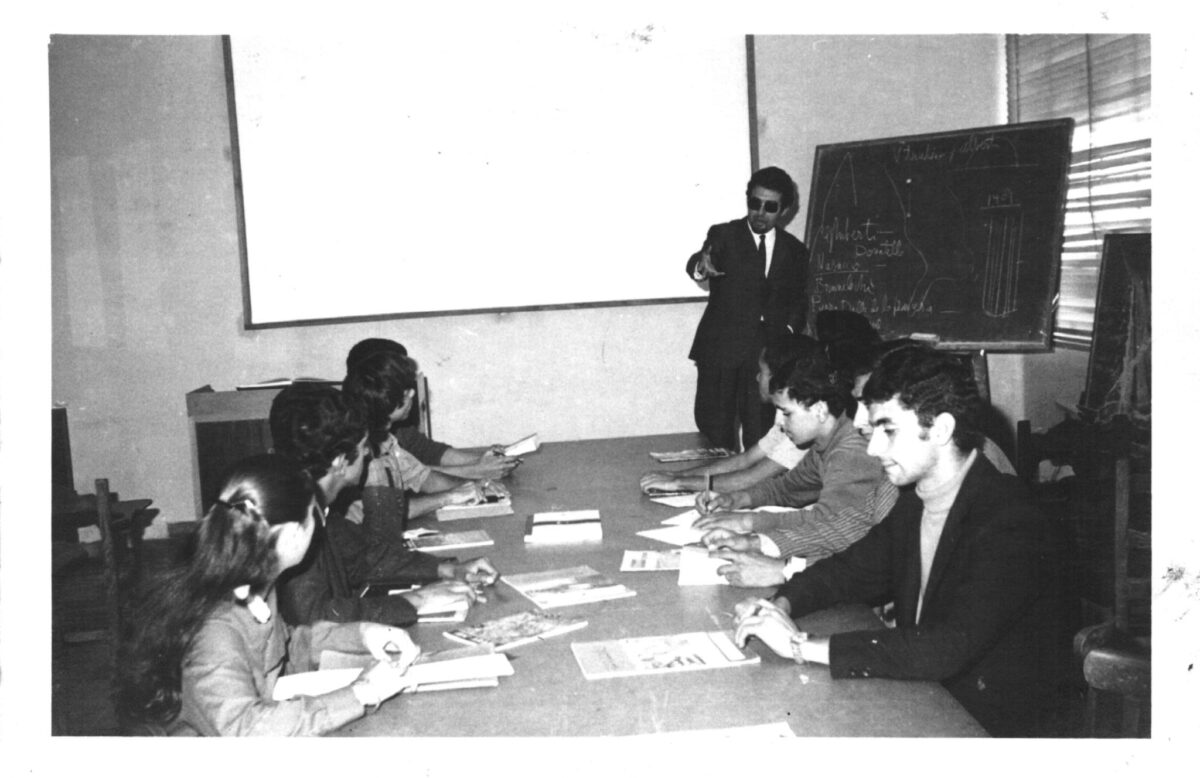
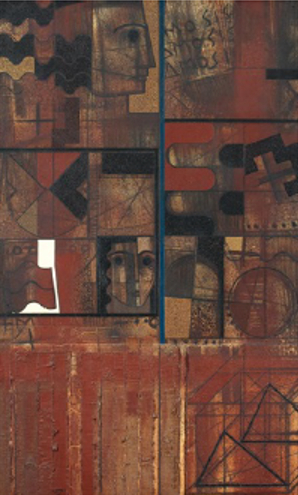
Saâd Ben Cheffaj, who was particularly concerned with conveying a unique Mediterranean identity, has often described himself as “of the Mediterranean”—rather than African, Arab, or Moroccan.35Saâd Ben Cheffaj, interview by author, 2018. I view his adoption of religious iconography and signs and symbols of the ancient civilizations as a desire for mythmaking in order to equate Tetouani identity with a sophisticated Mediterranean culture. By associating with ancient civilizations, Ben Cheffaj is aligning himself with the Western world and its artistic canon—a subject he taught at ENBA (fig. 10).36Ben Cheffaj was trained in art history at the École du Louvre in Paris, where he developed an interest in ancient mythology and Roman, Greek, and Egyptian cultures. He adopted figuration, expressionism, neorealism, and abstraction while exploring this unique subject matter. In the mixed-media work Composition from 1976, we see Ben Cheffaj’s signature style combining nude figures and references to ancient mythology emerge for the first time (fig. 11). The composition is structured in four sections: In the upper right, the repeated word “Amosis” references the Egyptian pharaoh, while pyramidal forms appear below. To the left, a statuesque female profile recalls the stylization of Minoan frescoes. Ben Cheffaj’s choice of subject matter aligns him with pan-Arab artistic trends of the time. Artists of the modern period were looking to ancient civilizations and regionalism; Lebanese excavated Phoenician culture, while Egyptian artists referenced the Pharaonic past.
Last but certainly not least, Ahmed Amrani is perhaps the most enigmatic figure of this generation. After returning to Morocco in 1965, he began teaching drawing, and by 1976, he had been named deputy director of ENBA, a position he held until 1984, when he left to assume his new role as director of Tetouan’s Ethnographic Museum. Throughout the 1960s and 1970s, Amrani’s work was the most politically charged and formally diverse of all his peers. His painting Protesta (1969)—the subject of my forthcoming monograph with Anthem Press—was a response to the Rif Revolts. I argue that other paintings, such as Adelante (1979) and Palestina (1978), serve as expressions of solidarity with the Palestinian cause and as metaphors for domestic turmoil in Morocco during the Years of Lead (1962–99).37Barouti, “Palestine as Solidarity and Metaphor in Morocco’s Rif,” 2025. In 1979, with the help of Bouzaid, Abdelkrim Ouazzani (b. 1954), and Habiba Bouhoumou, Amrani would launch the Spring Exhibitions in Tetouan, thereby introducing installation art to the city and changing the course of the institution for good.38I have an essay on this topic in a forthcoming book chapter being published by the American University in Cairo Press.
Moroccan art critics and art historians have not been kind to Tetouan’s modern artists. In his seminal text Peinture et identité, Khalil M’Rabet deems the alumni of the school “hispanized” in their training and comments that “in the end . . . nothing special stands out, except that each one aims at a personal style.”39Khalil M’Rabet, Peinture et identité: L’expérience marocaine (L’Harmattan, 1987), 93. He goes on to argue that Tetouan’s artists were “more connected to the metropole [Madrid] than to the rest of Morocco. It is not by chance that ‘The School of Tetouan’ was for years pampered in isolation.”40M’Rabet, Peinture et identité, 93. M’Rabet’s belief that “nothing special stands out” is an example of a popular pervasive attitude among Moroccan curators, collectors, and critics that Tetouan’s art school is “conservative,” “an island,” and even “a prison” where artists regurgitated a Spanish style of art-making.41These words were shared with me by cultural workers in Morocco during my fieldwork there in 2016–19. For Mohammed Melehi (1936–2020), who studied at the EPBA before becoming a central figure in the Casablanca Group, what he and his peers were doing was a “far cry from the decrepit academic dogma” found in Tetouan’s art school.42Mohammed Melehi, “Memories,” bauhaus imaginista journal, http://www.bauhaus-imaginista.org/articles/13/memories-of-mohamed-melehi. These words portray Tetouani artists as not upholding the celebratory narrative of the decolonial artist that has come to be expected of those working in postcolonial contexts.
The Tetouan art school’s slow transition away from the conservative arts pedagogy inherited from Spain coupled with the Rif region’s disenfranchisement by the state are reasons why the city’s modern artists have been understudied, misinterpreted, and sidelined in Morocco’s national art history. Although artists like Megara, Ben Cheffaj, Amrani, and others were experimenting in their own work, as demonstrated above, a pedagogical shift at the institution did not take place until the 1990s, when a young Faouzi Laatiris (b. 1958) launched his Volume and Installation workshop in 1993. Tetouan’s artists of the 1950s through 1970s, with their diversity of formal approaches, demonstrate that Moroccan modernism is multifaceted and challenge the singular definition of Moroccan modernism that has prevailed in the rapidly developing historiography of the past few decades.
Every effort has been made to contact the copyright holders for Figures 3 and 8 in this article. If you hold the rights to any of the material used and have not been contacted, please reach out to contact_c-map@moma.org so that proper credit can be attributed or the material removed.
- 1According to Elisa Germán, after the Spanish Civil War, which resulted in General Franco’s victory and the start of his military dictatorship, the government attempted to rehabilitate its negative image through the arts. I argue that the arts were also used as a form of soft power to create connections and to emphasize a shared Andalusian past with Morocco to justify Spain’s claims to the land. Germán, “The Creative State: The Calcografía Nacional and Printmaking in the Spanish Civil War and Francoist Madrid, 1936–1959” (PhD diss., Boston University, 2020), 147. ↩︎
- 2Bouabid Bouzaid, “Centro de arte moderno de Tetuán,” in Catálogo: Centro de arte moderno de Tetuán, ed. Bouabid Bouzaid et al., exh. cat. (Centro de Arte Moderno de Tetuán, 2013), 14. ↩︎
- 3Bouzaid, “Centro de arte moderno de Tetuán,” 14. ↩︎
- 4It is important to note that this exchange opportunity was also extended to students in Spain. Spanish academies sent their students to Chefchaouen and Tetouan to “perfect their technique, sensibility, and contact with their brother country” during the protectorate era. Khalil Ben Oumaïa, “Succès artistiques à Madrid, avec l’exposition d’un peintre marocain (Janvier 1941),” in Hommage à Feu Mohamed Sarghini: Artiste Peintre, 1923–1991, exh. cat. (Ministère des Affaires Culturelles, Rabat,1991), unpaginated. ↩︎
- 5Mahmoud Hammad, “Arab Art . . . and Its Position in Relation to the World’s Art (1971),” in Modern Art in The Arab World: Primary Documents, ed. Anneka Lenssen et al. (The Museum of Modern Art, 2018), 339. ↩︎
- 6Maria Begoña Fernandez Cabaleiro, “La Escuela de Madrid en la crítica de arte del Franquismo: La ‘nuncarota’ conexión con la vanguardia,” in “Nueva época,” special issue, Espacio, Tiempo, y Forma Serie VII. Historia del Arte, no.3 (2015): 86. Germán, “The Creative State,” 116. ↩︎
- 7Germán, “The Creative State,” 118. ↩︎
- 8Bouabid Bouzaid, “Madrasa Tetouan al Tashkili,” in Peintres de Tétouan, ed. M’hammed Benaboudand Bouabid Bouzaid (L’Association Tétouan Asmir, 2009), 2: 9–10. ↩︎
- 9Germán, “The Creative State,” 123. See also Fernando Labrada Martín, La estampación artística. Discursos leídos ante la Academia de bellas artes de San Fernando en la recepción publica de Sr. D. Fernando Labrada el día 2 de abril de 1936 (Real Academia de bellas artes de San Fernando, 1936). ↩︎
- 10Mohamed Sarghini received his teaching certification in 1950, Meriem Meziane in 1959, Meki Megara in 1961, Saâd Ben Cheffaj in 1962, and Ahmed Amrani in 1965. ↩︎
- 11Scholars Silvia Naef and Nada Shabout have both stated that contemporary practice is incorrectly believed to have emerged from a “total void” or from what has been categorized as “ethnographic artifacts” of Islamic and traditional African arts, which is a view that “utterly neglects the modern.” Naef, “Visual Modernity in the Arab World, Turkey, and Iran: Reintroducing the ‘Missing Modern,’” Asiatische Studien—Études Asiatiques 70, no. 4 (2016): 1005; and Shabout, “Writing of Art History, Archiving, and the Arab World,” posted May 13, 2020, YouTube, https://www.youtube.com/watch?v=PvLNpXZg7g4. ↩︎
- 12Tina Barouti, “Palestine as Solidarity and Metaphor in Morocco’s Rif: Ahmed Amrani’s Palestina (1978) and Adelante (1979),” in “Morocco’s Palestine,” special issue, Souffles-Monde: A Pan-African Journal and Platform, no. 3 (2025), https://www.soufflesmonde.com/posts/palestine-as-solidarity-and-metaphor-in-moroccos-rif-ahmed-amranis-palestina-1978-and-adelante-1979. ↩︎
- 13It is important to also credit Chems Eddoha Ataa Allah, who began her studies at the ENBA in 1957 and became the first Moroccan woman to graduate from the school in the postindependence era. ↩︎
- 14María Dolores Jiménez Valiente, “La Escuela pictórica de Tetuán: Historia, desarrollo e impronta del arte marroquí contemporáneo” (PhD diss., Universidad de Alicante, 2018), 132; Tania Chorfi, “Introduction à l’art contemporain marocain: L’école picturale de Tétouan (Partie 1),” posted July 25, 2020, YouTube, https://www.youtube.com/watch?v=iJqI4Ydrs8E; Bouzaid, “Centro de arte moderno de Tetuán,” 14–15. ↩︎
- 15Barouti, “Palestine as Solidarity and Metaphor in Morocco’s Rif,” 2025. ↩︎
- 16Bouzaid, “Madrasa Tetouan al Tashkili,” 9–10. ↩︎
- 17Bouzaid, “Madrasa Tetouan al Tashkili,” 9–10. ↩︎
- 18Valiente, “La Escuela Pictórica de Tetuán,” 130. ↩︎
- 19Valiente, “La Escuela Pictórica de Tetuán,” 130. ↩︎
- 20Valiente, “La Escuela Pictórica de Tetuán,” 124. ↩︎
- 21Farid Belkahia et al., “Responses to the Souffles Artists’ Questionnaire (1967),” in Lenssen et al., Modern Art in the Arab World, 271. ↩︎
- 22Belkahia et al., “Responses to the Souffles Artists’ Questionnaire” (1967),” 271–72. ↩︎
- 23Tina Barouti, “Vernacular Culture and Abstraction,” in Cy Twombly: Marocco, 1952/1953, exh. cat. (Humboldt Books, 2023): 9. ↩︎
- 24For more, see Tina Barouti, “Our Dream Was to Rescue: Preserving the Past and Preparing the Future in Tétouan’s Centro de Arte Moderno,” Spain-North Africa Project, posted July 8, 2019, https://www.spainnorthafricaproject.org/bulletin/2019/7/8/arts-feature-our-dream-was-to-rescue. ↩︎
- 25For more on Meriem Meziane’s reception in Spain and her studio in Ceuta see “MERIEM MAZIAN Moroccan painter 1953 مريم مزيان معرض التراث المغربي باسبانيا,” posted June 27, 2019, YouTube, https://www.youtube.com/watch?v=aJC4_1o0Ke0. ↩︎
- 26Samir El Azhar, “The Changing Roles of Female Visual Artists in Morocco,” Journal of Global Initiatives: Policy, Pedagogy, Perspective 14, no. 2 (2019): 69. ↩︎
- 27El Azhar, “The Changing Roles of Female Visual Artists in Morocco,” 69. ↩︎
- 28Mohamed Adib Slaoui, Moroccan Visual Art: A Female Perspective, trans. Samir El Azhar (Editions Oumnia, 2012), unpaginated. ↩︎
- 29In Egypt, for example, Mahmoud Mukhtar monumentalized the peasant woman in his iconic pink granite sculpture Nahdat Misr (Egyptian Awakening; 1919–28). ↩︎
- 30Meriem Meziane, “The Painter’s Reflections,” trans. Dawn Schwartz, in Morocco as Seen by a Painter (Royal Air Maroc, 1982), 49. ↩︎
- 31Meriem Meziane, “The Painter’s Reflections,” 49. ↩︎
- 32M’hammed Benaboud, Mekki Megara (ASMR Association), 3. ↩︎
- 33Carlos Antonio Areán González, Cinco momentos en cien años de arte español, 1874–1973 (Organización Sala, 1973), 271. ↩︎
- 34Carlos Antonio Areán González, Comprender la pintura (Teide, 1969), 107. ↩︎
- 35Saâd Ben Cheffaj, interview by author, 2018. ↩︎
- 36Ben Cheffaj was trained in art history at the École du Louvre in Paris, where he developed an interest in ancient mythology and Roman, Greek, and Egyptian cultures. ↩︎
- 37Barouti, “Palestine as Solidarity and Metaphor in Morocco’s Rif,” 2025. ↩︎
- 38I have an essay on this topic in a forthcoming book chapter being published by the American University in Cairo Press. ↩︎
- 39Khalil M’Rabet, Peinture et identité: L’expérience marocaine (L’Harmattan, 1987), 93. ↩︎
- 40M’Rabet, Peinture et identité, 93. ↩︎
- 41These words were shared with me by cultural workers in Morocco during my fieldwork there in 2016–19. ↩︎
- 42Mohammed Melehi, “Memories,” bauhaus imaginista journal, http://www.bauhaus-imaginista.org/articles/13/memories-of-mohamed-melehi. ↩︎