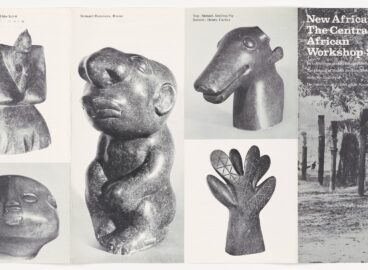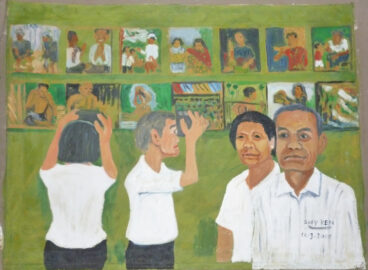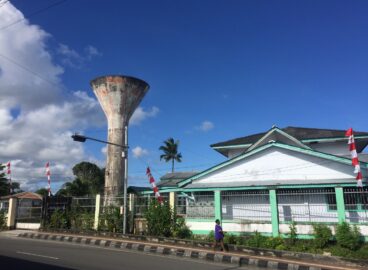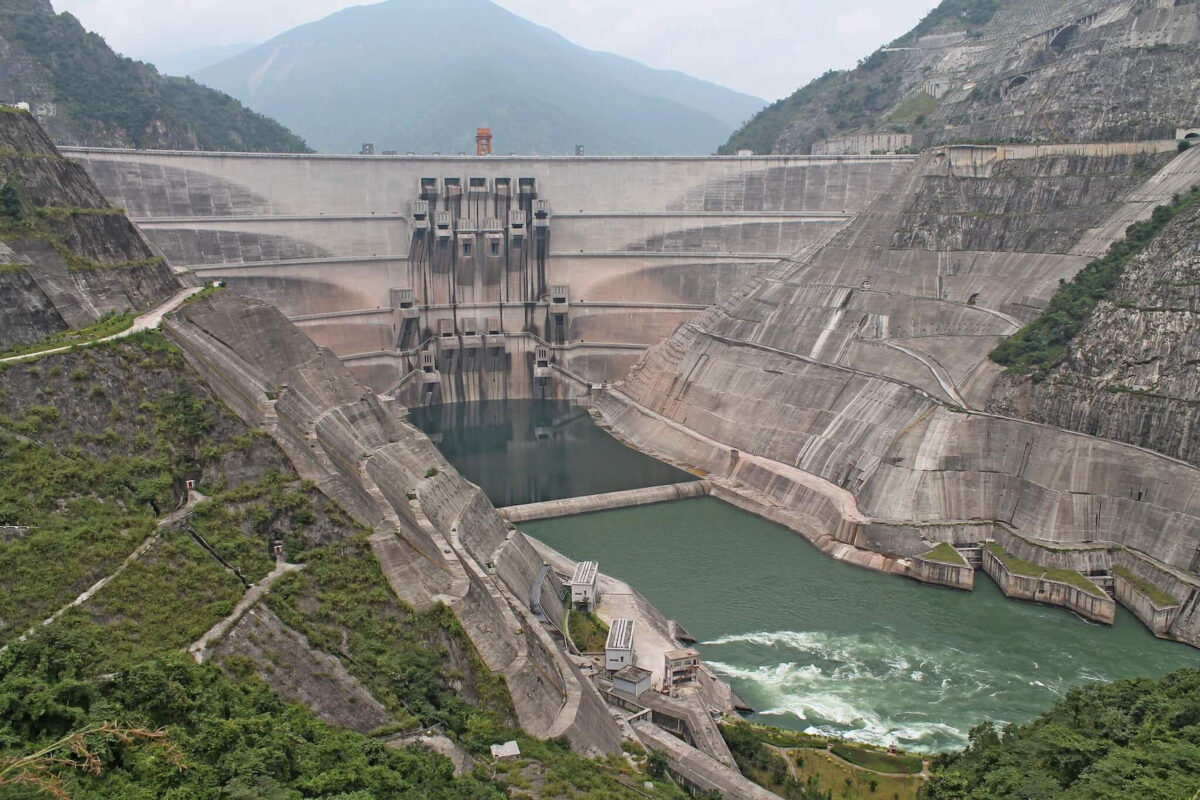
When we speak of the Mekong, we are referring not only to a body of water, a river that runs approximately 2,500 miles (4,000 kilometers) from the Plateau of Tibet to the South China Sea, but also to a body of land, a region, a geography of nations interconnected by this shared artery. Traversing China, Myanmar, Laos, Thailand, and Cambodia before dispersing into the Mekong Delta in the southern reaches of Vietnam, the river materializes what is described as the Greater Mekong Subregion (GMS). Today, the Mekong and the GMS signify a problem of intensifying scale, one woven together by material geography, political governance, development strategy, and climate change. As Anoulak Kittikhoun (former CEO of the Mekong River Commission) has observed, the Mekong operates as a transnational artery of exceptional consequence, sustaining regional economies through rice production and hydropower while remaining among the most intensively “interfered with” waterways in the world, shaped by uneven regimes of management and intervention from colonial hydrology schemes to contemporary dam infrastructures (fig. 1).1“The Mekong: A Confluence of Power, Survival, and Change,” webinar hosted by SOAS University of London and Chulalongkorn University, March 16, 2026, https://www.soas.ac.uk/about/event/mekong-confluence-power-survival-and-change. Alongside these technocratic and geopolitical frames, other epistemologies exist. For riverine communities, the Mekong holds cosmological significance and yields situated knowledge. Animated by spirits, omens, and ritual and narrative traditions, the river continues to be apprehended as a medium of passage, impermanence, and cyclical renewal.
This juxtaposition of the multiple ways in which the Mekong exists as a figure of signification and a lived site gestures to the distinctions one might draw, not uncomplicatedly, between regionalism and regionality. If “regionalism” denotes the institutional pursuit of collective, coordinated identity, “regionality” suggests the more tacit, shared, or parallel worldviews that surface in a contiguous topography. Art exhibitions can be driven by regionalist enterprise, aspiration, and strategy. Artworks as well. But perhaps artworks can reveal more about cross-border affinities and imaginations shaped by shared ecological conditions and practices of worldmaking. To pursue this question, I turn first to earlier curatorial uses of geographical metaphor before shifting from representation to perception through close readings of specific works.
In my 2013 essay “Metaphor as Method: Curating Regionalism in Mainland Southeast Asia,” I examined the ideological work performed by geographical metaphor through the curatorial construction of regional art histories.2Pamela N. Corey, “Metaphor as Method: Curating Regionalism in Mainland Southeast Asia,” Yishu Journal of Contemporary Chinese Art 13, no. 2 (2014): 72–84. The essay was published as part of the proceedings of the conference “Sites of Construction: Exhibitions and the making of recent art history in Asia,” hosted by Asia Art Archive in October 2013. Drawing from political geography and humanist spatial theory, I approached terms such as “Asia,” “the Mekong,” and “the Ho Chi Minh Trail” not as neutral toponyms but rather as charged conceptual frameworks through which space is transformed into place and endowed with political, cultural, and historical meaning.3See Yi-Fu Tuan, “Sign and Metaphor,” Annals of the Association of American Geographers 68, no. 3 (1978): 363–72; and Pekka Korhonen, “Monopolizing Asia: The Politics of a Metaphor,” Pacific Review 10, no. 3 (1997): 347–65. Because metaphor operates through transference, if not transformation, I examined how artist-organizers and curators mobilized it in the 1990s and 2000s, when institutions such as the Association of Southeast Asian Nations (ASEAN) and the Japan Foundation sponsored exhibitions and symposia to reify Southeast Asia’s regional integration. Focusing on mainland Southeast Asia, which lacks the linguistic and geographic cohesion often associated with maritime Southeast Asia, or “Nusantara,” I argued that “the Mekong” functioned as more than a cartographic fact. It can be understood instead as a palimpsest of competing historical imaginaries, from colonial fantasy and wartime violence to its 1990s rebranding as the Greater Mekong Subregion. As such, the river functioned less as metonym than as metaphor, registering the traces of cross-border histories through which the region has been materially and imaginatively constituted.
Therefore, when curators invoked “the Mekong,” they were tapping into this deeply sedimented imagery. Exhibitions like the Mekong platform at the 6th Asia Pacific Triennial of Contemporary Art in 2009, co-curated by Richard Streitmatter-Tran and Russell Storer, attempted to lend coherence to a selection of artists from Cambodia, Laos, Myanmar, Thailand, and Vietnam. There, the riverine metaphor functioned conceptually and pragmatically, as a recognizable framework for international audiences, a rationale for artist selection, and a narrative scaffold for regional dialogue, articulated by Streitmatter-Tran as a “mutual Mekong.”4Richard Streitmatter-Tran, “Mapping the Mekong,” The 6th Asia-Pacific Triennial of Contemporary Art, exh. cat. (Queensland Art Gallery, 2009), 120. Yet the presentation drew criticism for its exclusion of China, through which more than 40 percent of the river flows, leading one critic to accuse it of producing a simplified, appealing image of Southeast Asia that masked the region’s complex political and resource conflicts.5Sue Hajdu, “Missing in the Mekong,” Contemporary Visual Art + Culture Broadsheet 38, no. 4 (2009): 268. If this critique exposed the limits of metaphor as curatorial gloss, the 2010 Long March Project: Ho Chi Minh Trail intensified these concerns.“6Long March Project – Ho Chi Minh Trail,” http://longmarchproject.com/en/project/changzhengjihuahuzhimingxiaodao/. By overlaying the geohistorical specificity of the Vietnam War’s Ho Chi Minh Trail with the Chinese Red Army’s Long March, the artist-organizers sought to mobilize metaphor as a method for transnational dialogue. However, in tense dialogues that surfaced during the project segment in Phnom Penh, local artists and organizers challenged the project’s extractive nature, its privileged jargon, and its failure to acknowledge the specificities of Cambodian history, ultimately foregrounding the asymmetries of exchange that can underwrite such ostensibly collaborative ventures.7Việt Lê, Christ Hearle, and Thien-Huong T. Ninh, “Ho Down: Long March’s ‘Ho Chi Minh Trail Project,’” diaCRITICS: Diasporic Vietnamese/Southeast Asian Literature & Art, November 7, 2010, https://diacritics.org/2010/11/ho-down-long-marchs-ho-chi-minh-trail-project-in-phnom-penh/.
An emphasis on the curatorial can mute the agency of artworks, meriting a shift from the question of exhibition as regional representation to the operations of metaphor as artistic method. Metaphor is always already at the heart of what art does in terms of poetic estrangement and provocation, as Soviet literary theorist Viktor Shklovsky theorized.8Viktor Shklovsky, “Art as Device” [1917], On the Theory of Prose, trans. Shushan Avagyan (1925; Dalkey Archive Press, 1990), 6. This prompts consideration of how contemporary artworks engage the temporal and tacit dimensions of regional imagination, in which metaphor is treated less as geographical anchor and more as material and structural condition. Case studies from the 2023 Thailand Biennale, specifically works by Apichatpong Weerasethakul (b. 1970, Thailand) and Nguyễn Trinh Thi (b. 1973, Vietnam), demonstrate how landscape, ecology, theater, sound, and automation produce shifting, often indeterminate metaphorical associations that resist narrative legibility (figs. 2, 3). In doing so, these works activate geographical metaphor as a process of defamiliarization and refamiliarization, evoking the Mekong as a multiplicity of lived realities and an unstable metaphor for futurity.
Before turning to the 2023 Thailand Biennale, it is useful to situate perceptions of the Mekong as a catalyst for cultural production. Gridthiya Gaweewong traces the lack of coherence in earlier subregional initiatives to their roots in top-down geopolitical and philanthropic frameworks shaped by Cold War alignments and transnational funding.9Gridthiya Gaweewong, “Mekong as Site of Artistic Production,” SouthEastAsia: Spaces of the Curatorial; Räume des Kuratorischen, ed. Ute Meta Bauer and Brigitte Oetker (Sternberg Press, 2016), 84–93. Often conceived in metropolitan centers and realized in urban capitals, these projects cast the Mekong less as a lived site than as a symbolic vehicle for “collaboration” in the service of regional development, with local practitioners positioned as ancillary to externally authored narratives. This echoes Patrick Flores’s critique that curatorial regionalism presents a quandary in which regional actors may be reduced to informants rather than interlocutors.10Patrick Flores, “Difficult Comparisons: The Curatorial Desire for Southeast Asia,” di’van: a journal of accounts art/culture/theory 3 (2017): 64. In response to limited local initiative and indifference among Thai artists toward neighboring scenes, Gaweewong pursued a more grounded approach inspired by Montien Boonma’s proposal for a community-based “art and life” project, developing the Mekong Lab.11Gaweewong, “Mekong as Site of Artistic Production,” 86. Montien Boonma (b. 1953, Thailand–d. 2000, Thailand) had himself participated in artist exchanges hosted in neighboring countries with developing contemporary art scenes, like Vietnam. See “Meeting Point—Workshop of Thai & Vietnamese Artists,” Blue Space Contemporary Art Archive, Asia Art Archive, https://aaa.org.hk/en/collections/search/archive/blue-space-contemporary-art-center-archive-meeting-point-workshop-of-thai-vietnamese-artists. Gaweewong, “Mekong as Site of Artistic Production,” 86. Though constrained by early 2000s political and economic conditions, she argues such efforts helped shift the Mekong from retrospective metaphor to a site of contemporary artistic production; she notes, however, that as institutional exhibitions featuring the Mekong proliferated, grassroots initiatives declined due to diminishing sources of international funding, underscoring the fragility of regionally embedded practices.12Gaweewong, “Mekong as Site of Artistic Production,” 86.
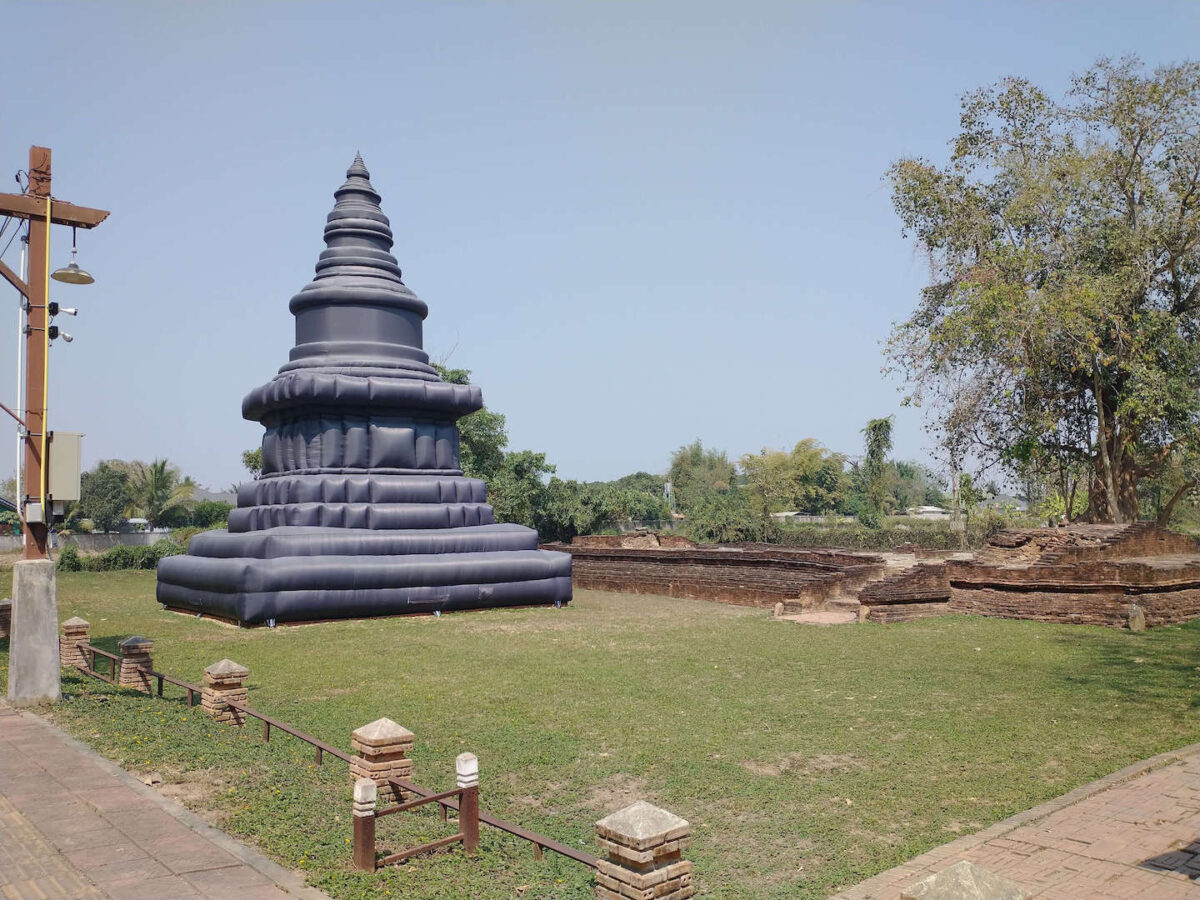
More than a decade later, the 2023 Thailand Biennale, titled The Open World, revisited the Mekong as both river and region (figs. 4, 5). Co-directed by Gridthiya Gaweewong and Rirkrit Tiravanija, and co-curated by Angkrit Ajchariyasophon and Manuporn Luengaram, the biennale featured exhibitions and works installed across Chiang Rai province in northernmost Thailand, with sites in the cities of Chiang Rai and Chiang Saen, and along the Mekong in the Golden Triangle (the riverine confluence of Thailand, Laos, and Myanmar). Addressing themes of ethnic and artistic diversity, narcopolitics, and transborder mobility, it was distinguished not only by its spatial dispersion but also by the visible investment of local communities, shaping its social infrastructure and prompting its characterization as a biennale “only for the locals.”13Rirkrit Tiravanija, quoted in María Inés Plaza Lazo, “The Open World,” Arts of the Working Class, April 5, 2024, https://artsoftheworkingclass.org/text/the-open-world. Here, the Mekong was not mobilized as curatorial metaphor or developmental trope, but rather encountered as a material site and figure of transborder and subregional historical formation. Curatorial and artistic strategies emphasized shifts in scale from city to province to region, privileging geohistorical genealogies, such as Lanna and the Golden Triangle, over current national frameworks, and inviting a more dispersed, diachronic sense of regionality. Chiang Rai thus served as a generative location through an embedded yet shifting configuration of perspectives, rather than as a centralized historical framework, abstract provocation, or fixed vantage point.14For additional Southeast Asian context, David Teh’s inquiry into the national construction of region (from the perspective of Singapore) is instructive. See Teh, “Regionality and Contemporaneity,” World Art 10, no. 2–3 (2020): 351–70.
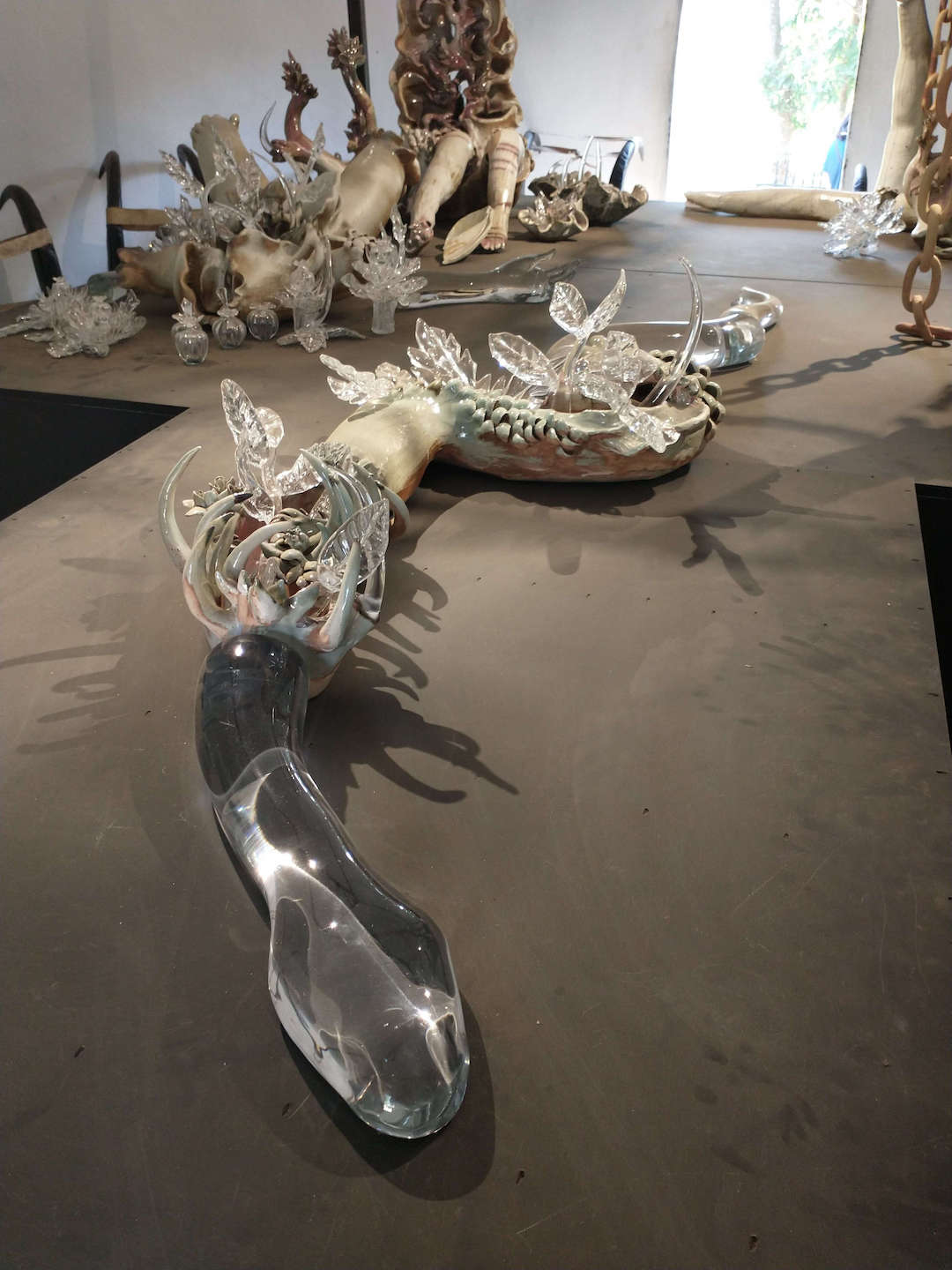
The 2023 Thailand Biennale thus demonstrates a shift in regional representation that has been gaining currency. While major exhibitions of “Southeast Asian art” have tended to represent the region as a syncretic assemblage of artists from ASEAN addressing national problems15See, for example, Chanon Kenji Praepipatmongkol “Sunshower: Contemporary Art from Southeast Asia, 1980s to Now,” ArtForum, October 2017, https://www.artforum.com/events/sunshower-contemporary-art-from-southeast-asia-1980s-to-now-2-234999/., over the past two decades, artworks and films have increasingly turned to microhistories and human geography, foregrounding the Mekong’s precarity across environmental, infrastructural, and religious domains. Here, the river emerges as a medium through which different forms of agency are negotiated. In his book Mekong Dreaming (2020), anthropologist Andrew Alan Johnson describes dreaming as an agentic technology mediating human and nonhuman worlds and enabling riverine communities to navigate the disruptions of hydropower and environmental change and the legacies of historical violence, opening vistas onto “new realms of the unknown and unnamed.”16Andrew Alan Johnson, Mekong Dreaming: Life and Death along a Changing River (Duke University Press, 2020), 19. For those who live alongside it, the Mekong is thus understood through a confluence of science and lore. At the same time, the river functions as a metaphor for precarious ecology and uncertain temporality—figuring a speculative nonlinear time that plays with ambiguous duration and already mourns possible futures.
The moving image has most notably been used to represent the Mekong as both physical site and shifting signifier, using the multimodal capacities of the medium to register precarity, unknowability, and temporal flux. Two films commissioned for The Quiet in the Land: Luang Prabang, Laos (2004–8, curated by France Morin), exemplify this approach. In All That’s Solid Melts into Air (Karl Marx) (2006), Vong Phaophanit and Claire Oboussier destabilize visual primacy through an atmospheric interplay of sound, voice, and image, producing what I have described elsewhere as a “horizon of un-knowing” that privileges listening over sight.17Pamela N. Corey, “Toward a Horizon of Un-Knowing: Aurality, Voice, and the Politics of Identification in the Art of Vong Phaophanit and Claire Oboussier,” Oxford Art Journal 43, no. 2 (2020): 221–38. Similarly, in The Ground, the Root, and the Air: The Passing of the Bodhi Tree (2004–7), Jun Nguyễn-Hatsushiba stages collective, futile gestures along the river to evoke disorientation and temporal slippage, casting the Mekong as a horizon without fixed destination, using presentism and transience as allegories for globalization.18Jun Nguyen-Hatsushiba: The Ground, the Root, and the Air: The Passing of the Bodhi Tree,” Quiet in the Land: Luang Prabang, Laos (The Quiet in the Land, 2009), 138. This unsettling of expected riverine imagery is echoed by Phan Thảo Nguyễn (b. 1987, Vietnam) in the film Mekong Mechanical (2012), where the pastoral delta is supplanted by industrial repetition and agribusiness, refiguring the river as a site of labor and environmental degradation, and the oneiric factory setting a site where personal and collective pipe dreams collide. Film theorist May Adadol Ingawanij observes how in Phan’s later film Becoming Alluvium (2019), the Mekong is revisited through a humanist, mythologizing framework, its “eco-aesthetics” rendering the Mekong’s cosmological and regenerative force, and interweaving cyclical and linear temporalities to position the river as both maternal and destructive.19May Adadol Ingawanij, “Vietnamese Artists’ Moving Image as Figural Aesthetics,” in Signs and Signals from Vietnam: Essays on Contemporary Art, ed. Pamela N. Corey, Nora A. Taylor, and Đỗ Tường Linh (National University of Singapore Press, forthcoming).
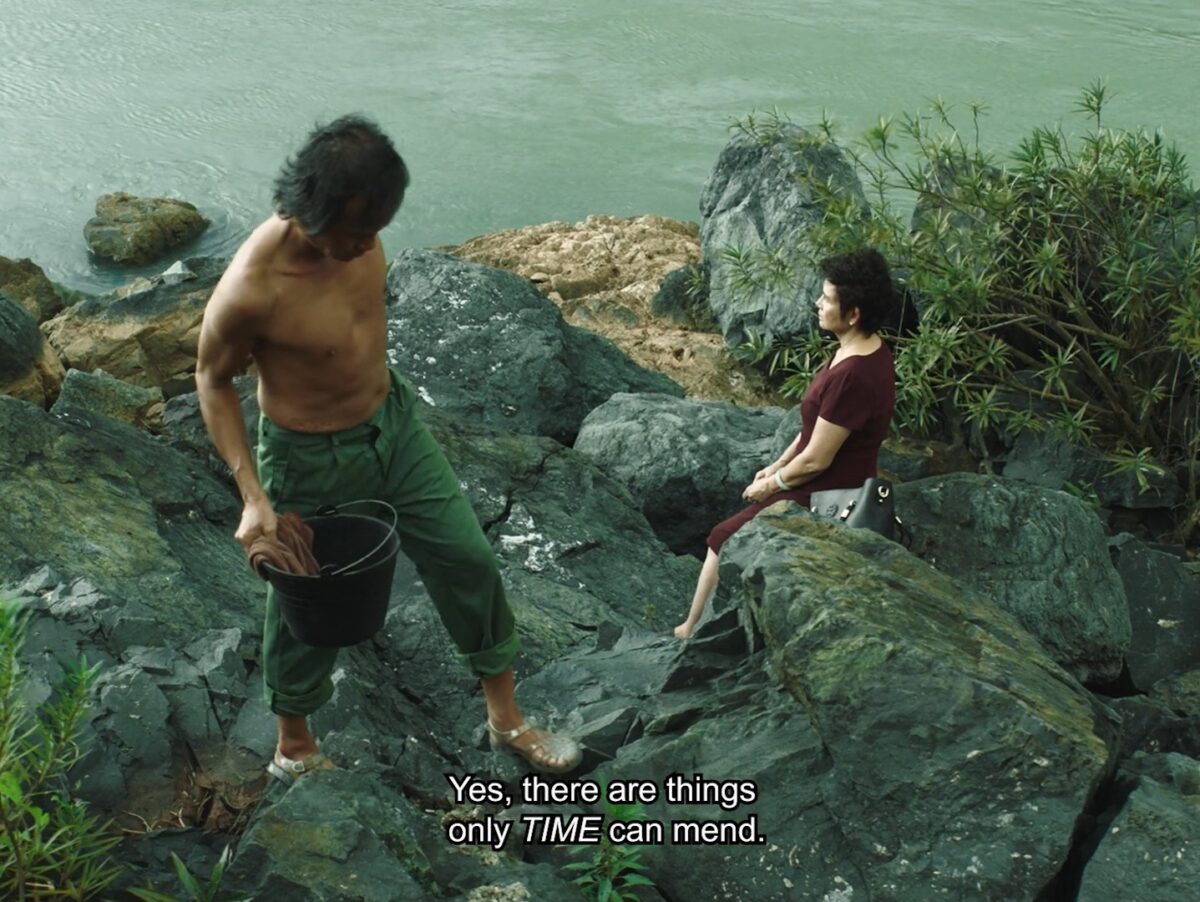
Other recent filmic projects have similarly explored the Mekong’s temporal currents, prompting “Mekong Futurism” as a potential shorthand.20Giang Hoang, “Sustainable Nostalgia to Dystopian Future: Toward a Tropical Transnational Ecocinema in Mekong 2030,” eTropic: electronic journal of studies in the Tropics 24, no. 1 (2025): 240–60; Alfonse Chiu, “A River in Crisis Runs Through Southeast Asia,” Hyperallergic, September 8, 2020, https://hyperallergic.com/mekong-2030-southeast-asia-anthology-film/#:~:text=Five%20directors%20speculate%20on%20the%20uncertain%20future,River%20in%20the%20anthology%20film%20Mekong%202030; and “WOMEN IN FILM 2025: Camp! Along The Mekong River,” Objectifs: Centre for Photography and Film, https://www.objectifs.com.sg/women-in-film-2025-camp-along-the-mekong-river/. Even if the naming of another regional futurism risks romanticization, projects like Mekong 2030 (2020), an omnibus of short films produced by the former Luang Prabang Film Festival, demonstrate the productive complexity of such speculative approaches. Bringing together filmmakers from across the region, Mekong 2030 taps into the draw of imagining possible futures.21In Mekong 2030, films were chosen by jury selection to speculate the existence of the Mekong and its national communities in just ten years, neither the near nor distant future. “Mekong 2030,” Blue Chair, https://bluechair.film/film/mekong-2030/. The resulting films range in tone from the allegorical and didactic to the lyrical and experimental, such as The Unseen River (2020) by Phạm Ngọc Lân (b. 1986, Vietnam), in which the Mekong becomes a metaphor for reversible flows of time, carrying regret, aspiration, and spiritual transformation through both narrative and cinematic form (fig. 6).22For a deeper analysis of The Unseen River in relation to these themes, see Ingawanij, “Vietnamese Artists’ Moving Image as Figural Aesthetics.”
Phạm’s approach resists the techno-fetishism often associated with futurism, instead foregrounding more subtle constructions of riverine imaginaries. This reverts to the closing note of my earlier essay, which concludes with an alternative model of signification employed by the Reyum Institute of Arts and Culture (est. 1998) in Phnom Penh, as discussed by Ashley Thompson.23Ashley Thompson “Forgetting to Remember, Again: On Curatorial Practice and ‘Cambodian Art’ in the Wake of Genocide,” diacritics 41, no. 2 (2013): 82–109. Reflecting on the untranslated Khmer word reyum (“cicada crying/singing”), Thompson describes it as a “present absence,” an inarticulate sonic trace of loss that resists translation.24Thompson, “Forgetting to Remember, Again,” 86. In this sense, reyum operates as a culturally specific sonic metaphor. Rather than seeking external legibility, it focuses on local address as an affective and meaningful evocation that may suggest inarticulable loss, but also a regional cadence of cyclical, seasonal time measured by insect song.
Along these lines, two artworks featured at the 2023 Thailand Biennale—Blue Encore (2023) by Apichatpong Weerasethakul (b. 1970, Thailand) and Ri s̄eīyng (Sound-Less, 2023) by Nguyễn Trinh Thi (b. 1973, Vietnam)—reveal something similar about the Mekong and metaphor. Focusing on their use of technology and theatricality, I question how one might infer a sense of regional identification from the artists’ visualization and auralization of landscape and ecology. The two artists are renowned as filmmakers, yet while these projects extend their cinematic trajectories, the works contain no filmic components. And in contrast to the works just discussed, the Mekong as region and river is visually elusive but not without some mimetic trace. What is most compelling here is how metaphor operates less as subject matter than as the technological, temporal, and atmospheric structures of the works themselves.
Thai filmmaker Apichatpong Weerasethakul’s stories are typically set in the northeastern Isan region of Thailand, where animist cosmologies collapse boundaries between human, nonhuman, and spiritual realms. Informed by firsthand encounters with the Mekong’s ecological crises during projects such as Uncle Boonmee Who Can Recall His Past Lives (2010), he incorporates these conditions and regional mythologies into works like For Tomorrow For Tonight (2011) and Mekong Hotel (2012).25Gaweewong, “Mekong as Site of Artistic Production,” 89. A recurring motif is sleep, which functions not only as narrative device but also as a medium of sociopolitical and perceptual transformation, akin to Johnson’s arguments about Mekong dreaming. In these liminal states, characters inhabit nonlinear temporalities marked by memory, rebirth, and the unresolved traces of political violence—what Ingawanij describes as the “stranded temporality” of post–Cold War Thailand.26May Adadol Ingawanij, “Animism and the Performative Realist Cinema of Apichatpong Weerasethakul,” in Screening Nature: Cinema beyond the Human, ed. Anat Pick and Guinevere Narraway (Berghahn Books, 2013), 91–109. For Weerasethakul, this threshold between sleep and waking becomes a generative space: “Dreams are very important to me, because a dream is like a movie, an illusion. It defies time and space. A dream is like another life recurring.”27Apichatpong Weerasethakul, in “Interview with Apichatpong Weerasethakul: ‘A Dream is Like Another Life Recurring,’” interview [in Dutch] by Kerstin Winking, Metropolis M 4 (2013). English translation archived at Kerstin Winking, June 2013, https://kwinking.com/2013/06/01/about-dreams-memories-an-interview-with-apichatpong-weerasethakul/.
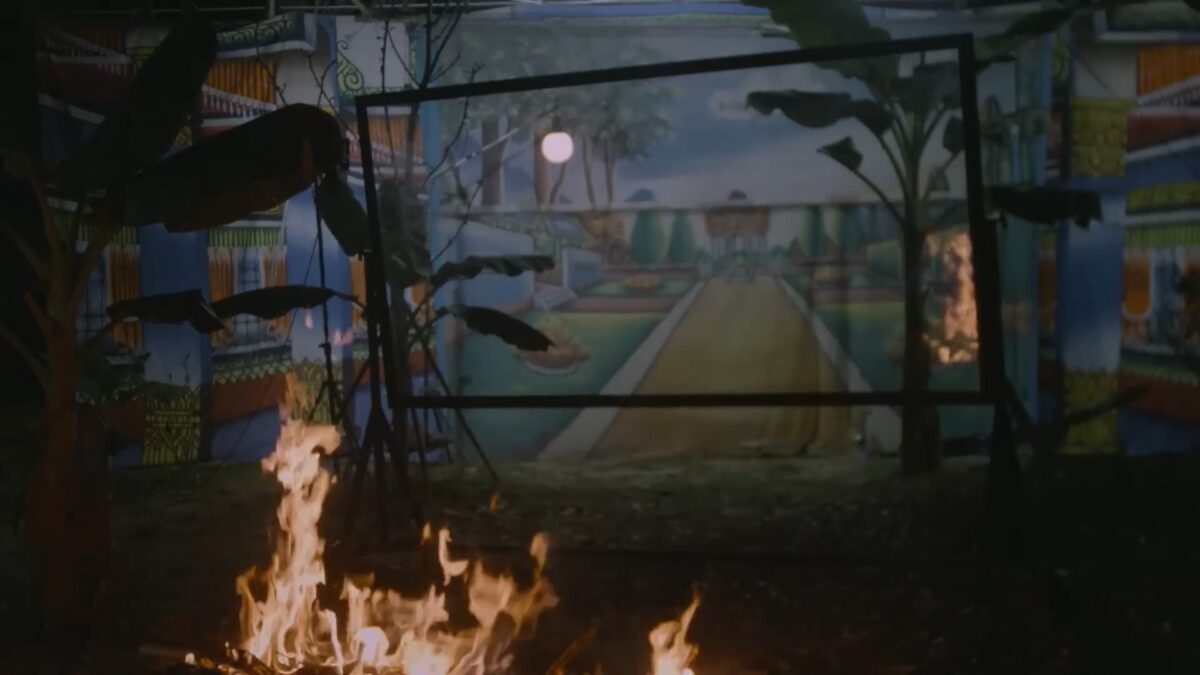
Weerasethakul’s Blue series—comprising the 2018 film Blue, the 2022 film and performance collaboration On Blue, and the 2023 installation Blue Encore—suggests a dreamscape constituted by restless slumber. In Blue (2018), a woman lapses between sleep and wakefulness in a nighttime forest setting in which a painted theater backdrop unfurls to alternate between two landscapes: one a sunset on the water and the other a royal palace courtyard. As translucent flames slowly spread from the woman’s torso to engulf her recumbent body, and then her surroundings, the screen continues to spool and unspool, the movement and squeaking sound of the pulley punctuating a relentless rhythm even as the fire spreads to consume the dreamscape (fig. 7). On Blue (2022), created with composer Rafiq Bhatia, reimagines the earlier film and synthesizes it with a live, orchestral performance. As Weerasethakul describes: “On Blue was inspired by the moments of awakening, of sunrise. As uncertainty becomes the norm, I treasure this phenomenon’s consistency. It’s predictable yet brings tremendous change.”28“Sun Dogs: A new film-sound series debuts,” Liquid Music, October 12, 2022, https://liquidmusic.org/blog//sun-dogs.
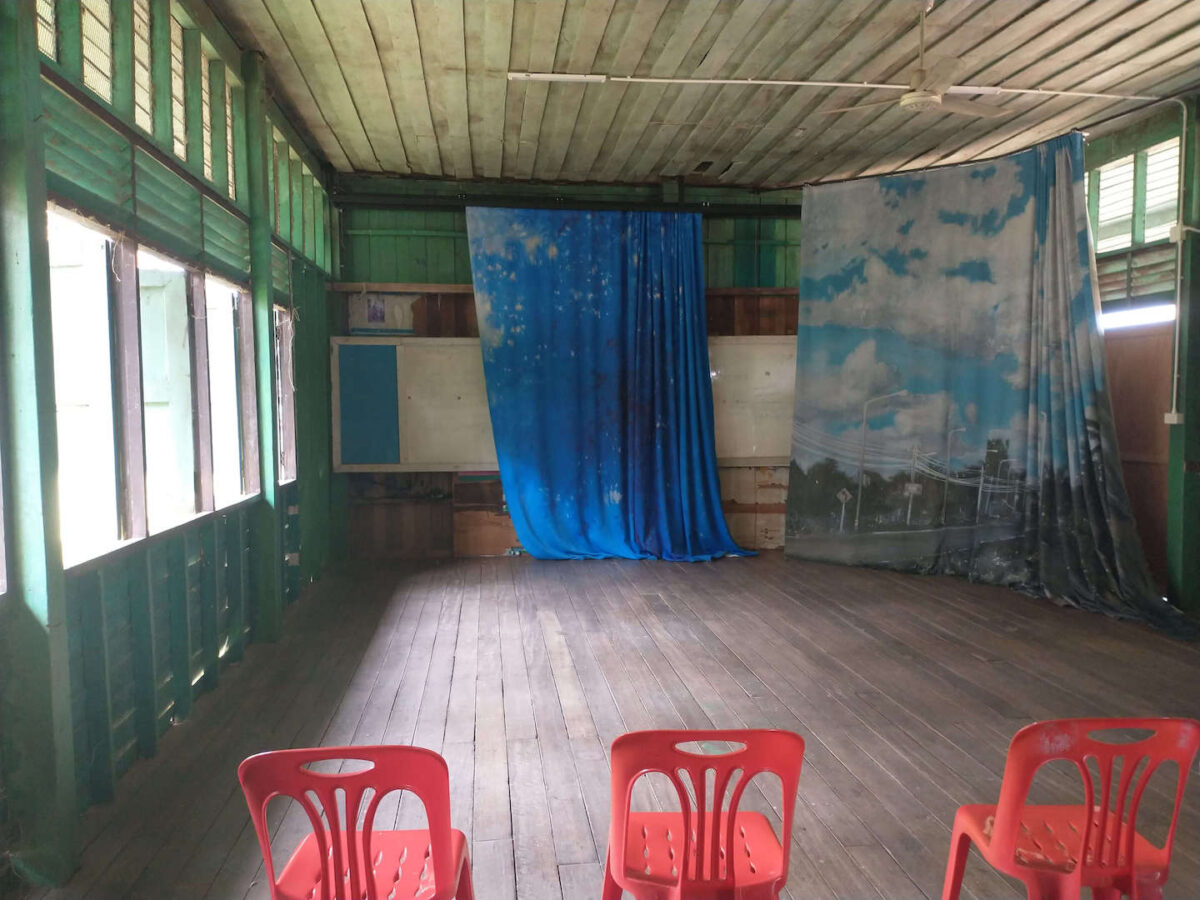
Blue Encore (2023), the third iteration in the series Blue, was presented at the 2023 Thailand Biennale. The installation comprised curtains printed with landscape paintings by Chiang Rai artists and set along the perpendicular walls of a classroom in a former primary school that is now a Buddhist community center. In Blue Encore, Weerasethakul withholds any filmic elements to physically literalize the moving image, creating a stage in which automated curtains expand and contract along walls and windows, the fabric flowing against the ground. The moving panels set organic form against geometry in choreographed animation and in perpetual interaction with the atmospherics of light and dust particles as daylight fluctuates. The movement of curtains traditionally marks spatial and temporal boundaries in theater, creating the illusion of a self-contained world and facilitating unnatural shifts through time and place via the setting of scene. Curtains play a similar role in cinema, opening and closing on the screen to cue the beginning and end of the audience’s release into spectatorship. In Blue Encore, Weerasethakul defamiliarizes the theatrical curtain as it has been naturalized through theater’s hypnotic effects and conflates the scene/screen with the curtain, or the work with its frame. Like the actions of the unspooling theater backdrop in Blue, the automated movements of the curtains are both dramatic and anticlimactic, performing without a narrative logic, their only seeming purpose to reveal the pictures on the painted fabric as they stretch to their full expanse.
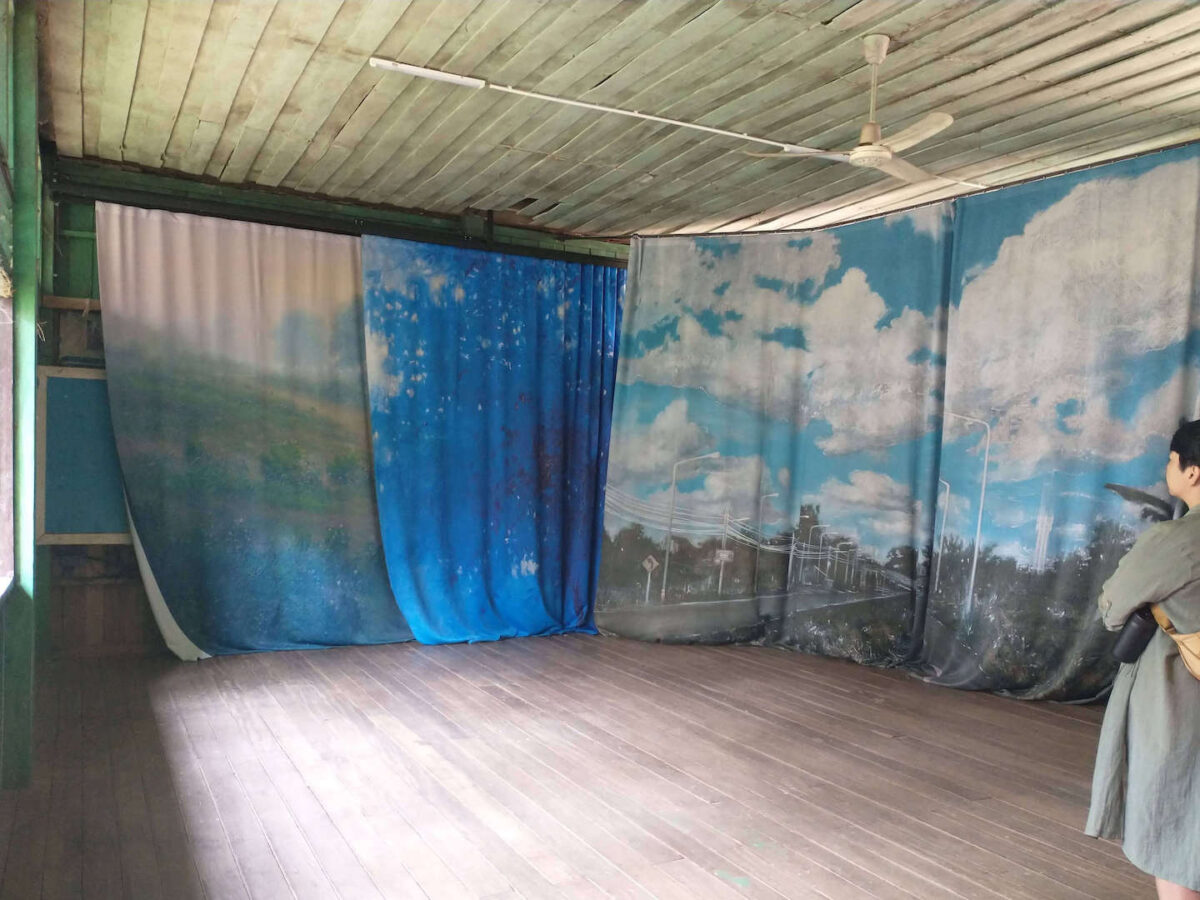
Two of the panels feature rural landscapes painted by artists from Chiang Rai, a community of artists that Weerasethakul describes as local “impressionists” (fig. 8).29Rémy Jarry, “Apichatpong Weerasethakul on unveiling installations at the Thailand Biennale,” March 14, 2024, stir world, https://www.stirworld.com/inspire-conversations-apichatpong-weerasethakul-on-unveiling-installations-at-the-thailand-biennale. The third panel appears saturated in vibrant shades of blue, evoking water or some kind of aquatic abstraction, particularly against the green and brown classroom walls. Water and land thus appear to meet, overlap, and retreat from each other in a set sequence of slow and repeated mechanized actions that may test the viewer’s patience. Through the specific choice of landscape painting, they also conjure regional metaphors specific to Chiang Rai and the installation’s setting in Chiang Saen, a town and site of an ancient city located on the west bank of the Mekong River bordering Laos.
As W. J. T. Mitchell has argued, landscapes have long been instrumentalized for ideological projection, whether as the dreamwork of imperialism or as metaphor for social order.30W. J. T Mitchell, “Imperial Landscape,” in Landscape and Power, ed. W. J. T. Mitchell (University of Chicago Press, 1994), 5–34. There is a dense web of national—and regional—art historical associations signified by the painterly style of these images and the audiences for whom they are intended.31A type of Post-Impressionist picturesque landscape tradition can be found in histories of early 20th-century modern art throughout Southeast Asia, from the Mooi Indië (“Beautiful Indies”) aesthetic of the Dutch East Indies to the painterly styles taught at the École des beaux arts de l’Indochine in Hanoi, Vietnam. The paintings capture the modern rural idyll, bucolic but not without technological affordance, that is cyclically unveiled and contracted. The painted rural landscape as familiar visual and commercial stock presents itself theatrically and strangely—both as a physical and a symbolic one, and as a literal moving image, on curtains that frame the physical site itself as something to be revealed and looked at in a new way. The defunct primary school turned gathering place for Buddhist learning and social outreach is now activated as a scene and microhistory, as well as a metaphor for community, hope, and slow renewal. The repetition of the curtain’s movements thus engenders a recursive presentation of site within site, landscape within landscape, metaphor within metaphor, image and place as one—familiar and yet unfamiliar to audiences experiencing them as such within Weerasethakul’s installation.
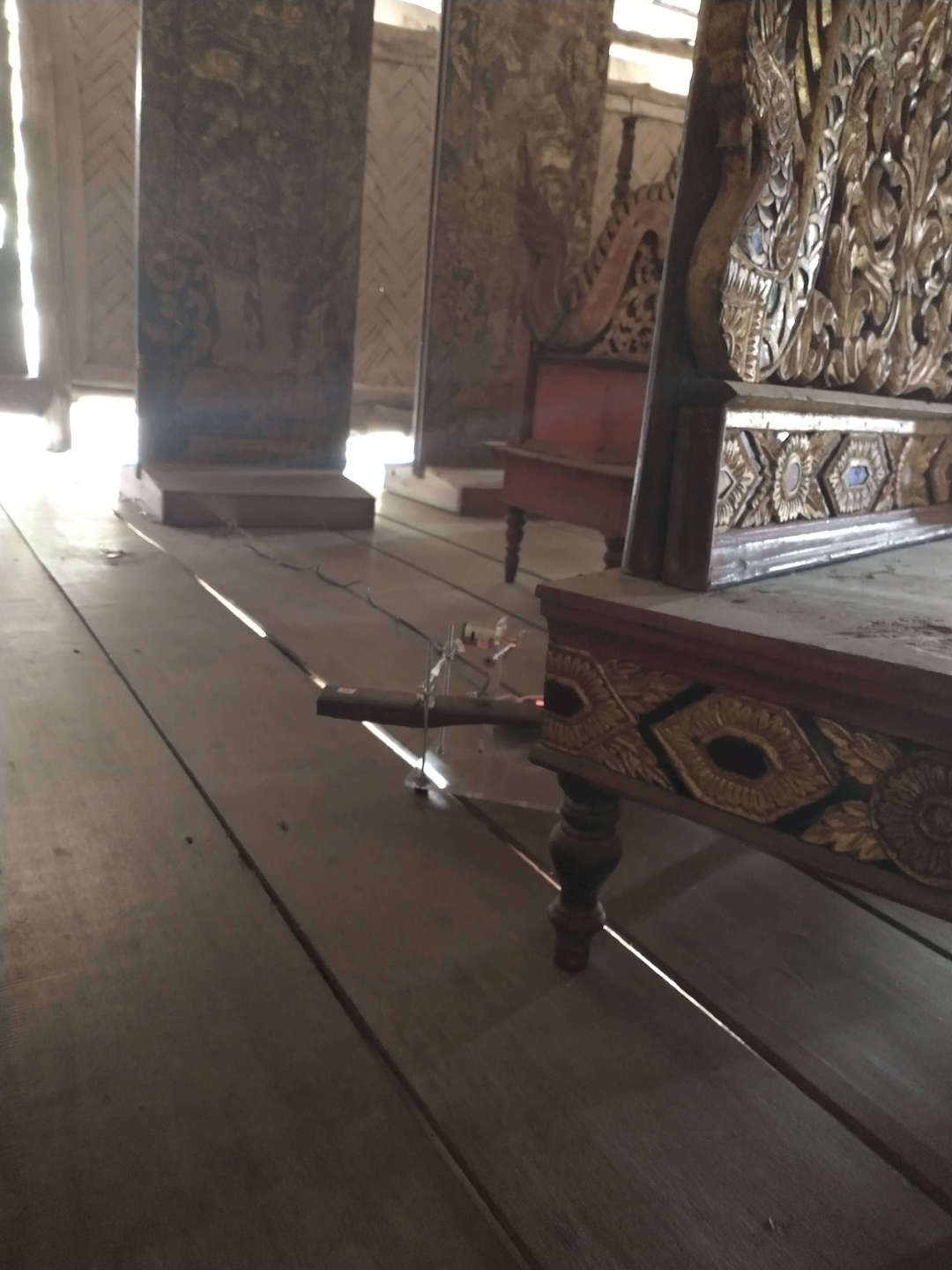
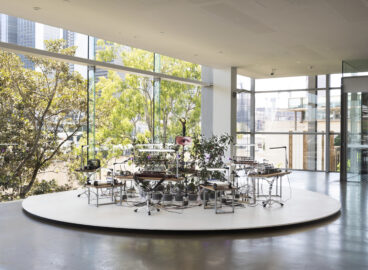
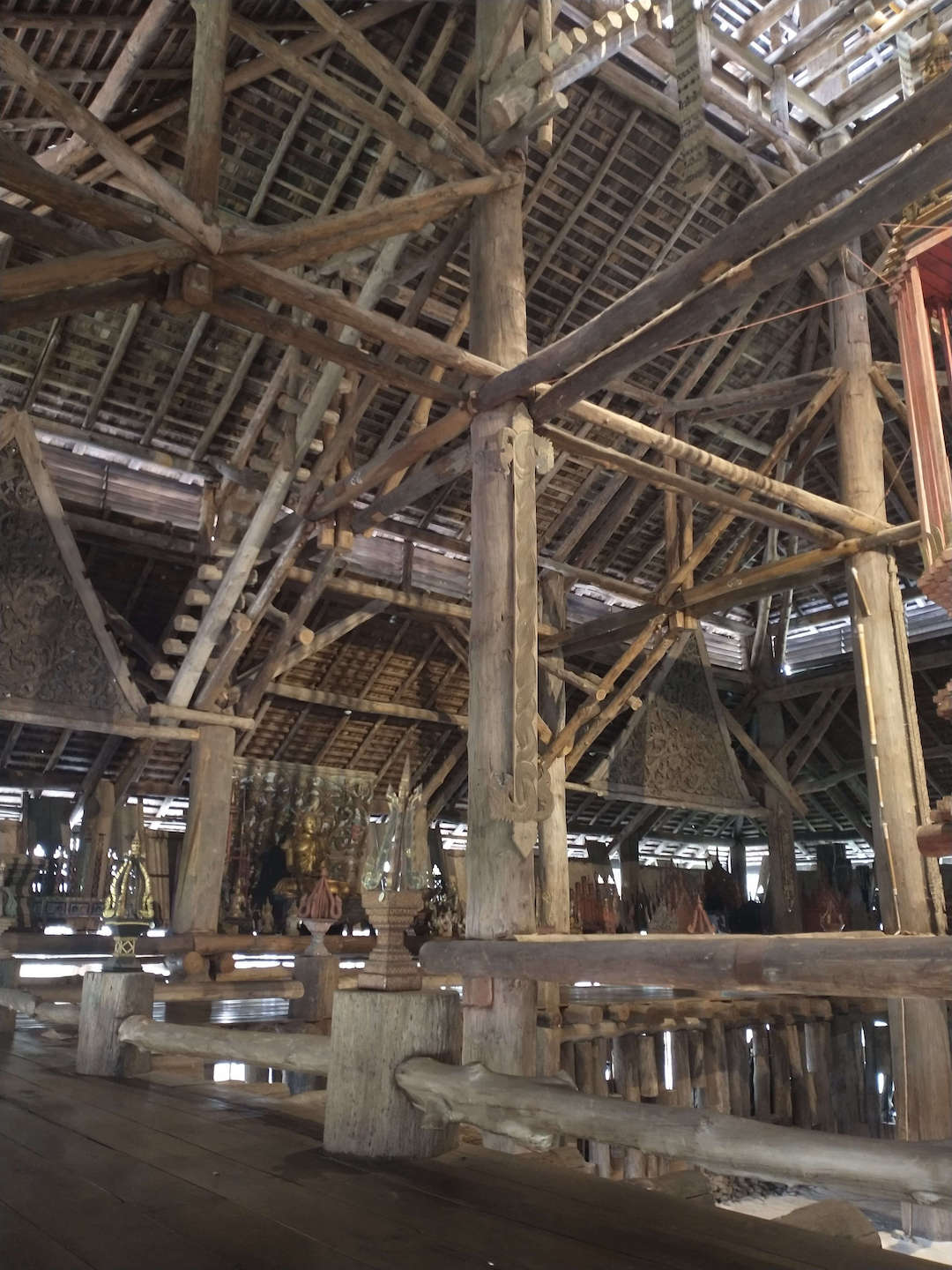
Weerasethakul finds assurance in the measured repetition of programmed movement, replicating the predictable cycle of solar movement that organizes our experience of time regardless of the pace of change that happens around us. But in Vietnamese artist and filmmaker Nguyễn Trinh Thi’s Ri s̄eīyng (a Thai word that translates as “soundless” or “voiceless”), presented at Haw Kham (a wooden structure that once served as a royal residence and is now a museum of Lanna art), she uses instrumental sound to index the opposite: the unpredictable flux of water levels in the Mekong River that are a result of anthropocenic environmental change. In Ri s̄eīyng, deconstructed xylophones (ranat ek) and reed instruments (khaen) play automated musical chords coded to data gathered by water sensors in the Mekong River (fig. 9). Like Nguyễn’s previous work, And they die a natural death (2022), at documenta fifteen, the work has been metaphorized as theater—live, improvisational, musical, atmospheric—coproduced with nonhuman actors via environmental biofeedback mechanisms (fig. 10). While informed by environmental activism around hydropower and river modification, Ri s̄eīyng extends Nguyễn’s artistic praxis from earlier films such as Letters from Panduranga (2015), which uses epistolary narration to question ocularcentrism and recalibrate authorial voice, to films that explore the aural ecologies of highland communities in Vietnam (How to Improve the World, 2021), toward the predominant commitment to sound that has characterized her recent projects.32See Pamela N. Corey, “Siting the Artist’s Voice,” Art Journal 77, no. 4 (2018): 84–96, https://doi.org/10.1080/00043249.2018.1549879; and Philippa Lovatt, “The Acoustics of the Archipelagic Imagination in Southeast Asian Artists’ Film,” Journal of Cinema and Media Studies 60, no. 3 (2021): 176–81. Across her works, relationality is increasingly articulated through cut and soundtrack, centering auditory fields over image, and in her recent installations, the listener becomes part of an autonomous system of attunement between objects, space, and sound.
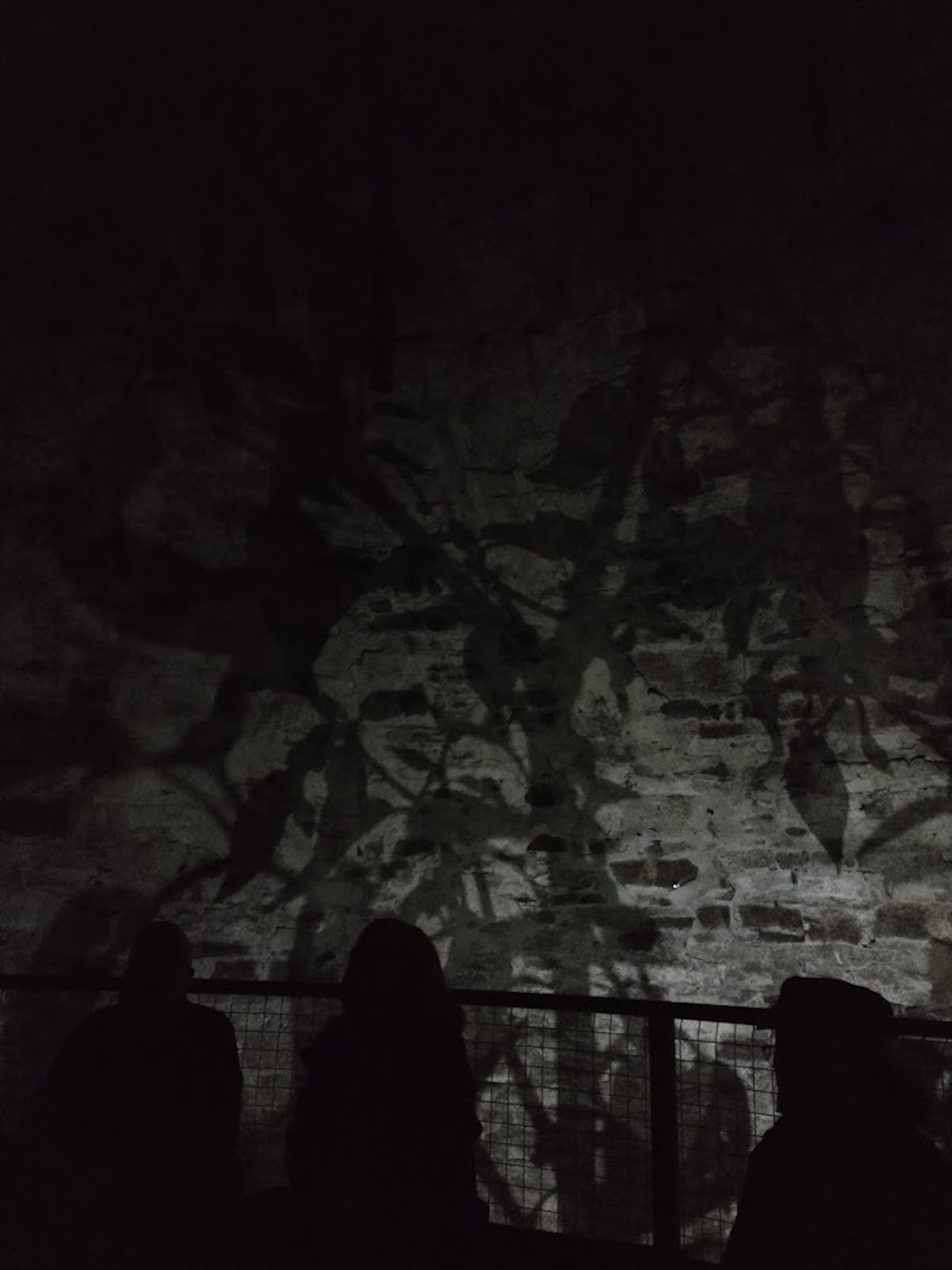
For Nguyễn, the musical notes in Ri s̄eīyng represent collaboration, based on the ways in which Indigenous musicians compose music. As she describes: “One thing that I have learned from observing Indigenous communities across Vietnam play their instruments—and which have been incorporated in both installations at documenta and the Thailand Biennale—is that each person plays only one note on a single instrument. In contrast to the individualist figure of the Western composer, Indigenous music players cannot create melodies by themselves. This requires them to listen to one another and orchestrate their tunes collectively. I find this a compelling metaphor for community building; only when a balance between manifestations of the ego and collective coordination is reached can music be created.”33Hùng Dương and Nguyễn Trinh Thi, “A Feast of Sound. Nguyễn Trinh Thi in Conversation with Hùng Dương,” August 1, 2025, Afterall: New Writing, https://www.afterall.org/articles/a-feast-of-sound-nguyen-trinh-thi-in-conversation-with-hung-duong/.
The installation in Chiang Rai also plays with signifying operations that may seem to contend with one another: index and metaphor. Sound is an index here; it traces and measures the river, translating its biodata into a nonhuman musical field. Metaphor then serves as a tool for the listener to link the sounds with conceptual imagery. The question here is what metaphors are invoked by the index, or the musical chords generated by the percussive and wind instruments. They render a soundscape and a cultural imagination that points back to its regional source—the river. Soundscape is traditionally understood as that which is produced by the atmospherics of a physical place (a form of ethnographic acoustic document) but can also construct the idea of a place and its culture. Ri s̄eīyng invokes aural familiarity through singular instrumental notes instead of recognizable compositional patterns; it does not attempt to reinforce the concept of a unified regional music, rather, it sounds out instruments that are widespread and go by different names throughout the Mekong region, especially in Thailand, Cambodia, Laos, and Vietnam. Even the names of specific instruments in Thai or Lao contain metaphoric dimensions embedded in concepts of music-making that suggest passage between worlds and dream encounters.34For an analysis of regional musicality and associated metaphors in Southeast Asia and its diasporas, see Deborah Wong, “History, Memory, Re-Membering,” in Speak It Louder: Asian Americans Making Music (Routledge, 2004), 19–52. As such, in Ri s̄eīyng these sounds indexically and metaphorically point to the Mekong and its associated imaginations.
In conclusion, the trajectory of metaphor—from a curatorial shorthand for regional cohesion to an artistic method probing the tacit and temporal—signals a shift in imagining mainland Southeast Asia. The artworks of Apichatpong Weerasethakul and Nguyễn Trinh Thi do not simply represent the Mekong region but likewise suggest its contemporary associations (such as the nonlinear flow of time, precarity, dreaming) through their very material and temporal constitutions. Blue Encore’s recursive theatricality and Ri s̄eīyng’s indexical soundscape foreground a regionality constituted not through geopolitical definitions but instead through image, sound, environment, and automation. They shift toward abstraction to offer more sensorial, sited, and opaque forms of representing place.
This essay benefited from feedback at MoMA C-MAP Southeast and East Asia, Yale Council on Southeast Asian Studies, NYU Institute of Fine Arts, and LASALLE College of the Arts; I am grateful to Carlos Quijon, Jr., Erik Harms, Joan Kee, Francis Maravillas, and Jeffrey Say for enabling those exchanges. I also thank Alexander Cannon for his musicological insights into the Mekong region.
- 1“The Mekong: A Confluence of Power, Survival, and Change,” webinar hosted by SOAS University of London and Chulalongkorn University, March 16, 2026, https://www.soas.ac.uk/about/event/mekong-confluence-power-survival-and-change. ↩︎
- 2Pamela N. Corey, “Metaphor as Method: Curating Regionalism in Mainland Southeast Asia,” Yishu Journal of Contemporary Chinese Art 13, no. 2 (2014): 72–84. The essay was published as part of the proceedings of the conference “Sites of Construction: Exhibitions and the making of recent art history in Asia,” hosted by Asia Art Archive in October 2013. ↩︎
- 3See Yi-Fu Tuan, “Sign and Metaphor,” Annals of the Association of American Geographers 68, no. 3 (1978): 363–72; and Pekka Korhonen, “Monopolizing Asia: The Politics of a Metaphor,” Pacific Review 10, no. 3 (1997): 347–65. ↩︎
- 4Richard Streitmatter-Tran, “Mapping the Mekong,” The 6th Asia-Pacific Triennial of Contemporary Art, exh. cat. (Queensland Art Gallery, 2009), 120. ↩︎
- 5Sue Hajdu, “Missing in the Mekong,” Contemporary Visual Art + Culture Broadsheet 38, no. 4 (2009): 268. ↩︎
- 6Long March Project – Ho Chi Minh Trail,” http://longmarchproject.com/en/project/changzhengjihuahuzhimingxiaodao/. ↩︎
- 7Việt Lê, Christ Hearle, and Thien-Huong T. Ninh, “Ho Down: Long March’s ‘Ho Chi Minh Trail Project,’” diaCRITICS: Diasporic Vietnamese/Southeast Asian Literature & Art, November 7, 2010, https://diacritics.org/2010/11/ho-down-long-marchs-ho-chi-minh-trail-project-in-phnom-penh/. ↩︎
- 8Viktor Shklovsky, “Art as Device” [1917], On the Theory of Prose, trans. Shushan Avagyan (1925; Dalkey Archive Press, 1990), 6. ↩︎
- 9Gridthiya Gaweewong, “Mekong as Site of Artistic Production,” SouthEastAsia: Spaces of the Curatorial; Räume des Kuratorischen, ed. Ute Meta Bauer and Brigitte Oetker (Sternberg Press, 2016), 84–93. ↩︎
- 10Patrick Flores, “Difficult Comparisons: The Curatorial Desire for Southeast Asia,” di’van: a journal of accounts art/culture/theory 3 (2017): 64. ↩︎
- 11Gaweewong, “Mekong as Site of Artistic Production,” 86. Montien Boonma (b. 1953, Thailand–d. 2000, Thailand) had himself participated in artist exchanges hosted in neighboring countries with developing contemporary art scenes, like Vietnam. See “Meeting Point—Workshop of Thai & Vietnamese Artists,” Blue Space Contemporary Art Archive, Asia Art Archive, https://aaa.org.hk/en/collections/search/archive/blue-space-contemporary-art-center-archive-meeting-point-workshop-of-thai-vietnamese-artists. Gaweewong, “Mekong as Site of Artistic Production,” 86. ↩︎
- 12Gaweewong, “Mekong as Site of Artistic Production,” 86. ↩︎
- 13Rirkrit Tiravanija, quoted in María Inés Plaza Lazo, “The Open World,” Arts of the Working Class, April 5, 2024, https://artsoftheworkingclass.org/text/the-open-world. ↩︎
- 14For additional Southeast Asian context, David Teh’s inquiry into the national construction of region (from the perspective of Singapore) is instructive. See Teh, “Regionality and Contemporaneity,” World Art 10, no. 2–3 (2020): 351–70. ↩︎
- 15See, for example, Chanon Kenji Praepipatmongkol “Sunshower: Contemporary Art from Southeast Asia, 1980s to Now,” ArtForum, October 2017, https://www.artforum.com/events/sunshower-contemporary-art-from-southeast-asia-1980s-to-now-2-234999/. ↩︎
- 16Andrew Alan Johnson, Mekong Dreaming: Life and Death along a Changing River (Duke University Press, 2020), 19. ↩︎
- 17Pamela N. Corey, “Toward a Horizon of Un-Knowing: Aurality, Voice, and the Politics of Identification in the Art of Vong Phaophanit and Claire Oboussier,” Oxford Art Journal 43, no. 2 (2020): 221–38. ↩︎
- 18Jun Nguyen-Hatsushiba: The Ground, the Root, and the Air: The Passing of the Bodhi Tree,” Quiet in the Land: Luang Prabang, Laos (The Quiet in the Land, 2009), 138. ↩︎
- 19May Adadol Ingawanij, “Vietnamese Artists’ Moving Image as Figural Aesthetics,” in Signs and Signals from Vietnam: Essays on Contemporary Art, ed. Pamela N. Corey, Nora A. Taylor, and Đỗ Tường Linh (National University of Singapore Press, forthcoming). ↩︎
- 20Giang Hoang, “Sustainable Nostalgia to Dystopian Future: Toward a Tropical Transnational Ecocinema in Mekong 2030,” eTropic: electronic journal of studies in the Tropics 24, no. 1 (2025): 240–60; Alfonse Chiu, “A River in Crisis Runs Through Southeast Asia,” Hyperallergic, September 8, 2020, https://hyperallergic.com/mekong-2030-southeast-asia-anthology-film/#:~:text=Five%20directors%20speculate%20on%20the%20uncertain%20future,River%20in%20the%20anthology%20film%20Mekong%202030; and “WOMEN IN FILM 2025: Camp! Along The Mekong River,” Objectifs: Centre for Photography and Film, https://www.objectifs.com.sg/women-in-film-2025-camp-along-the-mekong-river/. ↩︎
- 21In Mekong 2030, films were chosen by jury selection to speculate the existence of the Mekong and its national communities in just ten years, neither the near nor distant future. “Mekong 2030,” Blue Chair, https://bluechair.film/film/mekong-2030/. ↩︎
- 22For a deeper analysis of The Unseen River in relation to these themes, see Ingawanij, “Vietnamese Artists’ Moving Image as Figural Aesthetics.” ↩︎
- 23Ashley Thompson “Forgetting to Remember, Again: On Curatorial Practice and ‘Cambodian Art’ in the Wake of Genocide,” diacritics 41, no. 2 (2013): 82–109. ↩︎
- 24Thompson, “Forgetting to Remember, Again,” 86. ↩︎
- 25Gaweewong, “Mekong as Site of Artistic Production,” 89. ↩︎
- 26May Adadol Ingawanij, “Animism and the Performative Realist Cinema of Apichatpong Weerasethakul,” in Screening Nature: Cinema beyond the Human, ed. Anat Pick and Guinevere Narraway (Berghahn Books, 2013), 91–109. ↩︎
- 27Apichatpong Weerasethakul, in “Interview with Apichatpong Weerasethakul: ‘A Dream is Like Another Life Recurring,’” interview [in Dutch] by Kerstin Winking, Metropolis M 4 (2013). English translation archived at Kerstin Winking, June 2013, https://kwinking.com/2013/06/01/about-dreams-memories-an-interview-with-apichatpong-weerasethakul/. ↩︎
- 28“Sun Dogs: A new film-sound series debuts,” Liquid Music, October 12, 2022, https://liquidmusic.org/blog//sun-dogs. ↩︎
- 29Rémy Jarry, “Apichatpong Weerasethakul on unveiling installations at the Thailand Biennale,” March 14, 2024, stir world, https://www.stirworld.com/inspire-conversations-apichatpong-weerasethakul-on-unveiling-installations-at-the-thailand-biennale. ↩︎
- 30W. J. T Mitchell, “Imperial Landscape,” in Landscape and Power, ed. W. J. T. Mitchell (University of Chicago Press, 1994), 5–34. ↩︎
- 31A type of Post-Impressionist picturesque landscape tradition can be found in histories of early 20th-century modern art throughout Southeast Asia, from the Mooi Indië (“Beautiful Indies”) aesthetic of the Dutch East Indies to the painterly styles taught at the École des beaux arts de l’Indochine in Hanoi, Vietnam. ↩︎
- 32See Pamela N. Corey, “Siting the Artist’s Voice,” Art Journal 77, no. 4 (2018): 84–96, https://doi.org/10.1080/00043249.2018.1549879; and Philippa Lovatt, “The Acoustics of the Archipelagic Imagination in Southeast Asian Artists’ Film,” Journal of Cinema and Media Studies 60, no. 3 (2021): 176–81. ↩︎
- 33Hùng Dương and Nguyễn Trinh Thi, “A Feast of Sound. Nguyễn Trinh Thi in Conversation with Hùng Dương,” August 1, 2025, Afterall: New Writing, https://www.afterall.org/articles/a-feast-of-sound-nguyen-trinh-thi-in-conversation-with-hung-duong/. ↩︎
- 34For an analysis of regional musicality and associated metaphors in Southeast Asia and its diasporas, see Deborah Wong, “History, Memory, Re-Membering,” in Speak It Louder: Asian Americans Making Music (Routledge, 2004), 19–52. ↩︎