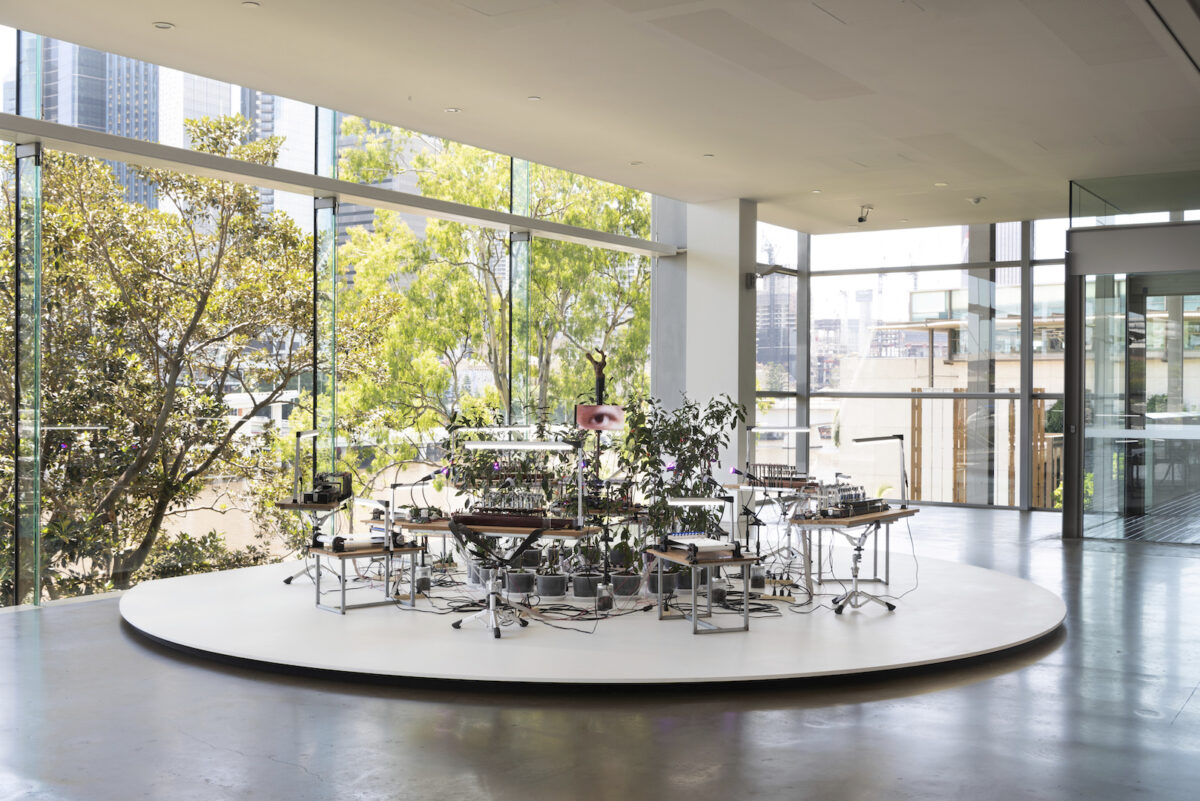
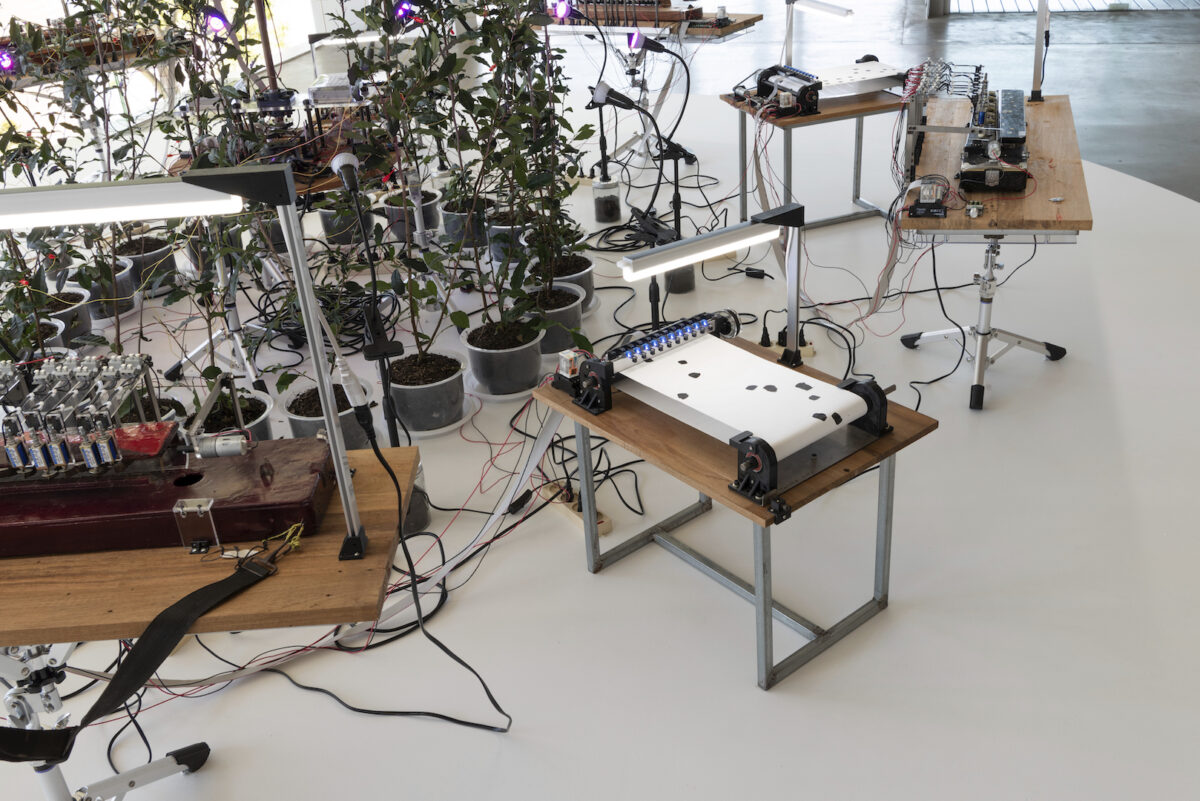
A Diasporic Mythology (2021) by Bagus Pandega (Indonesian, b. 1985) is a kinetic and sound installation organized in concentric rings (fig. 1). In the outer ring, several stringed instruments are similar in shape but culturally distinct: a taishōgoto from Japan and a sijobang harp, Balinese penting, Lombok penting, and mandaliong, all native to Indonesia. At the center of this arrangement are live tea plants equipped with MIDI Sprout sensors that capture bio-information from plants, which is translated to signals that activate the instruments. The MIDI sensors are also connected to a mechanical system that reads musical scores printed on a sheet of vinyl paper. The scores are informed by interviews Pandega conducted with local musicians who played the instruments included in the work. From these conversations, Pandega wrote scores that the sensors read as digital annotations, triggering a network of solenoid drivers and rotating motors to strike strings or press keys, creating an automated, live performance. This automation is bound by an invisible thread of historical and cultural translation. While the instruments explore how the same acoustic apparatus (the string instrument) circulates and adapts across different regions and cultures, the tea plants speak of the colonial history of the Dutch bringing tea from Japan to Indonesia.1There are several accounts of how tea came to be cultivated in Indonesia. Camellia sinensis tea was first introduced to Indonesia from Japan in 1684 in the form of seeds brought by a German VOC employee named Andreas Cleyer and planted as an ornamental plant in Batavia, now Jakarta, Indonesia. In 1694, the monk F. Valentijn also reported that he saw the same type of tea plant in the garden of the VOC Governor-General, Camphuys, also in Batavia. Without oversimplifying the work through a mere, brief description, this is the intricacy of Pandega’s aesthetic.
Pandega assembles various electronic components, musical instruments, found objects, and 3-D-printed custom parts and software into artworks that combine and generate kinetic, acoustic, and light elements in a modular way: Each of the constituent components can be replaced, modified, or exchanged to form another iteration. Despite the technical marvel of his installations, Pandega’s approach to artistic practice remains fundamentally DIY—an artistic ethos that intentionally bypasses industrial standards. Pandega has adopted this “maker” mentality—rooted in Indonesia’s 1990s media landscape—to reexamine the collision between society and nature, as seen in The Diasporic Mythology.
DIY culture in Indonesia as it relates to art is primarily associated with self-organizing. It acts as a response to the lack of art infrastructure or institutions, and takes form in collective or community-based practices. However, DIY can also be seen in the process of creating artwork through a culture of customization and the use of “low technology” in media and new media art, that was introduced to Indonesia in the 1990s, along with the growing consumption of media and information technology, such as computers and the internet, in Indonesia and Southeast Asia in general.
Pioneering multimedia artist Krisna Murti (1957–2023) utilized video installations to critique the friction between Indonesian tradition and technological consumerism. Canonical works such as 12 Hours in the Life of Agung Rai, the Dancer (1993)2See 12 Hours in the Life of Agung Rai, the Dancer, Studio R-66, Bandung, September 1993. See Krisna Murti, 12 Hours in the Life of Agung Rai, the Dancer, posted February 18, 2011, by the artist, YouTube, 1 min., 9 sec., https://www.youtube.com/watch?v=nJ96llODHkE. and Learning to Queue Up to the Ants (1996)3See Learning to Queue Up to the Ants / Belajar Antri Kepada Semut, Soemardja Gallery, Bandung Institute of Technology, December 10–23, 1996, https://mahagurukrisnart.com/belajarantredarisemut/index.html. See also Krisna Murti, Learning to Queue Up to the Ants, posted February 2, 2011, by the artist, YouTube, 18 sec., https://www.youtube.com/watch?v=1sxfK2Dlwuw&t=9s. highlighted a clash of modernities in which the digital medium was used to examine tradition rather than replace it. While Murti’s installations were not modular and, furthermore, were typically fixed in their configuration, his interdisciplinary approach laid the groundwork for the more fluid systems developed by the next generation.
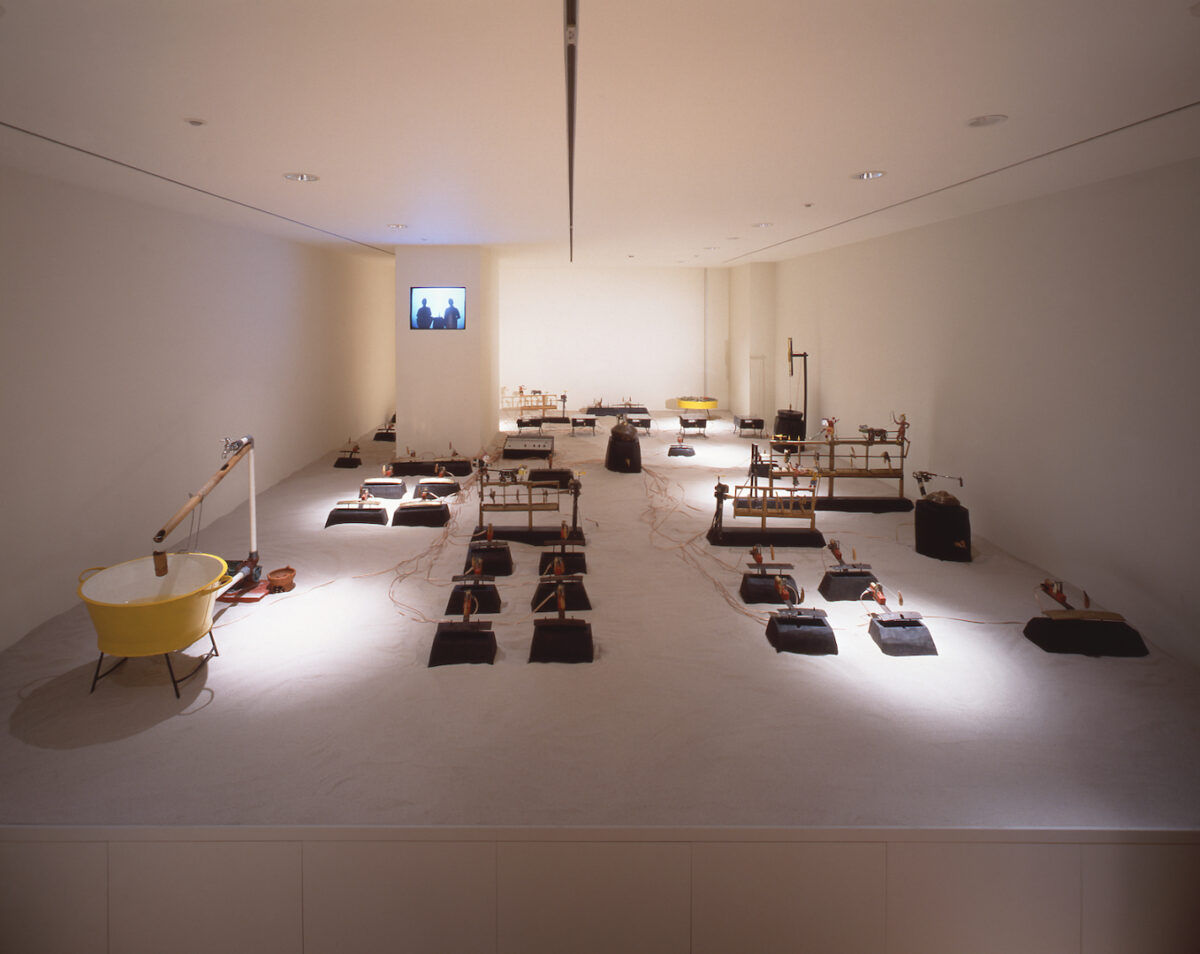
In contrast, Heri Dono (b. 1960) created low-tech kinetic installations that critique Indonesia’s position as a consumer of technology. Observing that defective electronics were more often discarded than repaired, he incorporated used motors and coils into his work. Dono looked upon this process of “reviving” obsolete objects as a form of mechanical animism.4See, for example, “Interview | Yogyakarta-Based Artist Heri Dono,” Asian Art Contemporary, posted June 20, 2025, https://asianartcontemporary.com/2025/06/20/interview-yogyakarta-based-artist-heri-dono/. His practice was further informed by the concept of dua seni rupa (two arts) first explored by Sanento Yuliman in 1984, which encourages a dialogue between “high” and “low” sociocultural phenomena.5See Sanento Yuliman, Dua seni rupa: Sepilihan tulisan Sanento Yuliman, ed. Asikin Hasan (Yayasan Kalam, 2001). Dono’s works, for example Gamelan of Nommunication (1997), use mechanical devices and samples to automate traditional instruments, prefiguring the automated ensembles later made by Pandega (fig. 2).
In their work in the 1990s, Murti and Dono examined encounters between technology and tradition as well as the binary tensions arising from symbolic and performative gestures addressing them. Sometimes, they distanced themselves from the concept of high technology. At other times, they were satirical or parodic in their approaches to it. Their video works are parts of fixed installations that would always be arranged in the same way—as opposed to being modular and reconfigured depending upon the context. Yet, their works are also interdisciplinary in nature, a characteristic that foreshadows the new media works of a later generation of artists.6Having studied shadow puppetry, Dono often incorporated elements of wayang, a theatrical form of storytelling that frequently uses puppets and that, in itself, integrates visual, kinetic, and musical elements. On the opening night of Learning to Queue Up to the Ants, Murti staged a dance performance and poetry reading accompanied by traditional Balinese music around the installation. As Indonesian curator Agung Hujatnika has observed, the early Indonesian media artists who merged art and technology were not driven by a spirit of “scientific discovery” but rather by their interest in the impact of technological culture on and in the everyday lives of Indonesians.7“Tentang Seni Media Baru: Catatan Perkembangan” [About New Media Art: Notes on Developments], in Apresiasi Seni Media Baru [New Media Art Appreciation] (Directorate of Arts, Ministry of Culture and Tourism, 2006), 11–27.
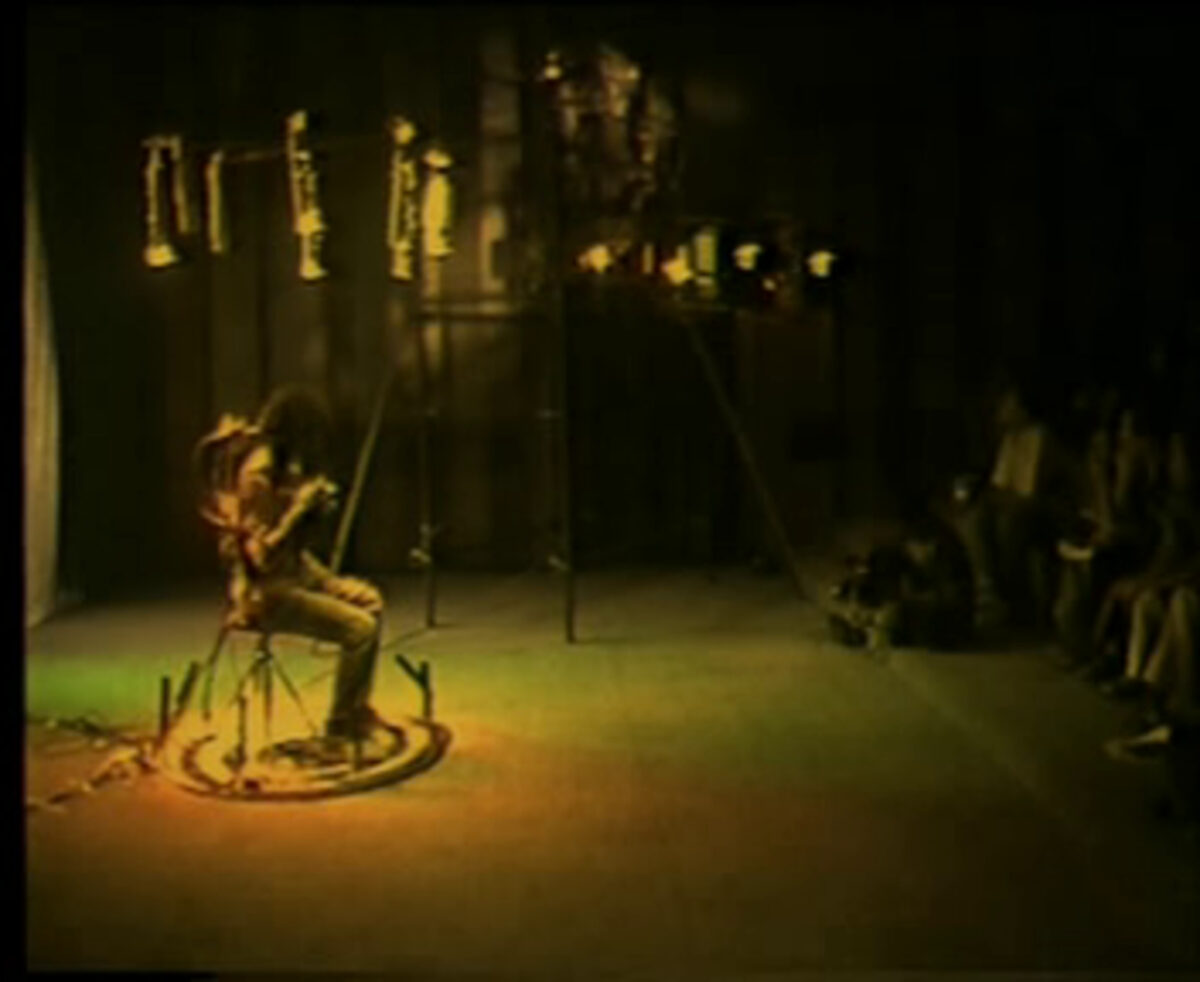
Ade Darmawan (b. 1974) and other artists working at the dawn of the 2000s—in post-Reformasi Indonesia—expanded new media art in terms of both artistic expression and infrastructure.8The Indonesian post-Reformasi period—which began with the resignation of President Suharto on May 21, 1998, after a 32-year-long authoritarian regime—was characterized by democratization and social reform. Though the cultural mood of this period was in many ways euphoric, including for artists and musicians, the capitalist television and music industries, which favored more popular media, remained a hegemonic and out-of-reach ecosystem. As a reaction to this, machine customization culture, closely linked to experimental sound and music performance, flourished. For example, the early sound installation performances of the short-lived Yogyakarta-based artist duo Garden of the Blind—Jompet Kuswidananto (b. 1976) and Venzha Christ (b. 1975)—were primarily constructed from tinkered technology. Kuswidananto described their practice as “electrocraft,” a term he coined for a method of working that falls somewhere between the realms of analog and digital.9Jompet Kuswidananto in discussion with the author, November 6, 2025. Kuswidananto coined the term without further theoretical explanation. This kind of low-tech assembly is apparent in the duo’s performance Kingdom of Broken Heart (2001), which features a cyborg-like performer equipped with a sensor-based right-hand glove and a spine that emits beeps when it moves (fig. 3). Seated in a chair on a postapocalyptic stage, beneath rotating televisions suspended from the ceiling, the performer remains central to the installation.
Pandega’s practice emerged from a more established landscape of artist-led infrastructure, including collectives like ruangrupa (est. 2000, Jakarta), which staged the first OK. Video—Jakarta International Video Festival in 2003, and Bandung Center for New Media Arts, which institutionalized DIY and DIWO (do-it-with-others) mentalities. As part of the generation that emerged after the new media artists born in the late 1950s, 1960s, and 1970s, Pandega had earlier and more significant exposure to technology and relatively established infrastructure and reception. He earned a Bachelor of Arts in sculpture in 2008 and a Master of Fine Arts in 2015 from the Faculty of Art and Design at the Institut Teknologi Bandung (ITB). Pandega’s artistic development coincided with the emergence in 2007 of “intermedia” within the practical and pedagogical trajectory of ITB, which developed the category as a new and separate discipline within its fine arts department as a means of integrating art within media and information technology. Though Pandega himself remained an autodidact, this institutional shift in focus made new media art a budding practice within the formal infrastructure of ITB, which traditionally, had been more artist-initiated and grassroots-oriented.
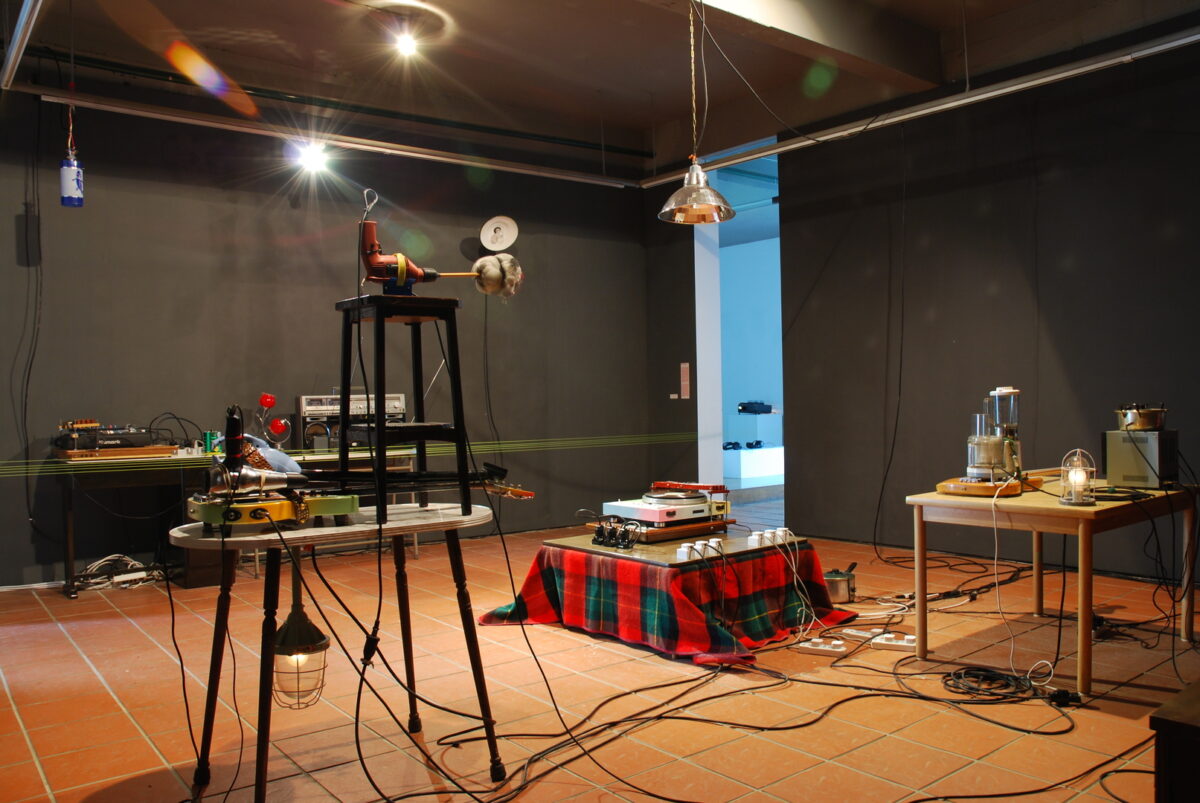
In 2007, Pandega also encountered the work of Japanese artist Muneteru Ujino (b. 1964) at KITA!! Japanese Artists Meet Indonesia, where Ujino exhibited The Rotators (2007) (fig. 4).10KITA!!: Japanese Artists Meet Indonesia is a residency and group exhibition program in Jakarta, Bandung, and Yogyakarta, Indonesia, that included Selasar Sunaryo Art Space as its Bandung venue, April 19–May 18, 2008. Ujino is known for sound installations that combine 20th-century industrial products, such as household appliances, electric guitars, cars, and building materials, with DIY technology. Pandega took inspiration from his practice and started exploring the tension between the functional history of an object and its potential to generate sound.
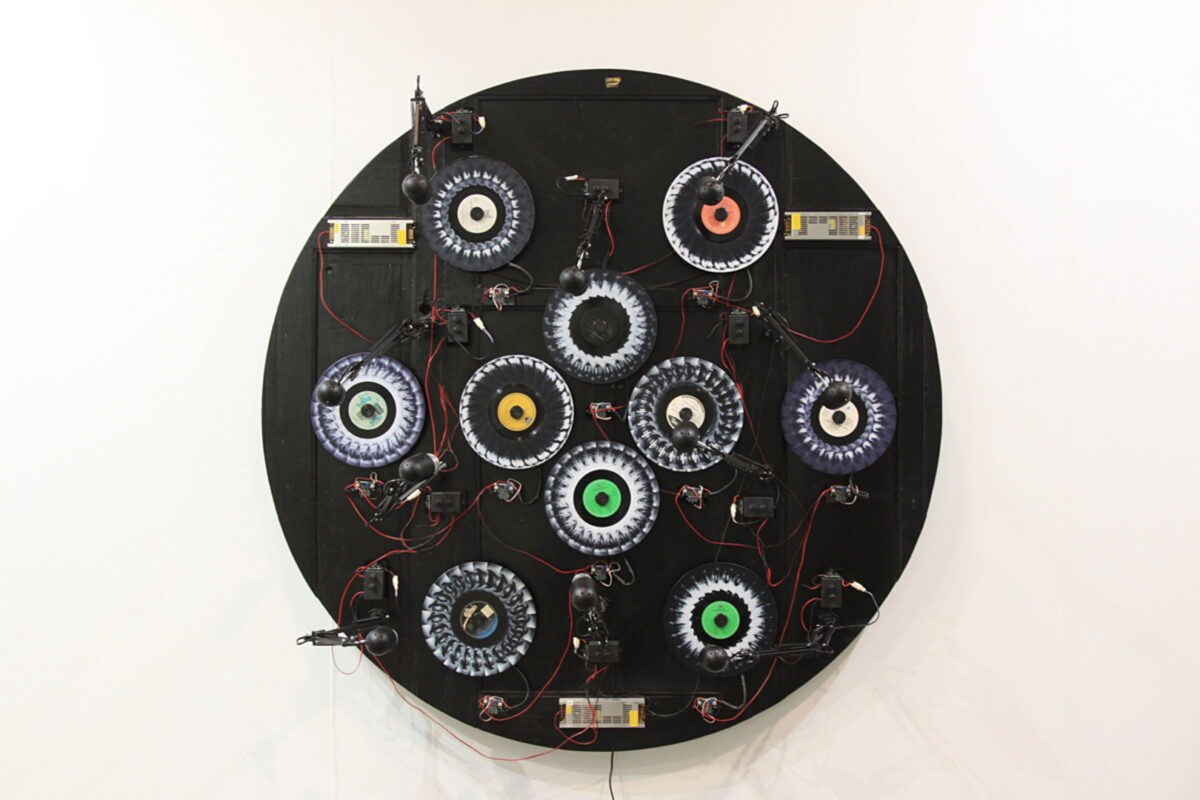
By 2015, Pandega was fully integrating modularity, treating installation components as individual, wall-bound units of vinyl and light—a pivotal shift evident in his Clandestine Transgression series (fig. 5). In subsequent works, like Polka (2016) and A Tea Poi on Moo (2016), he further distilled the complex setups into self-contained modules. This new approach allowed him to extract and recontextualize various components across exhibitions, to look upon them as technical and conceptual nomads rather than fixed parts of a single unit. While Murti and Dono utilized traditional musical instruments to symbolically illustrate a cultural clash with modernization, Pandega favored a different friction: stripping the instruments of their melodic expectations and treating them as raw sound generators.
Referring to his practice as “social-based DIY,” Pandega visits local smiths and technicians—such as lathe operators—to commission components and machine parts for his installations as well as to establish long-term relationships with the people integral to his artistic practice.11Bagus Pandega in conversation with the author, February 15, 2025. His works are hands-on, and his deep, consistent engagement with objects and the smiths who make them is testament to the dialogic and often communal nature of new media arts in Indonesia. Pandega’s work transforms and deconstructs the functionality and nature of everyday objects, some of which he has acquired secondhand. His use of modern musical instruments, whether they are intact or physically deconstructed, echoes the interdisciplinary ethos of earlier artists. Whether using vinyl LPs, lamps, or custom instruments, Pandega treats every variable as a technical and conceptual nomad that can be continually repurposed through new prompts and iterations across different modular systems.
A Diasporic Mythology explores the diaspora of culture and objects through trade and musical influence. This kinetic and sound installation establishes relationships between Indonesia and Japan by bringing together seemingly unrelated items from across borders into a diasporic ensemble. The taishōgoto, a 1912 Japanese invention, hybridizes a typewriter mechanism and stringed instrument. In joining it with Indonesian instruments—a mandaliong (Lombok), penting (Bali and Lombok), and kecapi sijobang (West Sumatra)—Pandega creates a cross-cultural dialogue.
This ensemble is connected to the live Camellia sinensis, a tea plant with deep roots in colonial trade between Asia and Europe. MIDI Sprout sensors detect the plants’ electrical conductivity as biodata, triggering solenoids and motors to pluck the strings. The resulting sound is a musical and historical cacophony that highlights three of Pandega’s core interests: 1) an assembly of instruments from different cultures; 2) the use of nonhuman agency (nature) to “control” technology; and 3) the contrast between traditional, native instruments and modern, technological devices and softwares. The contrasts explored here by Pandega mirror the cultural tensions explored by Murti and Dono in the 1990s.
In the context of A Diasporic Mythology, modularity operates on two levels: technically, in merging electronic components and living organisms into reconfigurable systems, and conceptually, in recasting cultural objects and their inherent histories as interrelated fragments brought together to reconstruct an ensemble or an ecology. The modular logic allows each work to perform as a fluid mechanism capable of being dismantled and recalibrated to inhabit new geographical and curatorial environments without losing its integrity. Since its inception, A Diasporic Mythology has experienced a dispersion from its original articulation. The work debuted in 2021 as a commissioned piece in the 10th Asia Pacific Triennial of Contemporary Art. It was then featured in 2022 in Pandega’s solo exhibition O (pronounced “circle”), the focus of which was ecological extraction and circular economies. On both occasions, the arrangement of individual modules, each enabled by its own inherent technical and architectural capability, echoes the diaspora it aims to address.
The modular nature of A Diasporic Mythology is also due to the functional independence of its components. As previously mentioned, Pandega treats acoustic, light, and kinetic as individual elements that can be brought together to form a more expansive body of work, that is, a richer ecology. This work is composed of several self-contained modules that can operate independently or on a smaller scale. Indeed, some of them have been used in entirely different artworks. For example, the taishōgoto is also part of Pandega’s Remaining Ending (2020). In this earlier piece, an orchid is clipped to the MIDI Sprout so that its conductivity can be read by the device to play the taishōgoto. In front of the musical instrument, Pandega placed three books on Pendidikan Sejarah Perjuangan Bangsa (Education on the History of the National Struggle), a subject in the curriculum of the Indonesian New Order.12The New Order (Orde Baru) was instituted by Suharto, Indonesia’s second president, who was in power from 1966 to 1998. In 1984, Suharto mandated that the Education on the History of the National Struggle (PSPB) be taught as a required subject from elementary through high school. The implementation of this curriculum remains controversial, as it is widely viewed as propaganda designed to promote the government’s official nationalist narrative and legitimize the military’s prominence in state discourses. Different from A Diasporic Mythology, the taishōgoto in Remaining Ending conceptually represents the history of education in Indonesia, which was influenced by Japanese colonialism, and links it to the education system and controlled narratives of the New Order era.
In A Diasporic Mythology, this same instrument conceptually represents a different colonial historical network, a shift that is further complicated by a series of similar stringed instruments with nonetheless different cultural associations. This example shows how the very same module might conceptually transform when it is recontextualized, or placed within a different and more entangled installation.13Remaining Ending and Witnessing Pentang have “simple” configurations and their mechanisms are traceable, while A Diasporic Mythology has a more complex circuitry. This particular mechanism also echoes the diaspora in that modules formerly concentrated in one environment have scattered from their homeland to inhabit new, more culturally intricate environments.
A Diasporic Mythology does not hide its modularity (fig. 6). Indeed, its constituent parts are literally laid bare—with nothing shrouding them. Viewers can simultaneously observe the exposed circuitry, structure, and tangled wires up to the electric power socket into which they are plugged. On full display, the modules making up A Diasporic Mythology are thereby rendered visibly equal—even though the tea plant and musical instruments serve as the main discursive points, and despite the fact that the rotating LED screen is at the center and top of the concentric installation. Pandega’s objective as a new media artist is to invite viewers to pay attention to his work’s complexity. A Diasporic Mythology coaxes them to trace how the tea and taishōgoto, for example, are connected not only through the MIDI Sprout, but also through the cultural diaspora. The repetition of certain objects across Pandega’s works demonstrates a configurability that reveals both diasporic and prototypic dimensions.14For example, Pandega’s first collaboration with Kei Imazu, Artificial Green by Nature Green, has undergone several versions derived from previous ones. Its first iteration was made in 2019, and at the time of writing, the latest, 4.1, was presented in 2025. By considering the same mechanism in the context of different arrangements, we can see how it might serve as a prototype, or preliminary mechanism, for future rearrangements—wherein new elements are added and old ones subtracted or repurposed to serve a new ecology of relations. Ultimately, any one module might be rescaled and/or rearranged, evolving alongside the specific ecology of a particular exhibition.
To define the trait of a module and modularity in Pandega’s practice, we might look at how the artist combines physical hardware and historical objects. In Pandega’s practice, which evolved from studying fine art sculpture to applying his “social-based DIY” method, a module is not merely a building block of an installation; it is a self-contained conceptual block capable of inhabiting different contexts. Each module represents a combination of technical and conceptual components. Each possesses the functional capacity to operate as a single mechanism, as exemplified by Remaining Ending, or as part of a larger, webbing ecosystem, such as A Diasporic Mythology. Each constituent possesses a distinct history or association, be it with colonial trade or musical migration, that persists regardless of its physical and historical displacements. Hence, modularity is the aesthetic that allows the inherent cultural or historical quality of an object to be as reconfigurable as its hardware.
As seen in A Diasporic Mythology, modularity is also defined by the exposed relations within the installation. By baring its circuitry, the work weaves technical mechanisms into visible figures of speech. This unshrouded modularity invites the audience to trace the relationships between the modules—not just their physical presence. Modularity mirrors the diasporic framework: It embodies the historical dispersion of the objects it utilizes by migrating across geographical and curatorial ecologies.
Pandega’s modularity clearly addresses more than technological or scientific discovery. It also calls attention to artistic derivations resulting from the discrete material and conceptual properties of each module. It demands an understanding of a complex material ecology: What did the module look like previously? How does it function in the present work? What possible mechanisms might it operate in the future? Within this circuitry, historical moments serve as “invisible” modules, the connective tissue that complicates Pandega’s installations and enhances what might otherwise be a purely kinetic endeavor. By treating every component as a module, Pandega moves beyond the binary tensions of the 1990s media art into a space of fluid, intermedial conversation. Through this intricate assembly, Pandega ensures that the complexity of his modularity lies not just in its technical spectacle, but also in its ability to fundamentally question our own relationship with technology, its politics, its ecology, and its history.
- 1There are several accounts of how tea came to be cultivated in Indonesia. Camellia sinensis tea was first introduced to Indonesia from Japan in 1684 in the form of seeds brought by a German VOC employee named Andreas Cleyer and planted as an ornamental plant in Batavia, now Jakarta, Indonesia. In 1694, the monk F. Valentijn also reported that he saw the same type of tea plant in the garden of the VOC Governor-General, Camphuys, also in Batavia. ↩︎
- 2See 12 Hours in the Life of Agung Rai, the Dancer, Studio R-66, Bandung, September 1993. See Krisna Murti, 12 Hours in the Life of Agung Rai, the Dancer, posted February 18, 2011, by the artist, YouTube, 1 min., 9 sec., https://www.youtube.com/watch?v=nJ96llODHkE. ↩︎
- 3See Learning to Queue Up to the Ants / Belajar Antri Kepada Semut, Soemardja Gallery, Bandung Institute of Technology, December 10–23, 1996, https://mahagurukrisnart.com/belajarantredarisemut/index.html. See also Krisna Murti, Learning to Queue Up to the Ants, posted February 2, 2011, by the artist, YouTube, 18 sec., https://www.youtube.com/watch?v=1sxfK2Dlwuw&t=9s. ↩︎
- 4See, for example, “Interview | Yogyakarta-Based Artist Heri Dono,” Asian Art Contemporary, posted June 20, 2025, https://asianartcontemporary.com/2025/06/20/interview-yogyakarta-based-artist-heri-dono/. ↩︎
- 5See Sanento Yuliman, Dua seni rupa: Sepilihan tulisan Sanento Yuliman, ed. Asikin Hasan (Yayasan Kalam, 2001). ↩︎
- 6Having studied shadow puppetry, Dono often incorporated elements of wayang, a theatrical form of storytelling that frequently uses puppets and that, in itself, integrates visual, kinetic, and musical elements. On the opening night of Learning to Queue Up to the Ants, Murti staged a dance performance and poetry reading accompanied by traditional Balinese music around the installation. ↩︎
- 7“Tentang Seni Media Baru: Catatan Perkembangan” [About New Media Art: Notes on Developments], in Apresiasi Seni Media Baru [New Media Art Appreciation] (Directorate of Arts, Ministry of Culture and Tourism, 2006), 11–27. ↩︎
- 8The Indonesian post-Reformasi period—which began with the resignation of President Suharto on May 21, 1998, after a 32-year-long authoritarian regime—was characterized by democratization and social reform. ↩︎
- 9Jompet Kuswidananto in discussion with the author, November 6, 2025. Kuswidananto coined the term without further theoretical explanation. ↩︎
- 10KITA!!: Japanese Artists Meet Indonesia is a residency and group exhibition program in Jakarta, Bandung, and Yogyakarta, Indonesia, that included Selasar Sunaryo Art Space as its Bandung venue, April 19–May 18, 2008. ↩︎
- 11Bagus Pandega in conversation with the author, February 15, 2025. ↩︎
- 12The New Order (Orde Baru) was instituted by Suharto, Indonesia’s second president, who was in power from 1966 to 1998. In 1984, Suharto mandated that the Education on the History of the National Struggle (PSPB) be taught as a required subject from elementary through high school. The implementation of this curriculum remains controversial, as it is widely viewed as propaganda designed to promote the government’s official nationalist narrative and legitimize the military’s prominence in state discourses. ↩︎
- 13Remaining Ending and Witnessing Pentang have “simple” configurations and their mechanisms are traceable, while A Diasporic Mythology has a more complex circuitry. ↩︎
- 14For example, Pandega’s first collaboration with Kei Imazu, Artificial Green by Nature Green, has undergone several versions derived from previous ones. Its first iteration was made in 2019, and at the time of writing, the latest, 4.1, was presented in 2025. ↩︎