The Harvest of Evelyn Ashamallah
Evelyn Ashamallah (born 1948) presides over history from her small apartment in Talaat Harb in downtown Cairo. Across the past six decades, she has demonstrated a legacy of constant negotiation…
The annual Asilah Cultural Moussem, an international festival held in northern Morocco, was cofounded in 1978 by Mohamed Benaïssa and Mohamed Melehi in collaboration with Toni Maraini and Al Muhit Cultural Association. It served as a significant postcolonial cultural platform, involving activists from the Casablanca Art School and artists from Africa, the Arab world, Asia,…
This public program brought together Nancy Adajania, May Adadol Ingawanij, and Frida Muenala from Mullu for an evening of inquiry into forms and practices of gathering. The speakers, who represent diverse practices in the cultural fields—from art making to curation to institutional leadership—and operate across vast geographies, unpacked their different approaches to assemblies. Among the…
“The past must not be forgotten, but the present reminds us of the past, so we must take responsibility for it.” —Romuald Hazoumè Romuald Hazoumè (born 1962, Porto-Novo, Benin) began his artistic training unintentionally. Between the ages of 10 and 12, he made masks as part of…
Born in the village of Kwali, Ladi Dosei Kwali (1925–1984), the pioneering Nigerian potter, grew up in a family in which it was the norm for women to make pots for practical use and sustenance. Although it was customary for mothers to teach this skill to their daughters, Kwali learned pottery from her aunt. She…
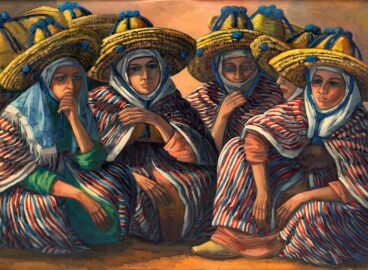
A few years after Algeria gained its independence from France in 1962, the artist Houria Niati (b. 1948) took up a position with the Ministry of Youth and Culture, where she taught painting, ceramics, and drawing to both adults and children. Art workshops were intended to help Algerians work through the trauma of the Algerian…
A work of openness and inscrutability, Salah Elmur’s Missing and Lost People’s Day (2021) commemorates a terrible moment in Sudan’s recent history: the massacre on June 3, 2019, when security forces opened fire on a peaceful protest in Khartoum. Hundreds were killed, injured, or arrested. In this painting, which Elmur made during a residency in…
In the mid-1980s, over the course of three years and across three continents, feminist artist Everlyn Nicodemus (born 1954, Kilimanjaro, Tanzania) gathered together women to discuss their everyday experiences. From these conversations, which took place in Skive, Denmark; Kilimanjaro, Tanzania; and Calcutta (now Kolkata), India, she produced a series of seventy-five paintings and related poems that…
Jean-Michel Atlan (1913–1960)—who signed simply as Atlan in his works—is most often considered a representative of lyrical abstraction, an art movement that took root in Paris after World War II. Born in the Casbah of Constantine to a Jewish Berber family…
Jean-Michel Atlan (1913-1960) – qui signait simplement Atlan – est le plus souvent considéré comme l’un des représentants de l’abstraction lyrique, mouvement qui marqua la scène parisienne dans l’après-guerre. Né dans la casbah de Constantine, au sein d’une famille juive berbère, comme…
The Non-Aligned Movement (NAM) was established in Belgrade, Yugoslavia, in 1961, during the peak of the Cold War, drawing inspiration from the principles of the 1955 Afro-Asian Conference in Bandung, Indonesia. Founded by developing countries opposed to formal alignment with either the United States or the Union of Soviet Socialist Republics, NAM advocated for national…
“Seyni Awa Camara doesn’t belong to any artistic school,” wrote art critic Massamba Mbaye in 2016. She resists any classification and has always considered herself a singular artist, whether in the context of her own country or in that of the international art…