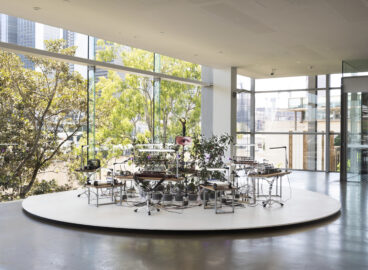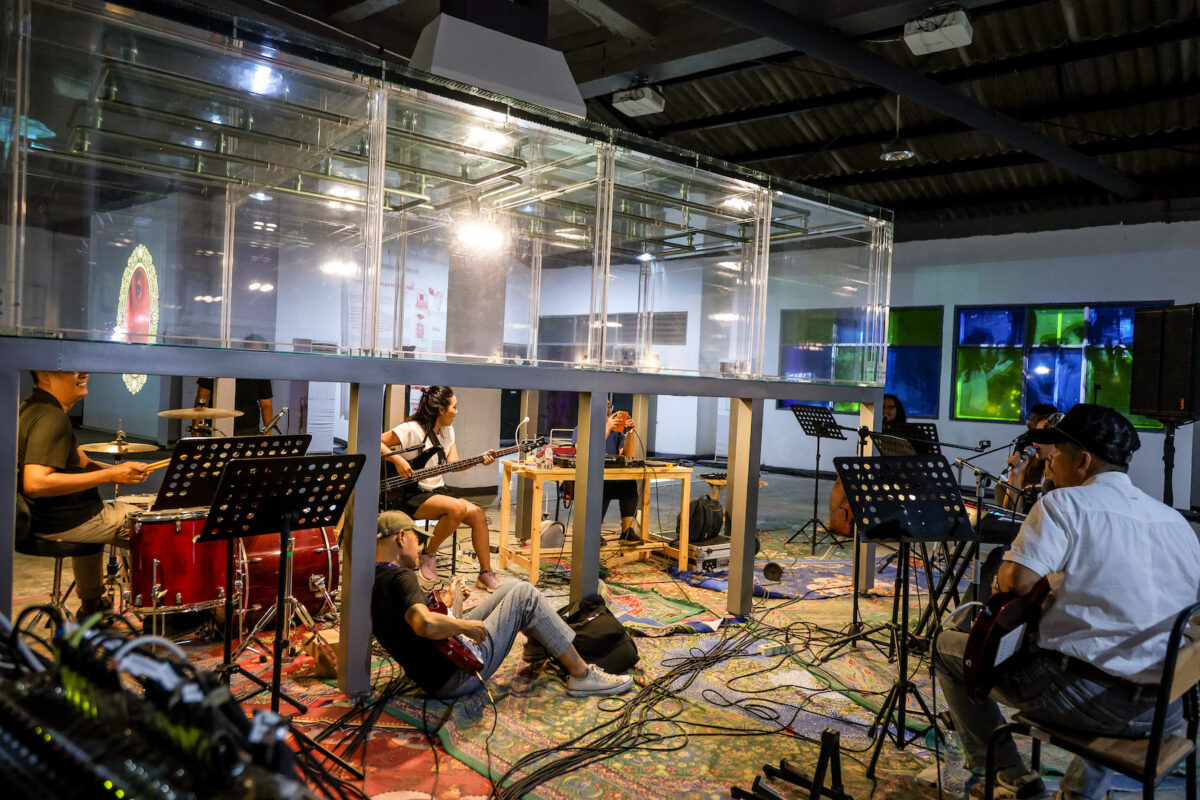
To begin with, I want to stay with the title.1I owe this title to the first image in the essay. For me, it is an instance in which conviviality operates within an exhibition site, despite its unavoidable white-cube-y isolation. Artists, musicians, and visitors gather in an unscheduled jam session—drums, guitars, microphones, cables sprawling across patterned carpets. They sit, stand, recline—in no fixed hierarchy. Above them, a transparent, boxlike structure (a smoking room, itself an artwork) hovers with visible ducting, at once enclosure and apparatus. The space feels improvised yet intentional: studio, rehearsal, social gathering, and installation at once. I do not elaborate on the work here; the image remains as a proposition within the essay. All of its terms are plural, and this matters. My concerns are not the singular, canonical, capital H History or the capital A, capital H Art History—the forms of knowledge claimed by the state or by national narratives, academic institutions, market logics, or whatever capital is able to extract value from them. Histories, convivialities, art practices: These are multiple, distributed, often contradictory, and they don’t require elaborate justification in the context of what I want to unfold here.
The idea of conviviality that I often return to comes from Paul Gilroy, a theorist of race and racism whose work continues to shape how we understand coexistence in postimperial worlds. Gilroy uses “conviviality” not as a slogan or a more cheerful synonym for multiculturalism, but to describe how people in postimperial cities actually live with difference: the ordinary, improvisational mess of everyday life. People who, despite long histories of race, empire, and inequality, still find ways to eat together, borrow sugar, share the same streets, laugh at the same jokes. He is drawn to those small negotiations—those moments in which what might have divided people (language, skin, faith, memory) ends up coexisting with what they share: a bus ride, a football team, the weather, the city itself.2Paul Gilroy, After Empire: Melancholia or Convivial Culture? (Routledge, 2004), xi–xiv.
When Gilroy’s book first appeared in Britain, it was titled After Empire: Melancholia or Convivial Culture?—a diagnosis of a nation unable to let go of its imperial past. But when it crossed the Atlantic to the United States, the title was quietly changed. Columbia University Press published it as Postcolonial Melancholia.3Paul Gilroy, Postcolonial Melancholia (Columbia University Press, 2005). “Empire” disappeared. “Convivial culture” was deemed too cheerful, too opaque, perhaps too British. Instead, “melancholia”—the mood of something lost but not admitted—fit the American atmosphere of the early 2000s. This was the period after 9/11, when the United States was in the thick of the “War on Terror” and attempting to police the world while insisting it wasn’t an empire. The new title spoke to that anxiety: a grief that follows power but refuses to name itself.4Gilroy, Postcolonial Melancholia, 105–10.
Gilroy was, of course, writing about postimperial Britain, where the residues of empire cling to everyday encounters—in accents, in skin, in smell, in gesture. And yet he observed how, despite all of this, people still manage to live side by side: joking, arguing, sharing food, improvising a common life out of uneven materials. This, for Gilroy, is conviviality. Not harmony, but the practice of staying with differences. And it is this practice—with all its messiness, its harshness, its in-your-face realities, its tragedies and anxieties and dramas, and its inseparability from humor, generosity, kindness, and the continuous effort to make not just a life but a livable environment for oneself and for others—that resonates so deeply with the archipelago now known as the Republic of Indonesia. A place where coexistence has long been ordinary and difficult at once, where differences are not exceptions but conditions of life.5Gilroy, Postcolonial Melancholia, 2–6.
Allow me to briefly outline what I mean by “modern Indonesia.” I do not mean a tidy timeline or a national story one finds in textbooks. I mean something provisional: the ongoing, unfinished effort of learning how to live together across differences—ethnic, linguistic, religious, ecological—and under changing regimes of power and imagination. This definition is not final, and it will never become final. It is subjective and temporal, crafted for the purposes of this moment, and one I would likely contest in another conversation. But it is a starting point—a way to think about how conviviality, histories, and art practices intersect in this archipelago and its many modernities.
Let’s say that the “modern Indonesia” began around 1908, with the Sumpah Pemuda—the Youth Pledge.6The Sumpah Pemuda (Youth Pledge), declared in 1928 by young nationalist groups in Batavia, articulated a commitment to “one motherland, one nation, and one language: Indonesia.” Rather than resolving the archipelago’s linguistic and cultural plurality, the adoption of Bahasa Indonesia functioned as a shared medium among already existing differences. It did not replace local languages, which continued to structure everyday life, but introduced a space of translation and negotiation. In this sense, the pledge can be understood less as a unifying solution than as an ongoing experiment in speaking—and living—together. For further discussions on language and nation formation in Indonesia, see Benedict Anderson, Imagined Communities: Reflections on the Origin and Spread of Nationalism, rev. ed. (Verso, 1991); Hendrik M. J. Maier, We Are Playing Relatives (KITLV, 2004); and Rudolf Mrázek, Engineers of Happy Land: Technology and Nationalism in a Colony (Princeton University Press, 2002). The moment when Bahasa Indonesia (Indonesian) was declared a unifying language across the archipelago that was colonized by the Dutch. It is important to note that even today, Bahasa Indonesia is the first “foreign” language most Indonesians learn in school. More than 700 languages continue to be spoken across the archipelago; for most people, one or two of these remain their mother tongue—some of the languages have their own scripts, their own cosmologies, their own epistemologies of the world.
The decision to adopt Bahasa Indonesia as a unifying language, the way I see it, was an invitation—not a solution or a magic key. It was a proposal for an experiment in speaking and being together across islands, tongues, and lifeworlds. Around this same period, in the arts, painters such as Wakidi (1889–1979), Abdullah Suriosubroto (1878–1941), and Mas Pirngadi (c. 1878–1979) were producing the mooi-indie (beautiful Indies) landscapes—colonial-era images of ordered nature, picturesque tranquility, and the comfort of distance. By the 1940s, other forms began to surface: the untamed figures of Emiria Sunassa (1894–1964)7See Heidi Arbuckle, “Performing Emiria Sunassa: Reframing the Female Subject in Post/colonial Indonesia” (PhD diss., University of Melbourne, 2011.), the expressive sculptures Tridjoto Abdullah (1917–1989)8See Ruang Arsip dan Sejarah Perempuan, Indonesian Women’s Archives and History Space (RUAS), Tracing Women Artists in Indonesia (1940–1970), 2022–ongoing. Developed in conjunction with the exhibition As if there is no sun, which was curated by Hyphen— as part of the 58th Carnegie International exhibition Is it morning for you yet?, this annotated bibliography is now maintained as an open, collaborative resource on Hyphen—’s wiki, last modified March 6, 2026, https://hyphen.web.id/index.php/Tracing_women_artists_in_Indonesia_(1940–1970).—gestures that argued, questioned, and refused to remain fixed within the available vocabularies. What, then, begins to shift in these works? Is it a matter of representation, or something else—perhaps a reconfiguration of relation, of subjecthood, of how bodies and environments hold one another? I will now introduce you to two of Emiria’s works that I have encountered and (re)staged. Even as they appear here within exhibition space, these figures do not fully settle into the distance of representation. They retain a proximity that resists being reduced to image alone.
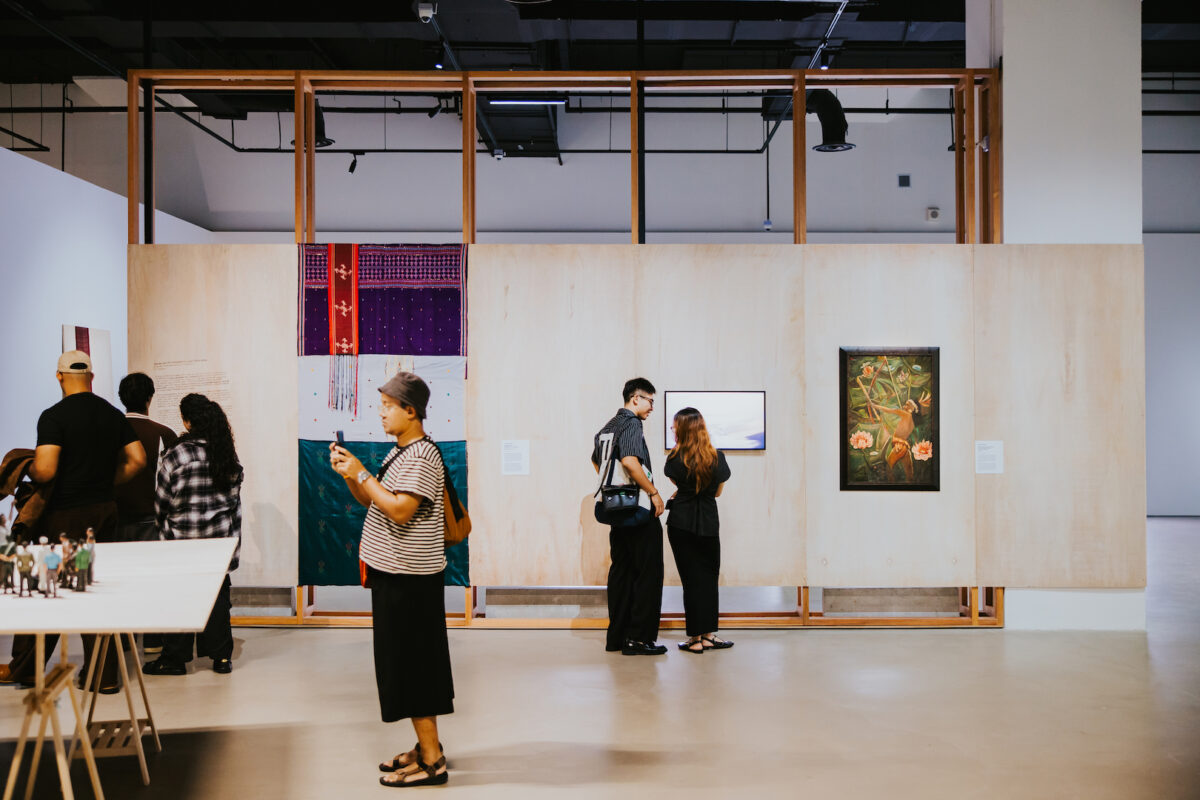
A male figure poised in mid-action. His archer’s bow drawn, body leaning back, muscles taut as he prepares to release an arrow. His dark-toned skin is accentuated by ornaments—large earrings, a feathered headdress, and a red sash at his waist. He stands within an environment dominated by the enormous vivid pink and red lotus leaves and blossoms that are blooming around him. The contrast between the earthy tones of the archer’s body enveloped in a dense vegetal field and the saturated hues of the lotus flowers creates a heightened sense of drama.
Emiria often painted figures from across the archipelago—from Balinese and Tidoreans to Dayaks, Bugis, Papuans, Javanese, and Sundanese—but here the figure’s identity is imagined, a creation of the artist’s vision. The surreal scale of the lotus plants transforms the scene into a suspended, almost mystical moment. Painted around 1941–46, during the final years of colonial rule and the dawn of Indonesia’s independence, the work conjures questions of identity, perception, and the Other, framing a human presence within a lush, dreamlike world on the threshold of a history in the making.9Hyphen—, Tokoh-tokoh, pengabdian, dan peradaban (Figures, dedications, and civilisations),exh. cat. (Hyphen—, 2026), 18–19. Published in association with the Singapore Biennale 2025: pure intention, October 31, 2025–March 29, 2026.
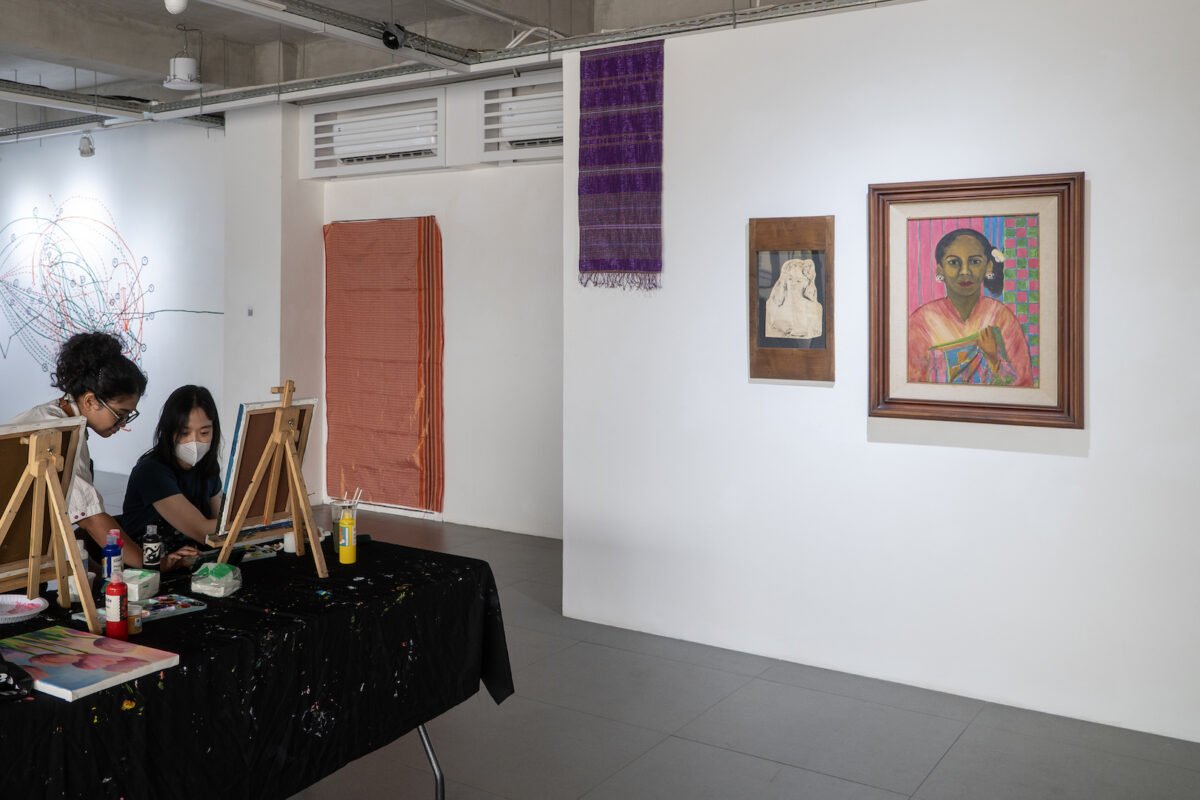
A female figure from Sulawesi. But let’s talk a bit about Emiria in around 1910–20. She entered Jakarta’s artistic and political circles in the 1940s and 1950s. Before then, she was remembered otherwise. Oral accounts suggest she was identified not as a princess of Tidore but rather as Emmy Pareira (a Minahasan woman from the Manoppo-Pareira clan), who was raised in Manado and educated in Christian missionary schools. In the mid-1910s, she and one of her sisters were known as musicians—a pianist and singer, respectively—who performed in Dutch society circles in Ternate and, briefly, in Europe (1914–15). There she went by the name “Sunny.” Later, in the 1920s, she described herself as a “girl from the East” who was studying Dalcroze eurhythmics (a musical pedagogy based on body movement) in Brussels and Vienna.10Hyphen—, Tokoh-tokoh, pengabdian, dan peradaban, 74–75.
In the late 1940s, art schools began to open, bringing Western curricular structures. What is now the Institut Teknologi Bandung (ITB) was established as the Technische Hoogeschool te Bandoeng in 1920 under Dutch colonial administration. After independence, its art-related programs developed within this technical and pedagogical lineage, eventually forming the Faculty of Art and Design in 1984.11See Helena Spanjaard, Artists and Their Inspirations: A Guide Through Indonesian Art History (1930–2015) (LM Publishers, 2016). Meanwhile, the Institut Seni Indonesia—Yogyakarta (the first of its kind, now replicated across the archipelago) emerged from a series of institutions founded by nationalist artists—many left-leaning and largely self-taught—including ASRI (Indonesia Academy of Fine Arts, 1950)12See Akademi Seni Rupa Indonesia [ASRI], 20 Tahun ASRI [20 Years of ASRI] (ASRI Dies Natalis, 1970)., ASDRAFI (Indonesia Drama and Film Academy), and AMI (Indonesia Music Academy). One might expect that this Yogyakarta group of founders—known for critiquing their predecessors’ idealized depictions of Indonesia in the style of colonial painters—would create a curriculum of their own. Mind you, they did not. The Jogja art school, too, adopted a Western structure and orientation. What is now the Institut Kesenian Jakarta (IKJ), which only formed in the late 1970s, is perhaps the only one that openly stated its grounding in the approaches of Santiniketan.13See Dolorosa Sinaga, Citra Smara Dewi, et al, 19 Tokoh Fakultas Seni Rupa, Institut Kesenian Jakarta, 1970–2010 [19 Figures from the Faculty of Fine Arts, Jakarta Arts Institute, 1970–2010] (Fakultas Seni Rupa Institut Kesenian Jakarta, 2010). Yet even there, the national education system surrounding it remained thoroughly Western in design, imagination, and form.
This quick sketch of these schools—their differences, their genealogies—is meant to show that the “modern” in Indonesia was never singular. With their establishment, people’s sense of what counted as “high art” shifted from wayang and temple reliefs toward painting, sculpture, and other forms taught in majority art schools all over the Western world. But the older forms never vanished. As long as they remained functional within their communities, they continued to circulate, inspire, and complicate any neat narrative of artistic progress. In speaking about “modern Indonesia,” I am thinking less in terms of chronology or style and more in terms of conviviality as practice: the everyday negotiation of languages, traditions, faiths, empires, merchants, farmers, rulers, and neighbors. The “modern” was—and remains—about relations: how to live together, how to keep conversations open, how to practice care even when histories, hierarchies, and inequalities persist.
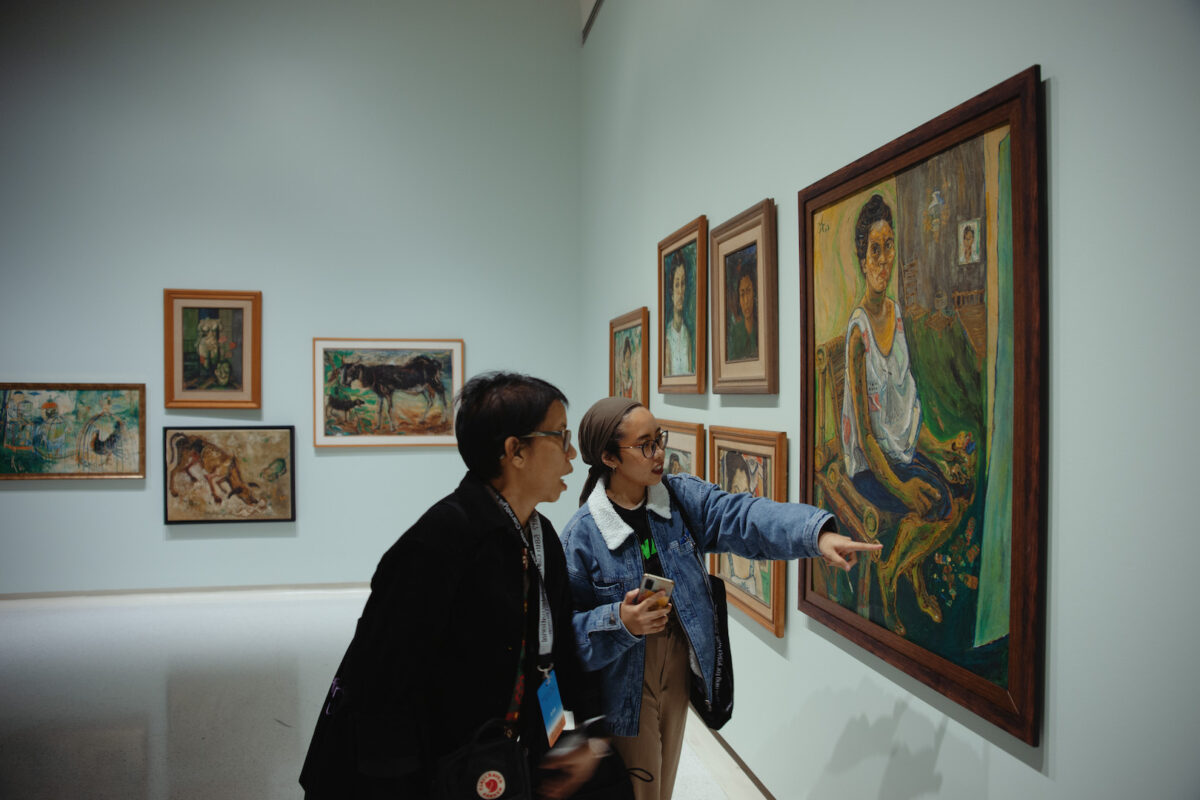
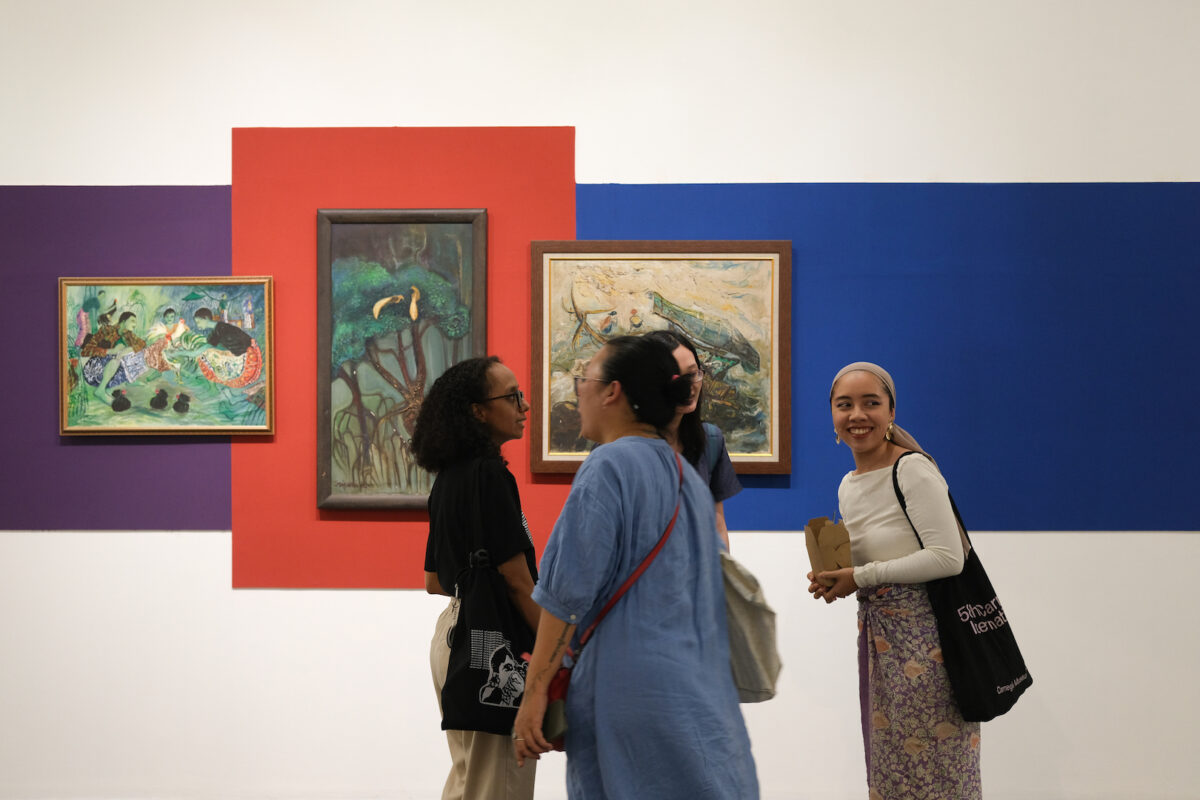
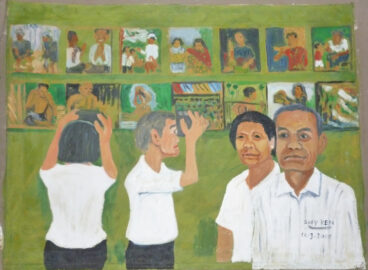
Another example, from a different time, might help to make this more tangible. These are images I often return to—of artworks and people being with them. Not just looking, but talking, pointing, laughing, pausing. There is curiosity there as well as a kind of ease. A willingness to stay with the work, and with one another, without needing to resolve anything too quickly. If we stay a little longer within these situations of looking, certain works begin to hold our attention differently. Not as examples of a period, but as presences that gather and redistribute how people stand, point, speak, and remain.
The first photograph was taken within As if there is no sun, an exhibition that was part of the 58th Carnegie International: Is it morning for you yet? in Pittsburgh (2022).14See Hyphen— [Akmalia Rizqita “Chita,” Grace Samboh, and Ratna Mufida], “Red frangipani in cold and darkness,” in Is it morning for you yet?: 58th Carnegie International, ed. Sohrab Mohebbi with Ryan Inouye and Talia Heiman, exh. cat. (Carnegie Museum of Art, 2022), 48–57. The other is from a more recent exhibition at Gajah Gallery in Yogyakarta titled Kebebasan Manusia Perasa (Freedom of the Sentient Beings, 2025).15See Hyphen—, Kebebasan Manusia Perasa (Freedom of the Sentient Beings), exh. cat. (Gajah Gallery, 2026). Research-wise, the latter extends the former, continuing Hyphen—’s inquiry into the practices, rhythms, and daily worlds of mid-twentieth-century painters often left out of national and mainstream narratives. Both titles are not newly coined.16Hyphen— (est. 2011) is a research group that I am a part of—hence the casual mention of it. See our wiki, last updated March 2, 2026, www.hyphen.web.id. They arrive from writings produced alongside the works themselves—from observers of their own time. In this sense, the exhibitions do not simply look back. They carry forward ways of sensing that were already in circulation, allowing them to meet the present again.
In the photograph from the Carnegie, one such work draws a more focused kind of engagement: Two viewers stand close to it; one points toward the lower part of the canvas, the other follows. The gesture is small, but it reorganizes the encounter. Attention narrows, slows, becomes directed. The painting is not simply seen; it is entered into through another’s indication. In her painting Aku Hamil (I’m Pregnant, 1962), Kartika (born 1934) presents her own body turning slightly away, even as her gaze meets ours. The interior around her—chairs, a hanging lamp, a smaller portrait—recedes unevenly, as if space itself is unsettled. Objects gather in her hand and scatter at her feet. The palette presses rather than opens: yellows, greens, ochers that feel closer to density than light. What is held here is not immediately shareable. The painting does not clarify itself; it withholds, or perhaps more precisely, it concentrates.
And yet, in the photograph, this interiority does not remain closed. It is approached collectively—through pointing, through conversation, through the act of showing something to another. What might otherwise remain singular becomes partially held in common. Not fully understood, not resolved, but shared enough to sustain an encounter. If conviviality names the practice of living with difference, then this moment suggests that such practice does not depend on transparency. It can also be built around what resists easy articulation—around forms of sensing that are unevenly distributed, guided, negotiated. One points, another follows. Attention is shared, but not equally. The work participates in this asymmetry, shaping how relation unfolds.
A different rhythm appears in the second image, where Title not yet known (2005) by Siti Roelijati (1930–2023), Bakau-bakau (Mangrove, 1973) by Sriyani (1930–2006), and Gerobag (Cart, 1969) by Kustiyah (1935–2012)—are gathered along the wall. Here, attention does not settle as tightly. It moves—across surfaces, between figures, from one painting to another, and back again. Viewers do not fix themselves in front of a single work; they circulate, pause, resume. The encounter becomes less about entering one interior and more about navigating a field. In Roelijati’s compositions, lines rarely rest. Figures, animals, and objects seem to emerge through movement rather than outline. The eye follows but never quite arrives. Looking becomes a matter of attunement—of staying with rhythms that do not resolve into a single focal point. Sriyani’s works, by contrast, often hold a quieter density. Forms gather slowly; darkness is not absence but a kind of presence that reveals itself over time. One does not grasp the image at once. It requires returning, adjusting, allowing the work to unfold at its own pace. Kustiyah’s paintings move still differently. Her brush seems to glide, carrying a lightness that does not negate depth but instead approaches it without weight. Flowers, objects, self-portraits—these do not insist on symbolic reading. They offer themselves as things to be lived with, to be encountered in their immediacy.
Taken together, these works do not present a unified style or direction. What they share is less formal than relational: a way of holding the world that allows proximity without collapse, distance without detachment. They invite forms of looking that are sustained, negotiated, and often shared. It is perhaps here that the words of Oei Sian Yok return, not as a statement to be confirmed, but as something that begins to resonate differently: “The birth of nationalist awareness at the beginning of this century also awakened Indonesia’s humanist consciousness. This, then, became their right to freedom as sentient beings.”17“Senirupa Indonesia jang representatip untuk djaman modern” [“Fine arts in Indonesia that is representative for a modern era”], in Dari Pembantu Seni Lukis Kita: Bunga Rampai Tulisan Oei Sian Yok, 1956–1961 [From the Helper of Our Paintings: Selected Writings of Oei Sian Yok, 1956–1961], ed. Brigitta Isabella (Dewan Kesenian Jakarta & Penerbit Gang Kabel, 2019), 403–5. The manuscript was first published on June 18, 1960. Emphasis is Hyphen—’s.
Read from within these situations—of looking, of pointing, of staying with works and with one another—this “right” does not appear as a declaration secured once and for all. It emerges, rather, in the act itself: in the ability to attend, to respond, to remain with what is not immediately resolved. Freedom, here, is not located outside the encounter but practiced within it. In one instance, it takes the form of a concentrated interiority—a figure who holds something not fully shareable, yet not entirely closed. In another, it disperses across a field of works, where attention moves between images and bodies, never settling for long. In both, what is at stake is not only what is seen, but also how seeing becomes possible, and with whom.
Marianne Katoppo’s writing offers another way to approach this. For Katoppo, freedom is rooted in compassion—not as sentiment, but as a capacity: the ability to be touched and to touch in return. Such a capacity does not eliminate distance; it works through it.18Marianne Katoppo, Compassionate and Free: An Asian Woman’s Theology (Orbis Books, 1979). It allows proximity without possession, relation without the need to resolve differences. Perhaps this is what these works—and the situations that gather around them—make available. Not a unified account of modernity, nor a stable image of the human, but a set of practices: of sensing, of attending, of being with others, human and otherwise, in ways that remain open, partial, and ongoing.
If histories are multiple, and convivialities are lived rather than declared, then art practices might be understood less as objects to be interpreted than as conditions for such encounters to take place. Not answers, but occasions. Not resolutions, but ways of staying.
- 1I owe this title to the first image in the essay. For me, it is an instance in which conviviality operates within an exhibition site, despite its unavoidable white-cube-y isolation. Artists, musicians, and visitors gather in an unscheduled jam session—drums, guitars, microphones, cables sprawling across patterned carpets. They sit, stand, recline—in no fixed hierarchy. Above them, a transparent, boxlike structure (a smoking room, itself an artwork) hovers with visible ducting, at once enclosure and apparatus. The space feels improvised yet intentional: studio, rehearsal, social gathering, and installation at once. I do not elaborate on the work here; the image remains as a proposition within the essay. ↩︎
- 2Paul Gilroy, After Empire: Melancholia or Convivial Culture? (Routledge, 2004), xi–xiv. ↩︎
- 3Paul Gilroy, Postcolonial Melancholia (Columbia University Press, 2005). ↩︎
- 4Gilroy, Postcolonial Melancholia, 105–10. ↩︎
- 5Gilroy, Postcolonial Melancholia, 2–6. ↩︎
- 6The Sumpah Pemuda (Youth Pledge), declared in 1928 by young nationalist groups in Batavia, articulated a commitment to “one motherland, one nation, and one language: Indonesia.” Rather than resolving the archipelago’s linguistic and cultural plurality, the adoption of Bahasa Indonesia functioned as a shared medium among already existing differences. It did not replace local languages, which continued to structure everyday life, but introduced a space of translation and negotiation. In this sense, the pledge can be understood less as a unifying solution than as an ongoing experiment in speaking—and living—together. For further discussions on language and nation formation in Indonesia, see Benedict Anderson, Imagined Communities: Reflections on the Origin and Spread of Nationalism, rev. ed. (Verso, 1991); Hendrik M. J. Maier, We Are Playing Relatives (KITLV, 2004); and Rudolf Mrázek, Engineers of Happy Land: Technology and Nationalism in a Colony (Princeton University Press, 2002). ↩︎
- 7See Heidi Arbuckle, “Performing Emiria Sunassa: Reframing the Female Subject in Post/colonial Indonesia” (PhD diss., University of Melbourne, 2011.) ↩︎
- 8See Ruang Arsip dan Sejarah Perempuan, Indonesian Women’s Archives and History Space (RUAS), Tracing Women Artists in Indonesia (1940–1970), 2022–ongoing. Developed in conjunction with the exhibition As if there is no sun, which was curated by Hyphen— as part of the 58th Carnegie International exhibition Is it morning for you yet?, this annotated bibliography is now maintained as an open, collaborative resource on Hyphen—’s wiki, last modified March 6, 2026, https://hyphen.web.id/index.php/Tracing_women_artists_in_Indonesia_(1940–1970). ↩︎
- 9Hyphen—, Tokoh-tokoh, pengabdian, dan peradaban (Figures, dedications, and civilisations),exh. cat. (Hyphen—, 2026), 18–19. Published in association with the Singapore Biennale 2025: pure intention, October 31, 2025–March 29, 2026. ↩︎
- 10Hyphen—, Tokoh-tokoh, pengabdian, dan peradaban, 74–75. ↩︎
- 11See Helena Spanjaard, Artists and Their Inspirations: A Guide Through Indonesian Art History (1930–2015) (LM Publishers, 2016). ↩︎
- 12See Akademi Seni Rupa Indonesia [ASRI], 20 Tahun ASRI [20 Years of ASRI] (ASRI Dies Natalis, 1970). ↩︎
- 13See Dolorosa Sinaga, Citra Smara Dewi, et al, 19 Tokoh Fakultas Seni Rupa, Institut Kesenian Jakarta, 1970–2010 [19 Figures from the Faculty of Fine Arts, Jakarta Arts Institute, 1970–2010] (Fakultas Seni Rupa Institut Kesenian Jakarta, 2010). ↩︎
- 14See Hyphen— [Akmalia Rizqita “Chita,” Grace Samboh, and Ratna Mufida], “Red frangipani in cold and darkness,” in Is it morning for you yet?: 58th Carnegie International, ed. Sohrab Mohebbi with Ryan Inouye and Talia Heiman, exh. cat. (Carnegie Museum of Art, 2022), 48–57. ↩︎
- 15See Hyphen—, Kebebasan Manusia Perasa (Freedom of the Sentient Beings), exh. cat. (Gajah Gallery, 2026). ↩︎
- 16Hyphen— (est. 2011) is a research group that I am a part of—hence the casual mention of it. See our wiki, last updated March 2, 2026, www.hyphen.web.id. ↩︎
- 17“Senirupa Indonesia jang representatip untuk djaman modern” [“Fine arts in Indonesia that is representative for a modern era”], in Dari Pembantu Seni Lukis Kita: Bunga Rampai Tulisan Oei Sian Yok, 1956–1961 [From the Helper of Our Paintings: Selected Writings of Oei Sian Yok, 1956–1961], ed. Brigitta Isabella (Dewan Kesenian Jakarta & Penerbit Gang Kabel, 2019), 403–5. The manuscript was first published on June 18, 1960. Emphasis is Hyphen—’s. ↩︎
- 18Marianne Katoppo, Compassionate and Free: An Asian Woman’s Theology (Orbis Books, 1979). ↩︎