The curatorial is typically understood as a mediation of artistic practice. This essay instead attends to some of the ways in which artists have mediated (and sometimes remediated) their interactions with curators as well as their understandings of the curatorial. It surfaces a less familiar view of artists’ experiences of curation as often fraught, even while such engagements may also be enabling and even nourishing. Discussing artworks made in the 2000s and 2010s in Cambodia and Vietnam, it proposes that artists’ representations of their encounters with the curatorial should be understood as a form of “critical activity.” This concept—like all of the sources cited in this essay—emerges from the abundant discourses on art that inhere in Southeast Asia.
With two images, I preface this speculative meditation on artistic (re)mediations of encounters with curators and with the curatorial. Both are paintings by Svay Ken (1933–2008), who began painting in 1993 at age 60, without formal training, having worked since the 1950s in a luxury hotel in Phnom Penh, Cambodia. In his autobiography, he wrote that he became an artist “in order to have money and be able to give offerings and do good deeds,” referring to common Buddhist practices.1Svay Ken, Painted Stories: The Life of a Cambodian Family from 1941 to the Present, ed. Ly Daravuth and Ingrid Muan (Reyum Publishing, 2001), 47. Despite his unusual beginnings, Svay Ken is widely celebrated as among the “first” contemporary artists in Cambodia.2Pamela N. Corey, “The ‘First’ Cambodian Contemporary Artist,” Udaya: Journal of Khmer Studies 12, no. 12 (2014): 61–94. See also Erin Gleeson, “Svay Ken: Home and Country,” ArtAsiaPacific, no. 46 (2005).
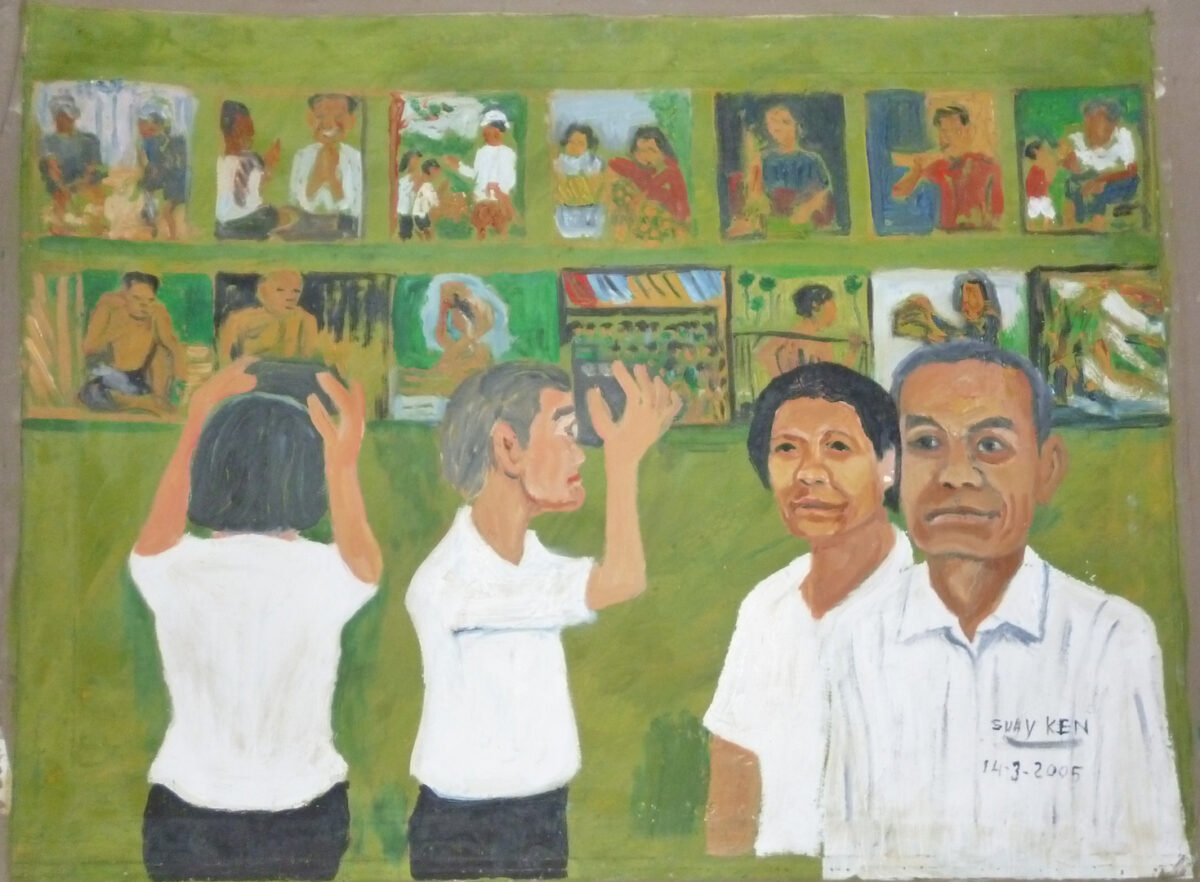
An untitled painting made in 2005 depicts two museum curators who, portrayed with cameras in their hands, are visiting from a major museum in Japan (fig. 1). They are keenly photographing paintings by Svay Ken, which hang in two rows in the upper half of the canvas. The curators were conducting curatorial research for the 1st Fukuoka Asian Art Triennale, a major exhibition held in 1999 at the Fukuoka Asian Art Museum that sought to convey what its curators described as “the free form of expression corresponding to the situation of each Asian region.”3Toshiko Rawanichaikul and Yamaki Yuko, eds., The 1st Fukuoka Asian Art Triennale 1999, exh. cat. (Fukuoka Asian Art Museum, 1999), 7–9. While greedily documenting Svay Ken’s singular practice, the curators appear in the painting to be completely ignoring the artist himself, as well as his wife, Tith Yun. The visitors look away from their hosts and rudely point their elbows sharply toward them. Curatorial research is presented here, from the artist’s perspective, as being instrumental, extractive, and perhaps even hit-and-run.
In this work, equally as conspicuous as the curators’ narrow fixation on the paintings rather than the painter, is the nakedly perturbed expression on Svay Ken’s lined and weary face. The artist’s knitted brows, clenched jaw, pursed lips, and slight squinting of one eye convey his tense feelings of discomfort with the encounter. Although slightly more inscrutable, Tith Yun also appears wary and withdrawn. Her eyes, like the artist’s, do not quite meet ours; instead, the couple stares vacantly off to one side, as if lost in the uneasy, perhaps unhappy experience of hosting these unfamiliar international curators.
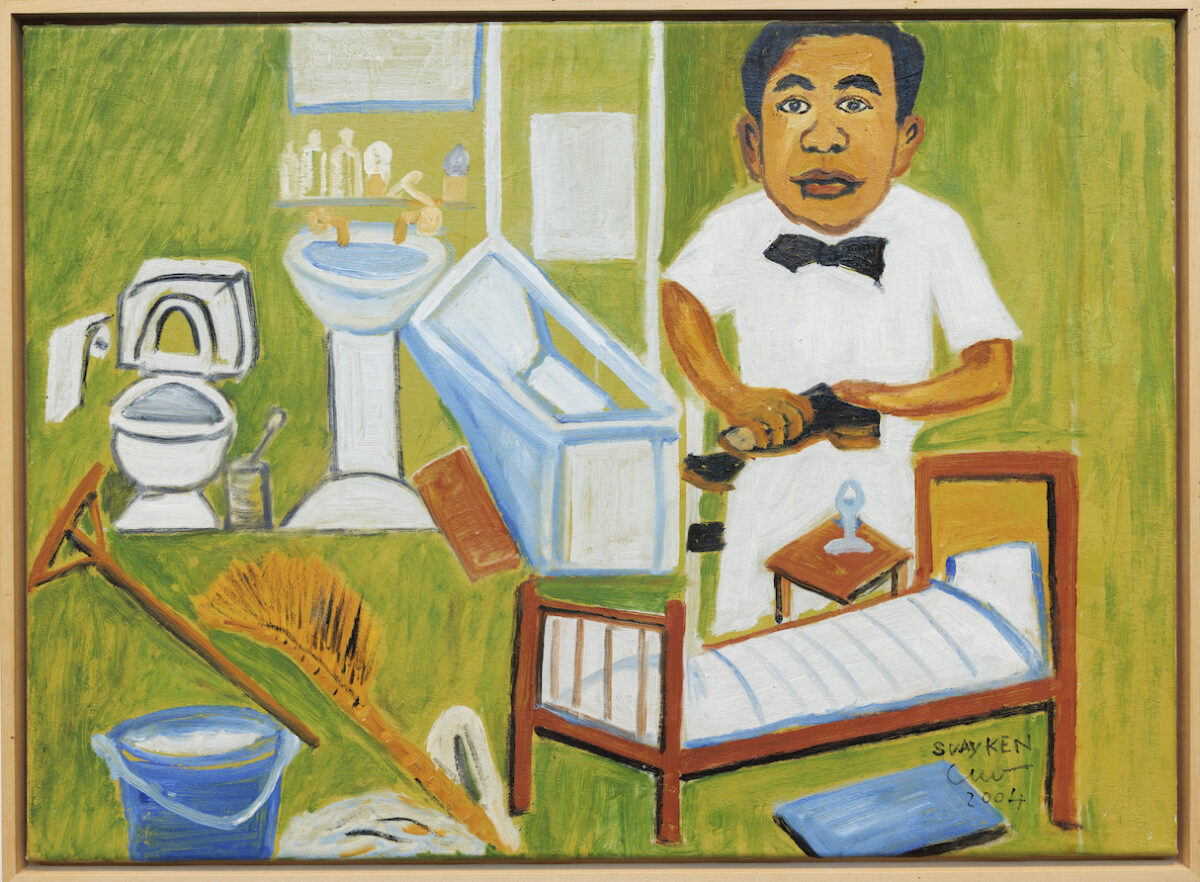
By contrast, in I in Hotel Room (2004), the artist stares confidently, calmly, and contentedly at viewers of the painting (fig. 2). His wide eyes meet and hold our gaze even while he is also hard at work polishing a shoe, one of his duties as a hotel employee. In this painting, the green background visually links Svay Ken to all the surfaces and objects around him, including the walls and floors of the hotel bathroom and bedroom. With his head grazing the upper edge of the picture, the artist dominates the scene, his prominence in the composition implying that he gladly reigns over this domain of green. Here, we see a happy and self-possessed man who is proud of his work, which he does to support his family and facilitate his devotional practices.
In many of Svay Ken’s paintings, the setting is rendered in a conspicuously flat and uniform green. This verdant background serves in one work as a stage for the artist’s discomfort and humiliation while meeting with international curators (fig. 1) and, in another, for his dignity and assurance while carrying out humble manual labor (fig. 2). The discrepant compositional function of the green background in the two paintings emphasizes the starkly different affective tenor of these two moments in Svay Ken’s long life. The color commingles fern and celadon, reflecting the naturecultures in which Svay Ken lived and worked. During the artist’s lifetime, these environments and contexts had shifted from easeful and peaceful to violent and pained and back again. I in Hotel Room portrays the artist harmoniously at one with his workplace environment. In the painting depicting the museum curators, however, the green background operates instead to separate the artist from his camera-wielding guests. The empty expanse of green marks a gulf between the artist and the curators that is not only spatial but also symbolic. The painting suggests that Svay Ken’s first encounter with curators was undignified, perhaps even injurious.
That the same shade of green background can invoke congenial harmony in I in Hotel Room and hostile isolation in the painting depicting the museum curators suggests that for Svay Ken, the experience of being an artist vacillated between divergent emotions. The green also reappears in several of the paintings seen hanging on the wall in the painting of the curators. This suggests that the use of green was a constant in the artist’s practice, while the experience of interacting with curators was an unusual interruption.
When the two museum curators from Japan visited Phnom Penh in 1998, it was the first time Cambodia had been included on the itinerary of the then-emerging class of international curators in Asia.4See Roger Nelson, “The Gap Which Separates: Simultaneity, Disparity, and Audiovisual-LinkingTechnologies in ‘Southeast Asian Contemporary Art,’” positions 33, no. 1 (2025): 161–91. https://doi.org/10.1215/10679847-11497369. Their visit came less than two decades after the overthrow of the Khmer Rouge regime, which between 1975 and 1979 had killed a vast majority of Cambodian artists along with a substantial portion of the overall population. With these circumstances in mind, it is therefore unsurprising that Svay Ken was palpably uncomfortable.
In the years since then—and particularly after the participation of several “Cambodian artists” in biennales and other major international exhibitions during the 2000s and 2010s—Phnom Penh has become a regular stop for curators on research trips in the region. This opportunity is welcomed by many but may nevertheless remain an ambivalent experience. Svay Ken was certainly proud of attracting the curators’ attention and being included in the Triennale—as he would later boast, “In 1999 my name was known throughout Asian art circles”—but his pleasure was tinged with distress, as intimated in figure 1.5Svay Ken, A Good Friend is Hard to Find: An Homage to Ingrid by Painter Svay Ken, trans. Helen Jarvis (Reyum Publishing, 2006), 9.
This visual record of Svay Ken’s encounter offers a rare insight into how it might feel for an artist to meet with curators—who are often strangers—visiting from a distant and unfamiliar location, and how this uncomfortable experience might manifest in an artist’s practice. Such encounters with curators often initiate larger and more amorphous engagements with the curatorial: a mode of practice and province of discourse that encompasses not only studio visits and exhibition-making, but also many other kinds of relating and mediating between practitioners and publics.
* * *
Artistic practices narrate, mediate, and sometimes fabulate histories: This is as well known in Southeast Asia as it is elsewhere.6See, for example, June Yap, Retrospective: A Historiographical Aesthetic in Contemporary Singapore and Malaysia (Strategic Information and Research Development Centre, 2016). Curators present and occasionally misrepresent artistic practices: This too is clear in this region and beyond. And artists can also be curators: This phenomenon has taken on special prominence in the history (and historiography) of contemporary art in Southeast Asia, particularly since the 1970s.7See Patrick D. Flores, Past Peripheral: Curation in Southeast Asia (NUS Museum, 2008); and Flores, “Turns in Tropics: Artist-Curator,” in Modern and Contemporary Southeast Asian Art: An Anthology, ed. Nora A. Taylor and Boreth Ly (Cornell Southeast Asia Program Publications, 2012), 171–88.
But how do artists represent and even historicize the curatorial and the experience of being curated? Beyond visits to artist’s studios and the preparation of museum exhibitions, in what ways does the curatorial manifest? What image of curation is immanent in artistic practice? These questions, seemingly straightforward enough, may elicit a surprising realization. Despite the inescapable ubiquity of the curatorial in global discourses on contemporary art, including in Southeast Asia, curation is rarely made visible within artistic practice.
In this short essay, by focusing on accounts of the experience of being curated that appear within artworks—rather than in written form—I propose that artistic practice can also constitute a form of critical and (art-)historical commentary. This claim is prompted, in part, by the influential and widely cited Southeast Asian art historian and curator T. K. Sabapathy who, as early as 1979, recognized that with art, “critical activity need not necessarily be defined in terms of, or limited to, literary forms.”8T. K. Sabapathy, “The Nanyang Artists: Some General Remarks” (1979), in Writing the Modern: Selected Texts on Art & Art History in Singapore, Malaysia & Southeast Asia, 1973–2015, ed. Ahmad Mashadi et al. (Singapore Art Museum, 2018), 345. Emphasis added.
As well as rejecting the false binary cleaving theory from practice and creativity from commentary, with this statement, Sabapathy is also insisting on the intelligence and criticality that inheres in artistic practice. His notion of “critical activity” positions the work of an artist or a curator as always already a dynamic and vital intervention in the world: Never only a static object, but instead a perpetually unfolding activity. Moreover, Sabapathy does not disavow the importance of textuality, which he calls “literary forms,” but he nevertheless affirms the need to transcend the textual even while encompassing it. These qualities of Sabapathy’s “critical activity” are also paradigmatic of the curatorial.
My discussion here addresses artists’ encounters with the curatorial, but in a forthcoming book titled Artistic Art Histories in Southeast Asia: Modernisms in Contemporary Practices, I discuss a wider array of ways in which artists engage with the art-historical within their artworks.9Roger Nelson, Artistic Art Histories in Southeast Asia: Modernisms in Contemporary Practices (Cornell University Press, 2026). This book will be available in September 2026. For more details, see https://www.cornellpress.cornell.edu/book/9781501788840/artistic-art-histories-in-southeast-asia/. I argue that art-historically engaged modes of practice proliferate globally but take on particular importance in Southeast Asia, where art history as an academic discipline remains relatively nascent and where, since the 1960s, many foundational texts on modern art have been written by artists (and more recently by curators).
Although I have argued elsewhere for the need to “deprovincialize” Southeast Asia’s art, in this essay I have chosen to draw exclusively on sources emerging from or explicitly related to the region, and thereby to center and amplify work being done in and on this part of the world.10See, for example, Roger Nelson, “‘My World is Modern’: Deprovincialising Chen Cheng Mei and You Khin, Artists from Southeast Asia Who Traversed the Global South,” Southeast of Now: Directions in Contemporary and Modern Art in Asia 5, nos. 1–2 (2021): 205–49, https://dx.doi.org/10.1353/sen.2021.0008. Like many commentators and practitioners engaged with Southeast Asia, I view the region not as a fixed geography but instead as a dispersed imaginary that is—in the words of curator and art historian Patrick D. Flores—“in the process of constant forming” and always contingently connected with “the vaster world of which it is a vital part.”11Patrick D. Flores, “Address of Art: Vicinity of Region, Horizon of History,” in Charting Thoughts: Essays on Art in Southeast Asia, ed. Low Sze Wee and Patrick D. Flores (National Gallery Singapore, 2017), 18.
* * *
In the paintings discussed above, Svay Ken mediates his early encounters with curators; by contrast, more recently another generation of artists has mediated their own experiences and understandings of the curatorial.
Curators are individuals, often working for institutions; in Southeast Asia, many of them feel that they must “play different roles” to “build our own infrastructure” through various forms of what Bill Nguyễn calls “engagement, facilitation and attention.”12Bill Nguyễn, “Dear R (or Every Day for the Rest of My Life),” Southeast of Now: Directions in Contemporary and Modern Art in Asia 6, no. 1 (2022): 255. In turn, the curatorial is a method, a practice, and a mode of thinking. In Flores’s articulation, the curatorial is “able to simultaneously particularize and generalize.”13Patrick Flores, “To Curate a Region,” ArtAsiaPacific 146 (2025): 51. Thus, the curatorial may be practiced by curators, but it nonetheless transcends the individual and the institutional.
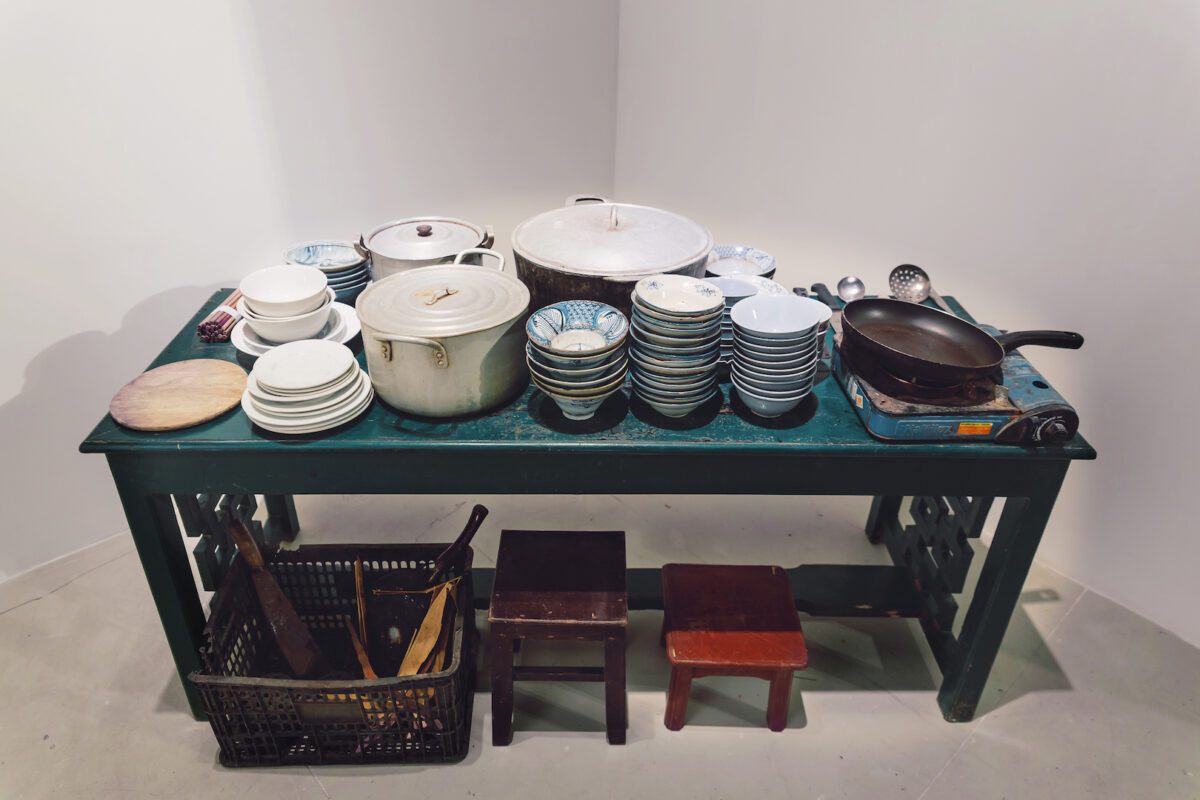
An exemplary case is 82 131 39, an installation initiated by the Hanoi-based Nhà Sàn Collective (est. 2013) in homage to their predecessors, an artist-run collective space called Nhà Sàn Studio (1998–2010), which was also located in Hanoi (fig. 4). Although the installation is credited to several makers, chief among them is Mẹ Lương (Lê Thị Lương): Her kitchen table—whose physical dimensions inspired the title—is at its heart, and she curated the accompanying cookbook, which is illustrated by other artists.14The cookbook includes illustrations by Nguyễn Đức Huy, Nguyễn Huy An, Nguyễn Mạnh Đức, Nguyễn Mạnh Hùng, Nguyễn Trần Nam, Phạm Thu Thuỷ, and Trần Lương. Beyond this physical facticity, the installation imaginatively mobilizes the kitchen table, cooking equipment, dishes, and stools as a fertile allegory for the hospitality and affective labor that underpin artistic and curatorial practice.
The installation was made for and first shown in the 2017 exhibition Spirit of Friendship, which focused on “artist groups” like Nhà Sàn Studio and Nhà Sàn Collective. The curators Zoe Butt, Bill Nguyễn, and Lê Thiên Bảo describe the project as seeking “to highlight the role and contribution of artist friendships in furthering the development of experimental languages in Vietnam, since 1975.”15Zoe Butt with Bill Nguyễn and Lê Thiên Bảo, “Spirit of Friendship: Artist Groups in Vietnam Since 1975,” Southeast of Now: Directions in Contemporary and Modern Art in Asia 2, no. 2 (2018): 145. https://dx.doi.org/10.1353/sen.2018.0005. A text made to accompany 82 131 39 begins by introducing Nhà Sàn Studio:
Considered one of North Vietnam’s most resilient independent art spaces, over the last two decades Nhà Sàn has continuously shape-shifted and endured the challenges brought about by both the artistic and social landscape of Vietnam, never once ceasing to maintain its status as a ‘home for the arts’ and a haven for the odd ones out in Hanoi; having nurtured generations of artists, while always keeping its doors open to those inspired enough to step in.16Spirit of Friendship, exh. brochure (The Factory Contemporary Art Centre, 2017), unpaginated. PDF version kindly provided by Bill Nguyễn.
This statement insistently and insightfully aligns resilience with nurturing, emphasizing hospitality as a cornerstone of creative practice and community. These enmeshed qualities—which are both affective and embodied—are then related to the curatorial, as the text continues:
As the status of art and artists in Vietnam today continues to be challenged (i.e., more and more we see artists responding to both past and present historical issues with their work), similarly the practice of the curator is expanding as a necessary role. The specificity of the sociopolitical and educational contexts of Vietnam means that a curator is to take on a myriad of other roles besides just an exhibition maker—as a study partner who shares knowledge, researches and debates with artists; and a mediator who negotiates and connects artists with the public, the authorities and other agents in the cultural field. It is no longer about what or who to curate, but rather, how.17Spirit of Friendship, exh. brochure.
With this context of the enlarged and layered function and reflexivity of the curatorial established, the culinary materials used in the installation are explained as being not only supplementary to curation, but also more profoundly connected to the practice and discourse of the curatorial:
Nhà Sàn Collective proposes a different look into the (grand) history of Nhà Sàn by presenting one of the often undiscussed micro-histories of Mẹ Lương (wife of Nguyễn Mạnh Hùng, one of the cofounders of Nhà Sàn Studio) and her kitchen space. Lovingly called “mẹ” (mother) by all, Mẹ Lương welcomes, cooks and tends to all artists, visitors, or any passersby; her motherly presence maintaining the organic and family-oriented soil upon which Nhà Sàn exists and flourishes. Her kitchen space is . . . enabling the more private and humble, but no less significant chitchats to take place. Inviting Mẹ Lương to use her kitchen space and self-curated cookbook as source materials, Nhà Sàn Collective metaphorically points to, and reiterates, what it means to make art and to be artists in the context of Vietnam today, while continuing their own legacy in further complicating and opening up our (as well as their own) perceptions of the other forms that art, art history, and curation can take.18Spirit of Friendship, exh. brochure.
This statement makes clear that 82 131 39 is not only an artistic mediation of the curatorial, but also a meditation on the corporeal and maternal labors of sustenance and care that underpin all forms of creative and critical practice, including the work done by artists and curators. As well as prizing “more private and humble” exchanges within creative communities, the installation positions that practice as productively contingent and perpetually fluctuant.
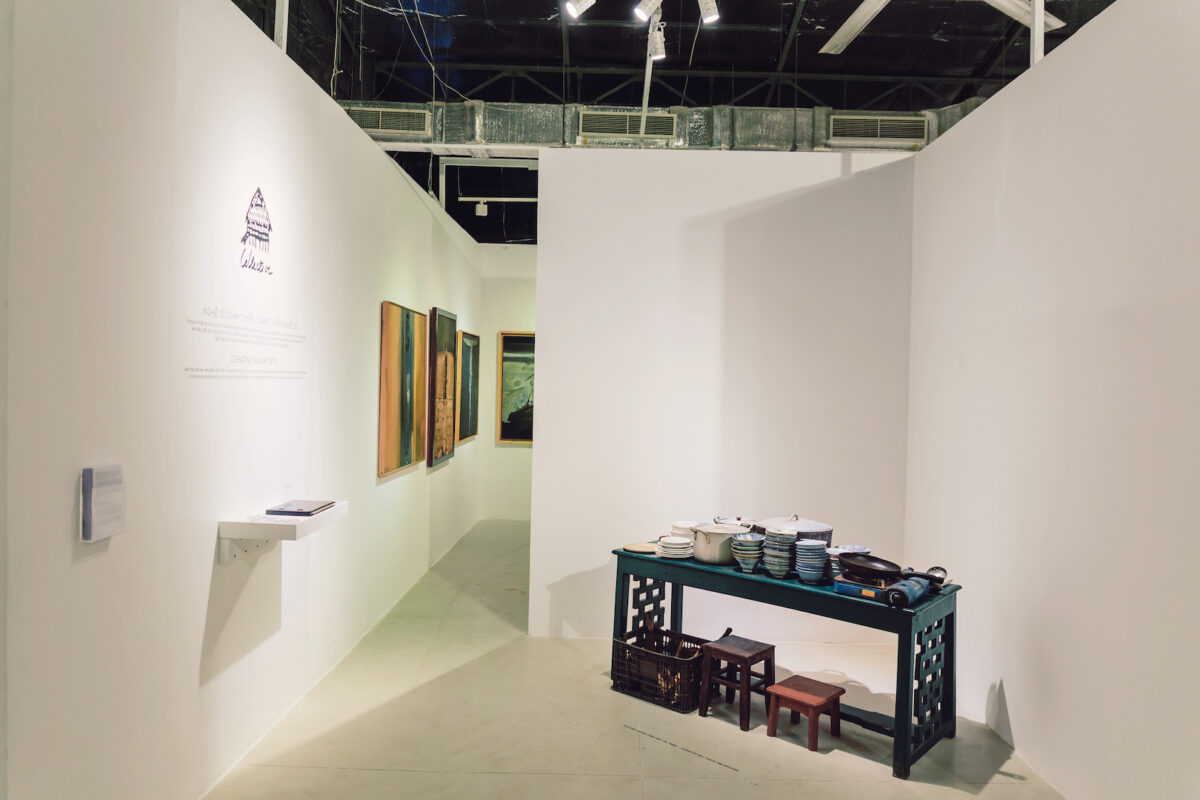
The installation was positioned near the heart of the Spirit of Friendship exhibition, with Mẹ Lương’s cookbook displayed on the same wall as paintings and other more conventional artworks (fig. 4). This unassuming yet effective gesture proffers the possibility that although artists’ encounters with curators may be fraught—as Svay Ken’s paintings make palpably plain—they offer abundant potential for affinities. Respect, sincerity, hospitality, care, and sustained engagement may be some of the necessary foundations for the curatorial to be experienced—and artistically mediated—as generative, and even generous, as opposed to extractive.
* * *
The labors and cares of artists and curators often overlap. As noted above, the figure of the artist-curator has been particularly prominent in Southeast Asia and important in the development of the region’s contemporary art and its dispersal into other discourses, including those in the North and the West. Nhà Sàn Collective epitomizes an increasingly prevalent mode of practice, one that is both artistic and curatorial. The distinctions between these modes of “critical activity” have begun to dissolve in recent years. But what are some antecedents of this conjoining of the artistic and the curatorial? How have artists mediated their own practices in contexts without well-developed infrastructures?
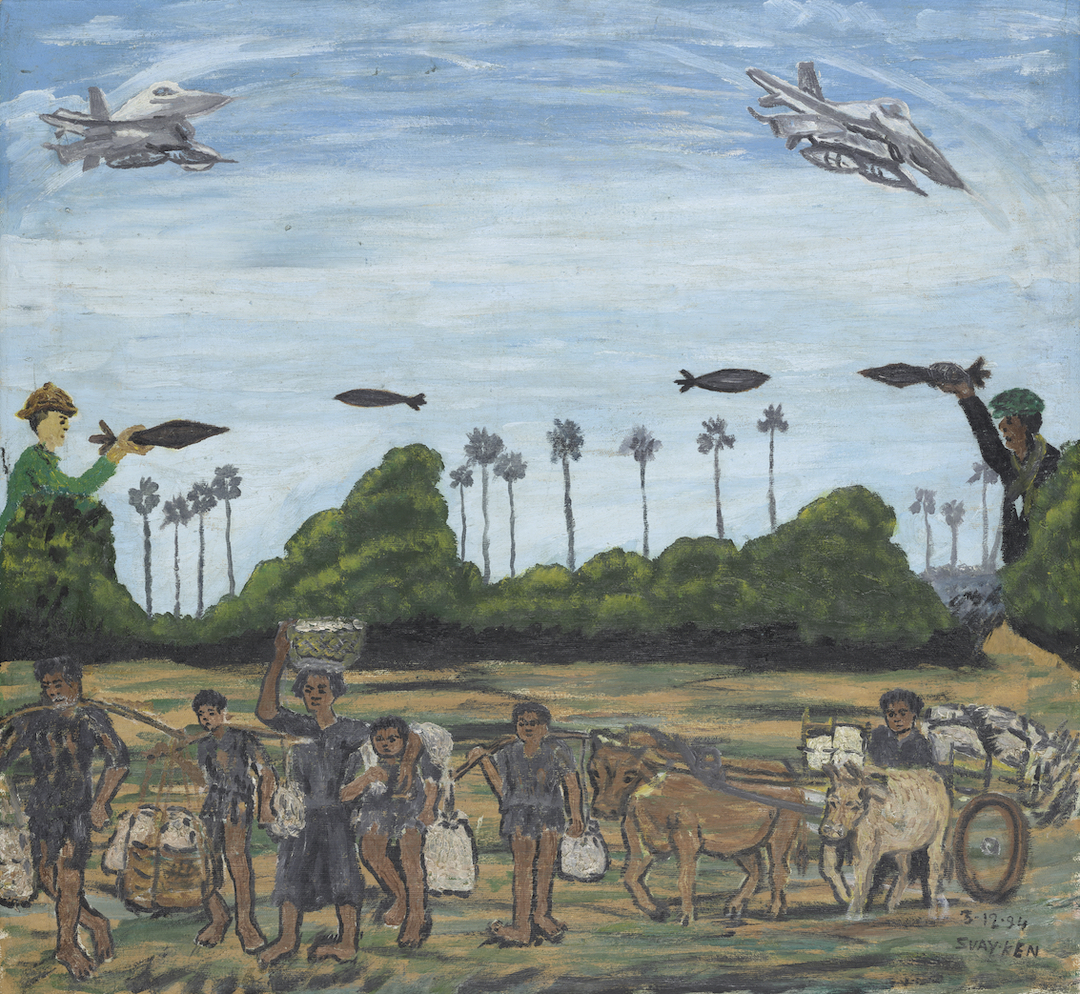
Svay Ken offers some answers to these questions. When he began painting, less than 15 years after the end of the genocide that annihilated Cambodia’s artists and intellectuals, the country still had almost no galleries in which to exhibit contemporary artworks, almost no art market, and almost no other infrastructural supports for “critical activity.” The memory of violence—which Svay Ken also painted early on (fig. 5)—was still fresh.
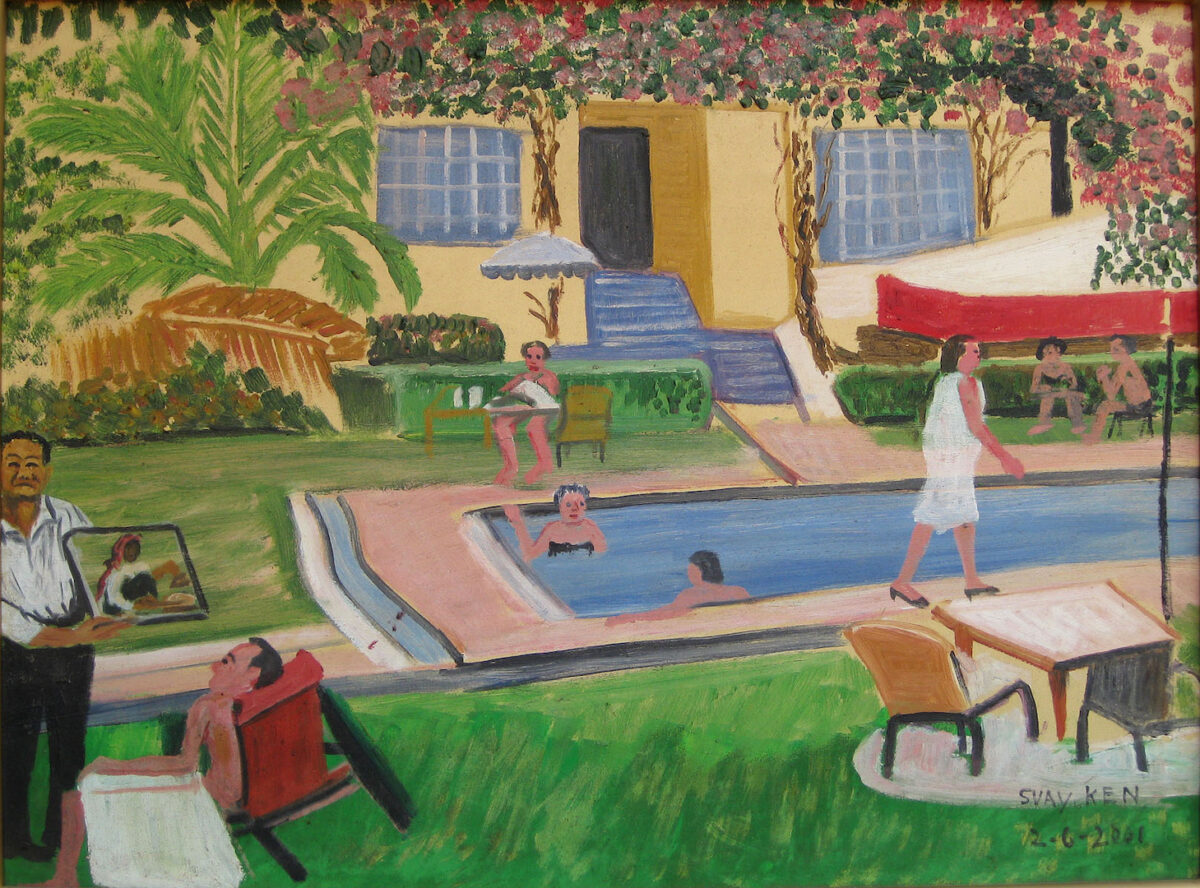
In stark contrast to painted scenes of violence, I Showed Guests at the Swimming Pool My Paintings (2001) offers a record of Svay Ken’s early experience of showing and selling his artworks to guests at the luxury hotel in which he worked (fig. 6).
In a substantial and detailed autobiographical text, Svay Ken recalls the scene: “When foreign guests came now and then to swim in the pool of the hotel, I would take my pictures and try to show them to them. Some guests were annoyed and didn’t want to look, but others who loved art looked at my paintings and smiled, praising the pictures.”19Svay Ken, Painted Stories, 40.
Looking at I Showed Guests at the Swimming Pool My Paintings, it is impossible to discern whether the pink-skinned man to whom Svay Ken is showing his painting is a guest who feels “annoyed and didn’t want to look” or is instead someone “who loved art” and was “praising the pictures.” What is unmistakable, however, is that the artist is resolute in his determination not only to make art, but also to make it public, to mediate its reception, and to textually annotate these procedures.
Thus Svay Ken was a curator of his own artwork. That he chose to memorialize and historicize this experience among all of the other moments that made up his turbulent life indicates that it was meaningful to him. The curatorial was, for Svay Ken, not only a form of “critical activity” but also a kind of becoming, even of liberation. From him, we still have a lot to learn.
- 1Svay Ken, Painted Stories: The Life of a Cambodian Family from 1941 to the Present, ed. Ly Daravuth and Ingrid Muan (Reyum Publishing, 2001), 47. ↩︎
- 2Pamela N. Corey, “The ‘First’ Cambodian Contemporary Artist,” Udaya: Journal of Khmer Studies 12, no. 12 (2014): 61–94. See also Erin Gleeson, “Svay Ken: Home and Country,” ArtAsiaPacific, no. 46 (2005). ↩︎
- 3Toshiko Rawanichaikul and Yamaki Yuko, eds., The 1st Fukuoka Asian Art Triennale 1999, exh. cat. (Fukuoka Asian Art Museum, 1999), 7–9. ↩︎
- 4See Roger Nelson, “The Gap Which Separates: Simultaneity, Disparity, and Audiovisual-LinkingTechnologies in ‘Southeast Asian Contemporary Art,’” positions 33, no. 1 (2025): 161–91. https://doi.org/10.1215/10679847-11497369. ↩︎
- 5Svay Ken, A Good Friend is Hard to Find: An Homage to Ingrid by Painter Svay Ken, trans. Helen Jarvis (Reyum Publishing, 2006), 9. ↩︎
- 6See, for example, June Yap, Retrospective: A Historiographical Aesthetic in Contemporary Singapore and Malaysia (Strategic Information and Research Development Centre, 2016). ↩︎
- 7See Patrick D. Flores, Past Peripheral: Curation in Southeast Asia (NUS Museum, 2008); and Flores, “Turns in Tropics: Artist-Curator,” in Modern and Contemporary Southeast Asian Art: An Anthology, ed. Nora A. Taylor and Boreth Ly (Cornell Southeast Asia Program Publications, 2012), 171–88. ↩︎
- 8T. K. Sabapathy, “The Nanyang Artists: Some General Remarks” (1979), in Writing the Modern: Selected Texts on Art & Art History in Singapore, Malaysia & Southeast Asia, 1973–2015, ed. Ahmad Mashadi et al. (Singapore Art Museum, 2018), 345. Emphasis added. ↩︎
- 9Roger Nelson, Artistic Art Histories in Southeast Asia: Modernisms in Contemporary Practices (Cornell University Press, 2026). This book will be available in September 2026. For more details, see https://www.cornellpress.cornell.edu/book/9781501788840/artistic-art-histories-in-southeast-asia/. ↩︎
- 10See, for example, Roger Nelson, “‘My World is Modern’: Deprovincialising Chen Cheng Mei and You Khin, Artists from Southeast Asia Who Traversed the Global South,” Southeast of Now: Directions in Contemporary and Modern Art in Asia 5, nos. 1–2 (2021): 205–49, https://dx.doi.org/10.1353/sen.2021.0008. ↩︎
- 11Patrick D. Flores, “Address of Art: Vicinity of Region, Horizon of History,” in Charting Thoughts: Essays on Art in Southeast Asia, ed. Low Sze Wee and Patrick D. Flores (National Gallery Singapore, 2017), 18. ↩︎
- 12Bill Nguyễn, “Dear R (or Every Day for the Rest of My Life),” Southeast of Now: Directions in Contemporary and Modern Art in Asia 6, no. 1 (2022): 255. ↩︎
- 13Patrick Flores, “To Curate a Region,” ArtAsiaPacific 146 (2025): 51. ↩︎
- 14The cookbook includes illustrations by Nguyễn Đức Huy, Nguyễn Huy An, Nguyễn Mạnh Đức, Nguyễn Mạnh Hùng, Nguyễn Trần Nam, Phạm Thu Thuỷ, and Trần Lương. ↩︎
- 15Zoe Butt with Bill Nguyễn and Lê Thiên Bảo, “Spirit of Friendship: Artist Groups in Vietnam Since 1975,” Southeast of Now: Directions in Contemporary and Modern Art in Asia 2, no. 2 (2018): 145. https://dx.doi.org/10.1353/sen.2018.0005. ↩︎
- 16Spirit of Friendship, exh. brochure (The Factory Contemporary Art Centre, 2017), unpaginated. PDF version kindly provided by Bill Nguyễn. ↩︎
- 17Spirit of Friendship, exh. brochure. ↩︎
- 18Spirit of Friendship, exh. brochure. ↩︎
- 19Svay Ken, Painted Stories, 40. ↩︎