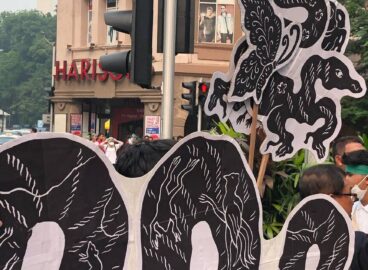
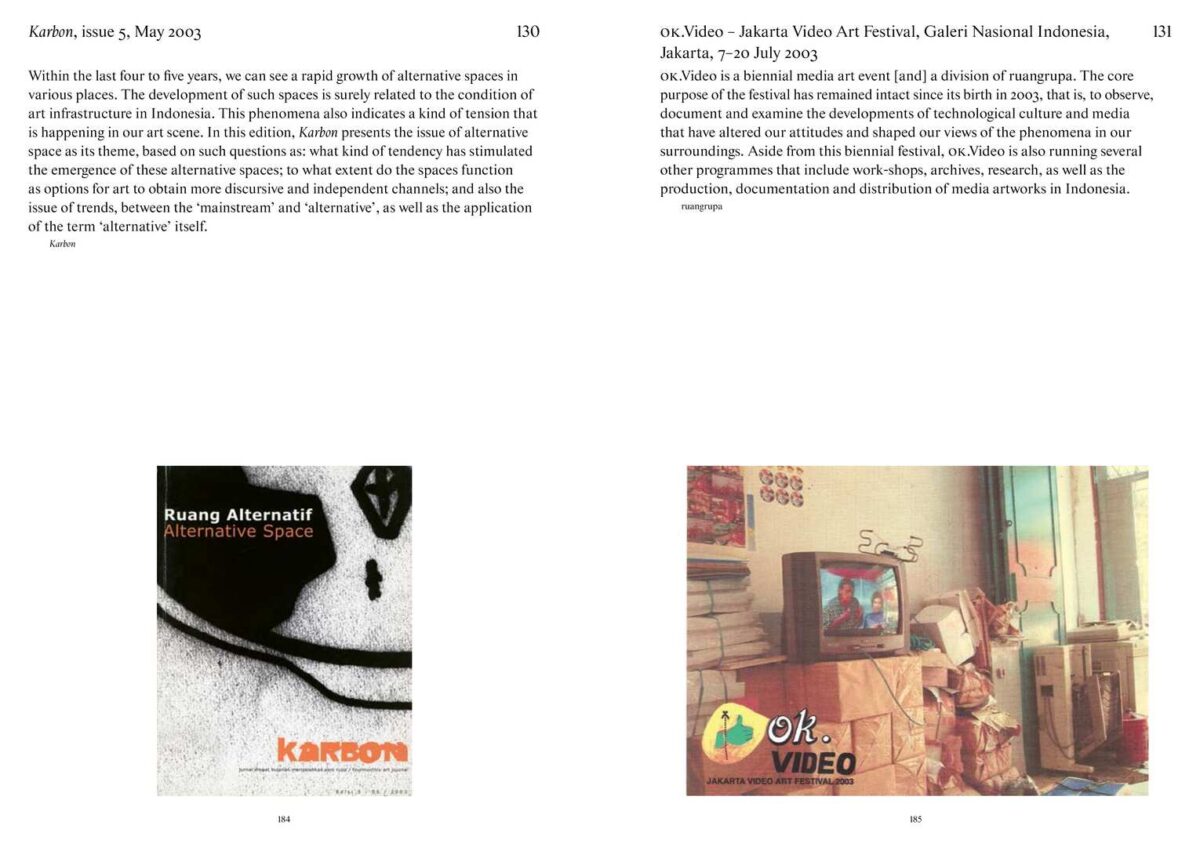
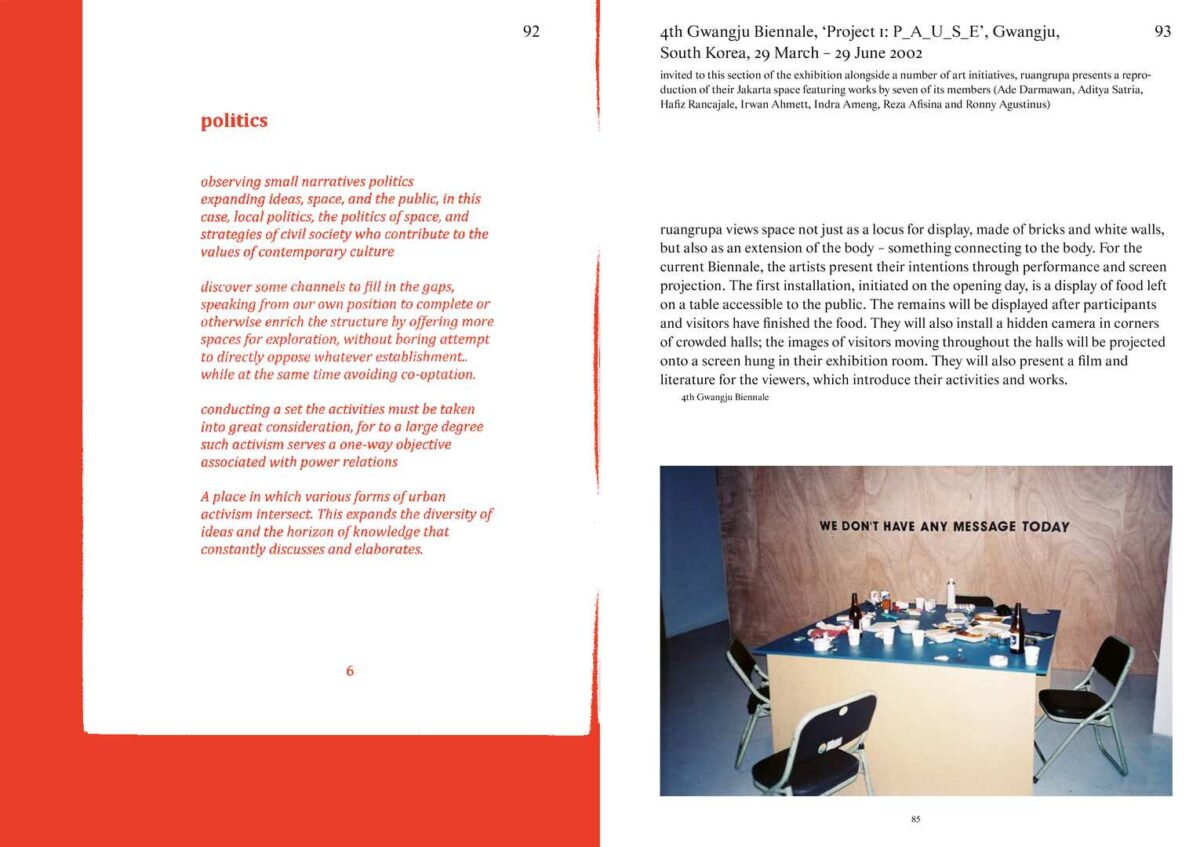
In recent years, the practice of the Jakarta-based collective ruangrupa has gained exceptional traction in the contemporary art world. Their appointment as the Artistic Director of documenta 15 in 2022 has allowed a more compelling understanding of the collective’s practice guided by the values of “lumbung,” “an alternative, community-oriented model of sustainability in ecological, social and economic terms, in which resources, ideas and knowledge are shared.” The book How to Pin Down Smoke: ruangrupa since 2000, published in 2025 by Afterall in association with Asia Art Archive; the Center for Curatorial Studies, Bard College; documenta Institut; and the Faculty of Fine, Applied and Performing Arts, University of Gothenburg, maps out the genealogy of the animated and complex ecosystem that ruangrupa has cultivated and which has shaped the trajectory of the group’s practice. Carlos Quijon, Jr. talks to the volume’s editors, Arianna Mercado, David Morris, and Wing Chan, about their editorial processes and considerations.
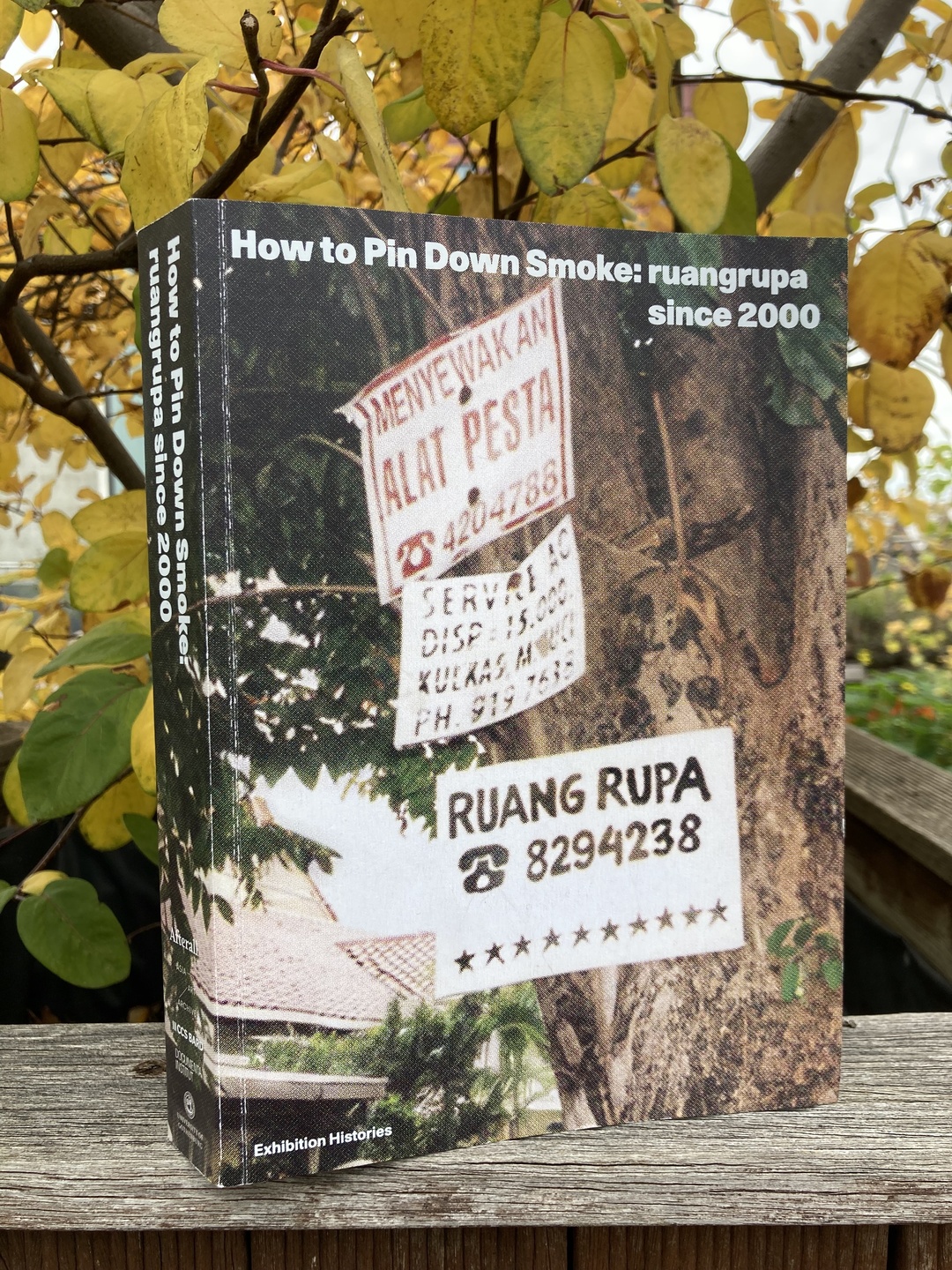
Carlos Quijon, Jr.: Can you walk us through the decision of choosing ruangrupa (ruru) for the Exhibition Histories book series? Of course, with the recent developments in ruru’s practice, talking for example about their artistic direction of documenta 15, the book has turned out to be a very timely historicization and mediation of the collective’s practice. I am wondering what the considerations were in writing about ruru’s practice at this particular historical moment?
David Morris: We can recall that conversations toward the book solidified around 2018, when farid rakun came to visit Afterall and spoke with exhibition studies students, and we started exploring the idea of archiving and historicizing ruru—the whys and the hows of it. It quickly became clear that this presented a number of challenges to the kind of research we do, practically and intellectually, and this seemed like a good place to start. As with most of the Exhibition Histories publications, the book developed quite organically from there, in a slow-burn way and across many conversations with our editorial collective and ruru friends and network, until it felt “ready.” (We often describe the Exhibition Histories process as a kind of simmering, slow cooking with multiple pots on at once.)
In short, when the documenta plan was announced, we were already some way along. If anything, it diverted our book plans since, understandably, documenta 15 (d15) took up a lot of the ruru bandwidth—although how things played out in Kassel made the need for a deeper analysis and understanding of ruangrupa’s work seem all the more urgent.
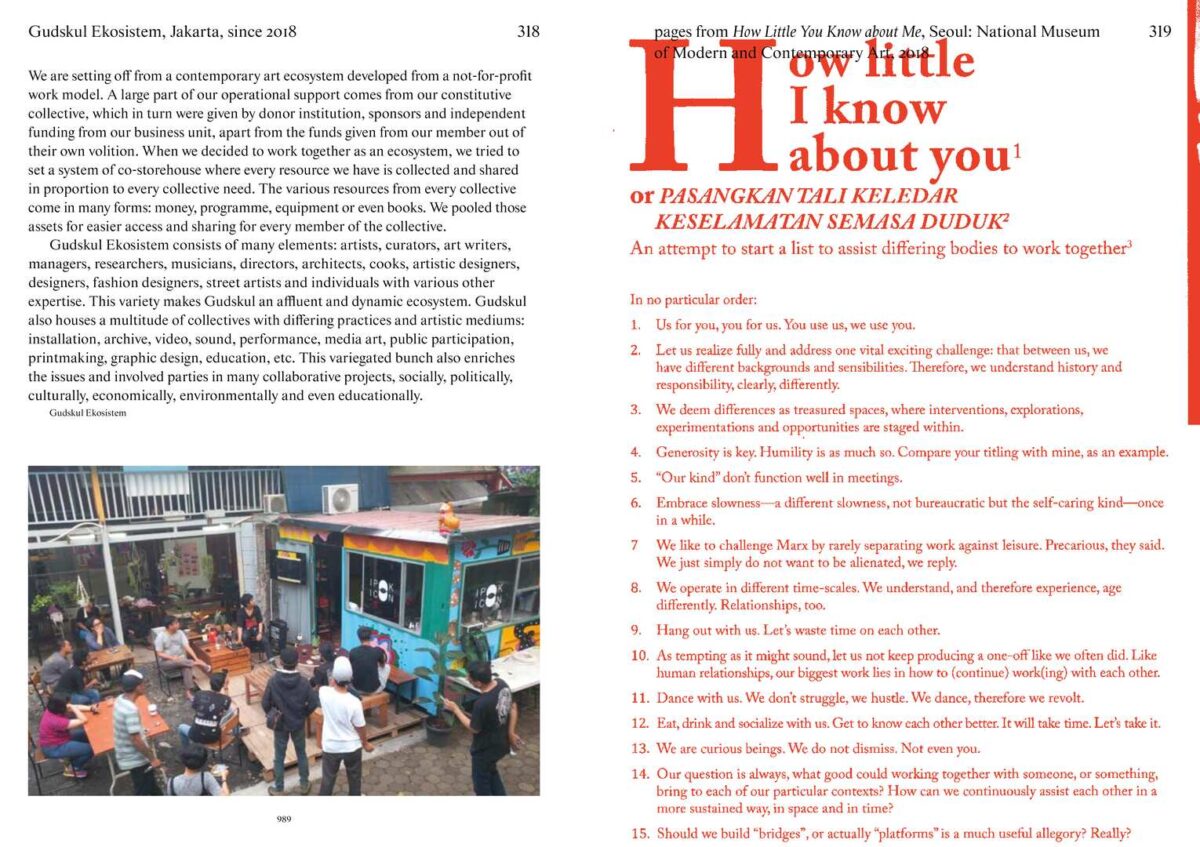
Wing Chan: In the book itself, ruru’s participation in d15 takes up maybe 2 percent of the overall page count. What interested us more are these questions: what kind of collective activism is ruru evocating? Where did it come from? How has it kept ruru going for decades in Jakarta and beyond? Personally, I feel ruru’s stories can teach us a lot about why it is important to not do things alone, about genuine, sustainable ways of relating to one another. It’s timely in this world full of wars.
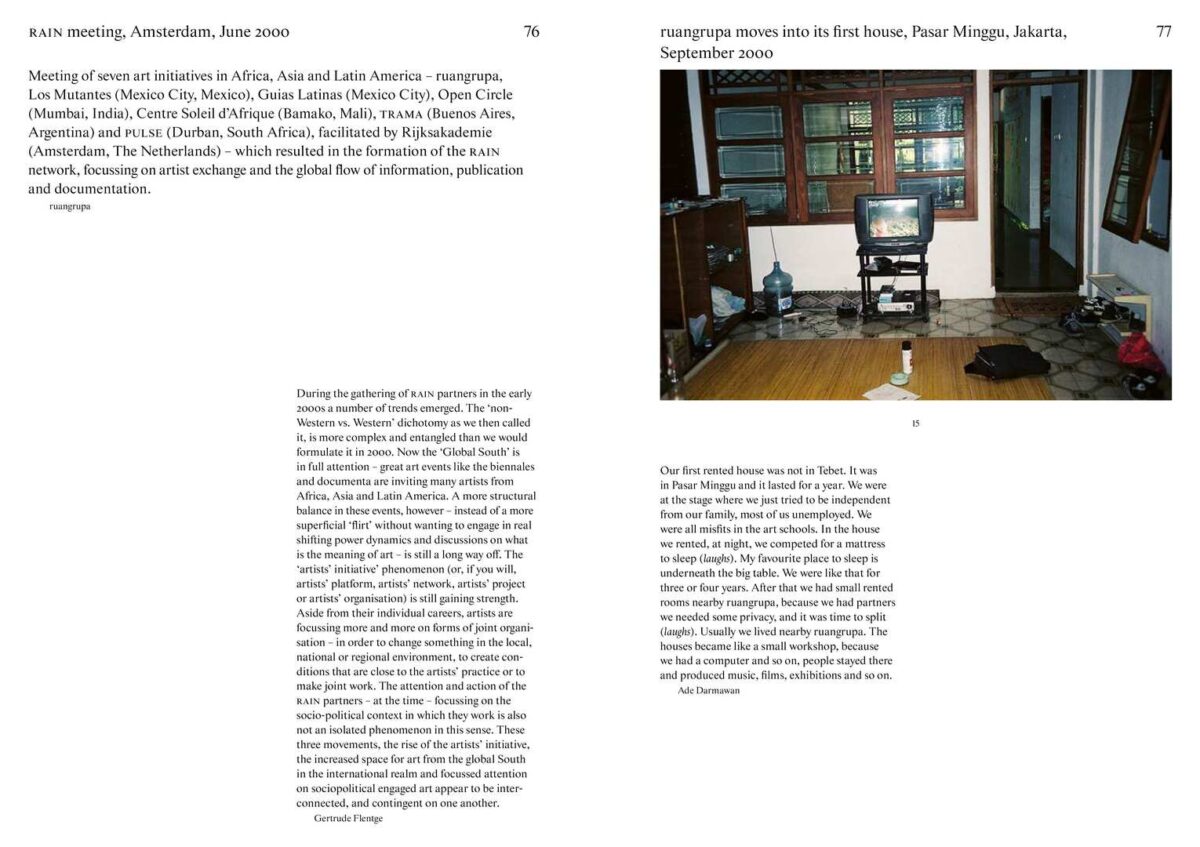
Arianna Mercado: After 2022, so much of the conversation around ruru and their process suddenly became only about d15 and its aftermath. There was much to be said about ruru and how they operate in global and local art ecologies that goes way back to before d15. In the process of making this book, we felt that it wasn’t necessary to just continue adding to the conversation around d15, hence it is only briefly covered in the book. Ruru has been working through lumbung, through ideas of sharing and reciprocity, since their inception, so we felt that it was necessary to highlight this immense body of work by focusing on their support systems and the infrastructures they have built in Jakarta, Indonesia, and beyond.
When Wing and I were first doing the research before we went to Jakarta, it was a lot of, “OK, so let’s put ourselves in their shoes in 1998. What did their life look like back then? What pop culture media were they consuming? What was circulating in universities and in more artistic circles?” We watched a lot of movies, especially romcoms, like Ada Apa dengan Cinta? (What’s Up with Love; 2002). We read some of the books that were banned at the time—Pramoedya Ananta Toer’s novel This Earth of Mankind (1980), for example. We also listened to a lot of music of their time. We wanted to put ourselves in the shoes of ruru to think about their dreams, aspirations, and lives before even trying to understand their practice.
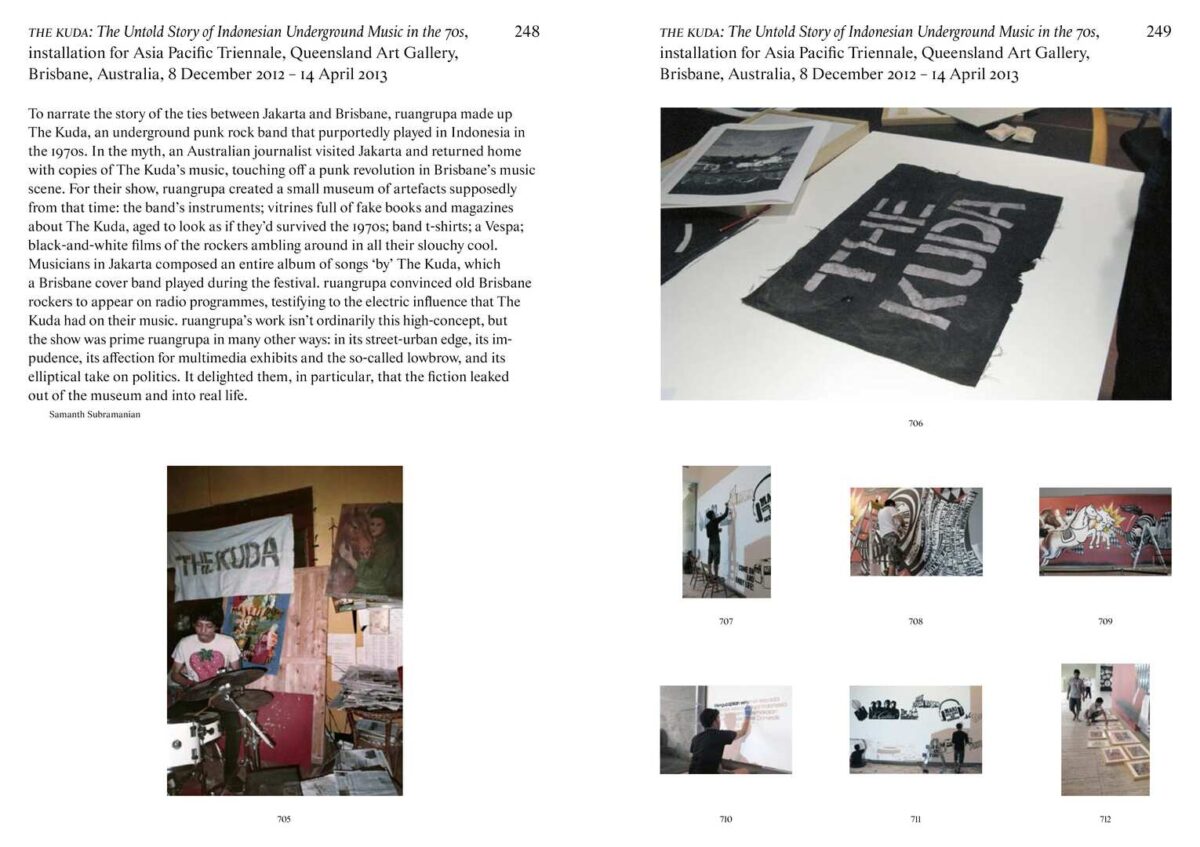
CQJr: I am interested in how you imagined the structure of the book. Of course, the book is about ruru’s 25-year history, so for the most part, it takes ruru’s practice as a frame through which a possible history of the interfacing between art, exhibition, and history (in Indonesia, in Southeast Asia, in Asia, in the global contemporary, etc.) can be written, understood, or—even as a baseline—be made legible. Because of the apparent “centrality” of ruru in the development of contemporary artistic discourse in Indonesia and across Southeast Asia (i.e., how almost all practitioners active in the contemporary art ecology of Indonesia were once part of or have worked with ruru), I am wondering if there were considerations around how to foil this narrative of centrality.
DM: ruru’s 25-year lifespan is the longest timeframe we have attempted in the series, and this was among the creative challenges we had in making it legible to a wider audience (we hope) as well as in opening up larger questions about “art”, “exhibition”, “publics” and their interconnected histories, geographies, economics, ecosystems, etc., and the difficulties and possibilities they create for researchers, art historians, artists and institutions—what methodologies they demand or suggest.
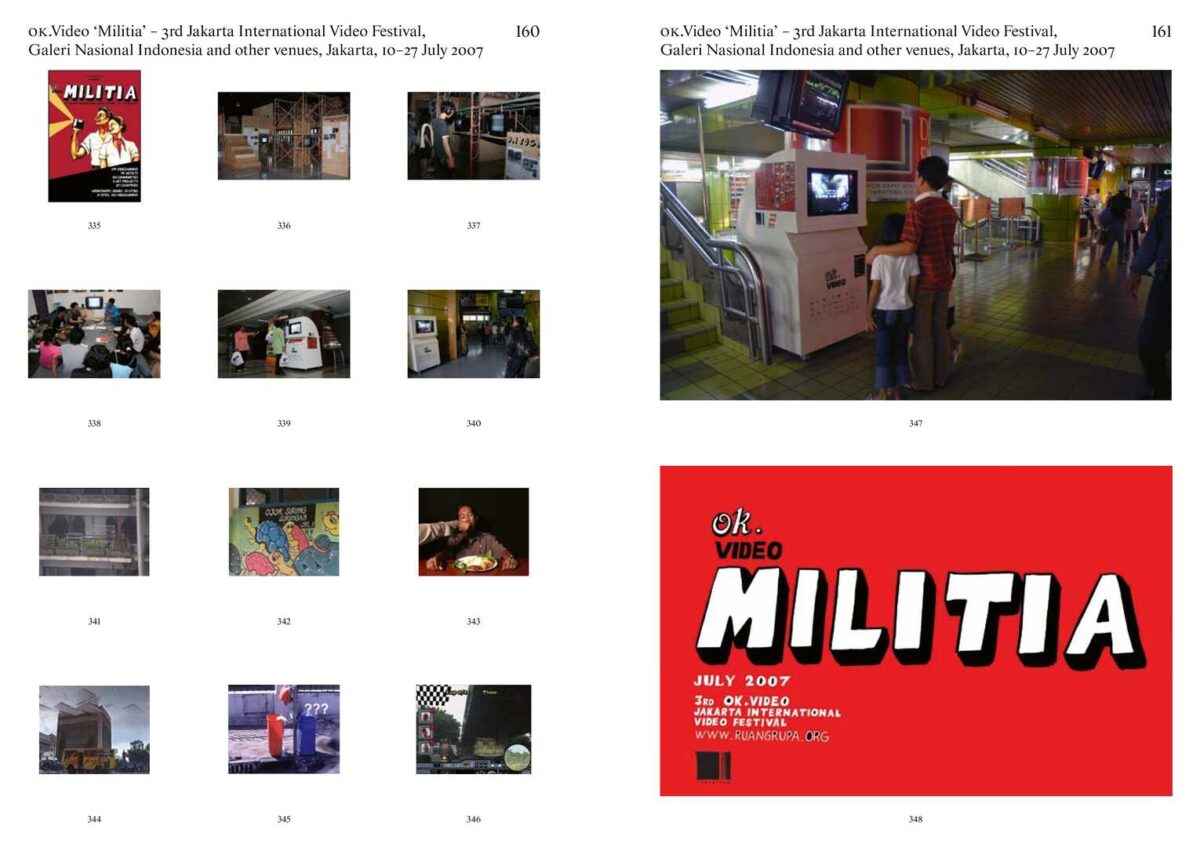
At some point early on, we were thinking it could be productive to constellate ruru with other different but comparable initiatives in the region, to look at all of them together, which might have worked to “decentralize” ruru and foreground a regional narrative—this is an approach of some earlier books in the series. But for this book, we took up a different challenge in trying to develop a kind of “institutional history” of ruru with the idea that perhaps a method would develop that could then offer an approach for other kinds of institutions, whether quite similar to or very different from ruru.
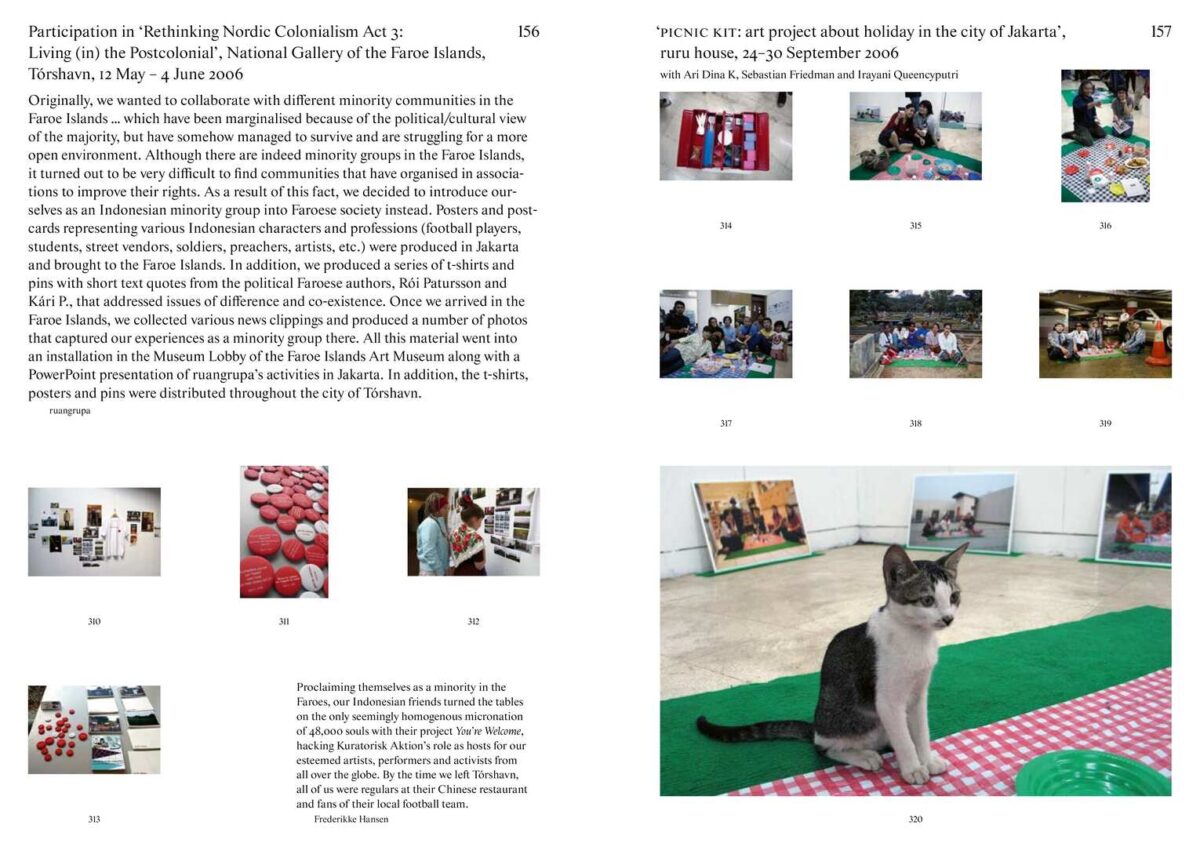
WC: Contributions to the last chapter of the book, namely Enin Supriyanto’s interview write-up and Nuraini Juliastuti’s essay on jamming, offer a long view on sustainable collective practices shaped by the sociopolitical climate in Indonesia and globally since the 1970s.1Enin Supriyanto, “Forces of Socio-political Change in Indonesia,” 461–71; Nuraini Juliastuti, “Pedagogical Moments in Jamming,” 472–93. We hope that people who care about ruru—and ruru themselves—will be informed by these perspectives. In addition, Melani Budianta’s research on ruru’s economic models from 2000 illustrates how ‘centrality’ could be a myth.2Melani Budianta, “Political Economy and Aesthetics of Space: Genealogy of ruangrupa’s Lumbung Practice,” 12–38. I’d like to believe that our writers have introduced some new focal points.
There are things that repeatedly emerged that we just picked up on. For example, people will say, “Oh, ruru is a boys club!” So Arianna and I would debrief and ask what they really mean? People would say, “Oh, ruru, they were a product of Jakarta.” When you hear this more than two times, three times, four times, you start to build a vocabulary about how to describe ruru and the narratives that counter these descriptions. Somehow, along the way, we also identified the writers that we wanted to commission to talk about these things. I think what is quite interesting about the ruru book is that the commissioning or the identification of the writers or artists happened throughout the entire process—rather than at the start of the actual research. It doesn’t matter how many books we have put together before. No formula applied neatly to ruru. Everyone—scholars, artists, ourselves—were learning. Our team learned by doing.
CQJr: How did you engage with the scope and address of ruru’s practice? I am imagining that looking at ruru’s practice would necessitate looking at it in relation to various coordinates and geographies and publics and ecologies and addresses: “Indonesian,” “Southeast Asian,” “Asian,” “global contemporary,” and so on. How did you deal with this editorially?
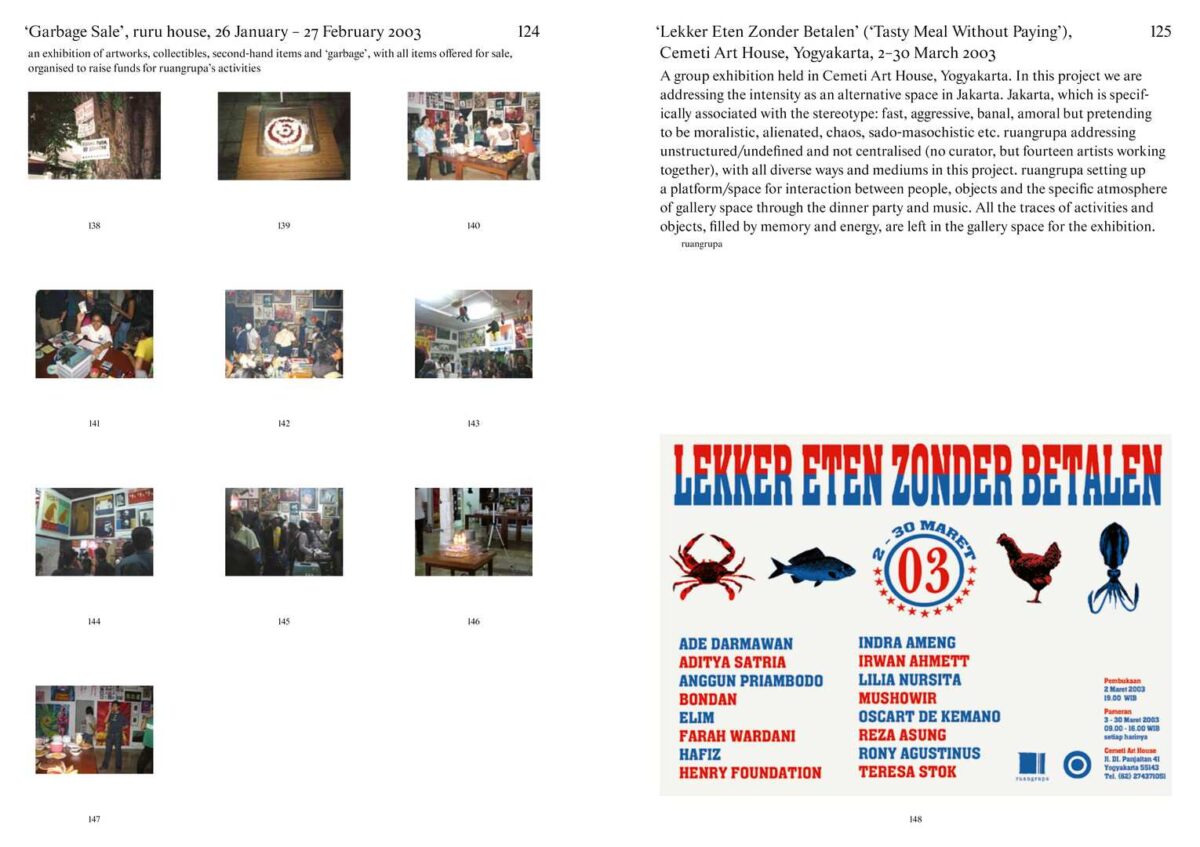
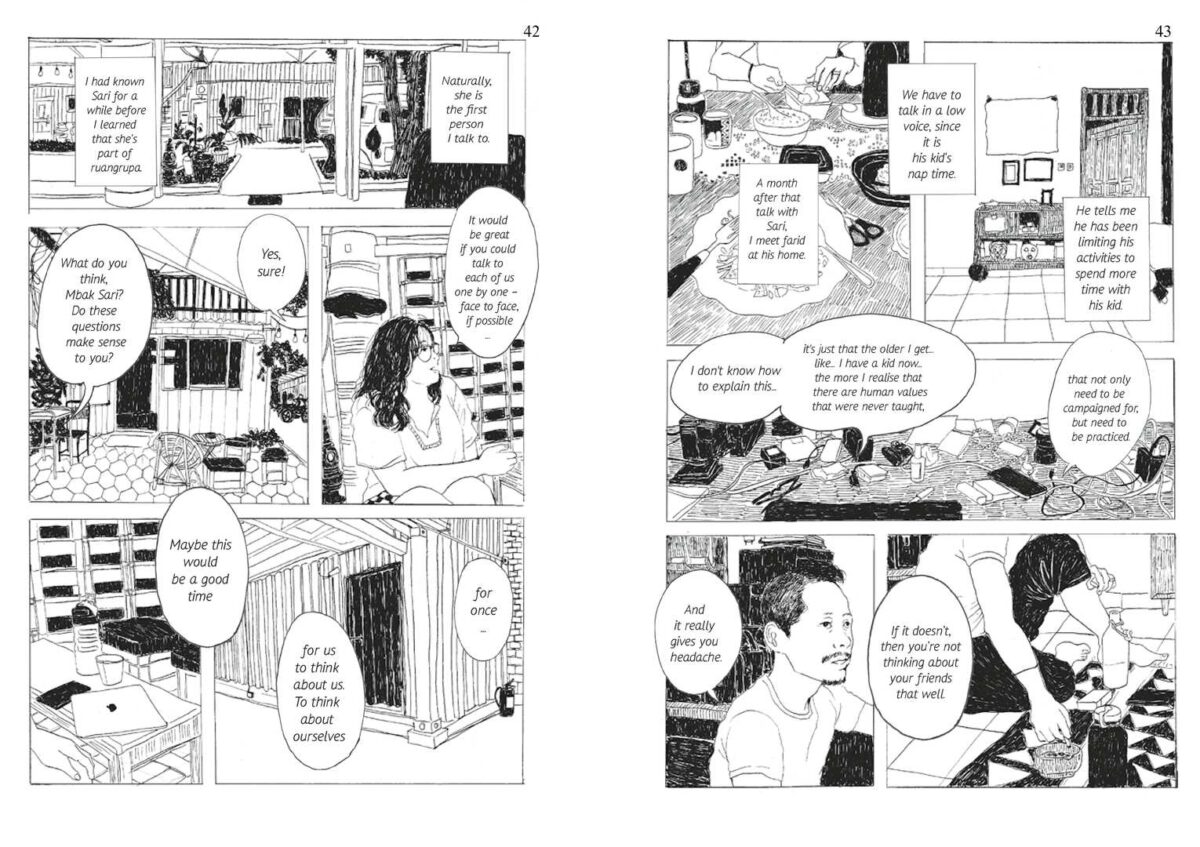
DM: I remember being very struck by how it was almost like there were at least two versions of ruru in circulation. Or, there were two in particular that we were thinking about from early on. What have they meant to people locally in their immediate context? And what have they meant to their wider publics, beyond Jakarta, beyond Indonesia? We were thinking about how to “translate” in both directions—people locally knew one side of the story, and people outside Indonesia (or even, outside their local Jakarta neighborhood) would know another. It’s a story that has many sides, but these are two parts of it we tried to bring together. They have such a presence internationally, such a currency, and it’s not really my sense that they’re much more concerned with that than with building their local infrastructure, with thinking about the next generation—you know, they’re very committed to that. I think that to some extent, there’s a calculation of using the international footprint as a way to consolidate the projects they have in and across Indonesia.
AM: It’s hard to specify the who’s of ruru’s address, because on the one hand, Jakarta (and Indonesia as a whole) is a really important part of the work that they do—on-the-ground and as material. But I do think that in extending their networks internationally, they give people different understandings of how to work, the ways in which you can work equitably or do things with your friends and build something together.
In the process of doing research for the book and commissioning writers, I personally felt that the idea of placing ruru within conventional narratives of “Southeast Asian art” seemed less and less appropriate—or necessary. When we visited Jakarta, the impact of ruru in the building of arts infrastructure felt very clear and palpable. Their documents, archives, and personalities have a somewhat mischievous nature, but in speaking to ruru and their collaborators, it was really interesting to hear about their efforts to build projects outside of Java, about how important upskilling is and how they engage with students and practitioners outside art fields. All of these plans and ideas are not very known or talked about in the realm of “global contemporary art,” partly due to language barriers, but perhaps also due to conceptions of what a “global contemporary art practice” might look like. We hoped through the book to be able to communicate the breadth of their practice and how it escapes these labels.
CQJr: Lastly, in terms of the category of the series Exhibition Histories: How do you make sense of ruru’s inclusion in this series? Did you see it as a case study that extends the categories of the “exhibition” and its “histories”? Is it a critique and maybe a move toward doing away with this framework? What were the kinds of conversations that you were having in relation to Exhibition Histories as a discursive formation and the book’s entry to the series?
WC: I think in terms of the series, from the book FESTAC ’77: The 2nd World Black and African Festival of Arts and Culture (published by Chimurenga and Afterall Books, in association with Asia Art Archive, the Center for Curatorial Studies, Bard College and RAW Material Company, 2019) onward, the Exhibition Histories framing is already not containable. Because the FESTAC book was already blurring what is actual historical material and what are new commissions. Visually they are treated pretty much the same, which means that the chronology is very blurry for a book on exhibition history.
If the ruru book is not part of Exhibition Histories, if it were placed in a bookshop, it would be grouped under something like relational intelligence instead of exhibition histories.
DM: We were also looking back to Artist-to-Artist: Independent Art Festivals in Chiang Mai 1992–98 (published by Afterall Books in association with Asia Art Archive and the Center for Curatorial Studies, Bard College, 2018), which was already starting to rethink the parameters of “exhibition history” in a comparable way. I think we’ve kept that descriptor even though in practice it’s become pretty expansive. FESTAC and Chimurenga were so amazing. It was a massive learning on my part—and on all our parts—in terms of how to take a very different approach to historical research and publishing.
FESTAC was a massive Pan-African festival that contained exhibitions as part of it. It was important to think about the whole thing and that’s where the focus must be. You miss a lot if you’re just talking about one of the exhibitions that were part of it. (They had a lot of really interesting exhibitions as well as the expansive presentation of artistic work from across the continent and diaspora there were dedicated exhibitions on contemporary Nigerian art; African architectural technology; Pan-African books, fashion, science, plus film and performance programmes, a huge conference . . . and still more!)
The way that “exhibition” was always understood by us is as a point where art meets a public, where it becomes a collective activity. With ruru, the idea of “art” is put into question—and while the “exhibition” is not where they’re coming from either, it’s still about practices of coming together.
I think there’s something to be said for the analytic—there’s something that it does when you put it in a framework of exhibition history that is, to me, still productive.
For one thing, it helps with people who are more invested in the exhibition as form, allowing them to reconsider their assumptions. In the part of the world where we live and work, there are more parts of the art ecosystem that are more invested in a certain idea of exhibition’s white-cube lineage. There’s a certain strategic value to saying, “Well, this practice has equal, and in my view, much more relevance. And if you want to talk about the history of exhibitions, we need to talk about this.” And perhaps the more things you put in this “box” of exhibition history that don’t look like that, the more stretchy and expansive the term can become. It allows a bit more openness to thinking about “exhibition” and “history,” both of which are, in the case of ruru, tricky terms.
- 1Enin Supriyanto, “Forces of Socio-political Change in Indonesia,” 461–71; Nuraini Juliastuti, “Pedagogical Moments in Jamming,” 472–93.
- 2Melani Budianta, “Political Economy and Aesthetics of Space: Genealogy of ruangrupa’s Lumbung Practice,” 12–38.