Exhibition

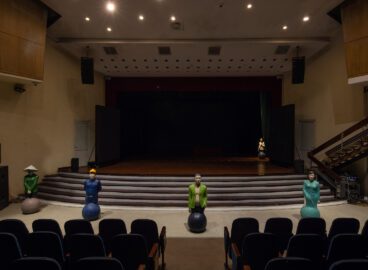
Hanoi Children’s Palace: Nostalgia for the “New Socialist Human” 

Beyond formal schooling, Hanoi Children’s Palace extended socialist cultivation into leisure time, reverie, artistic endeavors, and sports training. More than simply school routine, rituals were designed to develop the body and mind of the “new socialist human,” laying the foundation for building socialism in post-independence Vietnam. Taking the ideological history, architecture, and uncertain future of the Children’s Palace as a point of departure within the city’s broader projection of the creative industries as a strategic force, the project sought to examine how the institution’s pedagogical inheritance persists within the textures of everyday life and socialist memory.

The Asilah Cultural Moussem: Tricontinental Meeting Points, Toni Maraini in conversation with Morad Montazami

The annual Asilah Cultural Moussem, an international festival held in northern Morocco, was cofounded in 1978 by Mohamed Benaïssa and Mohamed Melehi in collaboration with Toni Maraini and Al Muhit Cultural Association. It served as a significant postcolonial cultural platform, involving activists from the Casablanca Art School and artists from Africa, the Arab world, Asia,…

Bali, Background for War (1943), Part II: A Proposal for Wartime Regional Materials Unit at MoMA; A Proposal for the Cultural Cold War

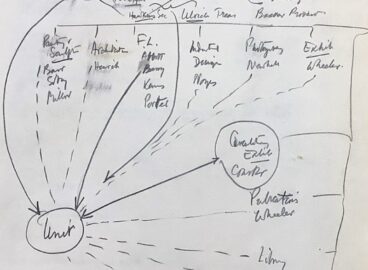
This two-part essay introduces the exhibition Bali, Background for War: The Human Problem of Reoccupation, an exhibition curated by anthropologist and cybernetics pioneer Gregory Bateson at The Museum of Modern Art in 1943. Bali, Background for War was an important exhibition of Southeast Asian modern art history and occupies an exceptional place in the Museum’s institutional history. This second essay traces the wide-ranging infrastructural implications of Bateson’s exhibition from the unrealized Wartime Regional Materials Unit at MoMA to the landscape of foreign capital flows and cultural infrastructure that contributed to the canonization and conceptualization of a Southeast Asian modern art during the Cold War.

Bali, Background for War (1943), Part I: A Regional Exhibition of Balinese Modern Art as a Military Technology of Worldmaking

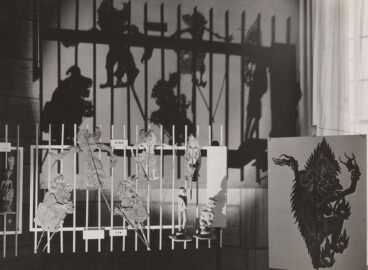
A wartime exhibition curated by anthropologist and cybernetics pioneer Gregory Bateson, Bali, Background for War opened at The Museum of Modern Art (MoMA) in late summer 1943 and then traveled to universities and museums across North America. Bali, Background for War was an anthropological exhibition of Balinese modern art and culture conceived as a technology for producing a necessary subjectivity in the American infantry and civilian administrators who would oversee the “reoccupation” of Japanese-captured territories, such as Bali. The exhibition sought to cultivate the ability to recognize cultural patterns so as to foster understanding of “those habits of thought and behavior” characteristic of a particular people.

Art-Driven Adaptive Reuse in Several Indian Cities

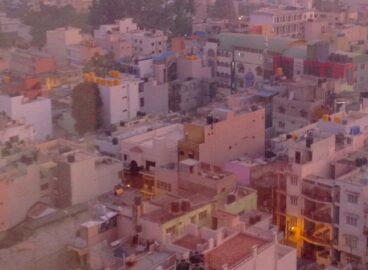
Preservation and reuse drive the art-driven adaptation of nineteenth- and twentieth-century architecture in cities across India, including Kochi, Goa, Mumbai. This essay explores how such sites can be spaces not just of preservation but of alternative making and institutional critique. From the 1960s revival of SoHo in downtown Manhattan to the 2009 opening of the Sharjah…

New Audiences, New Energy: Producing and Exhibiting Contemporary Chinese Art in 1993

Did 1993 mark a watershed for “contemporary Chinese art” in the then increasingly globalized art world? In this essay Peggy Wang discusses exhibitions of contemporary Chinese art held overseas in the year 1993, notably China Avant-Garde in Berlin, China’s New Art, Post-1989 in Hong Kong, and the Venice Biennale. Analyzing various readings of works by artists such as Wang…

Reiko Tomii Looks Back: Thoughts on Global Conceptualism

In this segment of the theme “Global Conceptualism Reconsidered,” the curators of the exhibition Global Conceptualism: Points of Origin, 1950s–1980s reflect upon their experiences organizing the exhibition. They address in the following interviews the origins of the exhibition’s concept, the challenges faced in defining and presenting the variety of conceptualisms across the exhibition’s many international subsections, and…