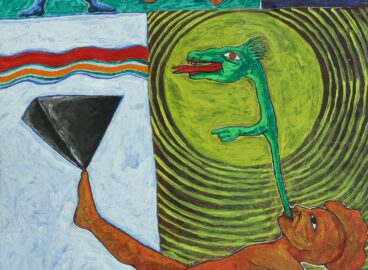
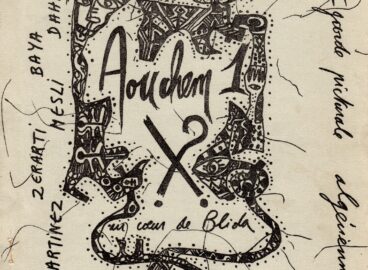
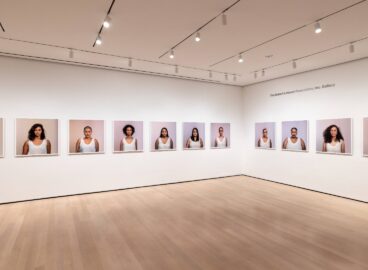
On February 1, 1974, the Senegalese newspaper Le Soleil published a shocking headline: “Younousse’s Slashed Painting: A Simple Matter of Scissors.” According to the article, Senegalese artist Younousse Seye (b. 1940) discovered that her painting Mame Coumba Bang (n.d.) had been vandalized as she guided Ethiopian visitors around the second Salon des artistes sénégalais at the Musée dynamique de Dakar, Senegal’s national collection. This event had high stakes: Pieces from the salon would be selected to tour internationally as part of the landmark traveling exhibition Arts sénégalais d’aujourd’hui opening in the Grand Palais in Paris. One might imagine, then, the shock, panic, and disappointment Seye must have felt upon seeing the strips of fiber that she had embedded into her painting sliced off and scattered across the floor.
Apart from three newspaper articles describing the incident, no visual record of the work survives. Nevertheless, reconstructing the imaginative depth of Seye’s Mame Coumba Bang through descriptions of its defacement opens a window into contested struggles within Senegal’s postindependence art world. Specifically, a closer reading of this scandal reveals not only the gendered and racialized structures of the cultural landscape Seye was navigating, but also her insistence on challenging them.
Before displaying her work in the Musée dynamique, Younousse Seye had emerged quickly on the Senegalese arts scene. Born in Saint-Louis in colonial Senegal in 1940, she came of age amid African independence movements, and her career evolved in tandem with this long moment of decolonization. Working across oil, wood, iron, marble, poetry, and cinema, the self-taught Seye expressed Pan-Africanist and feminist sympathies, grounding her oeuvre in woman-centered African aesthetic practices, techniques, and themes. While local artists of her generation share her Pan-African ideals, Seye’s assertive feminism distinguishes her work, periodically generating tensions with her male peers.1In a recent interview, Seye self-identified as a feminist, saying, “I am totally a feminist. Totally.” See Younousse Seye, interview by Merve Fejzula, Dakar, Senegal, May 11, 2024.
By the time Mame Coumba Bang was exhibited at the 1974 Salon des artistes sénégalais, Seye was more than a decade into her practice. Her creative sensibilities first developed when she was a child, while she assisted her mother in dyeing batik, working outdoors and observing nature’s color palette.2Seye frequently credits this as her entry point into the art world. See, for example, Annette D’Erneville, “Younousse Seye: Peintre,” AWA: La revue de la femme noire, no. 2 (November 1972): 22, https://www.awamagazine.org/acr_posts/november-1972-page-22/. She began painting in her spare time in the mid-1950s while pursuing secretarial work. The First World Festival of Negro Arts (FESMAN), held in Dakar in April 1966, marked a pivotal moment in Seye’s career. Eager to participate, she volunteered as a hostess and, through her encounters with Black artists and intellectuals from across the world, found the inspiration that led her to fully commit to an artistic path. Within three years of her participation in FESMAN, she shot to fame as both a painter and an actress, starring in Ousmane Sembène’s Mandabi (1968), which won the Special Jury Prize at the 1968 Venice Film Festival. By placing her work in the film’s background, Seye drew further international attention to her developing visual arts career.
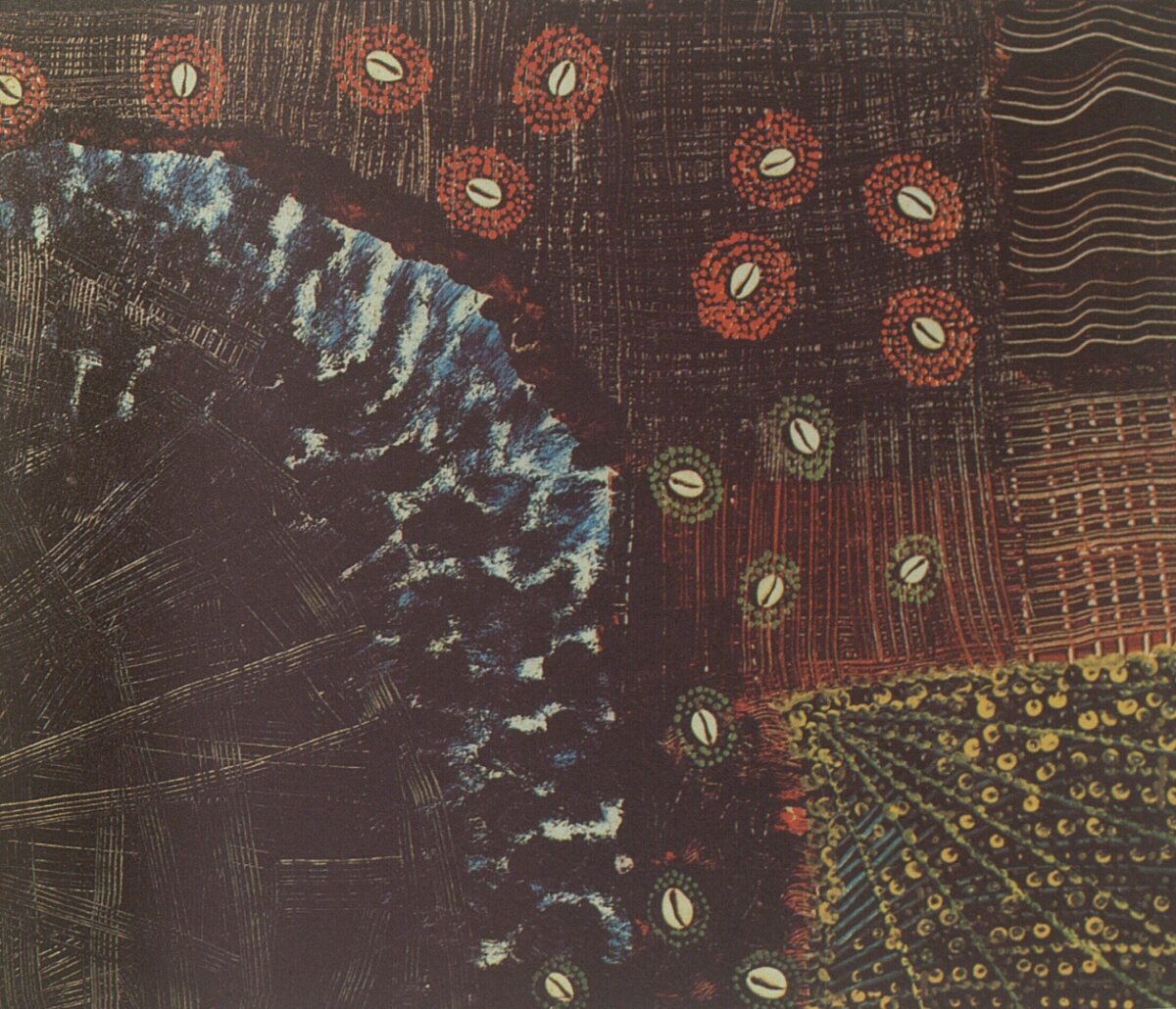
During this period, Seye became renowned for her distinctive use of cowrie shells. Once used as currency in Africa, cowries convey symbolic spiritual and material power. Across the continent, cowries are also associated with fertility, women’s adornment, and feminine power. Seye was among the earliest artists to employ them as a material, threading them onto canvas or embedding them into marble or iron, and she believed that “the language of the spirits is passed down through the secret of cowries.”3Noël Ebony, “Première artiste-peintre africaine, Younousse Seye: ‘Le langage des genies se transmet dans le secret des cauris,’” Fraternité-Matin, July 11, 1972. Through her signature use of the shell, Seye merged African spirituality, feminine symbolism, and continental themes of power and ritual in her work, creating a unique expression of Pan-African feminism. Her engagement with Pan-African themes quickly earned her the attention and patronage of President Léopold Sédar Senghor, who helped to propel her career from the early 1970s onward.4In 1969, the minister of culture officially invited Seye to debut with Senegal’s delegation at the Pan-African Cultural Festival in Algiers. There, she won a UNESCO residency, which she chose to spend in Côte d’Ivoire rather than Europe, deepening her exploration of cowries. Her first solo exhibition upon her return to Dakar in 1971 earned her critical praise. For more on Seye’s trajectory, including her participation in the 1969 Algiers festival, see Merve Fejzula, “Younousse Seye,” AWARE: Archives of Women Artists, Research & Exhibitions, 2023, https://awarewomenartists.com/en/artiste/younousse-seye/; and Judith Rottenburg, “Younousse Seye: The Making of a Pan-African Woman Artist in Post-Independence Senegal,” AWARE, December 15, 2018, https://awarewomenartists.com/en/magazine/younousse-seye-le-devenir-dune-artiste-panafricaine-dans-le-senegal-de-lapres-independance/.
Despite her success, Seye stood apart from other professionally exhibiting Senegalese artists in that she did not rise through the ranks of the Dakar School: a network of artists in the postindependence nation who received government patronage in the form of funding, training at national institutions, and participation in state-sponsored salons and exhibitions. It is notable that she never sought this label. Indeed, when Senghor offered her a teaching position at the national art school, she declined it.5Younousse Seye, interview by Merve Fejzula and Malick Welli, Dakar, Senegal, May 16, 2023. In this sense, Seye maintained a critical distance from the state’s cultural apparatus while, at the same time, benefiting from its international reach.
This was not without its costs. Senghor, too, maintained an ambivalent position toward Seye: Though he extended his patronage, he also voiced reservations about her aesthetic choices. Upon seeing Seye’s solo exhibition at the Théâtre national Sorano Theatre in Dakar in 1977, for example, he derided her characteristic use of organic materials like cowries and vegetable fibers. Senghor disassociated Seye’s use of female-gendered materials—subject to decay over time—from the “eternal” qualities of high art. He elaborated, “This is what gives European artists their practical superiority. We must try to renew the African art of painting for eternity.”6Djib Diedhiou, “Senghor à l’exposition Younousse Seye,” Le Soleil, December 9, 1977.
By the mid-1970s, many artists, critics, and intellectuals were expressing their disillusionment with Senghorian cultural policy, decrying its alleged neocolonial cultural visions and institutional structures.7For more on Senghorian cultural policy and its critics, see Elizabeth Harney, “The École de Dakar: Pan-Africanism in Paint and Textile,” in In Senghor’s Shadow: Art, Politics, and the Avant-Garde in Senegal, 1960–1995 (Duke University Press, 2004), 49–104. Critics felt their viewpoints affirmed when, in 1974, the minister of culture Alioune Sene appointed 26-year-old Frenchman Georges Hornn as curator of the Musée dynamique.8See, for example, Abdou Anta Kâ, “Qui a lacéré la toile de Younousse au musée?,” Le Soleil, January 30, 1974. Hornn had no curatorial experience; his artistic credentials included amateur photography and a film commissioned by the Senegalese government.9I. M. M’Boup, “Le tableau lacéré de Younousse: une simple affaire de ciseaux,” Le Soleil, February 1, 1974. He was appointed after arriving in Senegal as a coopérant militaire—a French civil service position that was itself a colonial legacy—two months prior.10During the mid-century wave of independence fervor, France and its former African colonies hashed out “cooperation accords.” Under these agreements, new governments tasked with creating administrative apparatuses could fill their ranks with French coopérants militaires, or civil servants. These civil servants undertook employment in a range of sectors, including law, education, and defense. For French leaders, staffing the ranks of African bureaucracies with coopérants was intended to protect, first, the interests of the empire and, later, its “accomplishments” amid the process of decolonization. For more on this system, see Sean Beebe, “Colonialism to Cooperation: France, Mauritania, and Senegal, 1960–1980” (PhD diss., Brandeis University, 2020). The defacement of Seye’s Mame Coumba Bang in 1974 under Hornn’s watch just weeks into his tenure crystallized this widening divide between the state and cultural actors, and at the same time, it underscored Seye’s outsider status within the arts establishment.
The vandalism of Mame Coumba Bang became public knowledge when, following the incident, the dramatist and critic Abdou Anta Kâ, who was Seye’s close friend, published a forceful editorial in Le Soleil. Kâ cast the slashing not as an isolated act, but rather as the result of institutional negligence under white museum leadership hostile to what he called “independent Senegalese painters.” He pointedly cited the Ethiopian delegates who first discovered the damage, noting their disbelief that works could be left unprotected in a state museum equipped with guards and a curator. According to Kâ, Hornn dismissed the incident altogether, claiming it was not “his business” to intervene.11Kâ, “Qui a lacéré la toile de Younousse au musée?”
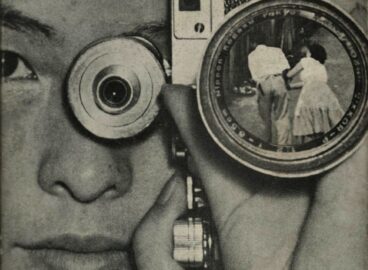
For Kâ, this indifference exemplified broader tensions within Senghor’s cultural establishment. He framed the attack as symptomatic of a neocolonial cultural policy in which white juries determined which African works merited international circulation. These critics, Kâ argued, claimed authority by evaluating artists according to whether they aligned with their own schools or theories of a “Black African aesthetic,” a posture he likened to that of the cercle commanders of the colonial era.12Kâ, “Qui a lacéré la Toile de Younousse au musée?” Commandants de cercle were French colonial administrators in French West Africa responsible for a range of tasks. These included overseeing the development of infrastructural projects, tax collection, and administration of the law. It was in the latter capacity, in particular, that many cercle commanders exercised the most authority, at times using the role to serve violent and repressive ends in meting out punishments to African subjects. For more on commandants de cercle and French colonial governance, see Victor T. Le Vine, Politics in Francophone Africa (Lynne Rienner Publishers, 2004), 44-48; Gregory Mann, “What Was the Indigénat? The ‘Empire of Law’ in French West Africa,” The Journal of African History 50, no. 3 (2009), 331-53. In this reading, Seye’s work was vulnerable not merely because of individual malice, but also because its value was decided through Eurocentric criteria embedded in the attitudes of the museum’s leadership.
State officials swiftly rejected this interpretation. In an interview published days later, Hornn denied responsibility, accusing Kâ and Seye of exploiting the vandalism as a “Trojan horse” for personal grievances. He dismissed the episode as a publicity stunt “underpinned by false anger.”13M’Boup, “Le tableau lacéré de Younousse.” Alioune Sène went further still, condemning Kâ’s critique as exceeding “the measure of tolerable bad taste.” He trivialized the damage by reducing Seye’s use of yoss—a vegetal fiber traditionally used by Senegalese women for braiding—to a matter of “snipped tresses” and echoed Hornn’s claim that the controversy sought to undermine the jury’s discernment.14Alioune Sene, “Point final à Mame Coumba Bang,” Le Soleil, February 2, 1974. Both men ultimately defended the authority of the museum and the legitimacy of the white jury as best qualified to represent Senegal on the international stage.
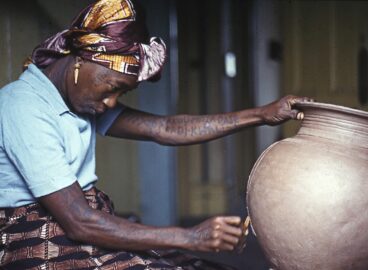
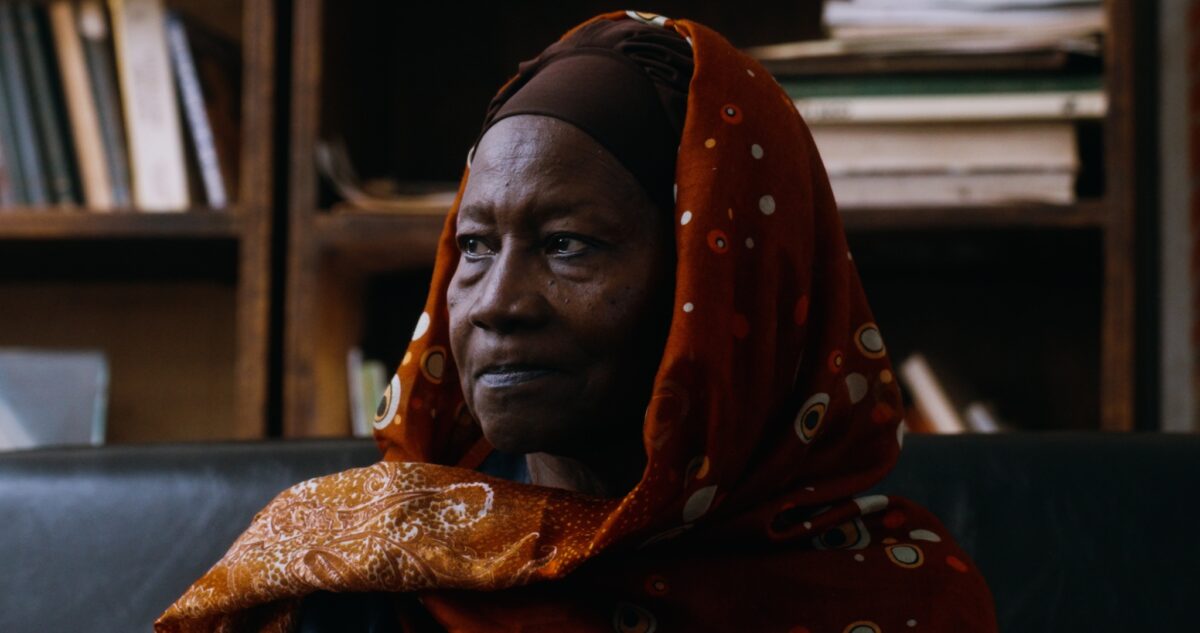
Notably absent from this exchange is Seye’s own voice. In later interviews, she recalled the perpetrator with restraint, describing him simply as someone who resented others’ success, and remarked bluntly of Hornn: “He didn’t like Younousse Seye” (fig. 4).15Seye, interview by Fejzula, May 11, 2024. Although Senghor later offered Seye compensation for the damaged painting, she refused it.16Younousse Seye, interview by Merve Fejzula, Dakar, Senegal, November 12, 2024. For her, the incident was never about publicity or restitution, but rather the museum’s failure to protect African artists from the lingering structures of colonial power. Responsibility, she maintained, lay both with the individual who carried out the act and with the institution that enabled it.17When asked who to blame for the incident, Seye asserted, “It was both of them, unfortunately.” See Seye, interview by Fejzula, November 12, 2024.
We still don’t know what Mame Coumba Bang looked like. After the Musée dynamique’s closure in 1988, much of the national collection was scattered, including this artwork.18On the history of the Musée dynamique, see Lauren Taylor, “The Spiral and the Crossroads: The Dual Universalisms of Senegal’s First Art Museum,” African Arts 57, no. 4 (2024): 44–59. According to accounts in Le Soleil, however, the painting Mame Coumba Bang, which depicted the titular deity, was part of a six-painting series representing protector spirits from each region of Senegal.19M’Boup, “Le tableau tacéré de Younousse.” Mame Coumba Bang, the river goddess of Seye’s hometown, carries importance as a protector of the Saint-Louis branch of the Sénégal River. Other paintings in the series were likely named for different titular spirits. Across Wolof, Lébou, and other cultures, female water deities are revered for their ability to shelter residents from misfortune, ailments, and infertility. Wolof people adore Mame Coumba Bang, and ritual offerings to her remain common.20Babacar M’Baye, “Mame Coumba Bang,” in African Religions: Beliefs and Practices Through History, ed. Douglas Thomas and Temilola Alanamu (ABC-CLIO, 2019), 165–66. Seye’s invocation of Mame Coumba Bang personified the goddess as a nourisher and protector of the country—just as the river nourishes the land and its people.
By depicting a pantheon of female deities, Seye continued her practice of routing local symbolism through feminine iconography. For example, in L’Afrique Nourricière (c. 1970), Seye depicted three women producing milk from their pierced breasts. For Seye, the painting reflects the essential role of women as sustainers. When asked about the painting, she asserted that womankind “is the guardian of our traditions, mother, wife, educator. She is everything and everything revolves around her.”21D’Erneville, “Younousse Seye,” 24. Likewise, Light Bearer (1971) depicts a female figure carrying a torch, which can be interpreted as symbolizing women’s roles in transmitting cultural traditions (fig. 3).22E. Okechukwu Odita, “1940: Younousse Seye, Senegal,” in Foundations of Contemporary African Art, 213, https://issuu.com/mtstanford/docs/focaart_500. Mame Coumba Bang thus fits squarely within Seye’s broader oeuvre.
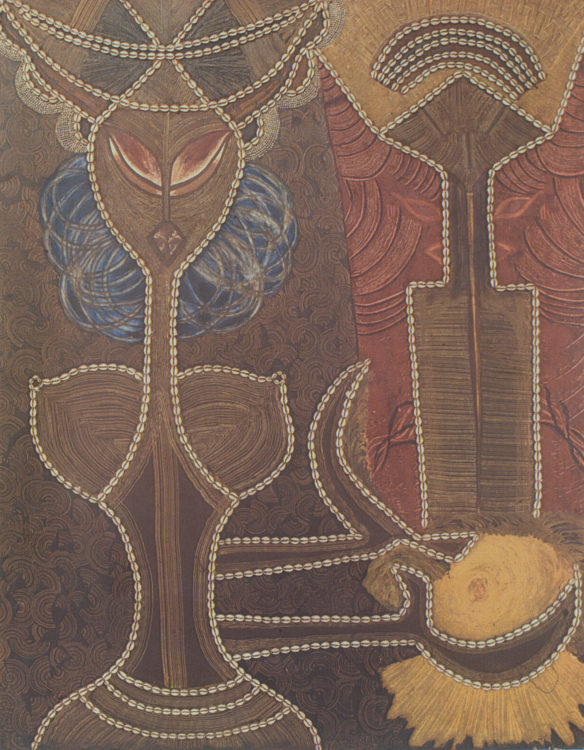
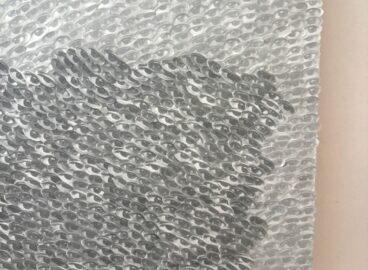
Mame Coumba Bang’s symbolism deepens with its materiality. According to the report in Le Soleil, Seye had woven the cowries onto a tuft of yoss.23This is based on a description in M’Boup, “Le tableau lacéré de Younousse.” Seye likely used yoss in the painting to celebrate its prominence in Senegalese feminine worlds, where it was historically employed by Senegalese women in the making of wigs, braids, and elaborate hairstyles, before the advent of synthetic fibers.24Seye, interview by Fejzula, November 12, 2024. The fiber’s derivation from the land additionally highlights Seye’s attachment to nature. The gathering of yoss and cowries encapsulates themes essential to Seye’s work: her proud rootedness in Senegal, her reverence for the natural world, and an emphasis on womanhood.
The choices of material, subject, and symbolism magnified the gendered stakes of the vandalism at the Salon: someone cut a tuft of yoss from the painting, causing it to shed fiber and cowries. Though the culprit was never publicly named, Seye claims he was a colleague who later confessed privately that he had defaced her painting out of jealousy.25Seye, interview by Fejzula, May 11, 2024. Symbolically, this perpetrator cut away the trademark African and feminine dimensions of Seye’s work. Materially, too, the act jeopardized the chance that the jury would select Mame Coumba Bang to tour internationally with Art sénégalais d’aujourd’hui. Ultimately, despite the controversy and swarming accusations, the jury chose two of Seye’s pieces, Femme aux cauris (n.d.) and La danse des cauris, to tour with the exhibition in 1974 (fig. 2). Seye was the only woman in the show, which traveled internationally until 1980.
Mame Coumba Bang survives today only in fragments—in hostile press clippings and the artist’s own recollections. Its destruction exposes the fault lines in Senegal’s postindependence art world, where state patronage, neocolonial cultural agents, and gendered hierarchies coexisted with genuine ambitions for emancipation. Seye’s differential treatment as a self-taught woman—as a woman artist who forged a singular artistic path during this moment of decolonization—became visible precisely when her work required care, protection, and institutional recognition. That the painting itself is now lost only sharpens its significance. What was cut away in 1974 was not simply a tuft of yoss, but also the possibility that feminine, spiritual, and materially grounded artistic practices could be fully safeguarded within national cultural institutions. Reading Mame Coumba Bang through its defacement thus clarifies the terms under which artists like Seye were asked to create and the costs of doing so on their own terms.
The authors gratefully acknowledge the insightful editorial guidance of Merve Fejzula.
- 1In a recent interview, Seye self-identified as a feminist, saying, “I am totally a feminist. Totally.” See Younousse Seye, interview by Merve Fejzula, Dakar, Senegal, May 11, 2024.
- 2Seye frequently credits this as her entry point into the art world. See, for example, Annette D’Erneville, “Younousse Seye: Peintre,” AWA: La revue de la femme noire, no. 2 (November 1972): 22, https://www.awamagazine.org/acr_posts/november-1972-page-22/.
- 3Noël Ebony, “Première artiste-peintre africaine, Younousse Seye: ‘Le langage des genies se transmet dans le secret des cauris,’” Fraternité-Matin, July 11, 1972.
- 4In 1969, the minister of culture officially invited Seye to debut with Senegal’s delegation at the Pan-African Cultural Festival in Algiers. There, she won a UNESCO residency, which she chose to spend in Côte d’Ivoire rather than Europe, deepening her exploration of cowries. Her first solo exhibition upon her return to Dakar in 1971 earned her critical praise. For more on Seye’s trajectory, including her participation in the 1969 Algiers festival, see Merve Fejzula, “Younousse Seye,” AWARE: Archives of Women Artists, Research & Exhibitions, 2023, https://awarewomenartists.com/en/artiste/younousse-seye/; and Judith Rottenburg, “Younousse Seye: The Making of a Pan-African Woman Artist in Post-Independence Senegal,” AWARE, December 15, 2018, https://awarewomenartists.com/en/magazine/younousse-seye-le-devenir-dune-artiste-panafricaine-dans-le-senegal-de-lapres-independance/.
- 5Younousse Seye, interview by Merve Fejzula and Malick Welli, Dakar, Senegal, May 16, 2023.
- 6Djib Diedhiou, “Senghor à l’exposition Younousse Seye,” Le Soleil, December 9, 1977.
- 7For more on Senghorian cultural policy and its critics, see Elizabeth Harney, “The École de Dakar: Pan-Africanism in Paint and Textile,” in In Senghor’s Shadow: Art, Politics, and the Avant-Garde in Senegal, 1960–1995 (Duke University Press, 2004), 49–104.
- 8See, for example, Abdou Anta Kâ, “Qui a lacéré la toile de Younousse au musée?,” Le Soleil, January 30, 1974.
- 9I. M. M’Boup, “Le tableau lacéré de Younousse: une simple affaire de ciseaux,” Le Soleil, February 1, 1974.
- 10During the mid-century wave of independence fervor, France and its former African colonies hashed out “cooperation accords.” Under these agreements, new governments tasked with creating administrative apparatuses could fill their ranks with French coopérants militaires, or civil servants. These civil servants undertook employment in a range of sectors, including law, education, and defense. For French leaders, staffing the ranks of African bureaucracies with coopérants was intended to protect, first, the interests of the empire and, later, its “accomplishments” amid the process of decolonization. For more on this system, see Sean Beebe, “Colonialism to Cooperation: France, Mauritania, and Senegal, 1960–1980” (PhD diss., Brandeis University, 2020).
- 11Kâ, “Qui a lacéré la toile de Younousse au musée?”
- 12Kâ, “Qui a lacéré la Toile de Younousse au musée?” Commandants de cercle were French colonial administrators in French West Africa responsible for a range of tasks. These included overseeing the development of infrastructural projects, tax collection, and administration of the law. It was in the latter capacity, in particular, that many cercle commanders exercised the most authority, at times using the role to serve violent and repressive ends in meting out punishments to African subjects. For more on commandants de cercle and French colonial governance, see Victor T. Le Vine, Politics in Francophone Africa (Lynne Rienner Publishers, 2004), 44-48; Gregory Mann, “What Was the Indigénat? The ‘Empire of Law’ in French West Africa,” The Journal of African History 50, no. 3 (2009), 331-53.
- 13M’Boup, “Le tableau lacéré de Younousse.”
- 14Alioune Sene, “Point final à Mame Coumba Bang,” Le Soleil, February 2, 1974.
- 15Seye, interview by Fejzula, May 11, 2024.
- 16Younousse Seye, interview by Merve Fejzula, Dakar, Senegal, November 12, 2024.
- 17When asked who to blame for the incident, Seye asserted, “It was both of them, unfortunately.” See Seye, interview by Fejzula, November 12, 2024.
- 18On the history of the Musée dynamique, see Lauren Taylor, “The Spiral and the Crossroads: The Dual Universalisms of Senegal’s First Art Museum,” African Arts 57, no. 4 (2024): 44–59.
- 19M’Boup, “Le tableau tacéré de Younousse.”
- 20Babacar M’Baye, “Mame Coumba Bang,” in African Religions: Beliefs and Practices Through History, ed. Douglas Thomas and Temilola Alanamu (ABC-CLIO, 2019), 165–66.
- 21D’Erneville, “Younousse Seye,” 24.
- 22E. Okechukwu Odita, “1940: Younousse Seye, Senegal,” in Foundations of Contemporary African Art, 213, https://issuu.com/mtstanford/docs/focaart_500.
- 23This is based on a description in M’Boup, “Le tableau lacéré de Younousse.”
- 24Seye, interview by Fejzula, November 12, 2024.
- 25Seye, interview by Fejzula, May 11, 2024.