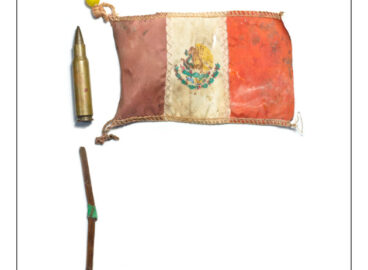
The mail art network connected hundreds of artists around the world, heralding art forms based on communication systems rather than objects.
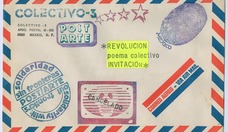
In 1981 in Mexico City, the artists’ group Colectivo 3 initiated Poema Colectivo Revolución in Mexico City in 1981 and drew upon the international mail art network, some of whose members had been exchanging artworks and unconventional ideas about art through the mail for more than a decade. The invited artists received sheets of paper with blank squares in the center, where they were invited to mark their responses to the theme of revolution. The results, mailed back to Colectivo 3 from forty-five countries, provide insight into a broad array of artistic and political views and strategies. One of the main principles of this artist-to-artist interaction was that all works submitted to the project were accepted, as was the case for all mail art projects. By refusing to employ selection criteria, mail artists constructed a system in which formalist notions of quality and curatorial intervention were of little importance.
Chosen two years after the triumph of the Sandinista revolution in Nicaragua, which overthrew the unpopular Somoza dictatorship, the theme of Poema Colectivo relates to the success of that venture and its repercussions in the rest of Latin America. However, it also points to the notion of “aesthetic revolution” (a literal “turning around”) inherited from the utopian ideas of concrete art and poetry. The mailings received by Colectivo 3 run the gamut from humorous banality to deep political commitment, giving anything but a unified take on the meaning of revolution at the dawn of the 1980s.
This collected/collective project provides us today with a snapshot of the mail art network at a moment of frenetic activity. Re-presented and recontextualized on post by Zanna Gilbert, former C-MAP Latin America Fellow at MoMA, in collaboration with Mauricio Marcin, curator at Museo el Eco in Mexico City, this archive of Poema Colectivo encourages us to thinkin about reconfiguring collectives and networks using the resources of digital communication. post would like to thank Colectivo 3 for generously sharing their archive with us.