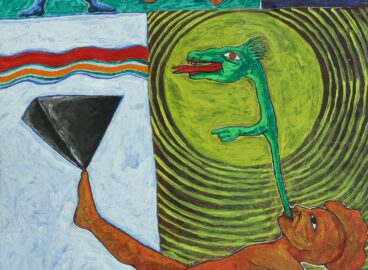
South Africa’s official record marks 1991 as a significant moment in the nation’s transition from the racially segregated regime of apartheid to a democratic government. Amid political unrest, massacres, and a state of emergency, the year is remembered in mainstream history as the beginning of multiparty negotiations—between the minority National Party, the recently unbanned African National Congress, and others—to dismantle apartheid and create a democratic constitution. Yet, alongside the spectacular depictions of violence, militarism, and male-dominated politics that have come to define 1991 in state accounts, intimate and more personal histories have often gone unrecorded.
One such incident unfolded on Christmas Eve in 1991. Berenice, the childhood friend of South African contemporary artist Gabrielle Goliath (born 1983), was fatally shot in an act of domestic violence. In contrast to the detailed recordings of the negotiations to end apartheid, the circumstances surrounding Berenice’s death remain obscured. The day after the tragedy, Goliath visited Berenice’s mother, who, upon seeing Goliath, cried out “Berenice,” not “Gabrielle,” and clung to her tightly. Being addressed as “Berenice” had a profound impact on the artist. “I recall how this name, Berenice, was spoken over me, into me, as a kind of sunken chord. It is a name never to be mine, and yet mine and of my heart—to be borne, as part of me and to be shared,” states Goliath.1Gabrielle Goliath in discussion with the author, November 2025.
Nineteen years after Berenice’s death, Goliath began producing a photographic series titled Berenice (2010–) commemorating her friend’s death. The series is ongoing and, to date, consists of three iterations, each composed of photographic portraits of sitters—mainly brown women, including the artist—surrogate figures for Berenice standing in her ghostly absence. The death of Berenice also catalyzed Goliath’s larger artistic practice of commemorative mixed-media installations dedicated to victims of racial and gendered brutality in and beyond South Africa.
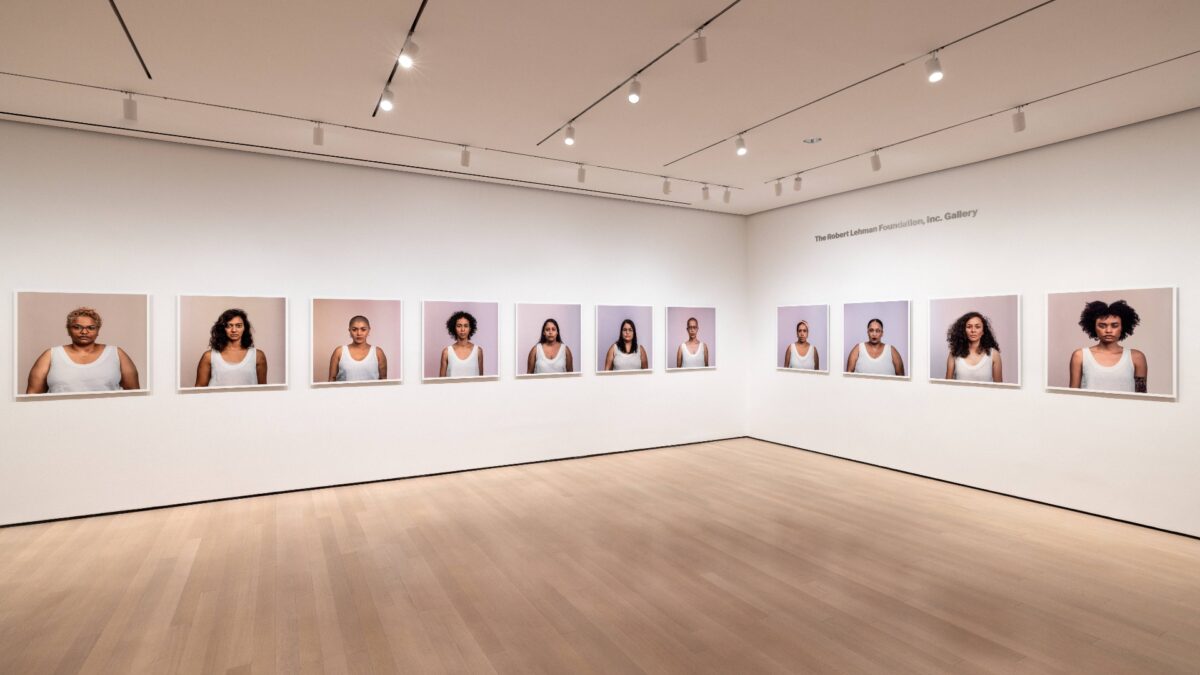
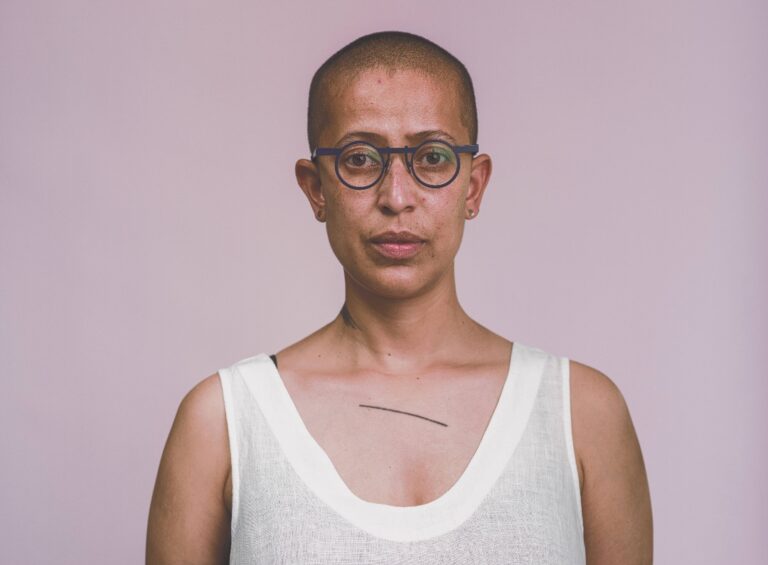
Berenice 29-39 (2022; fig.1) is a serial installation of eleven portraits, each of which depicts a woman wearing a white, diaphanous, sleeveless shirt. Each sitter, gazing directly at the viewer, embodies the absent presence of Berenice. The portraits are life-size. They are composed in a head-and-shoulders format, set against backgrounds ranging from earth tones to muted pinks and purples. Along with commemorating Goliath’s childhood friend, Berenice 29-39 registers the bereaved mother’s cry of “Berenice.” Her reverberating call echoes in the unwavering gaze and embodied presence of the sitters, who, along with Goliath, take on the name “Berenice.” The sitters, therefore, undertake a complex task of not only standing in for Berenice but also channeling her mother’s call.
The uniform head-and-shoulders composition of the portraits, which are tightly cropped at the upper torso, and their portrayal of stoic, straight-faced sitters conjure the visual language of administrative photographs. Meanwhile, the numbering in the individual works’ titles recalls the seriality of the state archive and its efforts to reduce people to anonymous, nameless subjects. Within South Africa’s historical context, a colonial photographic regime took shape in the newly formed nation in the early 20th century. It developed in tandem with cataloguing policies structured around gender, race, and class.2Loreno Rizzo, Photography and History in Colonial Southern Africa: Shades of Empire (Wits University Press, 2019). Building on these representational systems, South Africa’s apartheid government mandated that all individuals over the age of 16 be photographed and issued an ID under the newly enacted Population Registration Act of 1950. During this period, photography was adopted on a mass scale through the introduction of standardized headshots accompanied by classificatory textual codes that aimed to “fix and classify bodies.”3Rizzo, Photography and History in Colonial Southern Africa, 91. Moreover, “racialized looking” became formalized, which had perilous implications for those classified as “African” and “coloured”—particularly Black people subjected to pass laws.4Ingrid Masondo, “Unstable Forms: Photography, Race, and the Identity Document in South Africa,” in Ambivalent: Photography and Visibility in African History, ed. Patricia Hayes and Gary Minkley, New African Histories (Jacana Media, 2021), 78.
By engaging with the state’s scopic regimes, Berenice 29-39 reveals the links between the visual norms of the colonial-apartheid administration and ongoing systems of violence that continue to position difference as vulnerable and disposable. Drawing from these visual arrangements, Goliath emphasizes the sitters’ labor of stepping into what she calls “that policed archival register”—the state’s regulatory system of order from which the series draws—as a way of invoking Berenice and resisting “the total capture of the archive and the photograph.”5Goliath in discussion with the author, November 2025.
Berenice 29-39 is situated within Goliath’s ongoing investigation into histories of dominant representation and their contemporary afterlives. Goliath elaborates, “I’m directing much of my critique towards the field of aesthetics. A regime of representation that is itself already inherently raced, gendered, and classed.”6Gabrielle Goliath, “MASTERCLASS with Gabrielle Goliath in conversation with Rabia Abba Omar (The Discussion),” posted August 11, 2023, by Stellenbosch University, YouTube, https://www.youtube.com/watch?v=uFKB9Vtse7U. Through this critique and the foregrounding of women in Berenice 29-39, Goliath’s portraits expose the aesthetic production of a universal subject—white, male, and heterosexual—often against fixed depictions of Black and brown women who, in turn, have been rendered hyper-visible and vulnerable to violence.
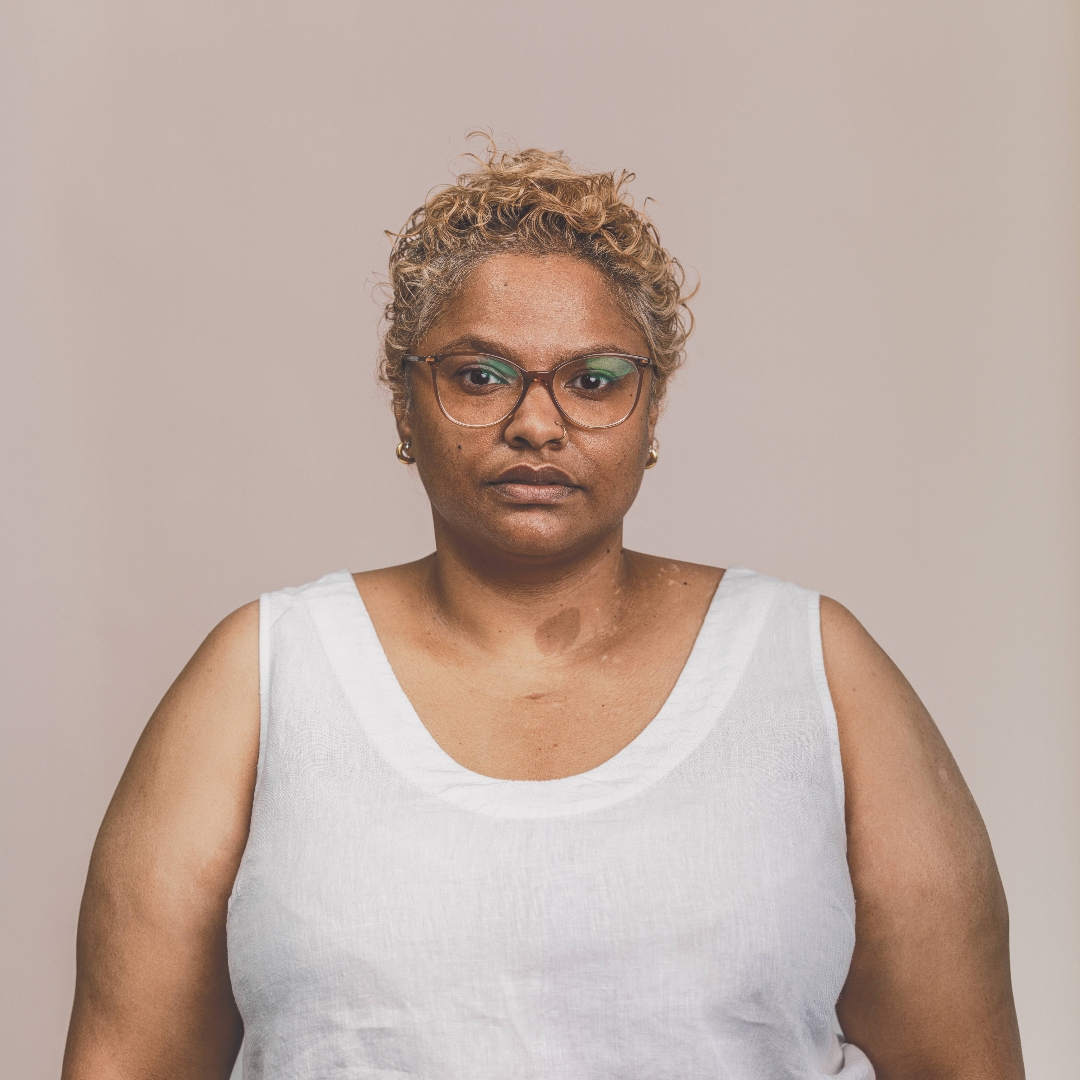
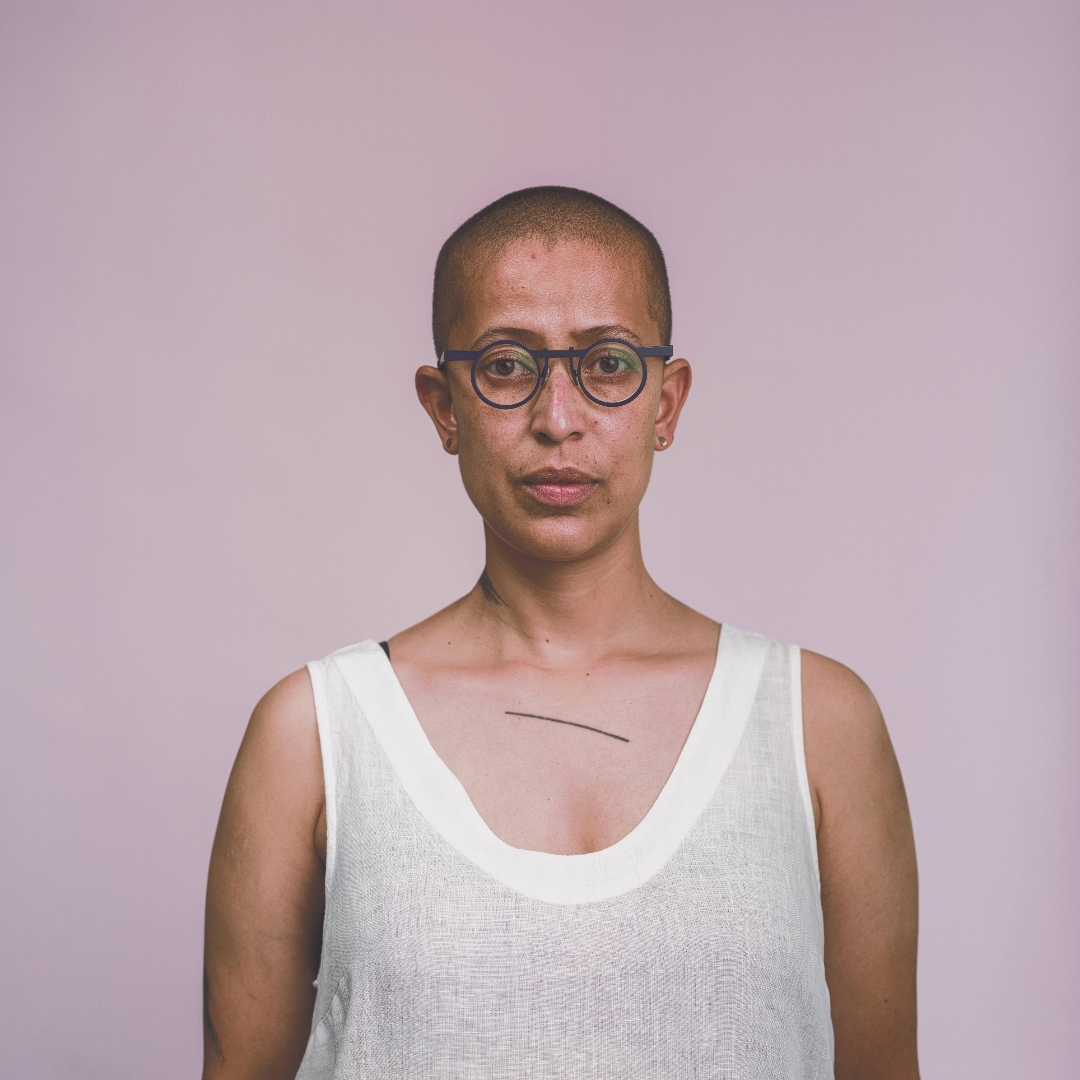
Confronting the prejudice inherent in photography and archival traditions, Goliath disrupts their extractive and classificatory logics to produce portraits in her own way. Unlike the fixed, monochromatic background of administrative photography, the tonal shifts in the series’ backdrops—from earth tones to pink and purple—suggest movement and improvisation (fig. 2–4). Given South Africa’s enduring systems of racial-gender violence, these colors gesture to hope, possibility, and renewal within a landscape marked by brutality.


Contending with the limits and possibilities of photography and the archive, Berenice 29-39 calls for an engagement sensitive to Berenice’s mother’s call. These portraits encourage a perceptive mode of engaging with photographs, in line with the scholarship of Tina Campt—a significant inspiration to the artist—who foregrounds the theory of listening to images “as a practice of looking beyond what we see and attuning our senses to the other affective frequencies through which photographs register.”7Tina Campt, Listening to Images (Duke University Press, 2017), 8. Campt’s approach invites us to perceive photographs, including bureaucratic pictures, not only as images of rigid subjectivities but also as sites in which dissent and fugitivity take place.
Unlike the small, state-issued photographs, Goliath’s photographs are life-size. By producing Berenice 29-39 at this scale, the artist encourages her audiences to confront the sitters head-on. The sitters’ presence is therefore inescapable as they look back at the audience—creating an almost mutual line of vision that troubles the panoptic gaze of the colonial-apartheid state.8Lorena Rizzo contends that the apartheid identification documents, particularly the pass books, codified “an almost panoptic regime of visual surveillance.” Rizzo, Photography and History in Colonial Southern Africa, 98. In this shared gaze between audience and sitters, questions arise about the potential of audience participation and photography: What might different ways of looking produce in the afterlives of the colonial-apartheid project, and how might the embodied presence of audiences extend the reach of Berenice’s mother’s call well beyond the photograph’s frame?
An Enduring Mourning
Goliath convenes sitters from her community to stand in for Berenice in the series. In this practice, which she refers to as a “lifework of mourning,” the artist’s ongoing series presents a shared, laborious ritual of invoking Berenice and the name her mother called out to Goliath.9Stephanie Bailey, “Gabrielle Goliath: Working in Trauma’s Wake,” ArtReview, April 8, 2025, https://artreview.com/gabrielle-goliath-working-in-traumas-wake/. Unlike the individualistic, alienating dynamics of bureaucratic systems, Berenice 29-39 becomes a space of collaboration, relationality, and collective solidarity. In this prolonged ritual of mourning, Berenice 29-39 proposes a different mode of remembering, one that is open-ended, collective, and uninhibited by the forgetfulness inherent in linear, monumental memorials. As the series unfolds over an extended period and each sitter assumes the spectral presence of Berenice, the portraits rehearse—over and over—a method for living and remembering in the shadows of an empire determined to see difference as expendable and unmemorable.10This notion of rehearsal is based on Ariella Aïsha Azoulay’s concept, which she presents as a way to “replace the imperial impulse” and to learn how to “be with others differently.” Azoulay, Ariella Aïsha. Potential History: Unlearning Imperialism (Verso, 2019).

This public and labor-intensive ritual of grief enacted in Berenice 29-39 calls to mind political mourning practices in South Africa. During the 1980s, mass funerals of Black activists murdered by the apartheid regime in the 1980s—and the circulation of their photographic documentation—became a critical site of “militant mourning” and Black resistance.11Louise Bethlehem and Norma Musih, “Between Emptiness and Superfluity: Funeral Photography and Necropolitics in Late-Apartheid South Africa,” photographies 15, no. 1 (2022): 57–77. More recently, the widows of the Marikana massacre, the wives of the Black miners murdered in South Africa in 2012, continue to mourn and demand justice for the reprehensible killing of the miners.12To read more about this, see Niren Tolsi, “Marikana Then and Now—A Tragedy that Keeps Unfolding,” Mail & Guardian, August 18, 2017, https://mg.co.za/article/2017-08-18-00-marikana-then-and-now-a-tragedy-that-keeps-unfolding/. Situating Berenice 29-39 within these public practices of mourning brings into view Black traditions of mourning in South Africa as strategies of liberation and radical remembering.13I would also like to call up the prescient writing of Hugo ka Canham, who describes Black mourning traditions in South Africa as a mode of renewal and encompassing a “rebellious register.” Hugo ka Canham, Riotous Deathscapes (Duke University Press, 2023). Goliath’s work is in conversation with these traditions and distinct in its enunciation of an artistic language rooted in durational embodied rituals that emphasize collectivity and relationality.
By sustaining a ritual of mourning for more than three decades after Berenice’s death, Berenice 29–39 performs, as Goliath explains, “a certain refusal of ‘the archive’ as a political configuration of differentially valued life.”14Goliath in discussion with the author, November 2025. This refusal is enacted through duration, embodiment, and collaboration. Against systems that render racialized and gendered violence legible only through anonymized data, the series holds a name—“Berenice”—close, repeating it without exhausting it. As sitters enter a photographic archival register, they inhabit it otherwise, transforming seriality into ritual and standardization into a collective labor of care. The life-size portraits (fig.5) confront viewers directly, interrupting the one-directional gaze of administrative photography and recasting spectatorship as an ethical encounter. Attuned to the reverberation of Berenice’s mother’s call, Berenice 29–39 asks what it means to remain with mourning rather than to resolve it. In doing so, the series moves beyond critique to model a way of living with loss that resists closure and forgetfulness, insisting instead on the ongoing grievability of a life the archive failed to hold.
Gabrielle Goliath‘s Berenice 29–39 (2022) is on view in the exhibition New Photography 2025: Lines of Belonging, from September 14, 2025, to January 17, 2026, at The Museum of Modern Art, New York.
- 1Gabrielle Goliath in discussion with the author, November 2025.
- 2Loreno Rizzo, Photography and History in Colonial Southern Africa: Shades of Empire (Wits University Press, 2019).
- 3Rizzo, Photography and History in Colonial Southern Africa, 91.
- 4Ingrid Masondo, “Unstable Forms: Photography, Race, and the Identity Document in South Africa,” in Ambivalent: Photography and Visibility in African History, ed. Patricia Hayes and Gary Minkley, New African Histories (Jacana Media, 2021), 78.
- 5Goliath in discussion with the author, November 2025.
- 6Gabrielle Goliath, “MASTERCLASS with Gabrielle Goliath in conversation with Rabia Abba Omar (The Discussion),” posted August 11, 2023, by Stellenbosch University, YouTube, https://www.youtube.com/watch?v=uFKB9Vtse7U.
- 7Tina Campt, Listening to Images (Duke University Press, 2017), 8.
- 8Lorena Rizzo contends that the apartheid identification documents, particularly the pass books, codified “an almost panoptic regime of visual surveillance.” Rizzo, Photography and History in Colonial Southern Africa, 98.
- 9Stephanie Bailey, “Gabrielle Goliath: Working in Trauma’s Wake,” ArtReview, April 8, 2025, https://artreview.com/gabrielle-goliath-working-in-traumas-wake/.
- 10This notion of rehearsal is based on Ariella Aïsha Azoulay’s concept, which she presents as a way to “replace the imperial impulse” and to learn how to “be with others differently.” Azoulay, Ariella Aïsha. Potential History: Unlearning Imperialism (Verso, 2019).
- 11Louise Bethlehem and Norma Musih, “Between Emptiness and Superfluity: Funeral Photography and Necropolitics in Late-Apartheid South Africa,” photographies 15, no. 1 (2022): 57–77.
- 12To read more about this, see Niren Tolsi, “Marikana Then and Now—A Tragedy that Keeps Unfolding,” Mail & Guardian, August 18, 2017, https://mg.co.za/article/2017-08-18-00-marikana-then-and-now-a-tragedy-that-keeps-unfolding/.
- 13I would also like to call up the prescient writing of Hugo ka Canham, who describes Black mourning traditions in South Africa as a mode of renewal and encompassing a “rebellious register.” Hugo ka Canham, Riotous Deathscapes (Duke University Press, 2023).
- 14Goliath in discussion with the author, November 2025.