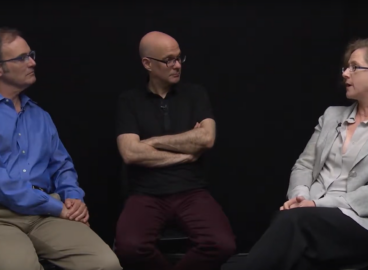
Julia Herzberg in conversation with Catalina Parra

After presenting during a C-MAP Latin America session at MoMA, artist Catalina Parra joined independent critic and curator Julia Herzberg for a conversation about her work. Herzberg, long-time researcher of Parra’s production, conducted an interview that went from politics to education and from Chile to Germany, with occasional stops in New York and Buenos Aires. Art under dictatorship, Fluxus, and Feminism seem to coalesce in Parra’s pieces, some of which are discussed in detail during this encounter that we now share with post readers.

More in this theme

A Conversation with Ann Pendleton-Jullian

Architect, astrophysicist, scholar, and Valparaiso-aficionado Ann Pendleton-Jullian talks about Chile, Chilean architecture and landscape, and the “ad hoc, ongoing work of art” that is Ciudad Abierta. Pendletton-Jullian, author of Road that Is Not a Road and the Open City, Ritoque, Chile, visited MoMA to talk to the C-MAP Latin America group about her 28+ year…

The Archival Impulse: Collecting and Conserving the Moving Image in Asia

Since the 1950s, there has been an active production of experimental film, animation, and video art in Asia. Yet, much of this work has not been consistently conserved or shared with the public due to the lack of accessible archives or organized collections dedicated to its preservation and dissemination. The conference “The Archival Impulse: Collecting…

New Audiences, New Energy: Producing and Exhibiting Contemporary Chinese Art in 1993

Did 1993 mark a watershed for “contemporary Chinese art” in the then increasingly globalized art world? In this essay Peggy Wang discusses exhibitions of contemporary Chinese art held overseas in the year 1993, notably China Avant-Garde in Berlin, China’s New Art, Post-1989 in Hong Kong, and the Venice Biennale. Analyzing various readings of works by artists such as Wang…

Subscribe to our newsletter

Related Content

Open Loop: Reconsidering the Relationship Between Mexican Wire Baskets and Ruth Asawa’s Looped-Wire Sculpture

In creating a mesh by looping and interlocking single strands of wire, Asawa defined an intricate shape without precluding a view of its interior; instead, she foregrounded space itself. The artist had learned the basic premise of looping wire into permeable volumes during an American Friends Service Committee volunteer trip to Toluca, Mexico, where in 1947, she encountered—and briefly studied—a unique wire-basketry technique. While today, thanks to a series of critical analyses from 2006 onward, Asawa’s art sits comfortably within the trajectory of radical innovations of modernist sculpture, the Mexican origin and craft pedigree of her signature looped-wire creations are typically cast in a role subservient to the major narrative of the artist’s singular contributions.

Female Approaches to the Divine: The Marian Representations of Norah Borges, María Izquierdo, and Miriam Inez da Silva / Acercamientos femeninos a lo divino. Las representaciones marianas de Norah Borges, María Izquierdo y Miriam Inez da Silva

“Mary is . . . a myth of a woman without a vagina,” proclaims queer theologian Marcella Althaus-Reid in Indecent Theology: Theological Perversions in Sex, Gender, and Politics. Moreover, Althaus-Reid declares that the adoration of the Virgin in Latin America in the…