Maya Varma: A lot of your work turns toward the lineages that shape Dalit life and knowledge. When you think about these histories, how do you understand the inheritances you’re carrying forward? What pasts are you in conversation with, and how do you imagine the canon you’re stepping into?
Shrujana Niranjani Shridhar: I think we need to think a little more carefully about what we call “our inheritance.” What you think is yours may not actually be yours in the way you imagine. I am not saying you do not have a right to access it, but you have to think about how and why and where you are using it. The culture I want to be part of, the culture I want to help create, is shaped by artists from oppressed castes, from Adivasi and Indigenous lineages.1Adivasi is a term used to describe Indigenous peoples of the Indian subcontinent, many of whom have distinct languages, cultural practices, and relationships to land that predate the formation of the modern Indian state. The term Indigenous is used here in a broader, comparative sense to situate Adivasi and other marginalized communities within global histories of Indigenous cultural production, dispossession, and resistance under colonial and settler regimes. Together, these terms emphasize lineage-based knowledge systems and artistic traditions that exist outside dominant caste and colonial frameworks. But being an artist from an oppressed caste in South Asia is not new. These are communities that have produced culture and developed visual traditions for centuries. Traditionally, we were the artists. We were the ones creating looms and weaves and pottery.
What the Western world now calls “craft” and what it sometimes demeans as “craft”—all of it was developed by those who belonged to oppressed castes, not by those from oppressor castes. So when I see people casually referencing certain patterns or weaves—as if it is simply, “I’m South Asian, I’m Indian, this exists in my work”—that is not how that works. That is not how those loom and weaving codes came to be. Those codes were developed in very specific political, social, and historical contexts.
So we have to think about what that canon really is. And we have to think about it very intentionally. I am not the first person saying this. Many artists, like me, talk about how the entire cultural, political, and visual culture of South Asia comes from communities that belong to oppressed castes. Yet in the larger art world, South Asian art is often represented only by those from oppressor castes. And that is deeply warped. It smells a bit of appropriation to be honest.
MV: This way of very intentionally thinking about inheritance has shaped how you work with material history, especially your Dalit Panthers Archive. You’ve often described yourself as an “accidental archivist.” Can you explain what the Dalit Panthers Archive is and what it meant to take on that work?
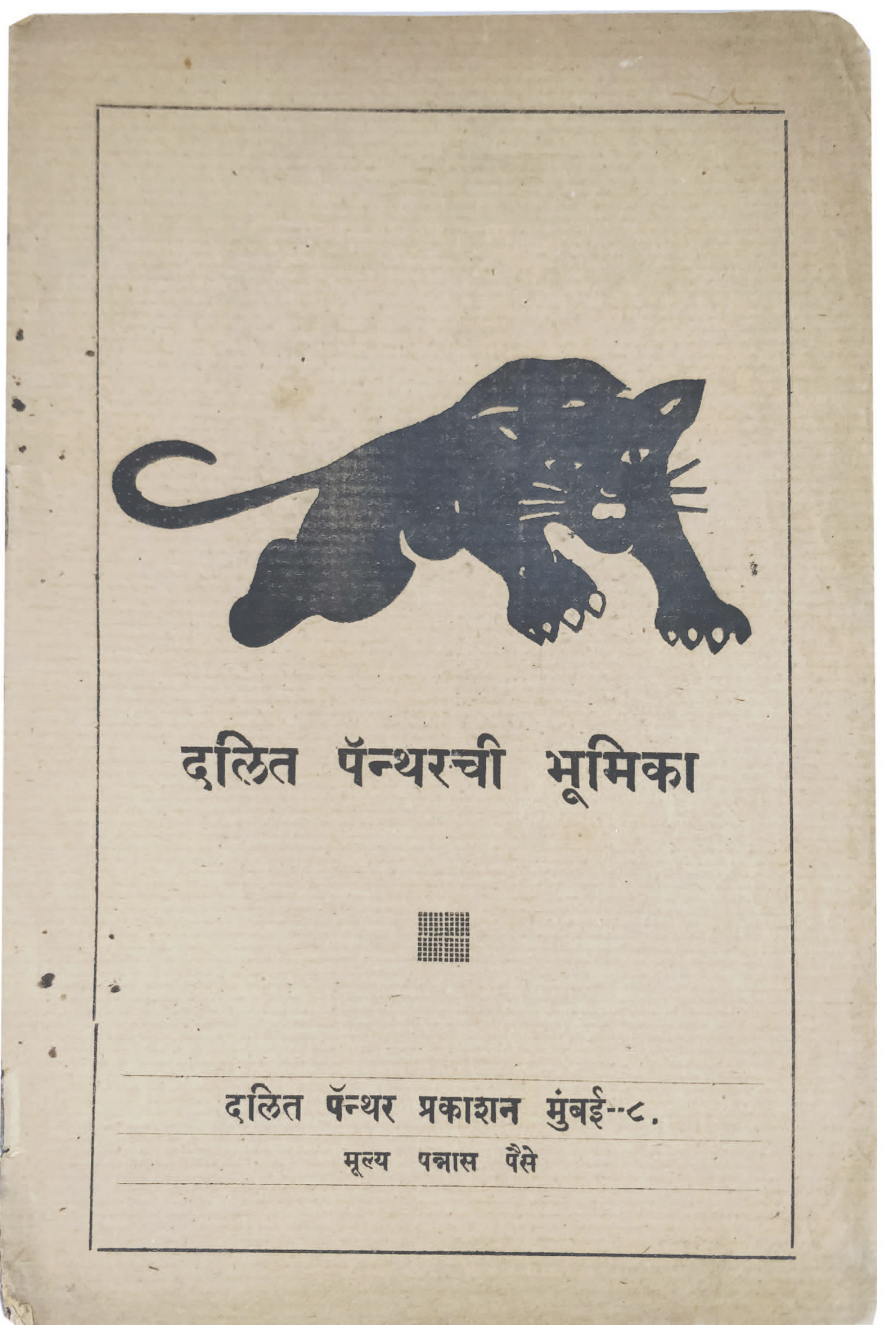
SNS: The Dalit Panthers Archive grew out of very practical circumstances. A few friends and I were researching a documentary on the Dalit Panthers, and we kept running into the same problem: There simply wasn’t enough accessible material.2The Dalit Panthers were a radical political and cultural organization founded in Bombay in 1972 by writers and activists including Raja Dhale, Namdeo Dhasal, and J. V. Pawar. Inspired in part by the Black Panther Party in the United States, the group mobilized against caste oppression, state violence, and social exclusion faced by Dalits in India. In addition to political organizing, the Dalit Panthers played a crucial role in shaping Dalit literature, poetry, and visual print culture, particularly through little magazines, pamphlets, and protest graphics during the 1970s. There were very few photographs, very little visual documentation, and that made it difficult to work on the project as nonfiction. As we continued researching, we realized that much of the Panthers’ history was being held privately. People had posters, pamphlets, and publications in their homes, but they were often in very fragile condition. We began scanning and recording these materials initially as part of the research process, but it quickly became clear that this work needed to be done more deliberately.
One thing that’s important to understand about the Dalit Panthers is that they were not visual artists or performers. They were writers and poets deeply involved in radical literary movements in Maharashtra at the time. The movement existed largely through poetry, writing, and publication. So we focused very specifically on that print culture: manifestos (fig. 1), book covers, little magazine publications, and writing by or featuring Panther poets and writers.3“Little magazines” were small-circulation, independently produced literary periodicals that emerged globally in the twentieth century as platforms for experimental writing and political dissent. In India—including in Maharashtra in the 1960s and 1970s—they played a crucial role in circulating radical literary and anti-caste thought outside commercial publishing networks.
After that, I spent months editing hundreds of images one by one, cleaning them up, and assembling them into readable PDFs. But almost all of this material was in Marathi, and I was extremely dissatisfied with displaying or circulating it without translation—especially outside of Maharashtra. When people can’t read the text, engagement stops. It becomes a visual reference rather than an encounter with the writing itself or the image and text in tandem.
That’s when translation became central to the archive. I applied for funding through the Sher-Gil Sundaram Arts Foundation so that the work could be translated, edited, and interpreted. Because this writing is rooted in a very specific time and place, translation required more than just linguistic accuracy. It meant understanding slang, cultural references, and historical context that doesn’t immediately carry across generations. In that sense, translation became part of the archival labor itself.
MV: As you were working through this material, was there a particular publication or person that you found yourself returning to?
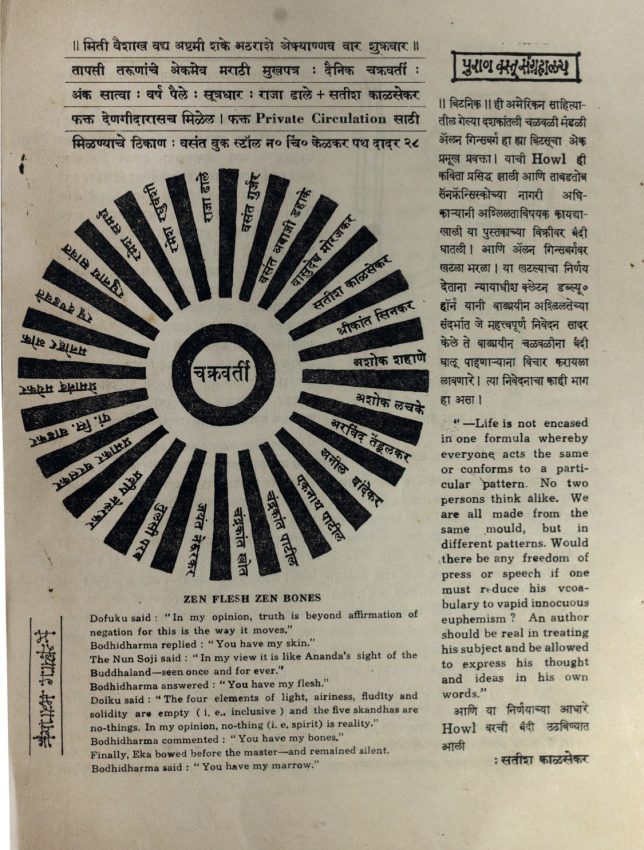
Figure 2. Cover of the original Marathi issue of Chakravarty, no. 8. Early 1970s. Published by Raja Dhale. Courtesy of the Dalit Panthers Archive
SNS: Through this process, I ended up getting extremely close to Raja Dhale’s work.4Raja Dhale (1940–2019) was an Indian writer, artist, activist, and founding member of the Dalit Panthers. Known for his radical writing and leadership within Dalit and Bahujan movements, Dhale also authored works reflecting on Dalit Panther history and politics. He died in Mumbai in at the age of 78. Not in the sense of speaking to him, unfortunately, because he passed away around the same time I was working on the translations. We had spoken earlier, during the documentary interviews, but not during the translation phase of the research—as I really wish we had.
Because once I started reading everything he had written—slowly, carefully—I understood him very differently. What became clear to me was how urgent his relationship to language was. He was thinking constantly about how we speak, how we write, how we publish, because he was deeply concerned with being misunderstood. He wanted language to be sharp, so that what was being said could not be easily distorted. I relate to that very strongly.
One publication that stayed with me was Chakravarty, a literary daily he published for fourteen days straight (fig. 2). That in itself is kind of insane! It was not about current affairs; it was only literature, only radical writing. And he did everything himself. What struck me about the text was that it was not dry or heavy. It was funny. It had a real sense of humor. There were fake obituaries, satire, moments of play. That combination of rigor and humor felt very important.
Working with Chakravarty also raised questions for me about form. I spoke to one of the artists whose work appeared in the publication, and he told me that the images often had nothing to do with the text. Dhale would simply say he liked the work and include it. The image did not illustrate the writing, and that separation was interesting to me. The publication itself became the work. And spending time with that material made me think much more seriously about skill, rigor, and intention in political practice. It challenged the idea that it is enough to just have something to say. The Panthers, and Dhale especially, were extremely precise about how they said it.
MV: What I find especially compelling in your work is how you move between very specific materials, like Dhale’s Chakravarty, and much wider cultural inheritances in India. How do you understand the Panthers’ place within older lineages, particularly Buddhist histories in Maharashtra?
SNS: When I think about my own lineages, the Panthers are a very direct influence, but they are only one part of a much larger anti-caste movement. And that movement comes from Buddhist cultures as well. Growing up in Bombay, a huge part of my childhood was having access to the Kanheri Caves (fig. 4). My mother used to take us every year during the monsoon. We would trek up and spend time in these over-2,000-year-old caves with extraordinary carvings and sculptures. These were not just monuments, but also Buddhist learning centers, places where people lived, studied, and created. Being in those spaces makes you think about what Mumbai once was—green, swampy islands where philosophers, artists, and writers lived. That is a very real cultural lineage for me.
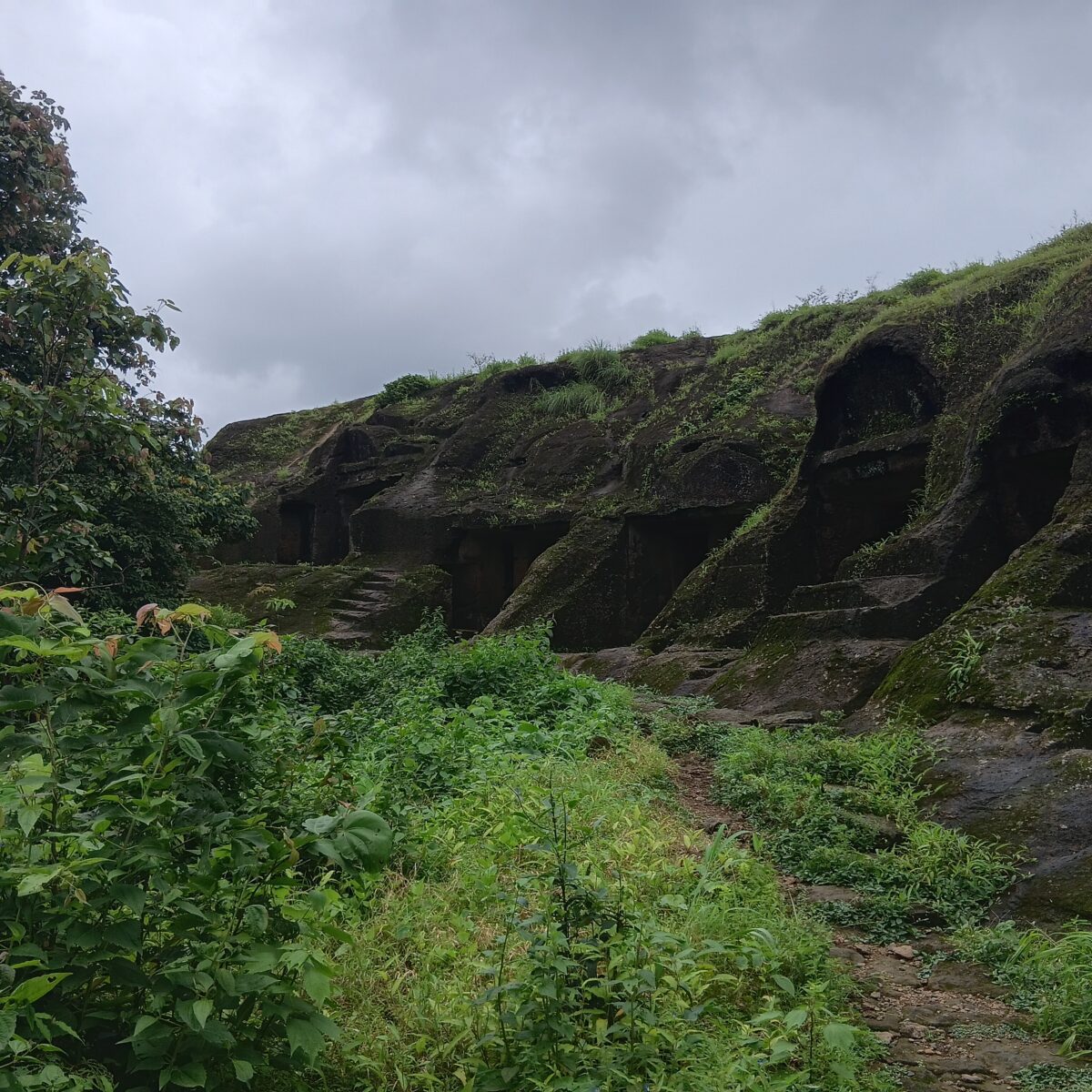
At the same time, you become very aware of how quickly these histories get absorbed into Brahminical narratives. These sites are constantly being reinterpreted as something else, often as places where the Pandavas rested, when they were clearly Buddhist spaces of learning.5The Pandavas are the five heroic brothers in the Sanskrit epic Mahabharata, part of the Brahmanical (Vedic) tradition associated with Sanskrit scriptures and Hindu religious authority. In later devotional traditions, many ancient monuments are attributed to the Pandavas’ travels; such retrospective associations recast earlier Buddhist monastic caves (c. 2nd century BCE–6th century CE) within a Brahmanical sacred history rather than reflecting their historical origins.
More recently, I was at the Elephanta Caves, and I was struck by how aggressively Buddhist history is being suppressed.6The Elephanta Caves are a rock-cut cave complex on an island in Mumbai Harbour in Maharashtra, India, dating primarily to the early medieval period (c. 5th–7th centuries CE) and comprising multiple excavated caves with architectural and sculptural programs. The site has a layered history, but what is happening now is not about complexity. On the plaques, they avoid even using the word Buddhist. Things are described as stylistically Buddhist, not as what they actually are. There is a very clear erasure of Buddhist and Jain traditions happening. Parts of the caves that are visibly Buddhist are left to crumble and remain closed, while other narratives are foregrounded.
MV: What does witnessing that erasure demand of you as an artist working with history?
SNS: I think about this a lot in relation to my position as an “accidental archivist.” I am not a historian or an archaeologist, but rather an artist working with history, I know that symbols matter. It becomes important to use them deliberately and clearly. This is not only about Buddhism as a religion of liberation for my community. It is also about recognizing traditions in South Asia that existed in opposition to Vedic culture. For me, engaging these older inheritances is part of the same work as engaging the Panthers. It is about insisting on histories that are foundational but repeatedly pushed aside.
MV: When you work within these older inheritances and the Panthers’ print culture, you are encountering symbols that already carry enormous political weight. I’m thinking of the panther in particular, a symbol shaped by a long history of Black civil rights struggles in the United States. How does this image surface in your work?
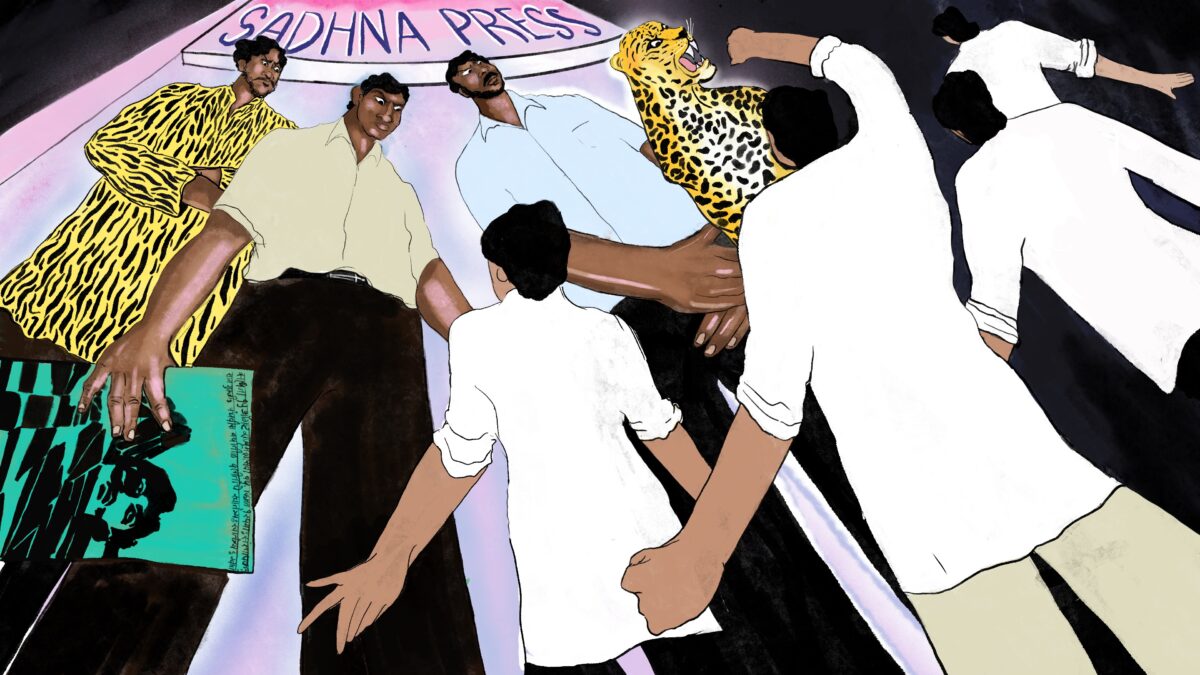
Being a Panther was something that people took on very passionately and very immediately. We adopted it because the panther is such a powerful-looking animal. It’s strong; it’s striking. Even now, I have a panther tattoo. That image resonated very deeply with people. I think it also stood in opposition to other symbols at the time, like the Shiv Sena tiger.7The Shiv Sena is a right-wing Marathi nationalist political party that was founded in Bombay in 1966 by Bal Thackeray. The tiger serves as the party’s emblem, symbolizing aggressive regional pride, masculinity, and territorial control, and it has been widely used in Shiv Sena’s visual propaganda, rallies, and street politics in Maharashtra.
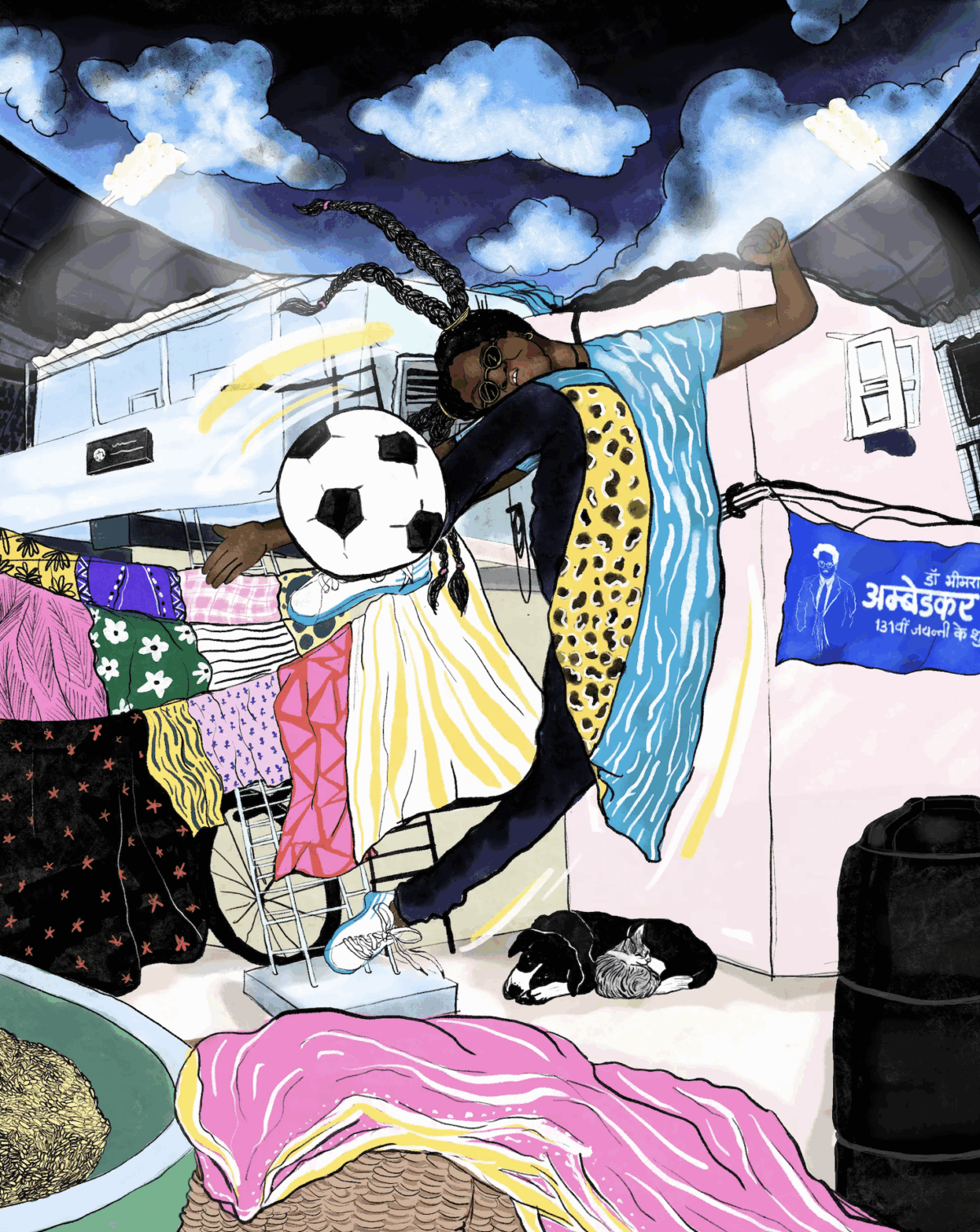
I was thinking through this symbol while working on an illustration based on the 2022 film Jhund (fig. 5).8Jhund (2022), directed by Nagraj Manjule, is a Hindi-language sports drama inspired by the work of social activist Vijay Barse that follows a retired sports teacher as he brings together children from marginalized neighborhoods in Nagpur to form a football team. Centered on the lives of the young players themselves, the film engages questions of caste, class, and state neglect through everyday acts of collective action. I represented one of the characters with a whole world operating around her, and from those details you can tell so much about her life. At the same time, she’s still the focus: She carries a sense of ambition and aspiration, and she’s also holding something of the “learned culture” that comes from expressing yourself through fashion or hair. We never see her like this in the film, but this is the version of her that has existed in my mind.
She is wearing a leopard print in the illustration, which is very intentional. It could easily look like a Western fashion reference, but for me it comes from somewhere very local. It’s inspired by Namdeo Dhasal, a leader and poet in the Dalit Panthers. He was known for his flamboyance, for wearing wild, printed kurtas. I’m not saying the girl is a “panther” or that the Panthers are the main point of the image. It’s more that their presence exists as a backdrop that she can stand confidently against. So even when a pattern or an emblem looks global, the reference is very local, very specific. It’s Dhasal. It’s the Panthers. And this is true across my portraits right now.
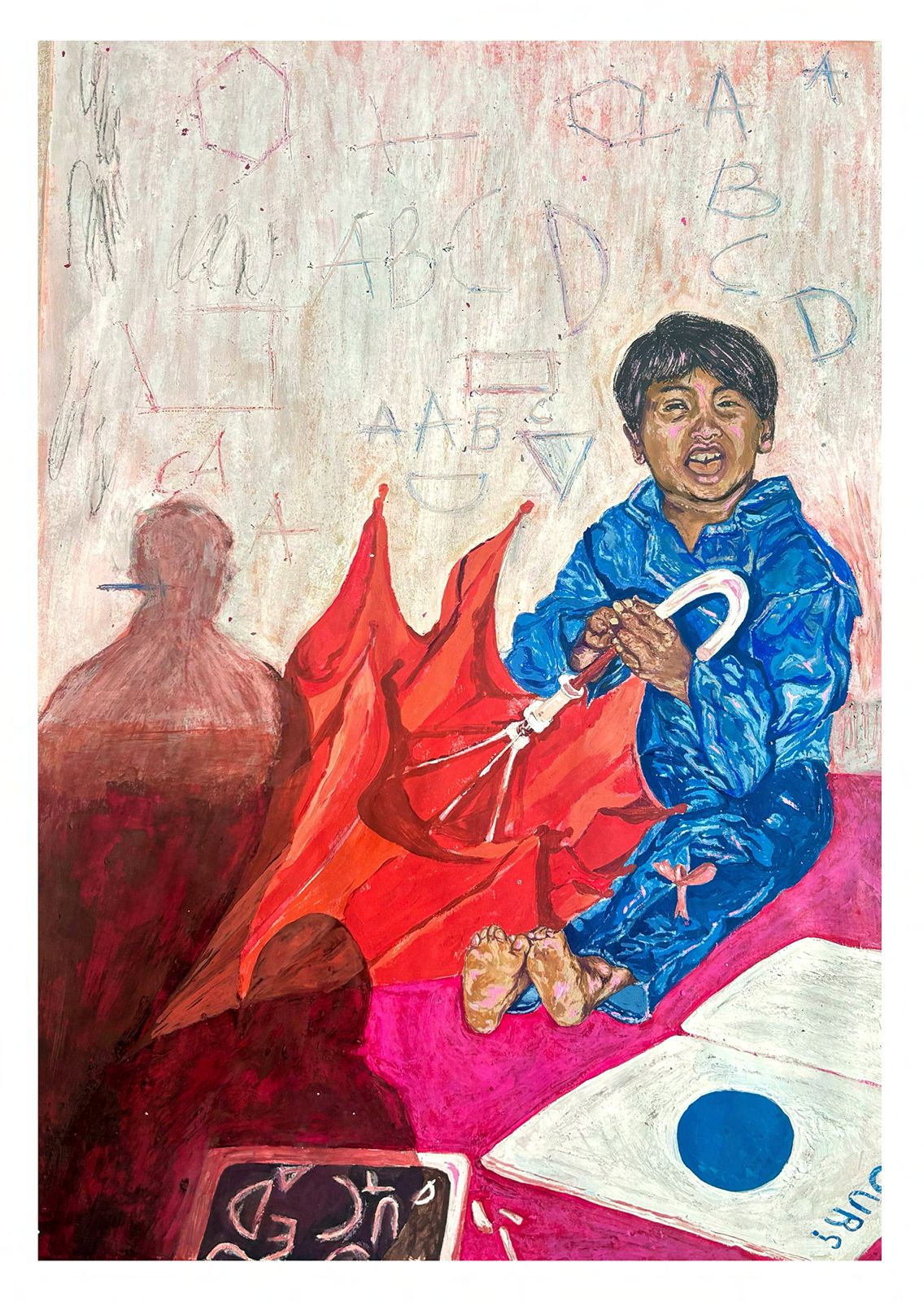
In one of my portraits in [the series] Educate, for example, I made a self-portrait about my early education at home (fig. 6). In almost every childhood photo of me, there’s a book—or I’m scribbling on the wall. Those scribbles aren’t imagined. My parents let me practice writing the alphabet directly on the walls. They encouraged that kind of learning. That portrait is about education in the home and how formative it was. From it, I made a ceramic chalk box with a panther on top as a companion object (fig. 7). When I started looking up references, I realized there’s a very popular Indian brand called Panther Chalks. It’s completely ordinary, mass-produced. So, I thought, I’m going to use it. I’m going to take this panther and make it mine.
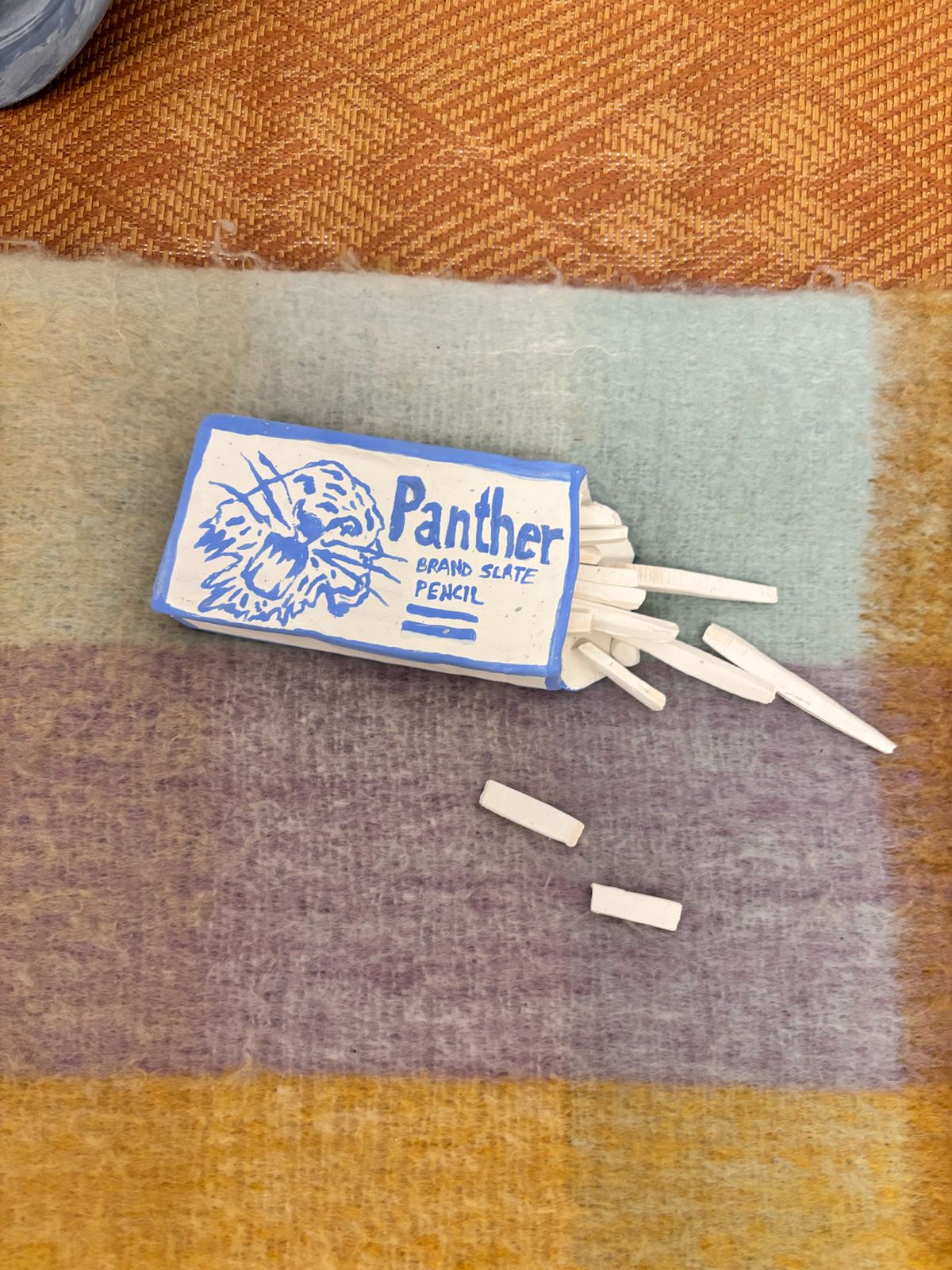
MV: In works like Panther Chalks, you’re clearly engaging the panther as a symbol, but not by reproducing the Black Panther image directly. Instead, you draw from the Indian leopard. Where does that image enter your thinking?
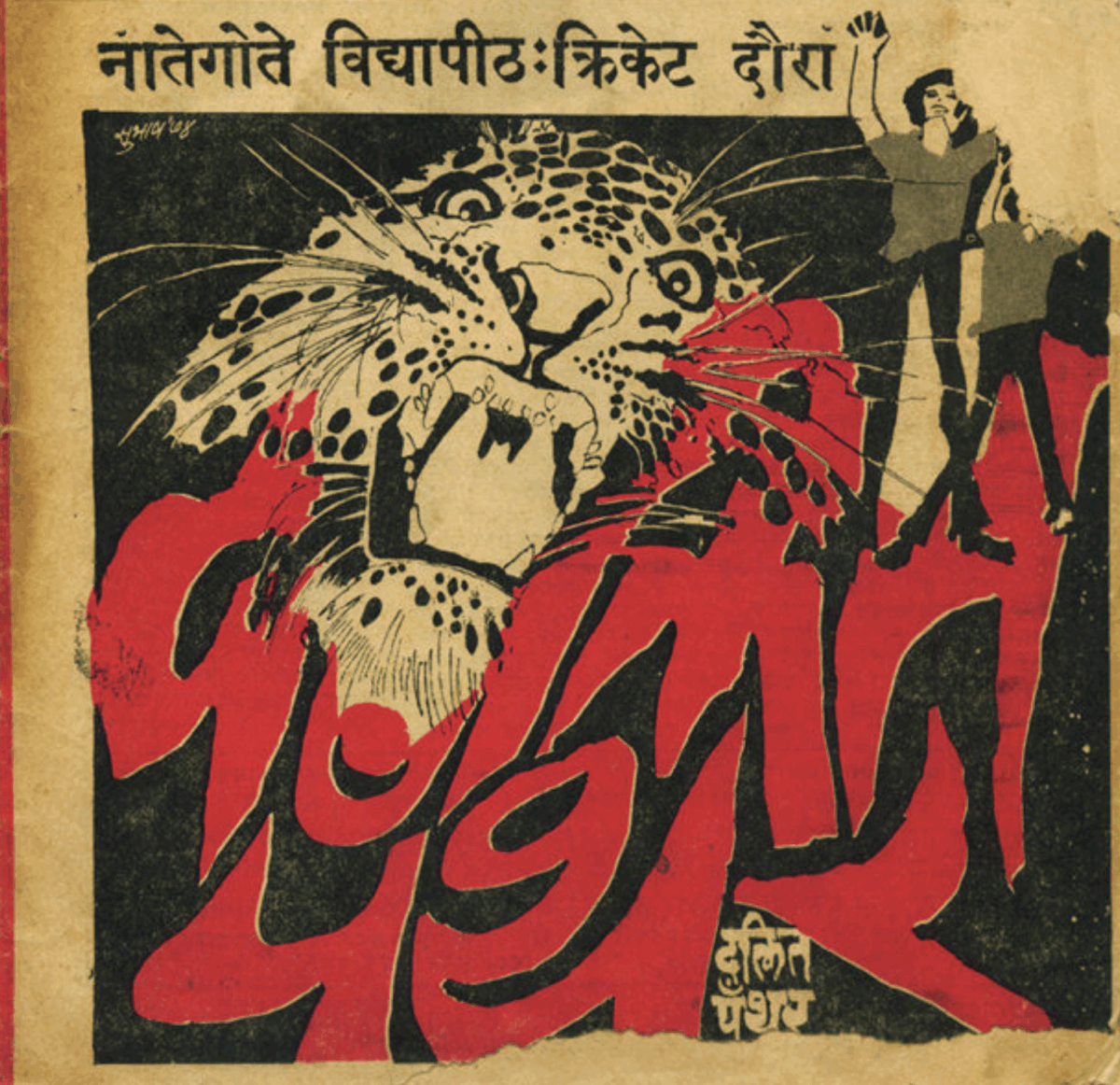
SNS: Yes. The specific panther I’m referencing was made by Subash Awachat, for a cover of Manohar Magazine (fig. 8). It wasn’t published by the Panthers themselves. It comes from a lineage of progressive print culture in Pune. The artist was representing the Indian panther, the leopard. I really loved that, because that’s also how I like to approach the Panthers. I don’t use the Black Panther panther in my work. I don’t think I ever have. That is not the panther I’m speaking through. It has its own legacy and its own history, and there was a reason the Dalit Panthers used that symbol in the 1970s. But now, from this moment and place, I use the Indian leopard. And even within the movement at the time, people were trying to visualize an Indian connection.
MV: It’s interesting because you’re creating new connections and lineages for this symbol. Now that you’re also working in the United States around the other lineage of the Black Panthers and the Black Power movement, has the panther taken on new meaning for you?
SNS: I’ll be honest: I don’t force myself to go looking for it. If something comes up naturally, I follow it. I had an opportunity in Chicago—a print workshop paired with a talk on the Dalit Panther Archive—at an event called “From Panther to Panther.”9“From Panther to Panther: Legacies of Resistance” was held at SpaceShift Collective in Chicago on March 7, 2025. See https://www.spaceshiftcollective.com/events/panther-to-panther. People who had engaged with both movements were there, and I met some former Black Panthers. That experience felt like being at home. But I don’t want to seek things out in a way that feels imposed on me. I also don’t want to exoticize Black history or Black political struggle by chasing after parallels. I do seek connections, but only when they’re organic. And there hasn’t been enough time for me here to explore that [connection] deeply. I also don’t want to replicate the dynamic of some white visitors in India who arrive and say, “Tell us everything.” I don’t want to replicate that here by demanding access to Black histories. If I was a tourist, I might spend all day in museums and archives. But when you live somewhere, you need to find your place in the culture instead of declaring, “I’m here now; love me.”
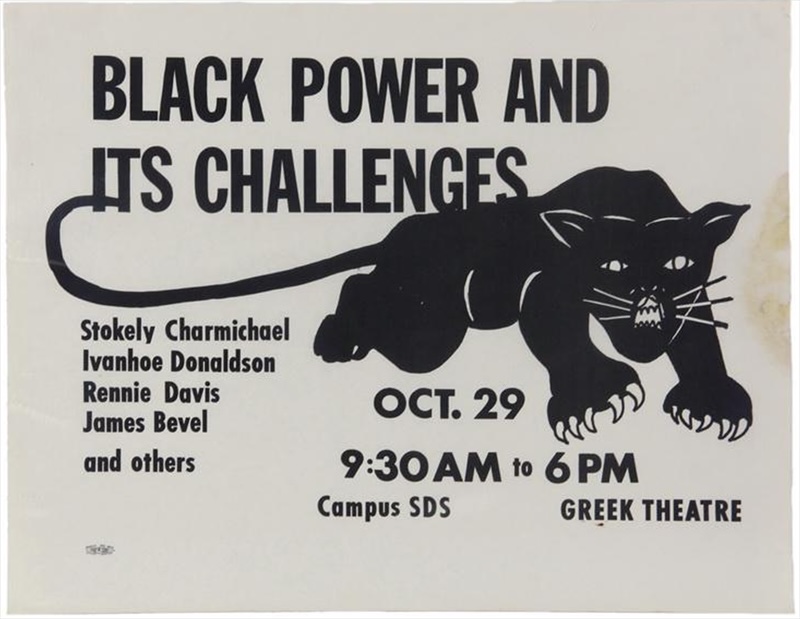
It would be a disservice to both communities and both political movements to place them side by side as if they’re the same. The contexts are entirely different, including [with regard to] the role of women in each movement. And while I feel deep solidarity with African American, Caribbean, and Indigenous communities here, I don’t want to impose that solidarity. It’s like any relationship: It has to be reciprocal. You can’t force it. It has to have time and space to emerge. That’s why I haven’t rushed to draw strict parallels. But when genuine connection happens—when I tell someone here about the Dalit Panthers, and they feel an immediate kinship—it’s beautiful. It feels like meeting someone from home, even though they belong to a different history.
MV: That’s why I find the leopard illustration so compelling. It’s not about superimposing one history onto another; it’s about finding forms of solidarity that grow from where you’re rooted.
SNS: The main reason that the leopard resonates so much with me is its relationship to Bombay. Its life inside that city, with its shrinking habitat and environmental pressures—that context matters. When the Black Panthers chose the black panther, there was intention: The animal’s sleekness, its quiet strategy, its defensive intelligence. If you look at the Indian leopard through the lens of Bombay, its survival carries a different meaning: Its connection to the land, to Indigenous communities, to environmental neglect, to the fact that leopards are often sighted near the Kanheri Caves—all of that is present. So when I use the leopard, I’m thinking very specifically about the leopard of Bombay, the context of the Dalit Panthers, and what it means that we come from the same place as this animal. That authenticity, that rootedness, is at the core of how a culture becomes deep enough that it can’t be erased. The Dalit Panthers as an organization didn’t last long, but the culture [that its members] generated runs deep. The same is true of the Black Panthers. The culture they built endures through the imagination of Black women, community programs, healthcare initiatives, the Free Breakfast for Children Program, etc. These are the things that sustain a movement, and they’re also what sustains culture.
It’s the same with art. The same energies that sustain political movements sustain visual culture. So the work has to keep reactivating itself. As an artist, I have to stay tuned to that. I don’t want the work or the culture we’re building together to be something that can easily disappear. There are always people ready to erase it the second they get a chance. I don’t want that chance to exist, and I want my art to offer a mutual sustaining, a feeding of each other.
- 1Adivasi is a term used to describe Indigenous peoples of the Indian subcontinent, many of whom have distinct languages, cultural practices, and relationships to land that predate the formation of the modern Indian state. The term Indigenous is used here in a broader, comparative sense to situate Adivasi and other marginalized communities within global histories of Indigenous cultural production, dispossession, and resistance under colonial and settler regimes. Together, these terms emphasize lineage-based knowledge systems and artistic traditions that exist outside dominant caste and colonial frameworks.
- 2The Dalit Panthers were a radical political and cultural organization founded in Bombay in 1972 by writers and activists including Raja Dhale, Namdeo Dhasal, and J. V. Pawar. Inspired in part by the Black Panther Party in the United States, the group mobilized against caste oppression, state violence, and social exclusion faced by Dalits in India. In addition to political organizing, the Dalit Panthers played a crucial role in shaping Dalit literature, poetry, and visual print culture, particularly through little magazines, pamphlets, and protest graphics during the 1970s.
- 3“Little magazines” were small-circulation, independently produced literary periodicals that emerged globally in the twentieth century as platforms for experimental writing and political dissent. In India—including in Maharashtra in the 1960s and 1970s—they played a crucial role in circulating radical literary and anti-caste thought outside commercial publishing networks.
- 4Raja Dhale (1940–2019) was an Indian writer, artist, activist, and founding member of the Dalit Panthers. Known for his radical writing and leadership within Dalit and Bahujan movements, Dhale also authored works reflecting on Dalit Panther history and politics. He died in Mumbai in at the age of 78.
- 5The Pandavas are the five heroic brothers in the Sanskrit epic Mahabharata, part of the Brahmanical (Vedic) tradition associated with Sanskrit scriptures and Hindu religious authority. In later devotional traditions, many ancient monuments are attributed to the Pandavas’ travels; such retrospective associations recast earlier Buddhist monastic caves (c. 2nd century BCE–6th century CE) within a Brahmanical sacred history rather than reflecting their historical origins.
- 6The Elephanta Caves are a rock-cut cave complex on an island in Mumbai Harbour in Maharashtra, India, dating primarily to the early medieval period (c. 5th–7th centuries CE) and comprising multiple excavated caves with architectural and sculptural programs.
- 7The Shiv Sena is a right-wing Marathi nationalist political party that was founded in Bombay in 1966 by Bal Thackeray. The tiger serves as the party’s emblem, symbolizing aggressive regional pride, masculinity, and territorial control, and it has been widely used in Shiv Sena’s visual propaganda, rallies, and street politics in Maharashtra.
- 8Jhund (2022), directed by Nagraj Manjule, is a Hindi-language sports drama inspired by the work of social activist Vijay Barse that follows a retired sports teacher as he brings together children from marginalized neighborhoods in Nagpur to form a football team. Centered on the lives of the young players themselves, the film engages questions of caste, class, and state neglect through everyday acts of collective action.
- 9“From Panther to Panther: Legacies of Resistance” was held at SpaceShift Collective in Chicago on March 7, 2025. See https://www.spaceshiftcollective.com/events/panther-to-panther.