As if intoxicated with beauty, the letter seeks to surpass its utilitarian role and its function as a conventional sign of the alphabet; it aspires to become a plastic expression . . . and succeeds magnificently. . . Elsewhere, words become obstinate labyrinths in which solids and voids hold each other in balance, where shadow and light provoke vertigo and dazzlement. How can one separate the mystical from the playful here? Pushing further, in a kind of extreme density, words occupy the entire surface and—paradoxically—negate space. The inscriptions, dark and light, interlock so perfectly with each other that they suppress conventional space and exist only through reciprocity. A phantasmagoria in which the void, once filled, ceases to exist. Only by reading—an intellectual act rather than a visual one—can one reconstitute this void.
—Mohamed Khadda1“Comme ivre de beauté, la lettre tend à dépasser son rôle utilitaire, sa fonction de signe conventionnel de l’alphabet, elle se veut expression plastique . . . et y parvient merveilleusement. . . . Ailleurs les mots deviennent labyrinthes entêtants où les pleins et les vides s’équilibrent, où les ombres et les lumières provoquent le vertige et l’éblouissement. Comment séparer ici le mystique du ludique? Allant plus loin dans une sorte de déti extrême, les mots occupent la totalité d’une surface et nient—paradoxalement—l’espace. En effet les inscriptions, sombre et claire, s’imbriquent si parfaitement l’une dans l’autre qu’elles suppriment l’espace habituel et ne se révèlent que par réciprocité. Fantasmagorie où le vide, parce qu’empli, n’existe plus. Seule la lecture, donc l’opération intellectuelle et non visuelle, peut reconstituer ce vide.” Mohamed Khadda, “Grandeurs et limites de la calligraphie arabe,” in Éléments pour un art nouveau suivi de feuillets épars liés et inédits (Barzakh, 2015), 80–81. All translations mine unless otherwise noted.
Following Algeria’s independence in 1962, a group of artists aspired to create a new visual idiom, one that could carry collective memory while moving beyond state-sponsored art movements—particularly Socialist Realism—and breaking away from colonial representations.2In postindependence Algeria, Socialist Realism did not operate as a strictly codified doctrine in the Soviet sense, but rather as an ideologically aligned mode of figurative representation promoted through state cultural institutions in the 1960s and 1970s. This tendency was notably embodied by Boukhatem Farès (b. 1941), who served as secretary-general of the Union nationale des arts plastiques (UNAP) from 1973 to 1982, and Bachir Yellès (1921–2022), who was the first director of the École nationale d’architecture et des beaux-arts d’Alger between 1962 and 1982. While both artists engaged with themes of labor, rural life, and national reconstruction, their practices remain heterogeneous and cannot be reduced to a unified or orthodox form of Socialist Realism. This impulse developed as a momentum shaped by the urgency to redefine modes of artistic production within a postcolonial framework. Among the designations used to describe it, the “School of the Sign” remains the most ambivalent, at once reductive and generative. The term itself is often misunderstood in two ways: First, it implies the existence of a unified movement based on a shared aesthetic. Second, it risks confining a broad concept to a form of formal nationalism, suggesting that the turn to the Sign is a retreat into identity or the revival of a dormant tradition.
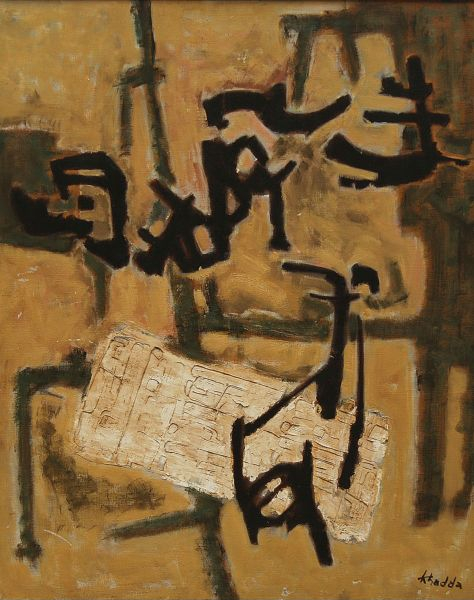
The “School of the Sign” refers to a conceptual and material proposition concerned with how the Sign can be mobilized as a critical space through art and literature. Far from constituting a school in the institutional sense, it is more aptly understood as a constellation of artists who explored the “Sign”—a term they preferred to “letter” or “symbol”—as a dense visual structure capable of articulating a grammar of liberation.3The term “Sign” is capitalized here to signal its use as a conceptual category within the aesthetic discourse of the so-called École du Signe (School of the Sign). This usage does not imply the existence of a single, fixed repertoire of signs, but rather denotes a shared approach to the sign as a critical and generative visual structure. Guided by the thought of writer Jean Sénac, Algerian artists such as Mohamed Khadda (1930–1991; fig. 1), Choukri Mesli (1931–2017), Denis Martinez (b. 1941; fig. 2) and, later, Ali Silem (b. 1947) contributed to a conceptualization of the Sign as a palimpsest that is simultaneously abstract and situated, mystical and insurgent.4See Camille Penet-Merahi, “L’écriture dans la pratique artistique algérienne contemporaine (1962–2012)” (PhD thesis, Université Clermont-Auvergne, 2019. This concept must also be considered in relation to the visual frameworks that have long shaped the reception of North African art, ranging from Orientalist projections to patrimonial models. Rather than reiterating colonial categories, these artists treated the Sign as a site of critical engagement against academic norms.
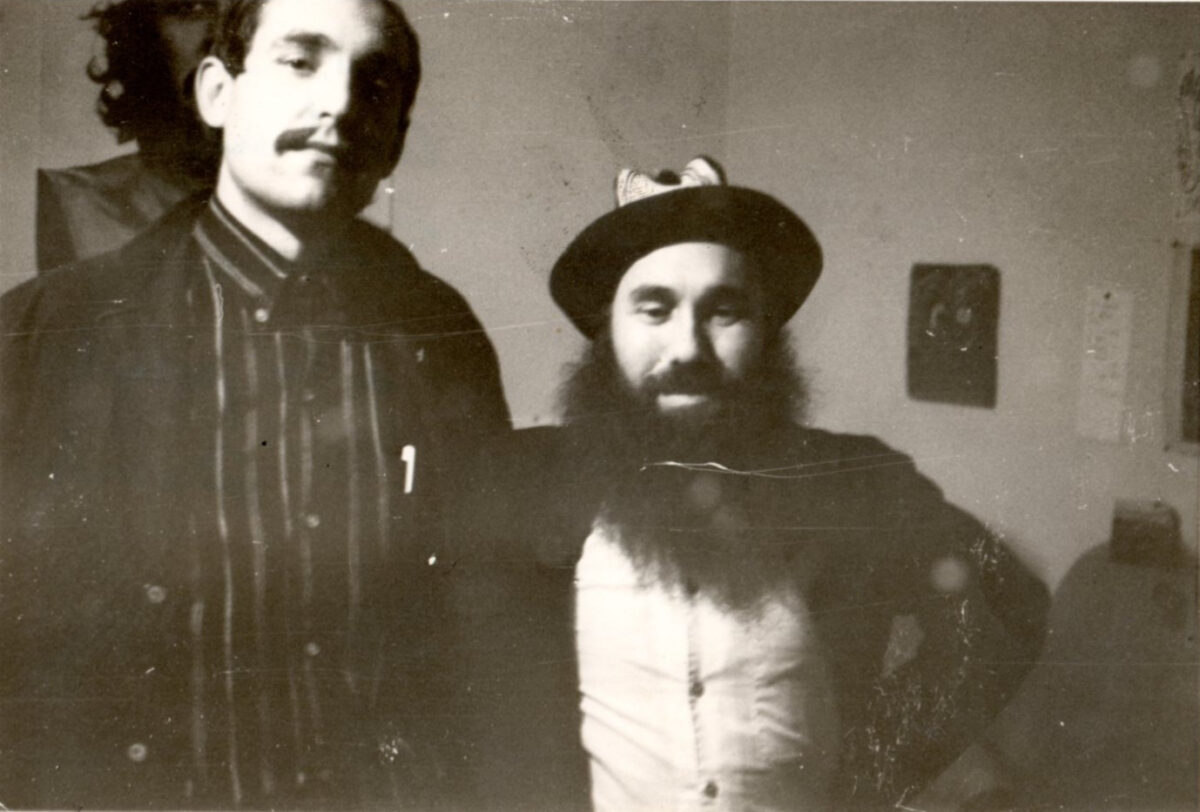
A central figure in Algeria’s postindependence cultural scene, Jean Sénac was primarily known as a poet and art critic, but he also played a crucial role as a mediator among artistic, intellectual, and political circles. In 1964, he founded Galerie 54, the first independent exhibition space in Algiers, which he conceived as a platform for experimental practices. Here, Sénac presented the work of artists such as Khadda and Martinez and coined the term “École du Noûn” (Noûn School). At the height of the postcolonial cultural revival, he made a first attempt at theorizing his observations, writing: “The Sign, rising from centuries past, from remote douars, from the songs of the meddahs [storytellers], bears witness to the permanence in the Maghreb of what could be called the École du Noûn.”5Jean Sénac, Visages d’Algérie: Regards sur l’art, ed. Hamid Nacer-Khodja (Edif 2000, 2002), 180. The “École du Noûn,” according to him, arises from the sensuality of the letter noûn, drawing on its dual resonance as a sacred character in the Qur’an and a visual form associated with desire. Sénac’s interpretation posits the noûn as all at once a female breast,6Naget Khadda, interview by author, May 16, 2025. an open beginning, a Sufi promise, and a corpoème (body-poem)—the latter a figuration in which poetry and corporeality are inseparable. This fusion of corporeal pleasure and textual creation lies at the heart of his poetry.7See Ali Chibani, “Les corps de Jean Sénac,” in “Les relais du corps dans les littératures francophones,” special issue, Relais 11, no. 11 (2025): 60–74.
Rather than defining a unified movement, Sénac sought to name a shared sensibility he perceived across the practices of several artists. From the late 1960s onward, he increasingly referred to this sensibility as the School of the Sign. The Sign, in his view, constitutes a living matrix rooted in Algerian heritage while remaining open to contemporary invention. While some artists—most notably Mohamed Khadda—engaged closely with Sénac’s writings and shared his conviction that the Sign could catalyze an artistic renewal,8Mohamed Khadda collaborated directly with Jean Sénac in 1964 by illustrating Sénac’s poetry collection La Rose et l’Ortie (Rhumbs, 1964). For further discussion of this, see “Mohammed Khadda and Jean Sénac: Art for an Independent Algeria,” in “Letters | الحروف: How Artists Reimagined Language in the Age of Decolonization,” online version of the exhibition first presented in the Bernice Layne Brown Gallery at Doe Library, University of California, Berkeley, March 13–August 31, 2023, https://exhibits.lib.berkeley.edu/spotlight/reimagined-language/feature/mohammed-khadda-and-jean-senac-art-for-an-independent-algeria. others maintained a more distant or independent relationship to his theoretical framework. Indeed, the School of the Sign did not emerge as a self-declared collective or common agenda but rather as Sénac’s own critical reading of converging artistic trajectories connected through dialogue and proximity. Artists of the Sign drew inspiration from Amazigh and Arabic scripts, prehistoric petroglyphs, and vernacular forms, aspiring to create a simultaneity of heritage and revolution. They did this by, for example, fragmenting cursive letters into angular modules, overlaying layers of script until legibility dissolved, or embedding geometric motifs from woven textiles into abstract chromatic fields.
The School of the Sign resonated with other artistic strategies in the region, such as Hurufiyya, an aesthetic movement that emerged among artists reinvesting ancestral signs as a means of resisting folklorization and gesturing toward plural modernities.9See Charbel Dagher, Arabic Hurufiyya: Art and Identity, trans. Samir Mahmoud (Skira, 2016). Emerging across the Arab world from the late 1940s onward, Hurufiyya designated a broad tendency that reintroduced the Arabic letter into modern artistic practice, often emphasizing its calligraphic and spiritual dimensions. While artists associated with the School of the Sign shared this refusal of folkloric repetition, they approached the letter less as a calligraphic form and more as a destabilized visual structure displaced from its conventional function. The turn to rock paintings, desert lines, and marginal alphabets did not aim to produce a nostalgic aesthetic; rather, it sought to reactivate the semiotic depth of these forms by working their internal tensions between figuration and abstraction, legibility and opacity. In Algeria, this engagement developed largely outside formal Hurufiyya circles and was instead shaped by local postindependence debates and artistic networks. Later figures, such as Rachid Koraïchi (b. 1947), would more explicitly align with Hurufiyya principles, albeit within a different historical moment and a transnational framework.
The School of the Sign was not devoid of internal frictions—notably, artists debated the very definition of popular art. The tensions ranged, on the one hand, from opposition to approaches that understand popular art as a shared visual heritage to be stabilized and made socially legible to, on the other hand, positions that emphasized abstraction and formal experimentation as a necessary break from inherited and imposed models. Multiple approaches to the Sign coexisted without canceling one another. These divergences became particularly visible in the distinct ways individual artists positioned themselves in relation to abstraction, spirituality, and the use of the letter. Artists such as Abdallah Benanteur (1931–2017) gravitated toward lyrical abstraction infused with an Islamic sensibility.10Jean Sénac, Peintres algériens: Benanteur, Khadda, Martinez, Zerarti (L’Orycte, 1982).
Born in Western Algeria, Benanteur followed an artistic path shaped by close personal and intellectual affinities rather than formal group affiliations. His long-standing friendship with Mohamed Khadda, forged in the mid-1940s when the two painted together around Mostaganem before traveling together to Algiers and later to France, was formative in this respect. Benanteur also maintained close ties with Jean Sénac, whose work he illustrated on several occasions and with whom he shared a commitment to postindependence cultural renewal.11Abdallah Benanteur collaborated closely with Jean Sénac, notably through the illustrated poetry volume Poésie (Imprimerie Benbernou Madjid, aux dépens d’un amateur, 1962). This book brings together Sénac’s texts and thirteen engravings by Benanteur. Taken together, these relationships situate Benanteur within the same generational and cultural milieu as the artists associated with the School of the Sign, even though his practice gradually shifted toward a more autonomous lyrical abstraction.12Although Benanteur is often discussed in connection with the School of the Sign, his work also developed in direct dialogue with European lyrical abstraction after his move to Paris in 1953. He quickly shifted away from figuration and Orientalist models, embracing a form of painting based on chromatic vibration and the evanescent trace of the letter. Exhibiting within the networks of the Second School of Paris (specifically, the Salon de Mai and Salon des Réalités Nouvelles), he positioned his practice within broader postwar experiments in abstraction. His use of Islamic references, particularly the letter noûn, was less a traditional claim than a modern reworking of spiritual and visual heritage. His work draws on the iconoclastic heritage of Maghrebi Islam and articulates a dynamic sense of universality. Although he occasionally deployed letters in his work and engaged in debates surrounding the Sign, Benanteur remained wary of prescriptive frameworks, privileging an approach grounded in individual spirituality and a universal conception of modern art.13For more on this subject, see Djilali Kadid, Benanteur: Empreintes d’un cheminement (Myriam Solal, 1998).
For his part, Sénac emphasized the proximity and divergence of Benanteur and Khadda in terms of their relationship to the Sign and to Islamic visual heritage. Referring to Khadda’s audacity in “reintegrating the Signs into the Body”14Jean Sénac, “Étreinte. 9,” in Œuvres poétiques complètes (Actes Sud, 1999), 525; quoted in Hervé Sanson, “Jean Sénac, citoyen innommé de l’Ailleurs,” Insaniyat 32–33 (2006): 127–39, https://doi.org/10.4000/insaniyat.3432. and seeking to “reincarnate the arabesque of his ancestors,”15Sanson, “Jean Sénac,” 135. Sénac notes that Benanteur, for his part, “having started from the Sign, seems to want to preserve only its trace, its aura,” bringing the noûn back “to its point of preciseness,”16Sanson, “Jean Sénac,” 135. whereas Khadda carried it toward a lyrical transcendence. This distinction sheds light on Benanteur’s singular position: situated within the same generational milieu, yet gradually moving toward a more autonomous and meditative abstraction.
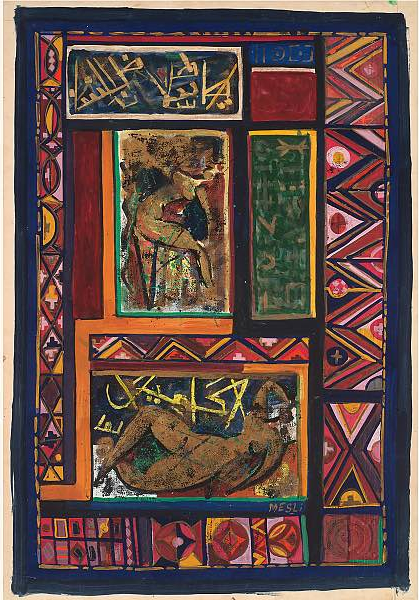
Others, like Choukri Mesli (1931–2017), worked the letter as a sensual form in its own right, one saturated with ambiguity, and explored the representation of the female body. His engagement does not follow the conventions of the academic nude; it is an allegorical image of the nation itself, tattooed, inscribed, and resilient, carrying cultural memory and strength in the face of war and historical trauma.17 See Françoise Liassine, “Mesli l’Africain,” in Mesli l’Africain, exh. cat. (Barzakh in association with the Musée National d’Art Moderne et contemporain d’Alger, 2009), 10. In the later Les Protectrices (1991), he continued to work the Sign in close relation to the female body, intertwining fragments of letters with corporeal forms (fig. 3). Here, writing does not appear as an autonomous calligraphic pattern but instead as an inscription borne by the figure itself—tattoo-like marks and the Arabic title al-ḥāmiyāt (the protectresses) fold the letter into the body, suggesting language as something carried and worn. The painting shows that even decades after the emergence of the School of the Sign, Mesli maintained an interest in the Sign as a lived and embodied language rather than a purely formal device.
Mohamed Khadda, by contrast, approached the Sign as a political project.18 See François Pouillon, “Abstraction et révolution dans l’Algérie postcoloniale: Mohamed Khadda,” in Exotisme et intelligibilité (Presses Universitaires de Bordeaux, 2017), 185–96. In his collection of essays Éléments pour un art nouveau (1972), he insists on the need to create a plastic writing that is neither subjected to Western abstraction nor limited to a rigid tradition.19 Khadda, “Perspectives,” in Éléments pour un art nouveau, 49–54. This position was shaped in part by his experience as a typographer in France, as well as by his artistic training at the Académie de la Grande Chaumière in Paris, where he was exposed to modernist debates while remaining attentive to the materiality of writing. In this same collection of writings, Khadda describes his creative process as one shaped by layers, rhythm, the interplay of positive and negative spaces, and the tensions between surface and depth.20 Khadda, “Perspectives,” in Éléments pour un art nouveau, 49–54. He emphasizes the plastic transformation of writing and its capacity to convey spiritual, poetic, and political dimensions, evoking letters as “male or female, solar or lunar,” and animated by a suggestive power akin to incantation.21See Mohamed Khadda, “Calligraphie et peinture,” in “Calligraphies. Hommage à Nja Mahdaoui,” special issue, Horizons Maghrébins—Le droit à la mémoire 35–36 (1998): 83–86.
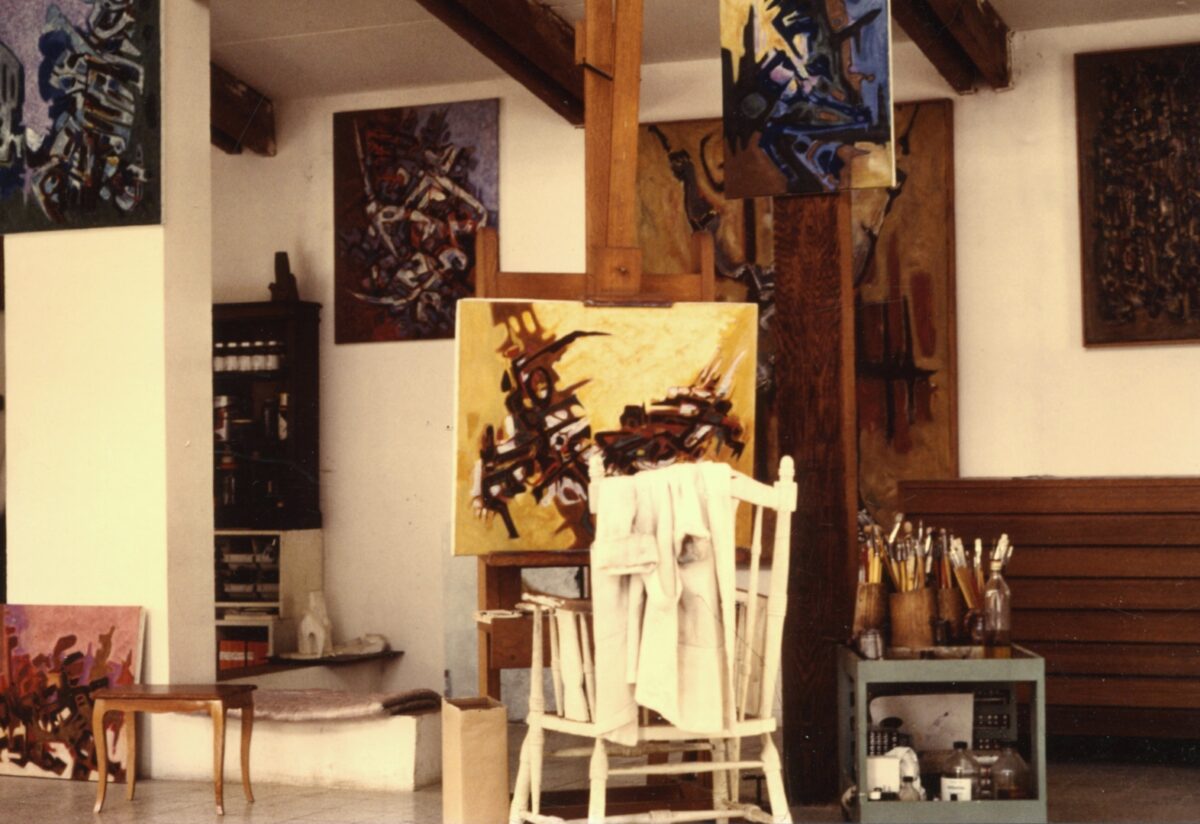
A photograph of Khadda’s atelier (fig. 4) provides a more concrete understanding of this process. This image shows a space filled with canvases at different stages, placed side by side and often overlapping. Signs reappear in one painting after another, shifting in scale and density. Tools and materials remain visible. The studio reflects a practice based on repetition, layering, and gradual transformation, which is consistent with Khadda’s background in typography and his sustained attention to the potentials of the Sign.
Some artists associated with the School of the Sign decided to further expand their reflection on the Sign by founding the Aouchem group (aouchem means “tattoo”) in 1967. Initiated by Denis Martinez, Choukri Mesli, and Mohamed Benbaghdad, among others, the group proclaimed in a groundbreaking manifesto that “the Sign is stronger than bombs.”22 Aouchem manifesto signed by Mesli, Adane, Saïdani, Martinez, Baya, Ben Baghdad, Zerarti, Dahmani, and Abdoun in Algiers on April 1, 1967. Archives Denis Martinez Aouchem approached the Sign as a trace of ancestral gestures and collective memory. They drew from the prehistoric cave paintings of Tassili n’Ajjer, popular talismans, and sacred scripts, introducing a decolonial interplay between art and ritual. The group asserted a lineage that was both African and Arabo-Berber and bound together less by formal doctrine than by friendship. Aouchem was, above all, a circle of close friends who met regularly, particularly in Blida, where long discussions and moments in everyday life contributed to their cohesion. These ties were not limited to exhibitions: Members also collaborated on texts, radio programs with poets, and the drafting of the manifesto. Alongside their collective initiatives, they informally circulated symbolic gestures, such as emblems or amulets bearing the group’s name, without ever imposing a uniform aesthetic.
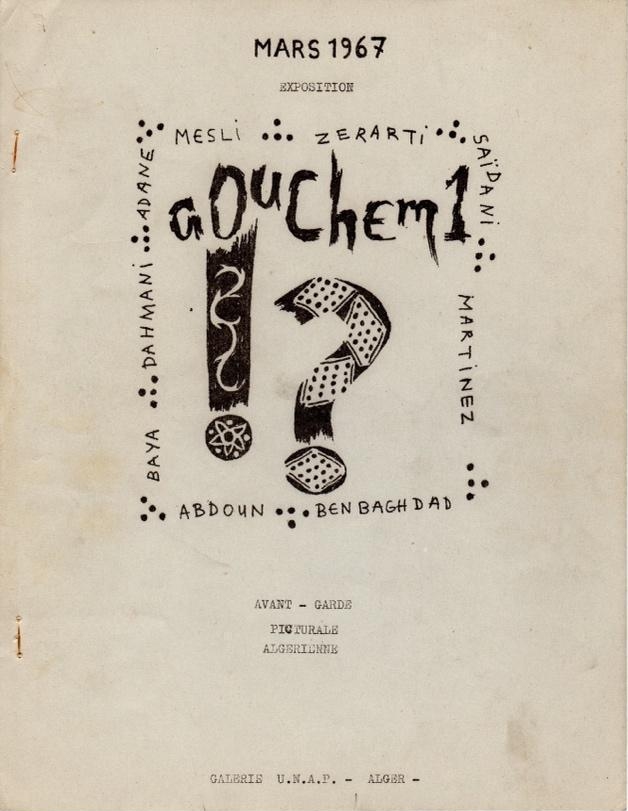
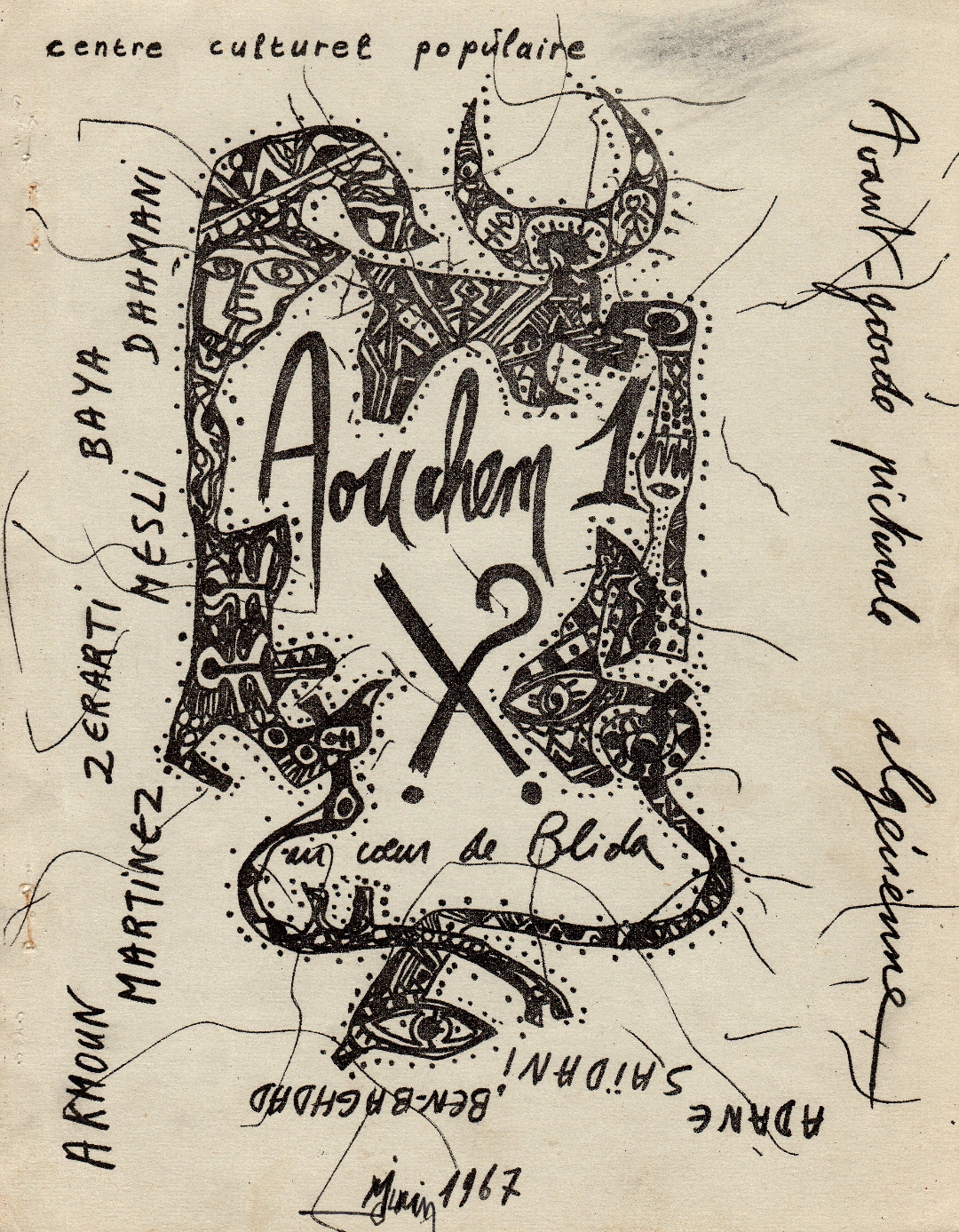
Jean Sénac, acting as a mentor, encouraged the inclusion of other Algerian artists, such as Baya (1931–1998) and Arezki Zerarti (1938–2024). He also played an important role as a mediator between artists and writers, maintaining close ties with members of the group and supporting the circulation of their work through exhibitions, publications, and broadcasts. In Algeria, where figuration could be perceived as either an academic colonial inheritance or propaganda, Aouchem chose abstracted figuration, opting for hybrid and interstitial creatures. Their refusal of both illustrative imagery and pure abstraction became a gesture of emancipation. The covers of the 1967 Aouchem exhibition catalogues (figs. 5, 6) reflect this stance. Both compositions bring together signs, fragmented figures, handwritten elements, and ornamental motifs, which are arranged without a clear hierarchy or focal point. Figurative references appear and dissolve without settling into a stable image or legible scene. Printed with a mimeograph, the catalogues preserve traces of their production: irregular lines, uneven lettering, visible overlaps. These material imperfections distinguish them from institutional graphic formats. The covers do not present a coherent visual statement; instead, they allow disparate marks, images, and gestures to coexist on the page.
Within Aouchem, the Sign became a means of activating a form of visual consciousness grounded in collective practice. While the group shared common concerns with the artists associated with the School of the Sign, it did not operate as its continuation. Rather, Aouchem developed in parallel, shifting the emphasis to material processes, ritual gestures, and collective experimentation. The materiality of the works themselves played a part in this effort. Some artists treated the canvas as a ritual surface, layered with ochers, earth, ash, natural pigments, and ink—materials that evoke an ancestral and vernacular register (such as henna or mineral earths), linking the pictorial gesture to imagined precolonial practices. For them, the Sign was no longer confined to drawing or inscription, but instead embodied in matter itself, making materials carriers of meaning. In addition to sourcing ancestral materials, Aouchem artists drew from their recent historical experience to develop a new vocabulary of the Sign. The barbed wire—a recurrent motif in the works of Denis Martinez, for example, emerged as a charged symbol: at once border, carceral memory, and visual marker of the constrained body.23See Nourredine Saadi, Denis Martinez, peintre algérien (Barzakh and Le Bec en l’air, 2003).
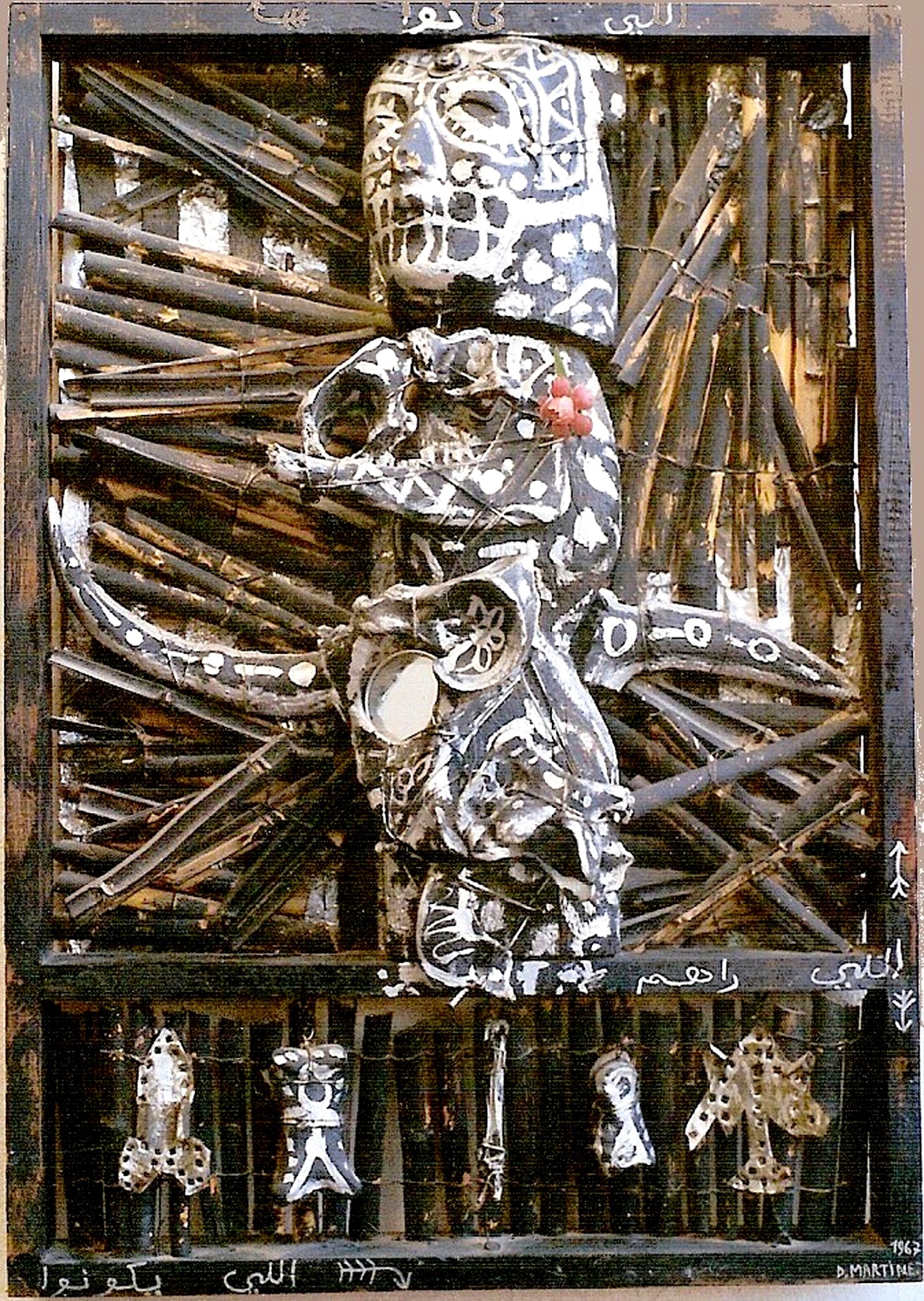
Denis Martinez’s Le petit miroir (1967; fig.7) illustrates how the precepts of the School of the Sign materialized within Aouchem as an expanded artistic practice. The piece is a mixed-media assemblage made of three branches, animal bones, and paper, among other materials, and stands somewhere between an image and a sculpture. Across the surface, there are silver, calligraphy-like motifs—dots, geometric patterns, short gestural arabesques, and words drawn from Algerian dialect—that are placed on fractured planes and roughly human-shaped forms. These Signs do not organize themselves into writing; indeed, they remain dispersed, uneven, and materially present. The combination of painted wood and raised forms gives the Sign a totemic presence, grounding it in artisanal practice. Here, it is no longer conceived as a system of visual forms to be read, but rather as a physical presence embedded in the object itself. Freed from its function as writing and reconfigured as an element of the assemblage, the Sign emerges through matter and volume, extending its logic beyond the pictorial field into a material and experiential register.
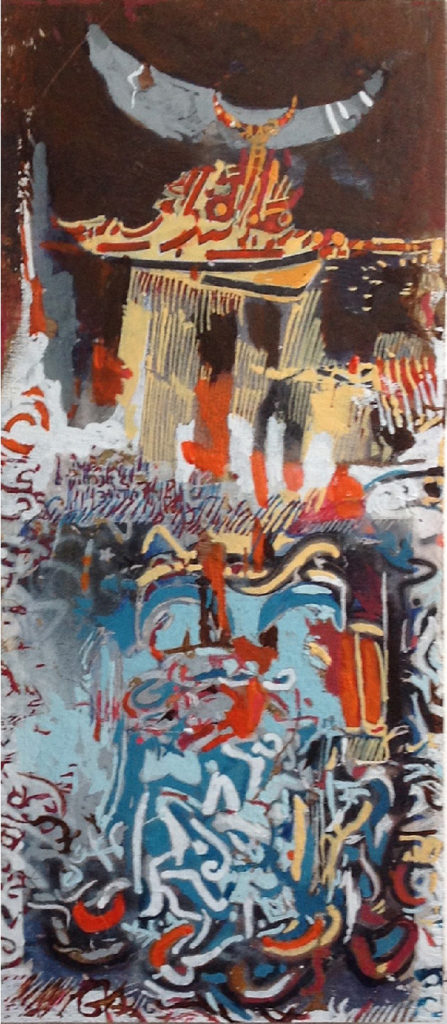
Ali Silem is another Algerian artist who built on the concept of the Sign. He defended the idea of a Sign in motion and of an open visual alphabet that rejects both identity-based assignment and state appropriation. He once remarked, “When you take a bird’s feather, for instance, you notice that it has the shape of the [Arabic letter] alif.”24 Lazhari Labter, “Entretien: Ali Silem, avec les yeux du présent” (1986), Founoune, February 25, 2021, https://www.founoune.com/entretien-ali-silem-avec-les-yeux-du-present-par-labter-lazhari-1986/. For him, the task was to move beyond the “School of the Sign” as a label or myth and to reimagine it as a fluid space of creation nourished by the friction between ancient forms and contemporaneity. While Silem’s work remains in dialogue with the concerns articulated by Mohamed Khadda and the artists associated with Aouchem, it unfolds along a distinct register. The Sign, in Silem’s view, does not reference a glorified past.25 Ali Silem explicitly rejects what he describes as “loin des reconstitutions artificielles et conformistes produites en Algérie en matière d’histoire de l’art” (artificial and conformist reconstructions of artistic heritage produced in Algeria in the field of art history) and “une récupération passéiste d’une portion sélective de l’imaginaire collectif” (nostalgic recuperation of a selective portion of the collective imaginary). Silem, “Jean-Michel Atlan, soleil du signe,” in Itinéraires intellectuels entre la France et les rives sud de la Méditerranée (Karthala, 2010), 176, 182. Moreover, although his practice—like that of Aouchem—reflects his interest in nonrepresentational Signs and a refusal of academic figuration, it is not positioned as a rupture and ritual confrontation. In one untitled work, for example, calligraphic fragments dissolve into color, rhythm, and painterly gestures, preventing the Sign from settling into meaning, keeping it in a state of visual flux (fig. 8).
Whereas Benanteur tended to preserve the Sign as an evanescent trace or aura, while Mesli embedded it within figuration, Silem approached the letter through restraint and compositional measure. As Khadda observed, Silem’s surfaces are structured by carefully “mastered trajectories,” a “cascade of noûn,” an “ascension of lâm,” and the discreet presence of alif as tutelary linear anchors, so that the Sign functions less as an embodied or atmospheric motif than as a controlled calligraphic architecture oriented toward balance and serenity.26 “J’associe le mot ‘mesure’ à l’œuvre de Ali Silem parce qu’il me semble qu’ici toute audace est maîtrisée, les tons pesés, les trajectoires évaluées. Une cascade de ‘noun’, une ascension de ‘lam’ ont le juste et ample espace de leur vol, la marge précise de leur assise. Ces signes créent la plage à leur respiration et l’air à l’envergure de leurs mouvements. Peinture de l’intelligence au moment où l’ignorance tente rageusement de nier l’esprit, art de l’émotion et des tensions contenues en ces temps d’indécence où les clowns et l’exhibitionnisme font encore illusion (parce que, n’est ce pas, les badauds aiment les artistes saignants), Silem propose, dans un calme défi, une œuvre de qualité et un artiste digne.” Mohamed Khadda, testimony in Silem: Gravures, exh. cat. (Fonds Pierre Gaudibert (MAM-ARCH-FPG), Musée d’art moderne de Paris, c. post-1986. For Silem, the Sign functions as a phenomenological event that is experienced before it is interpreted.27See Michel-Georges Bernard, Silem: La maison du signe, exh. cat. (Centre culturel français en Algérie, 1991). This emphasis on color, vibration, and poetic resonance is reinforced by the artist’s parallel activity as a poet, a pursuit he shares with artists such as Denis Martinez, for whom the Sign also circulates between visual and textual registers. In his lecture “Peintres et poètes d’Algérie,” Silem situated Algerian visual practice within a long continuum of “written stones” (hajarat el maktûba), where alphabets and drawings have been intertwined for millennia, and where contemporary artists continue to seek an embodied memory of inscription.28Ali Silem, “Peintres et poètes d’Algérie: Le papier en partagé,” unpublished manuscript of lecture delivered at Salle Frantz Fanon, Riadh El Feth, Algiers, April 23, 2006. Courtesy the artist In this lecture, Silem reflected on the long-standing entanglement of poetry and painting in Algeria, situating contemporary practices of the Sign within an older culture of orality, and tracing the role of artist-poet collaborations and bibliophile editions in the postindependence period.
What is singular in the way these artists engage the Sign is its semiotic operation. It is neither purely symbolic (in the Saussurean sense) nor reducible to index or icon. Beyond repeating motifs from pre-Islamic, Islamic, or Amazigh visual repertoires, these artists have transformed the Sign into a language charged with symbolic meaning that has been polished and displaced from its original function. It is often syncretic, combining plastic elements from disparate image regimes—magico-religious, vernacular, calligraphic, modern—within an unstable grammar. The point for these artists was not to convey a clear message but instead to unsettle the gaze, to demand a mode of reading that remains open, partial, and unresolved. These practices echo critical semiotic theories (such as those of Roland Barthes or Umberto Eco), which consider the Sign not as a transparent translation of content but rather as a surface of friction between the visible and the sayable.29 See, for example, Umberto Eco, A Theory of Semiotics (Indiana University Press, 1976); and Roland Barthes, Elements of Semiology, trans. Annette Lavers and Colin Smith (Hill and Wang, 1977).
If the Sign once served as a tool of decolonization, it has also, over time, been absorbed, recontextualized, and periodically emptied of its initial function. The legacy of the so-called School of the Sign has been transmitted in fragmented ways—celebrated as a landmark of Algerian modernity, yet often reconstructed retrospectively through teleological narratives.30 See Khalifa Chater, “La décolonisation du Maghreb et la dialectique modernité/identité (1955–1993),” Maghreb Review 19, nos. 1–2 (1994): 49–60. Over the decades, some artists have claimed this lineage. The very use of the term “school” has contributed to a partial museification of their artistic gestures, transforming what was a critical impulse into a closed chapter in the national art historical canon. This shift must also be understood within a broader context: the rise of postcolonial cultural policies, the globalization of art markets, and the rebranding of the Sign as a “cultural marker.” Displayed in this context, the Sign risks becoming precisely what it once resisted: an inert ornament rather than a living grammar of liberation.
In this sense, the School of the Sign is more than just a historical episode or an art movement. It is a critical horizon ready to be reactivated within other struggles and that stands as a philosophy of making and an ethic of form. In his essay “Sur L’olivier,” Khadda compares the Sign to an ancestral olive tree: a living structure, as opposed to a fixed form, in a steady process of growth and resistance, continually reshaped by time and experience.31 Mohamed Khadda, “Sur l’olivier,” Continents manuscrits 5 (2015), https://doi.org/10.4000/coma.597. For Khadda, the olive tree stands as a point of origin, a genesis from which Signs and writing emerge as traces (and not representations) bearing the memory of endurance, erosion, and continuity. With his conception of the Sign, Khadda proposes a method to inhabit Signs without either taming or submitting to them.
- 1“Comme ivre de beauté, la lettre tend à dépasser son rôle utilitaire, sa fonction de signe conventionnel de l’alphabet, elle se veut expression plastique . . . et y parvient merveilleusement. . . . Ailleurs les mots deviennent labyrinthes entêtants où les pleins et les vides s’équilibrent, où les ombres et les lumières provoquent le vertige et l’éblouissement. Comment séparer ici le mystique du ludique? Allant plus loin dans une sorte de déti extrême, les mots occupent la totalité d’une surface et nient—paradoxalement—l’espace. En effet les inscriptions, sombre et claire, s’imbriquent si parfaitement l’une dans l’autre qu’elles suppriment l’espace habituel et ne se révèlent que par réciprocité. Fantasmagorie où le vide, parce qu’empli, n’existe plus. Seule la lecture, donc l’opération intellectuelle et non visuelle, peut reconstituer ce vide.” Mohamed Khadda, “Grandeurs et limites de la calligraphie arabe,” in Éléments pour un art nouveau suivi de feuillets épars liés et inédits (Barzakh, 2015), 80–81. All translations mine unless otherwise noted.
- 2In postindependence Algeria, Socialist Realism did not operate as a strictly codified doctrine in the Soviet sense, but rather as an ideologically aligned mode of figurative representation promoted through state cultural institutions in the 1960s and 1970s. This tendency was notably embodied by Boukhatem Farès (b. 1941), who served as secretary-general of the Union nationale des arts plastiques (UNAP) from 1973 to 1982, and Bachir Yellès (1921–2022), who was the first director of the École nationale d’architecture et des beaux-arts d’Alger between 1962 and 1982. While both artists engaged with themes of labor, rural life, and national reconstruction, their practices remain heterogeneous and cannot be reduced to a unified or orthodox form of Socialist Realism.
- 3The term “Sign” is capitalized here to signal its use as a conceptual category within the aesthetic discourse of the so-called École du Signe (School of the Sign). This usage does not imply the existence of a single, fixed repertoire of signs, but rather denotes a shared approach to the sign as a critical and generative visual structure.
- 4See Camille Penet-Merahi, “L’écriture dans la pratique artistique algérienne contemporaine (1962–2012)” (PhD thesis, Université Clermont-Auvergne, 2019.
- 5Jean Sénac, Visages d’Algérie: Regards sur l’art, ed. Hamid Nacer-Khodja (Edif 2000, 2002), 180.
- 6Naget Khadda, interview by author, May 16, 2025.
- 7See Ali Chibani, “Les corps de Jean Sénac,” in “Les relais du corps dans les littératures francophones,” special issue, Relais 11, no. 11 (2025): 60–74.
- 8Mohamed Khadda collaborated directly with Jean Sénac in 1964 by illustrating Sénac’s poetry collection La Rose et l’Ortie (Rhumbs, 1964). For further discussion of this, see “Mohammed Khadda and Jean Sénac: Art for an Independent Algeria,” in “Letters | الحروف: How Artists Reimagined Language in the Age of Decolonization,” online version of the exhibition first presented in the Bernice Layne Brown Gallery at Doe Library, University of California, Berkeley, March 13–August 31, 2023, https://exhibits.lib.berkeley.edu/spotlight/reimagined-language/feature/mohammed-khadda-and-jean-senac-art-for-an-independent-algeria.
- 9See Charbel Dagher, Arabic Hurufiyya: Art and Identity, trans. Samir Mahmoud (Skira, 2016).
- 10Jean Sénac, Peintres algériens: Benanteur, Khadda, Martinez, Zerarti (L’Orycte, 1982).
- 11Abdallah Benanteur collaborated closely with Jean Sénac, notably through the illustrated poetry volume Poésie (Imprimerie Benbernou Madjid, aux dépens d’un amateur, 1962). This book brings together Sénac’s texts and thirteen engravings by Benanteur.
- 12Although Benanteur is often discussed in connection with the School of the Sign, his work also developed in direct dialogue with European lyrical abstraction after his move to Paris in 1953. He quickly shifted away from figuration and Orientalist models, embracing a form of painting based on chromatic vibration and the evanescent trace of the letter. Exhibiting within the networks of the Second School of Paris (specifically, the Salon de Mai and Salon des Réalités Nouvelles), he positioned his practice within broader postwar experiments in abstraction. His use of Islamic references, particularly the letter noûn, was less a traditional claim than a modern reworking of spiritual and visual heritage.
- 13For more on this subject, see Djilali Kadid, Benanteur: Empreintes d’un cheminement (Myriam Solal, 1998).
- 14Jean Sénac, “Étreinte. 9,” in Œuvres poétiques complètes (Actes Sud, 1999), 525; quoted in Hervé Sanson, “Jean Sénac, citoyen innommé de l’Ailleurs,” Insaniyat 32–33 (2006): 127–39, https://doi.org/10.4000/insaniyat.3432.
- 15Sanson, “Jean Sénac,” 135.
- 16Sanson, “Jean Sénac,” 135.
- 17See Françoise Liassine, “Mesli l’Africain,” in Mesli l’Africain, exh. cat. (Barzakh in association with the Musée National d’Art Moderne et contemporain d’Alger, 2009), 10.
- 18See François Pouillon, “Abstraction et révolution dans l’Algérie postcoloniale: Mohamed Khadda,” in Exotisme et intelligibilité (Presses Universitaires de Bordeaux, 2017), 185–96.
- 19Khadda, “Perspectives,” in Éléments pour un art nouveau, 49–54.
- 20Khadda, “Perspectives,” in Éléments pour un art nouveau, 49–54.
- 21See Mohamed Khadda, “Calligraphie et peinture,” in “Calligraphies. Hommage à Nja Mahdaoui,” special issue, Horizons Maghrébins—Le droit à la mémoire 35–36 (1998): 83–86.
- 22Aouchem manifesto signed by Mesli, Adane, Saïdani, Martinez, Baya, Ben Baghdad, Zerarti, Dahmani, and Abdoun in Algiers on April 1, 1967. Archives Denis Martinez
- 23See Nourredine Saadi, Denis Martinez, peintre algérien (Barzakh and Le Bec en l’air, 2003).
- 24Lazhari Labter, “Entretien: Ali Silem, avec les yeux du présent” (1986), Founoune, February 25, 2021, https://www.founoune.com/entretien-ali-silem-avec-les-yeux-du-present-par-labter-lazhari-1986/.
- 25Ali Silem explicitly rejects what he describes as “loin des reconstitutions artificielles et conformistes produites en Algérie en matière d’histoire de l’art” (artificial and conformist reconstructions of artistic heritage produced in Algeria in the field of art history) and “une récupération passéiste d’une portion sélective de l’imaginaire collectif” (nostalgic recuperation of a selective portion of the collective imaginary). Silem, “Jean-Michel Atlan, soleil du signe,” in Itinéraires intellectuels entre la France et les rives sud de la Méditerranée (Karthala, 2010), 176, 182.
- 26“J’associe le mot ‘mesure’ à l’œuvre de Ali Silem parce qu’il me semble qu’ici toute audace est maîtrisée, les tons pesés, les trajectoires évaluées. Une cascade de ‘noun’, une ascension de ‘lam’ ont le juste et ample espace de leur vol, la marge précise de leur assise. Ces signes créent la plage à leur respiration et l’air à l’envergure de leurs mouvements. Peinture de l’intelligence au moment où l’ignorance tente rageusement de nier l’esprit, art de l’émotion et des tensions contenues en ces temps d’indécence où les clowns et l’exhibitionnisme font encore illusion (parce que, n’est ce pas, les badauds aiment les artistes saignants), Silem propose, dans un calme défi, une œuvre de qualité et un artiste digne.” Mohamed Khadda, testimony in Silem: Gravures, exh. cat. (Fonds Pierre Gaudibert (MAM-ARCH-FPG), Musée d’art moderne de Paris, c. post-1986.
- 27See Michel-Georges Bernard, Silem: La maison du signe, exh. cat. (Centre culturel français en Algérie, 1991).
- 28Ali Silem, “Peintres et poètes d’Algérie: Le papier en partagé,” unpublished manuscript of lecture delivered at Salle Frantz Fanon, Riadh El Feth, Algiers, April 23, 2006. Courtesy the artist
- 29See, for example, Umberto Eco, A Theory of Semiotics (Indiana University Press, 1976); and Roland Barthes, Elements of Semiology, trans. Annette Lavers and Colin Smith (Hill and Wang, 1977).
- 30See Khalifa Chater, “La décolonisation du Maghreb et la dialectique modernité/identité (1955–1993),” Maghreb Review 19, nos. 1–2 (1994): 49–60.
- 31Mohamed Khadda, “Sur l’olivier,” Continents manuscrits 5 (2015), https://doi.org/10.4000/coma.597.