Two white shirts and a black top. One long-sleeve, two short-sleeve. Two bald heads and a crowned shrub of twists. Relaxed wrists and palms caressing a near-empty wine glass, some hands submerged in pockets, and another gently placed on a hip. Pressed cotton, embroidered lace. A ring, a watch, a necklace. Three radiant gazes. Mbulelo and Friends, Thembisa Township (2004; fig 1).
1.
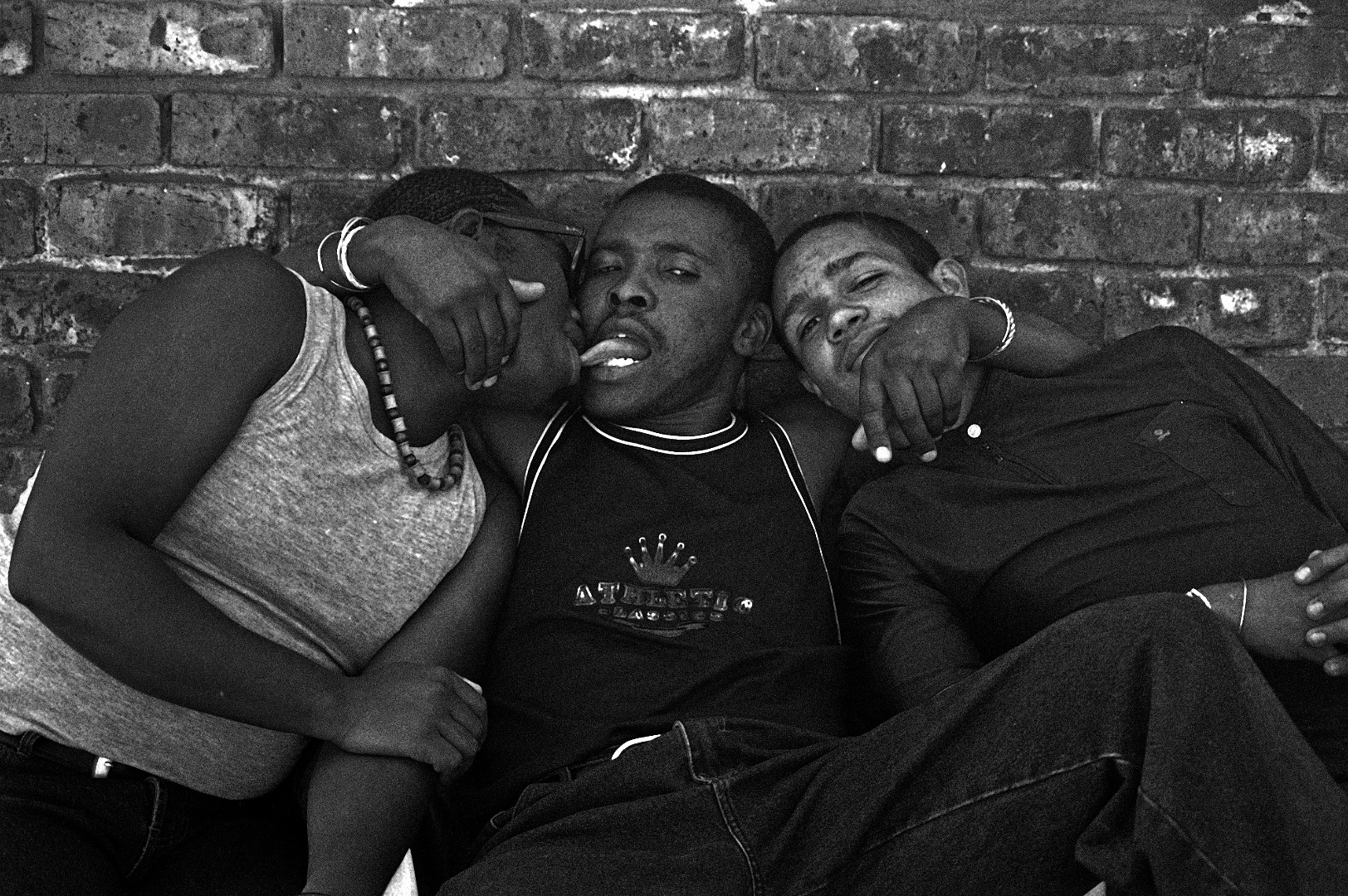
As one’s eyes dart between the formal contrasts in this silver gelatin print by Sabelo Mlangeni, observing the ways the image’s compositional differences never quite settle—elliptically forming and unforming in accordance with what figures or details the viewer momentarily foregrounds—we might take note of a quiet antagonism that labors within and beneath its visual field, one that interrupts the logics of identification that cohere the genre of portraiture. There is, in other words, a syncopated visual music in Mbulelo and Friends, Thembisa Township that emerges in the dynamic correspondence between the socio-material embodiment of the three photographed figures and the docu-realist aesthetic framing of Mlangeni’s camera. This tension raises more questions than answers as to who these figures are and what their relationships to each other might be. The image belongs to Mlangeni’s series Isivumelwano (2003–20), which documents wedding ceremonies and marital festivities throughout South Africa (and also in neighboring states such as Mozambique, Lesotho, and Eswatini). In the process of looking, we are prompted to refract the image through our own internal virtual archives of wedding celebrations, a cross-referential activity of visual recall that perhaps yields no further clarity.
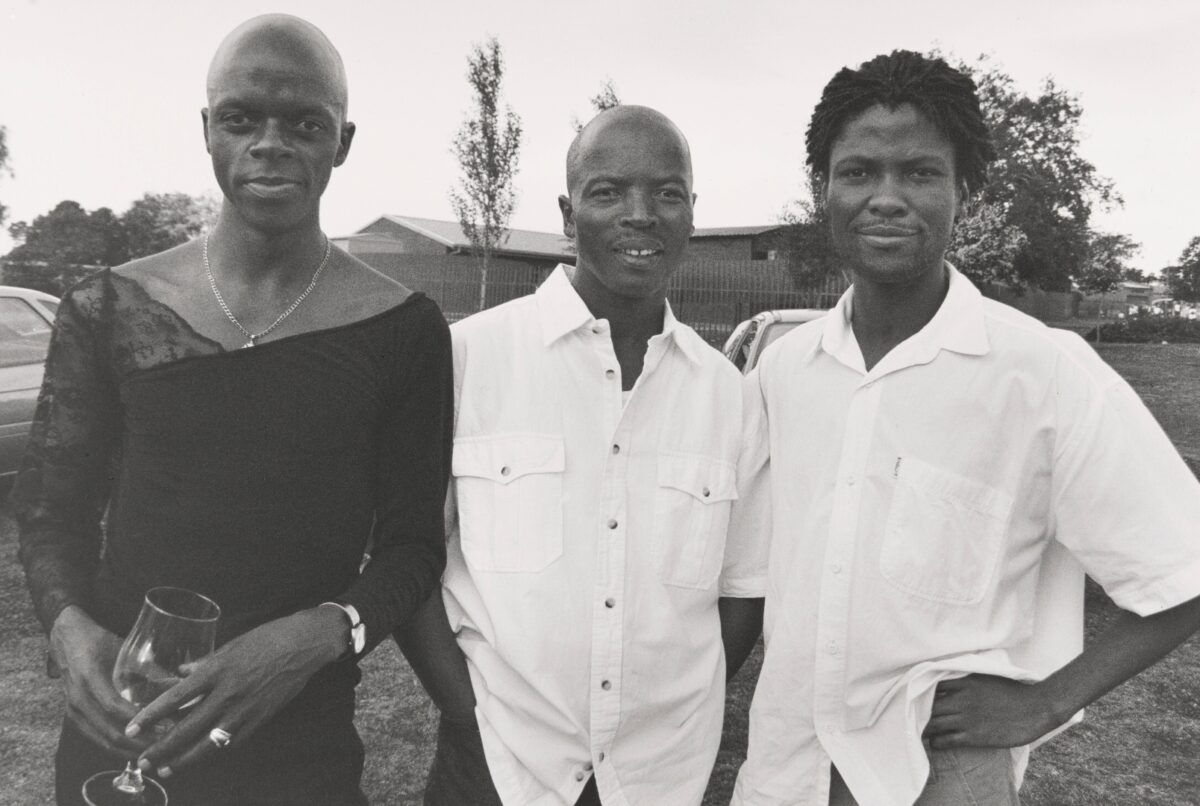
Among the three figures that confront us, who might Mbulelo be? Has Mlangeni positioned them in the center, or are they the figure on the left, who appears to stand out the most due to their relatively taller height and femme-adjacent presentation? This figure’s black, tight-fitting cross V-neck, which features a campy lace sleeve, and luminescent jewelry to match, forms a striking optical tension with the relatively normative loose-fitting white shirts worn by the other two figures, who are unaccessorized. It is at this moment, through Mlangeni’s choreographed conflation of aesthetic form and social signification, that the regulatory logics of gender and sexuality become foregrounded as organizing principles in the visual field. The effeminate figure in black forces a double take, one that destabilizes the presumed normativity of the neighboring figures. As if emanating a kind of irruptive, radioactive matter, this figure produces a semiotic disturbance in the texture of the composition that subverts the (colonial) association of bridal femininity—and by symbolic extension, virginal purity—with racial and chromatic whiteness. Such exorbitant matter and its disorderly effects have, in recent history, gone by the name of “queerness.”1This term, however, necessarily fails, by way of its Euro-modern discursive formations, in accounting for the non-normative, locally produced genders and sexualities of the global majority.
Yet, if indeed Mlangeni’s image invites a reading of these three Africans as corporeal figurations whose desires, expressions, and practices counter the structures of compulsive heteronormativity, there remains the unanswered question if what we see here is a glimpse of a “queer” African wedding.2In this context, heteronormativity functions as a set of ideological and juridical structures introduced in many regions in Africa in the 19th century by the entwined religious and capitalist imperatives of colonial states, missionaries, and merchants. If so, might we be looking at a fragment of the wedding’s stylish guests? Or alternatively, might one, or even two, of these figures in fact be the newly wedded couple?
2.
South Africa is the only country on the African continent that currently recognizes marital contracts between same-sex couples. This juridical exception is due to a combination of economic, historical, and geopolitical factors stemming from the termination of the apartheid regime in 1994 and the country’s subsequent reintegration into the capitalist world-system following decades of international boycotts and sanctions. The country’s neoliberal, progressive rebranding as a multicultural “rainbow nation”—amenable with an expansive outlook on human rights that includes sexual orientation—was based on a structural disavowal of decades of racial capitalist degradation and violence.3The political-economic framework of racial capitalism was first developed by South African organizers and intellectuals after which it was popularized and adapted to a US context by figures such as Cedric Robinson. See The South African Tradition of Racial Capitalism, ed. Zachary and Marcel Prest (Routledge, 2024). See also Cedric Robinson, Black Marxism: The Making of the Black Radical Tradition (University of North Carolina Press, 1983). These systemic forms of material, psychological, and spiritual denigration continue into the present day. Although discrimination on the basis of sexual orientation has been constitutionally protected since the state’s liberal democratic makeover in the 1990s, same-sex marriage was not legalized until 2006.
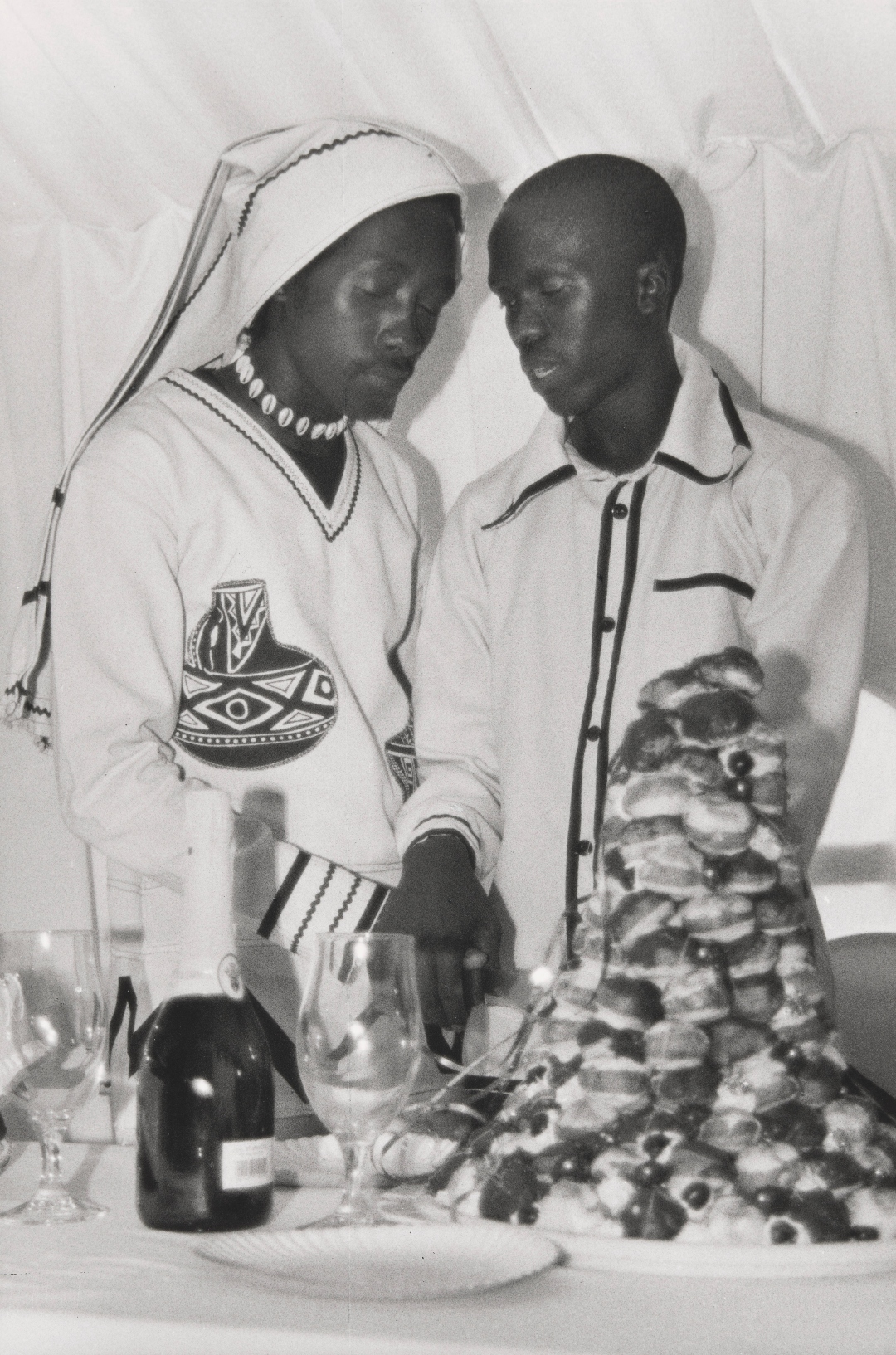
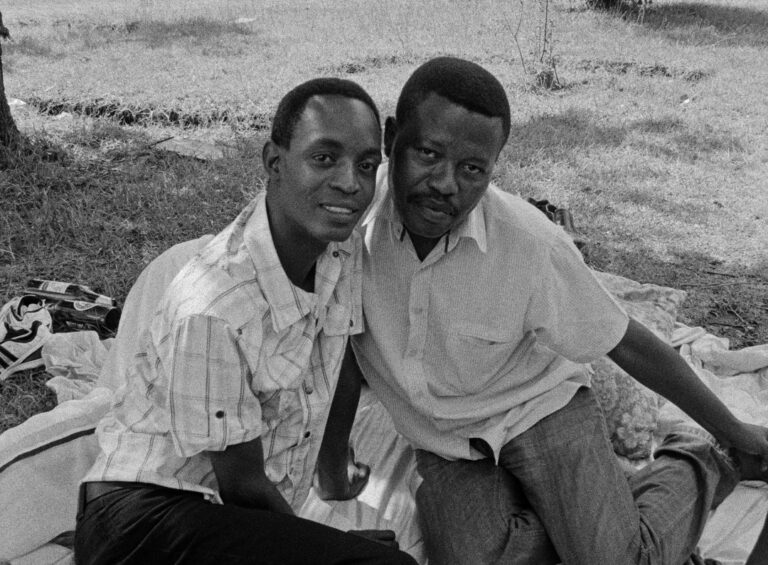
Mlangeni’s image is set in the Thembisa township, a spatial artifact of an apartheid-era policy that dispossessed indigenous Africans of their land and enclosed them as proletarianized units of racialized labor in surveilled and resource-extractive death zones. This social fact necessarily complicates potentially innocent readings of this image and the series to which it belongs as unfettered celebratory scenes of black love and kinship. That Mlangeni’s image, like Faith and Sakhi Moruping, Thembisa Township (fig. 2), is dated 2004—that is, before the legalization of same-sex marriage in South Africa—further gestures toward some of these depicted ceremonies as social-performative scenes wherein subjects refuse the recognition or valorization of their unions within the juridical confines of the postcolonial state.4I have previously theorized Africa-centered modalities of anarcho-queerness (by which I refer to the enduring structural antagonisms between queer[ed] African persons and the African postcolonial nation-state). See KJ Abudu “Anarcho-Ecstasy: Options for an Afri-Queer Becoming,” e-flux, no. 139 (October 2023), https://www.e-flux.com/journal/139/559729/anarcho-ecstasy-options-for-an-afri-queer-becoming. Therefore, while some images in the series materialize queerness as the warm, anticipatory illumination of an irreducibly utopian not-yet future, Mlangeni doubly situates such visions of Afri-queerness within and against the ongoing future-aborting machinations of settler coloniality and racial capitalism.5See José Esteban Muñoz, Cruising Utopia: The Then and There of Queer Futurity (New York University Press, 2009). It is precisely this visually articulated entanglement—authorized by Mlangeni’s fidelity to documentary ethics and a self-consciousness about the photographic apparatus’s subjective mediation—that lends his images their qualities of historical truth and affective potency.
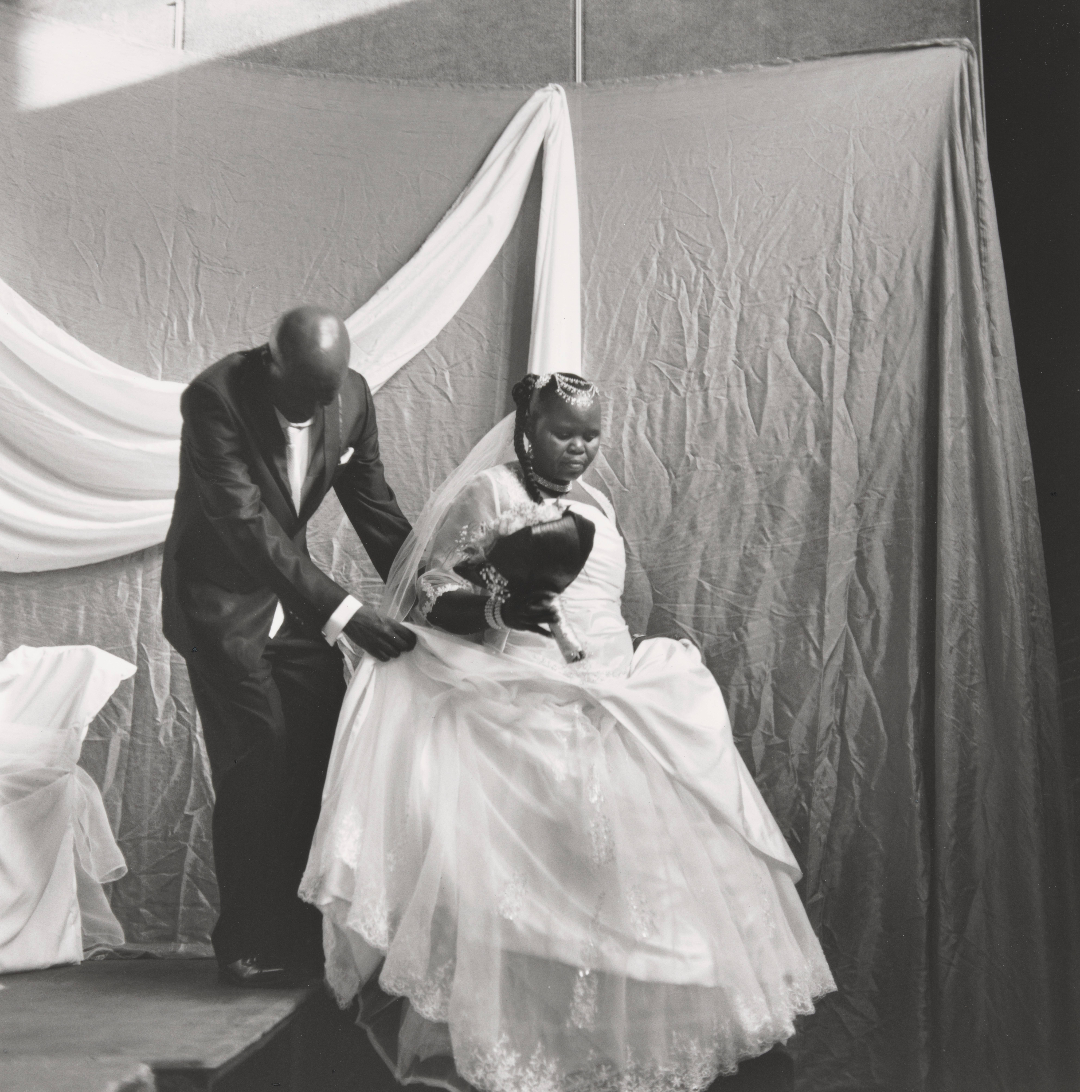
Importantly, Mlangeni’s Isivumelwano series does not only document queer marital unions. In fact, most of the pictures render conventional heterosexual couples. That being said, I suggest that Mlangeni’s work allows us to witness the enduring constitutive animations of what Hugo ka Canham has termed the “riotous deathscapes,” within which black working-class South Africans exist. Regardless of their sexual orientation, these individuals queerly articulate their historically undermined attempts at forming and sustaining bonds of intimacy, kinship, and commitment.6See Hugo ka Canham, Riotous Deathscapes (Duke University Press, 2023). Therefore, my use of “queerness” here exceeds identitarian ascriptions. Rather, it names processes and relations that unsettle and exceed the racially gendered and sexualized means through which the colonial-capitalist matrix of power reproduces itself on a global scale.7This understanding is indebted to frameworks formulated by decolonial feminism, black feminism, and queer of color critique. See María Lugones, “Heterosexualism and the Colonial/Modern Gender System,” Hypatia 22, no. 1 (2007): 186–209; and Cathy J. Cohen, “Punks, Bulldaggers, and Welfare Queens: The Radical Potential of Queer Politics,” in GLQ: A Journal of Gay and Lesbian Studies 3 (1997): 437–65.
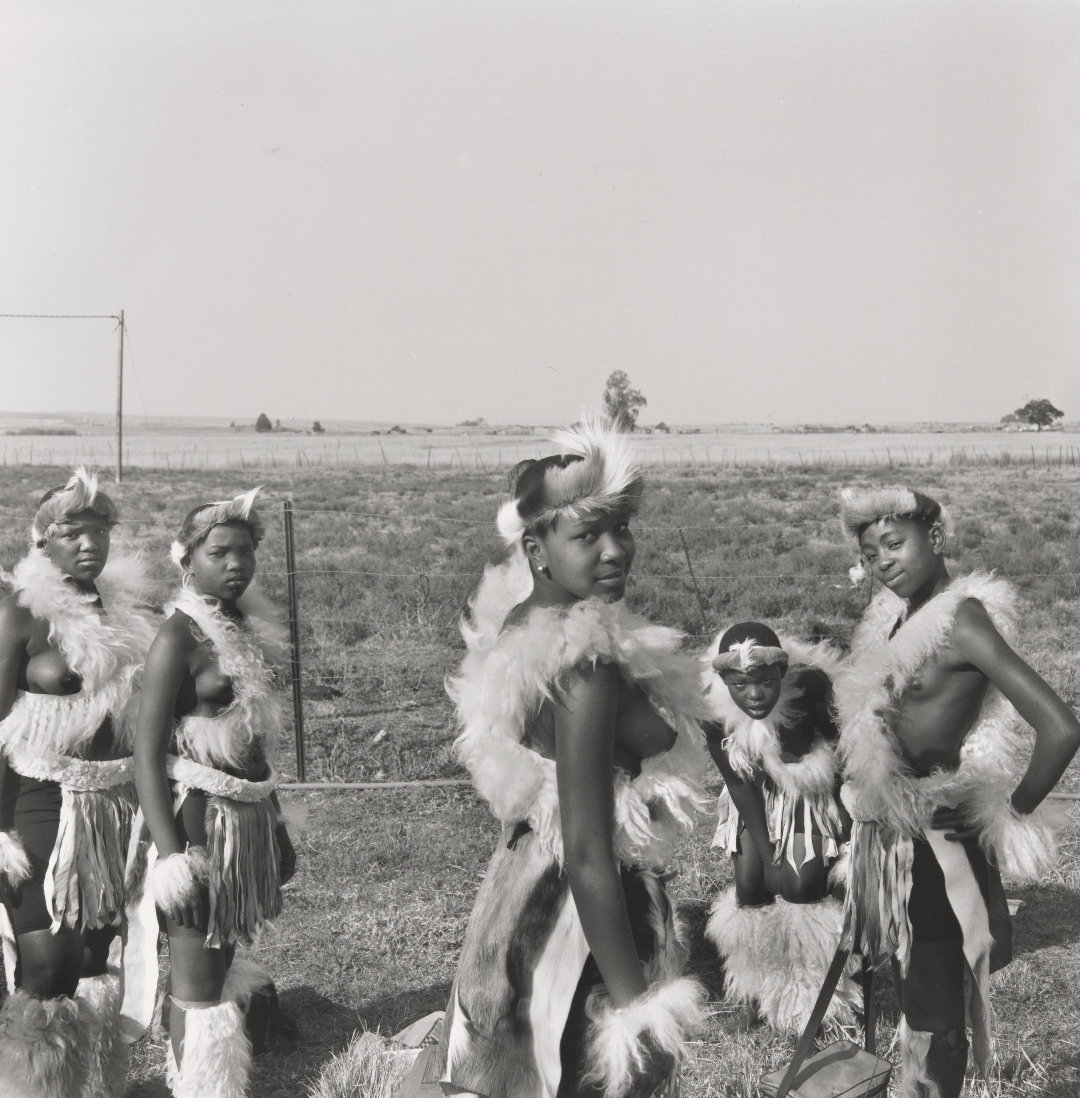
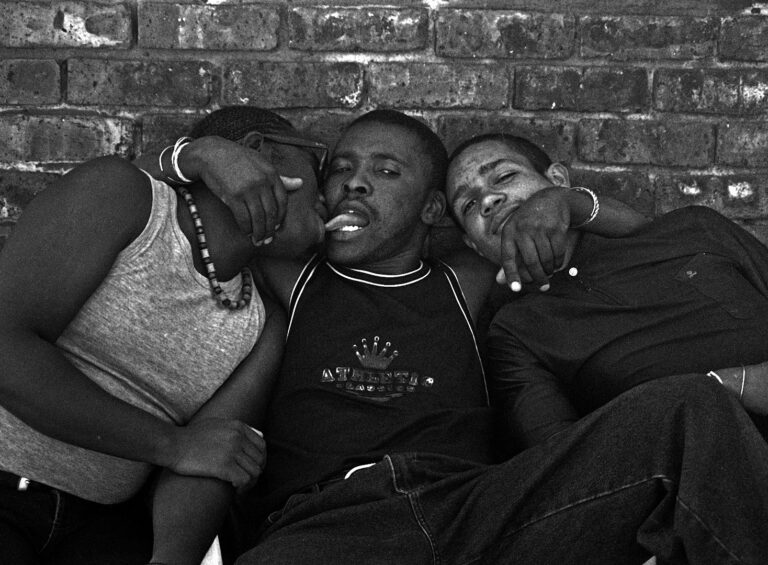
Indeed, throughout Mlangeni’s series, we observe a multitude of black working-class, Afri-queer, and Afri-indigenous disidentifications, creative appropriations, and outright rejections of the colonial-bourgeois genre of the “white wedding.”8See figure 4. Here, the wedding ceremony is projected as a revelatory social stage where contradictions of race, gender, sexuality, and private property are woven into turbulent convergence. Their inseparable articulations are determined by the ever-shifting structural configurations of the South African postcolony, as well as the neocolonial world-system to which it is interminably subjected.9My political-economic and juridical investment in these images is buttressed by the title of the series, Isivumelwano, which in the Nguni languages spoken in South Africa, means contract, agreement, or covenant.
3.
The rhythmic oscillation between joyous sociality and structural violence indexed in Mbulelo and Friends, Thembisa Township recalls a series by Mlangeni titled Country Girls (2003–9; fig. 5–8). In the scores of monochrome images that make up the project—all similarly shot over several years on analog film—we are given mediated access to loosely connected countryside communities of queer South Africans living in Mpumalanga province. Like Thembisa, Mpumalanga bears the unhealed geological, metaphysical, and societal scars of racial capitalist brutality due to coal mining and industrial agriculture. Yet, in Mlangeni’s series, we’re still able to hear the impossible thrums of black queer social life—wayward forms of social relation composed in the wake of the recursive catastrophe of coloniality.10Notions of waywardness and anarchic sociality are borrowed from Saidiya Hartman (see Hartman, Wayward Lives, Beautiful Experiments: Intimate Histories of Riotous Black Girls, Troublesome Women, and Queer Radicals (W. W. Norton, 2019), while the notion of catastrophe’s recursive temporality is borrowed from Bedour Alagraa (see Alagraa, “The Interminable Catastrophe,” Offshoot, March 2021, https://offshootjournal.org/the-interminable-catastrophe/). Such anarchic social geometries do not arise in a vacuum, but rather are intergenerationally sustained through forms of reproductive, system-antagonistic labor embodied by what Joy James calls the “captive maternal.”11See Joy James, “The Womb of Western Theory: Trauma, Time Theft, and the Captive Maternal,” in Carceral Notebooks, vol. 12, Challenging the Punitive Society, ed. Perry Zurn and Andrew Silts (2016): 253–296.

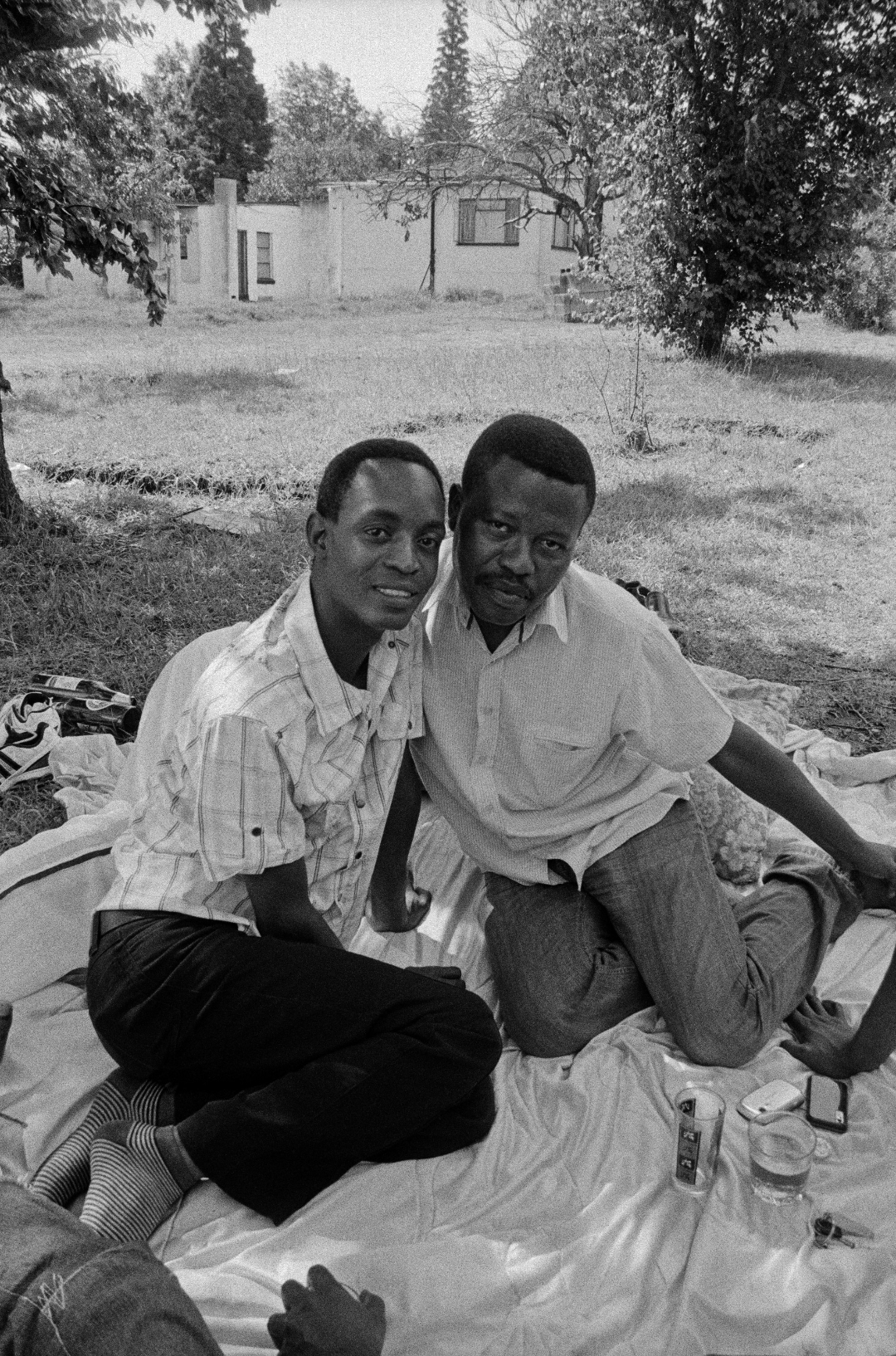
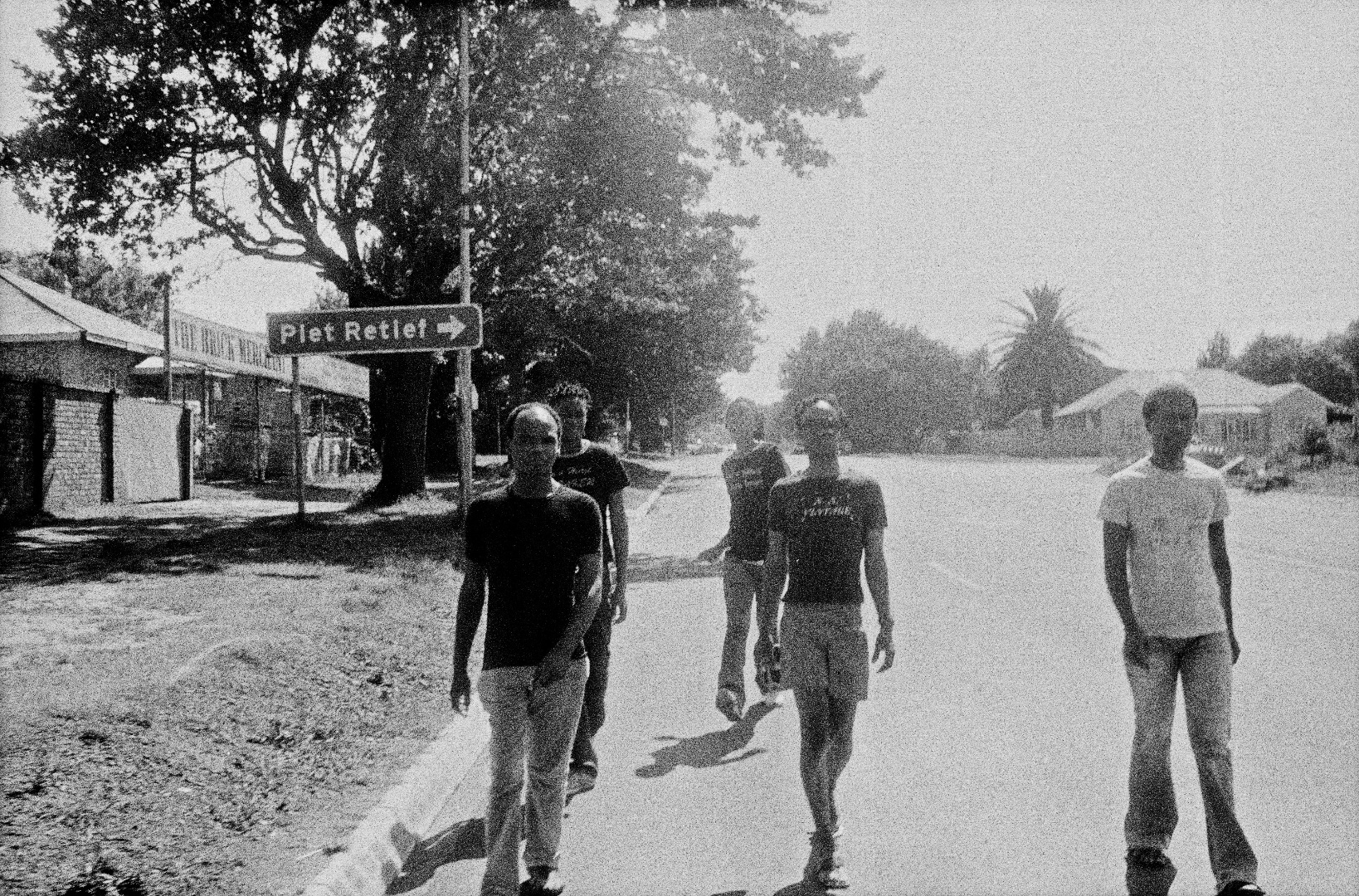
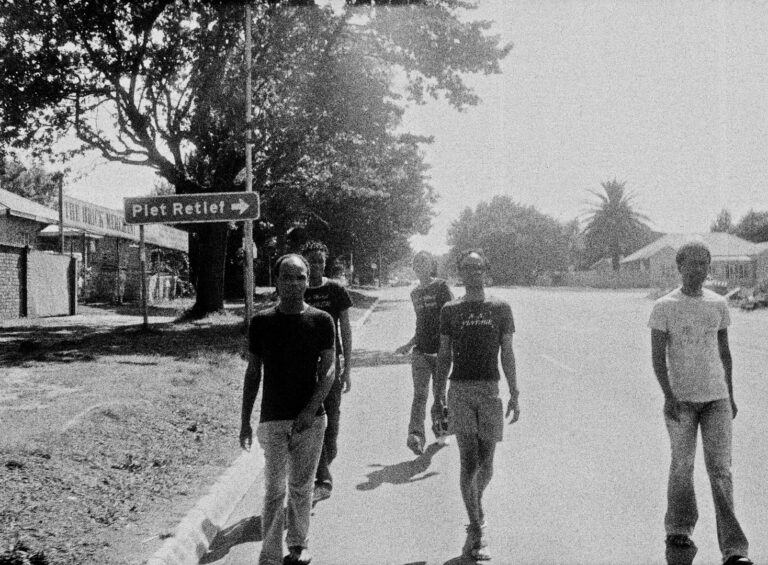
In Country Girls, a figure like the queer activist Bafana Mhlanga might approximate such a labor function. During a recent conversation, Mlangeni spoke of Mhlanga’s profound formal and informal organizing efforts, which provided the refuge-like conditions for the intimate, subterranean gatherings so movingly depicted through his camera lens.12Personal communication with author, September 17, 2026. In Bafana getting ready for work (2009; fig. 5), Mlangeni captures Mhlanga from behind with a towel wrapped around his waist as he inches towards an open door. The interior space is humble—a pot on a table, some objects on a dressing stand, a sheet lazily draped over a couch that might have just been slept on. The composition retains an atmospheric, soft-focus blur—as if Mlangeni took the image in a quick, improvised instant. Centering Mhlanga’s modest space and modest work through modest means, Mlangeni’s sensuous interior image alludes to a more capacious understanding of love, an “anoriginary” conception that precedes and transcends its institutionalized reification by wedding ceremonies or marital festivities.13The term “anaoriginary” is borrowed from Fred Moten. It broadly refers to that which precedes and exceeds a given formation, and is said formation’s constitutive yet anxiously exteriorized condition of possibility. See Stefano Harney and Fred Moten, The Undercommons: Fugitive Planning & Black Study (Minor Compositions, 2013), 47. This is a socially and temporally dispersed, non-individuated kind of love; a stubborn love of people who colonial modernity has long rendered valueless, unlovable; an ungovernable love that maintains an aversion to Power, no matter the cost; an intoxicating love, ever so determined, that seeks out and architects the birth of liberatory possibility.14Joy James has theorized this kind of love as “revolutionary love” and “agape.” See James, In Pursuit of Revolutionary Love: Precarity, Power, Communities (Divided, 2022), 295–99.
- 1This term, however, necessarily fails, by way of its Euro-modern discursive formations, in accounting for the non-normative, locally produced genders and sexualities of the global majority. ↩︎
- 2In this context, heteronormativity functions as a set of ideological and juridical structures introduced in many regions in Africa in the 19th century by the entwined religious and capitalist imperatives of colonial states, missionaries, and merchants. ↩︎
- 3The political-economic framework of racial capitalism was first developed by South African organizers and intellectuals after which it was popularized and adapted to a US context by figures such as Cedric Robinson. See The South African Tradition of Racial Capitalism, ed. Zachary and Marcel Prest (Routledge, 2024). See also Cedric Robinson, Black Marxism: The Making of the Black Radical Tradition (University of North Carolina Press, 1983). ↩︎
- 4I have previously theorized Africa-centered modalities of anarcho-queerness (by which I refer to the enduring structural antagonisms between queer[ed] African persons and the African postcolonial nation-state). See KJ Abudu “Anarcho-Ecstasy: Options for an Afri-Queer Becoming,” e-flux, no. 139 (October 2023), https://www.e-flux.com/journal/139/559729/anarcho-ecstasy-options-for-an-afri-queer-becoming. ↩︎
- 5See José Esteban Muñoz, Cruising Utopia: The Then and There of Queer Futurity (New York University Press, 2009). ↩︎
- 6See Hugo ka Canham, Riotous Deathscapes (Duke University Press, 2023). ↩︎
- 7This understanding is indebted to frameworks formulated by decolonial feminism, black feminism, and queer of color critique. See María Lugones, “Heterosexualism and the Colonial/Modern Gender System,” Hypatia 22, no. 1 (2007): 186–209; and Cathy J. Cohen, “Punks, Bulldaggers, and Welfare Queens: The Radical Potential of Queer Politics,” in GLQ: A Journal of Gay and Lesbian Studies 3 (1997): 437–65. ↩︎
- 8See figure 4. ↩︎
- 9My political-economic and juridical investment in these images is buttressed by the title of the series, Isivumelwano, which in the Nguni languages spoken in South Africa, means contract, agreement, or covenant. ↩︎
- 10Notions of waywardness and anarchic sociality are borrowed from Saidiya Hartman (see Hartman, Wayward Lives, Beautiful Experiments: Intimate Histories of Riotous Black Girls, Troublesome Women, and Queer Radicals (W. W. Norton, 2019), while the notion of catastrophe’s recursive temporality is borrowed from Bedour Alagraa (see Alagraa, “The Interminable Catastrophe,” Offshoot, March 2021, https://offshootjournal.org/the-interminable-catastrophe/). ↩︎
- 11See Joy James, “The Womb of Western Theory: Trauma, Time Theft, and the Captive Maternal,” in Carceral Notebooks, vol. 12, Challenging the Punitive Society, ed. Perry Zurn and Andrew Silts (2016): 253–296. ↩︎
- 12Personal communication with author, September 17, 2026. ↩︎
- 13The term “anaoriginary” is borrowed from Fred Moten. It broadly refers to that which precedes and exceeds a given formation, and is said formation’s constitutive yet anxiously exteriorized condition of possibility. See Stefano Harney and Fred Moten, The Undercommons: Fugitive Planning & Black Study (Minor Compositions, 2013), 47. ↩︎
- 14Joy James has theorized this kind of love as “revolutionary love” and “agape.” See James, In Pursuit of Revolutionary Love: Precarity, Power, Communities (Divided, 2022), 295–99. ↩︎